

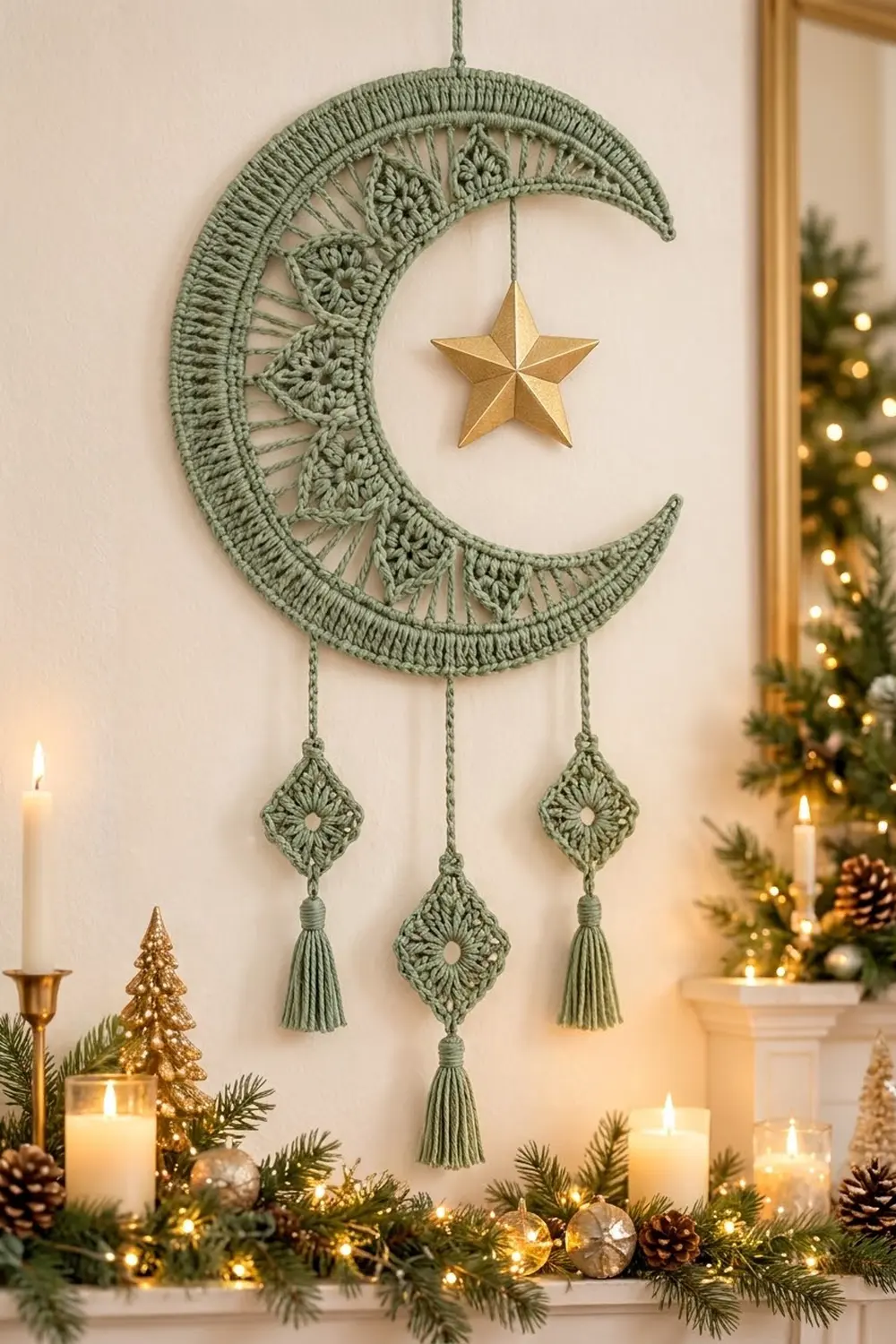
The Sage Moonlight Crescent is a calm, modern wall hanging. It is a crescent moon in soft sage green with a solid outer band and a rope-like edge. Inside that band is a fan of long openwork spokes, and seven small pointed petals rest on the spokes.
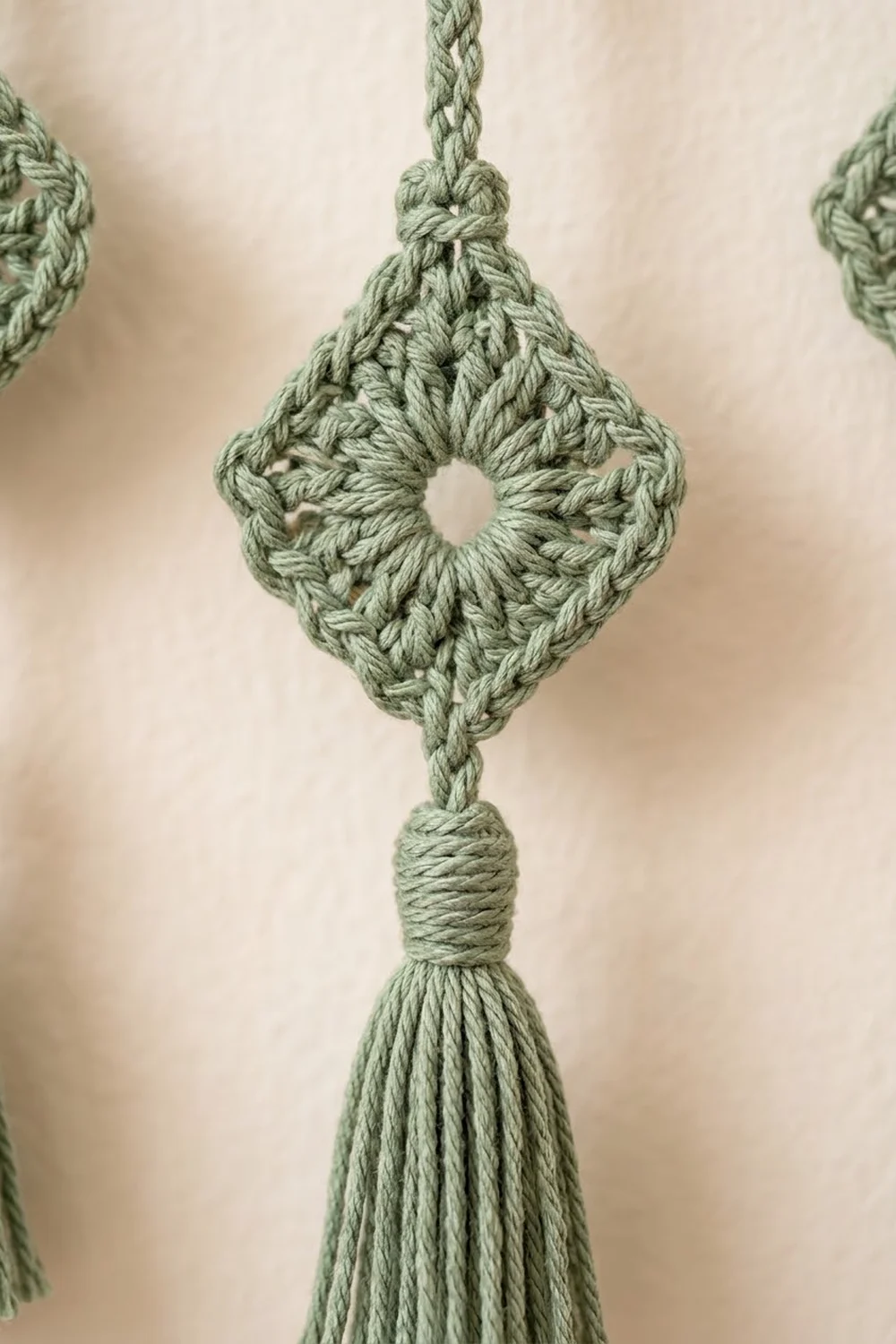
Three diamond charms hang below the moon on slip-stitch cords, and each one ends in a full tassel. A small gold star hangs inside the curve. Everything is worked in one color of worsted cotton, so the texture does the work. The style is boho and gentle.
This pattern uses US crochet terms. The finished crescent is about 9 in (22.9 cm) tall and 7.75 in (19.7 cm) wide. The whole hanging is about 17.75 in (45.1 cm) long, from the top of the moon to the tip of the center tassel.
You work the crescent flat in five rows, from the outer edge inward. Next you make seven petals, three diamonds and three tassels, then sew the petals on and add a two-round border. Last, you attach the cords, charms, star and hanging loop, and block the piece with stiffener.
Finished Size and Construction
- Finished crescent: 9 in (22.9 cm) tall x 7.75 in (19.7 cm) wide
- Total hanging length: about 17.75 in (45.1 cm)
- Skill level: Intermediate
- Terminology: US
- Yarn weight: Worsted (#4) cotton
- Hook: 4.5 mm (US 7)
- Crocheted pieces: 11 (1 crescent, 7 petals, 3 diamonds), plus 3 tassels, cords and 1 purchased star
- Layout: The opening faces right, the petals are evenly spaced on the spokes, and the charms hang from the lower outer edge.
- Crescent before border: 8.25 in (21.0 cm) tall x 7 in (17.8 cm) wide
- Border depth: 0.375 in (1.0 cm) on every edge
- Petal: 1.25 in (3.2 cm) long x 1 in (2.5 cm) wide
- Diamond: 2.5 in (6.4 cm) point to point
Materials
Choose a smooth, combed or mercerized worsted cotton. Cotton holds stiffener well and shows the spokes clearly. Acrylic also works, but it needs more stiffener to stay flat.
Yarn (one color):
- Sage green: 100 g, about 208 yd (190 m)
- Crescent and border: about 40 g
- Seven petals: about 14 g
- Three diamonds: about 9 g
- Three tassels: about 12 g
- Cords and hanging loop: about 5 g
These amounts include a margin of about 15 percent for swatching and for trimming the tassels.
Tools:
- 4.5 mm (US 7) crochet hook
- Tapestry needle
- 7 stitch markers
- Gold star ornament, about 2.5 in (6.4 cm), with a hanging hole
- Stiff card 3 in (7.6 cm) wide, for the tassels
- Fabric stiffener
- Blocking board, rustproof pins and plastic wrap
- Scissors and a ruler
Abbreviations (US Terms)
- ch: chain
- sl st: slip stitch
- sc: single crochet
- hdc: half double crochet
- dc: double crochet
- tr: treble crochet
- dtr: double treble crochet
- rsc: reverse single crochet
- sk: skip
- sp: space
- st(s): stitch(es)
- rep: repeat
Special stitch: reverse single crochet (rsc). Work from left to right (if you are right-handed). Insert the hook into the next stitch to the right, yarn over and pull up a loop. Yarn over again and draw through both loops. This stitch makes the twisted rope edge on the moon.
Gauge and Checkpoints
Gauge: 18 sc and 20 rows = 4 in (10.2 cm) in sc, worked flat.
Make one petal first. It is quick and shows how your tension behaves when working in rounds. It should measure 1.25 in (3.2 cm) from the base to the point.
Crescent checkpoints:
- After Row 1: 97 sc measure about 21.6 in (54.9 cm) when laid straight.
- After Row 3: The solid band is about 0.6 in (1.5 cm) deep.
- After Row 4: The depth at the center is about 1.75 in (4.4 cm).
- After Row 5: The depth is about 2 in (5.1 cm), and the inner edge is about 9.5 in (24.1 cm) long. The piece already curls into an arc.
If your piece is too big: Change to a 4 mm hook. Tall, loose dtr spokes are the usual cause.
If your piece is too small: Change to a 5 mm hook. If the inner edge is too tight, the moon curls into an almost closed ring.
Crescent
You work the crescent flat. Rows 1 to 3 make the solid outer band and Row 4 makes the spokes. Row 5 gathers the spokes into a shorter inner edge, and that is what creates the curve.
Row 1: Ch 98. Sc in the 2nd ch from the hook and in each ch across, turn. (97 sc)
Row 2: Ch 1 (does not count as a st, here and throughout). Sc in each st across, turn. (97 sc)
Row 3: Ch 1, sc in each st across, turn. (97 sc)
Row 4 (spoke row): Ch 1, sl st in each of the first 7 sts. Ch 5 (counts as the first dtr). *Ch 1, sk the next st, dtr in the next st; rep from * 41 more times, turn. Leave the last 6 sts unworked. (43 dtr and 42 ch-1 sps)
Check: The first dtr sits on st 7 and the last on st 91, so 6 sts stay unworked at each end. These stitches shape the tapered tips.
Row 5 (inner edge): Ch 1. Sc in each dtr, skipping all ch-1 sps, and work the last sc into the top of the ch-5. (43 sc)
Fasten off and weave in the ends. Place a marker in the 4th, 10th, 16th, 22nd, 28th, 34th and 40th sc of Row 5. These are the petal positions, and spoke 22 is the exact center.
Petals (Make 7)
Ch 4, sl st to the first ch to form a ring.
Round 1: Ch 3 (counts as dc), 11 dc in the ring, sl st to the top of the ch-3. (12 dc)
Round 2: Ch 1. 2 sc in the first st, sc in the next 2 sts, hdc in the next st, dc in the next 2 sts. (Tr, ch 2, tr) in the next st. Dc in the next 2 sts, hdc in the next st, sc in the next 2 sts, sl st to the first sc. (14 sts: 6 sc, 2 hdc, 4 dc and 2 tr, plus 1 ch-2 point)
The stitch with 2 sc is the rounded base. The point sits directly opposite it, with 5 stitches on each side. Fasten off and leave a 10 in (25.4 cm) tail for sewing.
Diamond Charms (Make 3)
Ch 6, sl st to the first ch to form a ring. The ring stays open.
Round 1: Ch 3 (counts as dc), 15 dc in the ring, sl st to the top of the ch-3. (16 dc)
Round 2: Ch 1, sc in the first st. *Hdc in the next st, (dc, ch 2, dc) in the next st, hdc in the next st, sc in the next st; rep from * 2 more times. Hdc in the next st, (dc, ch 2, dc) in the next st, hdc in the next st, sl st to the first sc. (20 sts and 4 ch-2 corners)
Round 3: Ch 1. Sc in each st, and work (sc, ch 2, sc) in each ch-2 corner. Sl st to the first sc. (20 sc worked 1 per st + 8 corner sc = 28 sc and 4 ch-2 corners; 7 sc per side, including the corner sc)
Fasten off. Each diamond measures 1.75 in (4.4 cm) per side and 2.5 in (6.4 cm) point to point.
Tassels (Make 3)
- Wrap yarn 20 times around the 3 in (7.6 cm) card.
- Slide a 10 in (25.4 cm) tie strand under the loops at the top and knot it tightly. Cut the loops at the bottom.
- Wrap a 12 in (30.5 cm) strand around the bundle 6 times, 0.375 in (1.0 cm) below the top. Knot it and bury the ends inside the tassel.
- Trim the tassel to 2.75 in (7.0 cm).
Make All Pieces
Each color count is in sage green:
- Crescent: 1
- Petals: 7
- Diamonds: 3
- Tassels: 3
- Purchased gold star: 1
Layout:
Row A:  [hanging loop at top of outer edge]
Row B:  [crescent with petals 1-7 on spokes 4-10-16-22-28-34-40] [star inside curve]
Row C:  [cord 2 in / 5.1 cm]  [cord 3.5 in / 8.9 cm]  [cord 2 in / 5.1 cm]
Row D:  [diamond]             [diamond]               [diamond]
Row E:  [tassel]              [tassel]                [tassel]
Joining the Petals
Sew the petals on before the border, so the border hides the petal tails.
Lay each petal on the spoke band. Its rounded base goes on a marked Row 5 sc, and its point faces the outer band. Each petal covers 3 spokes: the marked spoke and one on each side.
- Whipstitch the 2-sc base to the front loop of the marked sc only, so the back loop stays free for the border.
- Tack each side stitch to the spoke underneath it.
- Tack the ch-2 point to the Row 3 sc directly above the marked spoke.
Between neighboring petals, 3 spokes stay visible. Keep your tension relaxed, because tight stitches will pucker the spokes.
Size checkpoint: Lay the piece in a curve. It should measure about 8.25 in (21.0 cm) tall.
Border
Border gauge: Same as the crescent, 18 sc = 4 in (10.2 cm).
Round 1: Join yarn in the first sc of Row 5. Ch 1.
- Inner edge: Sc in each of the 43 sc.
- First tip: Sc in the side of Row 5 and 3 sc in the side of the dtr. Sc in each of the 6 unworked sts of Row 3. Sc in the end of Row 3, (sc, ch 2, sc) in the end of Row 2, sc in the end of Row 1.
- Outer edge: Sc in each of the 97 foundation ch loops.
- Second tip: Work the first tip in reverse, then sl st to the first sc.
Counts per side: the inner edge has 43 sc, each tip has 14 sc (1 + 3 + 6 + 4) and the outer edge has 97 sc. The total is 43 + 14 + 97 + 14 = 168 sc and 2 ch-2 points.
Round 2: Ch 1. Rsc in each sc around, and work (rsc, ch 1, rsc) in each ch-2 point. Sl st to the first rsc. (168 rsc worked 1 per st + 2 extra = 170 rsc)
Why the math works: Each border stitch goes into exactly one stitch, row end or chain loop, so the edge does not ruffle. The outer edge keeps its 97 stitches, which match Rows 1 to 3, and the inner edge keeps its 43 stitches. The only extra stitches are at the two tip points, which sharpen the horns. The border adds 0.375 in (1.0 cm) on each side, so the height goes from 8.25 in (21.0 cm) to 9 in (22.9 cm).
Attach the charms: Count the outer border stitches from the bottom tip point and mark the 4th, 16th and 28th. They are about 2.75 in (7.0 cm) apart.
- Side cords (make 2): Join yarn in the 4th marked st. Ch 10, then sl st in the 2nd ch from the hook and in each ch back (9 sl st, about 2 in or 5.1 cm). Repeat at the 28th st.
- Center cord: Join yarn in the 16th st. Ch 17, then sl st back along the chain the same way (16 sl st, about 3.5 in or 8.9 cm).
Sew each cord end to the top ch-2 corner of a diamond. Tie a tassel through each bottom corner.
Star: Join yarn in the 8th inner border sc from the top tip. Ch 12, then sl st back along the chain (11 sl st, about 2.5 in or 6.4 cm). Tie the star on.
Hanging loop: Join yarn in the 12th outer border st from the top tip point. Ch 15, then sl st in the same st. The loop is about 1.5 in (3.8 cm).
Final Blocking
- Draw an 8.25 in (21.0 cm) circle with a 4.25 in (10.8 cm) circle centered inside it. Cover the drawing with plastic wrap.
- Brush stiffener onto the crescent and petals only, keeping it off the cords, diamonds and tassels.
- Lay the outer border along the large circle and the inner border along the small circle.
- Pin every 3rd spoke straight, and pin both tips to sharp points.
- Pin each petal flat with its ring open.
- Let it dry for at least 24 hours.
- Steam the diamonds lightly. Comb the tassels and trim them back to 2.75 in (7.0 cm).
Final Quality-Control Checklist
- Rows 1 to 3 have 97 sc each.
- Row 4 has 43 dtr, with 6 unworked sts at each end.
- Row 5 has 43 sc.
- Border Round 1 has 168 sc, and Round 2 has 170 rsc.
- The petals sit on spokes 4, 10, 16, 22, 28, 34 and 40.
- Each diamond has 28 sc.
- The crescent is 9 in (22.9 cm) tall and hangs level.
Troubleshooting
- The moon is too straight: Row 5 is too loose. Rework it with a smaller hook.
- The moon closes into a ring: Row 5 is too tight. Recount it to 43 sc.
- The spokes lean: Pin each spoke straight while blocking.
- The tips are blunt: Check the (sc, ch 2, sc) points at the ends of Row 2.
- The hanging tilts: Move the hanging loop one or two stitches toward the heavier side.
Care
Dust gently or use a hair dryer on the cool setting. If you need to clean it, spot-clean with cool water and block it again, because washing softens the stiffener.
Final Notes
The measurements build on each other in a simple chain. A gauge of 18 sc to 4 in (10.2 cm) gives a 97-stitch outer edge, 43 spokes and a 43-stitch inner edge. Together they curve the moon to 8.25 in (21.0 cm). The border adds 0.375 in (1.0 cm) on each side, which brings the crescent to 9 in (22.9 cm). The cords, diamonds and tassels then bring the full length to about 17.75 in (45.1 cm).
Happy crocheting!