

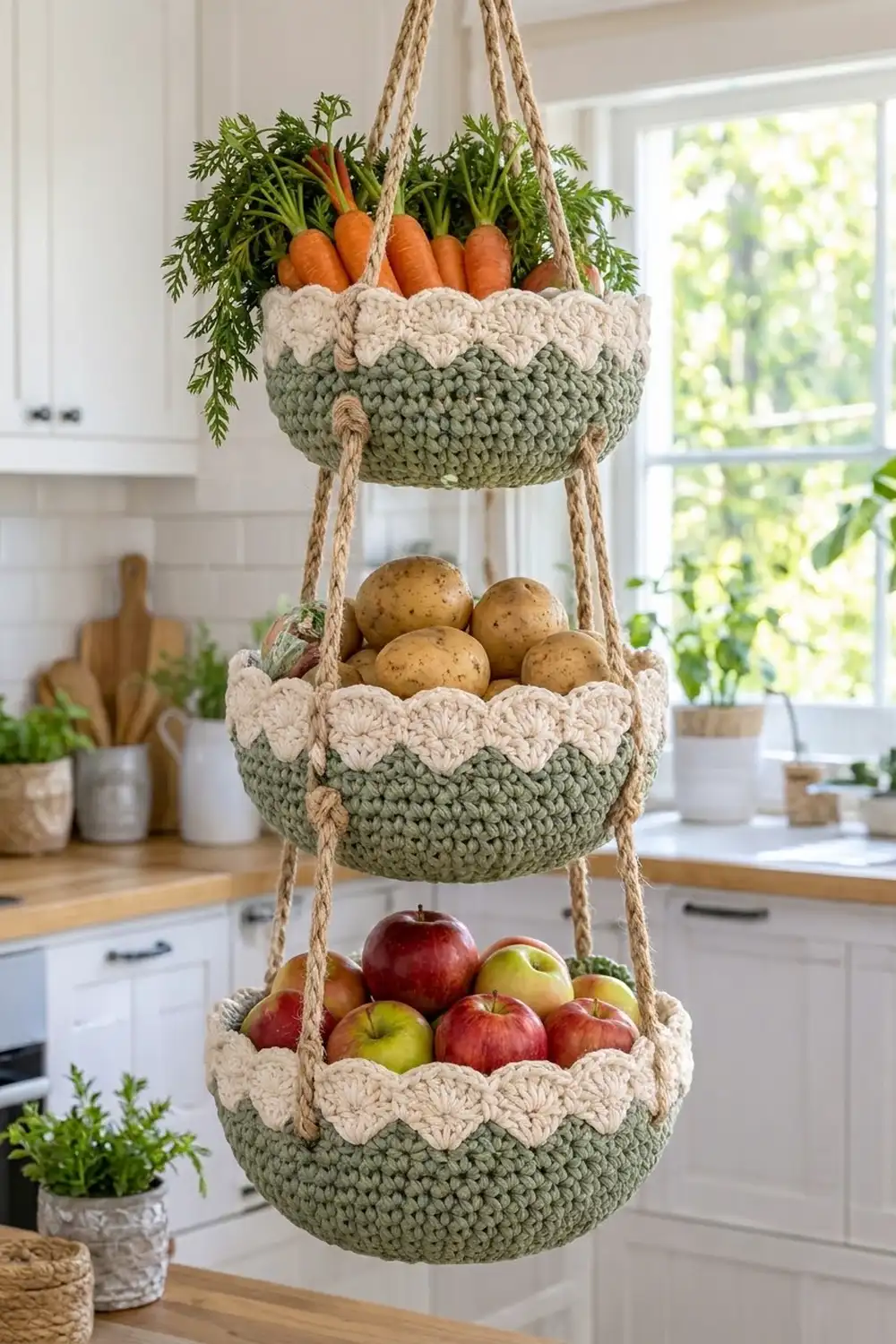
This three-tier hanging basket gets your produce off the counter and into the light. Three round bowls in soft sage green hang one above the other on natural jute cords. Each one has a cream band of fan-shaped shells along the rim.
The look is farmhouse-simple. Dense single crochet gives the bowls structure, one crisp ridge marks where the base turns upward, and a scalloped edge softens the whole piece. Sage and cream suit a white kitchen, and the jute cord adds warm texture.
This pattern uses US crochet terms. The finished bowls measure 7.0 in (17.8 cm), 8.9 in (22.6 cm), and 10.8 in (27.4 cm) across the rim. Hung, the full piece is about 42 in (106.7 cm) from the top loop to the base of the bottom bowl.
The construction is straightforward. Each bowl starts as a flat circle worked in joined rounds. A back-loop round turns it upward, one increase round adds a little flare, and a two-round cream shell border finishes it. Then you knot three jute cords through each rim to hang the bowls in a stack.
Finished Size and Construction
- Finished size (hung): about 42 in (106.7 cm) long
- Small bowl: base 6.4 in (16.3 cm), rim 7.0 in (17.8 cm), height 4.1 in (10.4 cm)
- Medium bowl: base 8.3 in (21.1 cm), rim 8.9 in (22.6 cm), height 4.5 in (11.4 cm)
- Large bowl: base 10.2 in (25.9 cm), rim 10.8 in (27.4 cm), height 4.8 in (12.2 cm)
- Skill level: Easy / advanced beginner
- Terminology: US
- Yarn weight: Bulky (#5) cotton or cotton blend
- Hook: 5.0 mm (H-8)
- Number of pieces: 3 bowls plus 3 hanging cords
- Layout: vertical stack, small on top, large at the bottom
- Wall height before border: 3.3 in (8.4 cm), 3.7 in (9.4 cm), and 4.0 in (10.2 cm)
- Border depth: about 0.75 in (1.9 cm)
Materials
Choose a firm, smooth cotton or cotton blend in bulky weight. Cotton holds its shape under the weight of apples and potatoes, while acrylic will sag more. A hook slightly smaller than the label suggests keeps the fabric dense.
- Sage green (MC): 300 g, about 330 m
- Cream (CC): 50 g, about 55 m
- Jute or cotton macramé cord, 5 mm: three lengths of 90 in (228.6 cm)
Tools:
- 5.0 mm (H-8) crochet hook
- Stitch markers (at least 4)
- Tapestry needle
- Scissors
- Measuring tape
- Spray bottle and pins for blocking
The yarn quantities include a margin of roughly 25 percent to cover gauge differences and a gauge swatch.
Abbreviations (US Terms)
- ch – chain
- sl st – slip stitch
- sc – single crochet
- dc – double crochet
- BLO – back loop only
- sk – skip
- st(s) – stitch(es)
- MC / CC – main color / contrast color
- rnd(s) – round(s)
Special stitch – Shell: Work 5 dc into the same stitch.
Standing sc: With a slip knot on the hook, insert the hook into the stitch, yarn over, and pull up a loop. Yarn over again and pull through both loops.
Gauge and Checkpoints
Gauge: 12 sc and 12 rnds = 4 in (10.2 cm) in sc with MC.
Make the small bowl first. It serves as your gauge test and uses the least yarn.
Checkpoints:
- Rnd 6 of base (36 sts): 3.8 in (9.7 cm) across
- Small base, Rnd 10 (60 sts): 6.4 in (16.3 cm)
- Medium base, Rnd 13 (78 sts): 8.3 in (21.1 cm)
- Large base, Rnd 16 (96 sts): 10.2 in (25.9 cm)
- Wall height before border: 3 rnds per 1 in (2.5 cm)
Lay the base flat and measure across the center without stretching it.
If too big: go down a hook size, or pull each sc a little tighter. If too small: go up a hook size. Do not change the stitch counts, because the border needs a multiple of 6.
If the base cups upward before the walls begin, you are working too tightly. If it ruffles, go down a hook size.

Bowl Pattern
All rounds are joined. At the start of each round, ch 1 (this does not count as a stitch) and work the first sc into the same stitch as the join. At the end of each round, sl st to the first sc. Move the join marker up each round.
Base (all sizes)
Rnd 1: With MC, make a magic ring, ch 1, 6 sc in ring, sl st to first sc. (6 sts)
Rnd 2: 2 sc in each st around. (12 sts)
Rnd 3: Sc 1, 2 sc in next 6 times. (18 sts)
Rnd 4: Sc 2, 2 sc in next 6 times. (24 sts)
Rnd 5: Sc 3, 2 sc in next 6 times. (30 sts)
Rnd 6: Sc 4, 2 sc in next 6 times. (36 sts)
Rnd 7: Sc 5, 2 sc in next 6 times. (42 sts)
Rnd 8: Sc 6, 2 sc in next 6 times. (48 sts)
Rnd 9: Sc 7, 2 sc in next 6 times. (54 sts)
Rnd 10: Sc 8, 2 sc in next 6 times. (60 sts) Small bowl: stop here.
Rnd 11: Sc 9, 2 sc in next 6 times. (66 sts)
Rnd 12: Sc 10, 2 sc in next 6 times. (72 sts)
Rnd 13: Sc 11, 2 sc in next 6 times. (78 sts) Medium bowl: stop here.
Rnd 14: Sc 12, 2 sc in next 6 times. (84 sts)
Rnd 15: Sc 13, 2 sc in next 6 times. (90 sts)
Rnd 16: Sc 14, 2 sc in next 6 times. (96 sts) Large bowl: stop here.
Each base round has 6 times its round number in stitches (Rnd 10 = 60). From Rnd 8 onward, you can stagger the increases by working half of the leading sc before the first increase. This keeps the base round instead of hexagonal, and the stitch count does not change.
Walls
Counts are given as small / medium / large.
Wall Rnd 1: Sc in BLO of each st around. (60 / 78 / 96 sts)
This round leaves a ridge of unused front loops on the outside and makes the wall turn upward.
Wall Rnds 2–4: Sc in each st around. (60 / 78 / 96 sts)
Wall Rnd 5 (flare):
- Small: Sc 9, 2 sc in next 6 times. (66 sts)
- Medium: Sc 12, 2 sc in next 6 times. (84 sts)
- Large: Sc 15, 2 sc in next 6 times. (102 sts)
Wall Rnds 6 to end: Sc in each st around. (66 / 84 / 102 sts)
- Small: work through Wall Rnd 10 (10 wall rnds).
- Medium: work through Wall Rnd 11 (11 wall rnds).
- Large: work through Wall Rnd 12 (12 wall rnds).
Checkpoint: the wall should be 3.3 in (8.4 cm) / 3.7 in (9.4 cm) / 4.0 in (10.2 cm) tall. Fasten off MC and weave in the end.
Make All Pieces
| Bowl | Base rnds | Wall rnds | Final count | Shells | MC | CC |
|---|---|---|---|---|---|---|
| Small | 10 | 10 | 66 | 11 | 60 g | 10 g |
| Medium | 13 | 11 | 84 | 14 | 95 g | 15 g |
| Large | 16 | 12 | 102 | 17 | 130 g | 20 g |
The gram figures above are estimated use. The totals in Materials include the margin.
Hanging layout:
        O   <- 3 in (7.6 cm) top loop
       /|\
      / | \   14 in (35.6 cm)
    [ SMALL ]
      | | |   10 in (25.4 cm)
   [ MEDIUM ]
      | | |   10 in (25.4 cm)
  [  LARGE  ]
Border (each bowl)
Work the border the same way on every bowl, directly into the last wall round.
Border gauge: one shell repeat (shell plus sc) covers 6 sts, which is about 2 in (5.1 cm) of rim.
Border Rnd 1: Join CC with a standing sc in any st. Sc in each st around, then sl st to the first sc. (66 / 84 / 102 sts)
Before Rnd 2, place 3 markers on this round for the cords, one every 22 / 28 / 34 sts.
Border Rnd 2: Ch 1, sc in first st, sk 2, shell in next, sk 2, sc in next; repeat from * around, ending with sk 2, shell in next, sk 2, sl st to first sc. (11 / 14 / 17 shells)
Each repeat uses 6 sts: 1 sc + 2 skipped + 1 shell base + 2 skipped. So:
- Small: 11 × 6 = 66
- Medium: 14 × 6 = 84
- Large: 17 × 6 = 102
Why the math works: every base round is a multiple of 6, and the flare round adds exactly 6, so each final count is still a multiple of 6. The shells always close evenly with no partial repeat. The cord markers (every 22 / 28 / 34 sts) divide each count into thirds, so the bowl hangs level.
Fasten off and weave in the ends.
Joining (Hanging Assembly)
The bowls are joined with cord, not crochet.
- Hold the three 90 in (228.6 cm) cords together. Fold over 6 in (15.2 cm) at one end and tie an overhand knot to form a 3 in (7.6 cm) loop.
- Separate the cords. Measure 14 in (35.6 cm) down each cord from the loop knot and tie an overhand knot.
- Thread each cord from the outside to the inside of the small bowl, through the wall just below a cord marker on Border Rnd 1. Bring it back out one stitch over. Tie a second overhand knot snug under the rim.
- On each cord, measure 10 in (25.4 cm) below the small bowl’s rim knot and attach the medium bowl the same way.
- Measure another 10 in (25.4 cm) down and attach the large bowl.
- Trim the tails to 6 in (15.2 cm). If you like, unravel the ends into small tassels.
Stitch logic: each cord passes through the fabric between Border Rnd 1 and the last wall round, so both rounds carry the load.
Tension: don’t tighten the knots on a bowl until all three of its cords are threaded. Adjust until the rim sits level, then tighten fully.
Size checkpoint: hang the piece empty. It should be about 42 in (106.7 cm) long overall, with the rims spaced 10 in (25.4 cm) apart.
Final Blocking
- Before attaching the cords, mist each bowl until it is damp but not soaked.
- Stuff the bowl with a towel, or set it over an upturned bowl of a similar size.
- Press the base flat and push the BLO ridge into a crisp edge.
- Pin each shell outward so the scallops open evenly.
- Let the bowls dry completely, for at least 24 hours.
- Remove the pins, then attach the cords.
Final Quality-Control Checklist
- Bases measure 6.4 in (16.3 cm), 8.3 in (21.1 cm), and 10.2 in (25.9 cm)
- Each bowl sits flat without rocking
- The BLO ridge is visible all the way around
- Shell counts are 11, 14, and 17
- Shells are evenly spaced with no partial repeat at the join
- Each bowl has three evenly spaced cord points
- Every bowl hangs level when empty
- All ends are woven in securely
Troubleshooting
Base cups or ruffles: First check the stitch count for that round. If the count is correct, change your hook size.
Walls lean outward too much: The flare round only adds 6 sts. If the walls still splay, work Wall Rnds 2–4 more tightly.
Shells don’t fit evenly: The last wall round is not a multiple of 6. Recount, then fix it with one decrease or increase on Border Rnd 1.
Bowl tilts when hung: A knot has slipped. Remeasure all three cords from the knot above and retie.
A diagonal line shows at the join seam: This is normal with joined rounds. Keep the join where a cord attaches so the cord hides it.
Care
Empty the bowls and wipe out any crumbs. Hand wash the bowls in cool water, reshape them, and dry them flat, keeping the jute dry where possible.
Final Notes
The measurement chain is simple. A gauge of 12 sc to 4 in (10.2 cm) gives bases of 6.4 in (16.3 cm), 8.3 in (21.1 cm), and 10.2 in (25.9 cm). One flare round brings the rims to 66, 84, and 102 sts. Those counts divide by 6 for 11, 14, and 17 shells, and by 3 for evenly spaced cords. With cord spacing of 14 in (35.6 cm) and 10 in (25.4 cm), the finished hanger is about 42 in (106.7 cm) long.
Check your gauge on the small bowl and trust the counts. The rest falls into place.
Happy crocheting!