

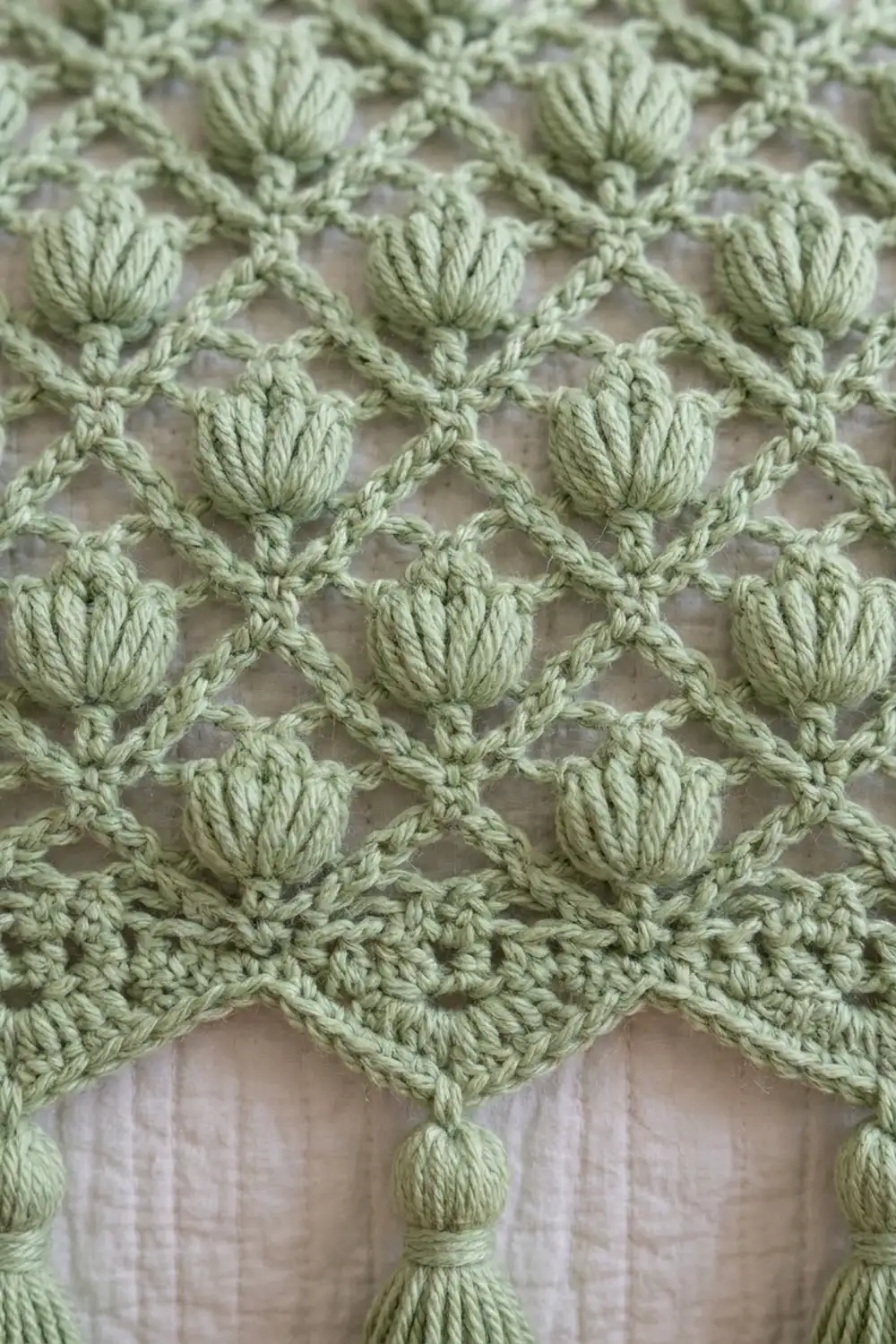
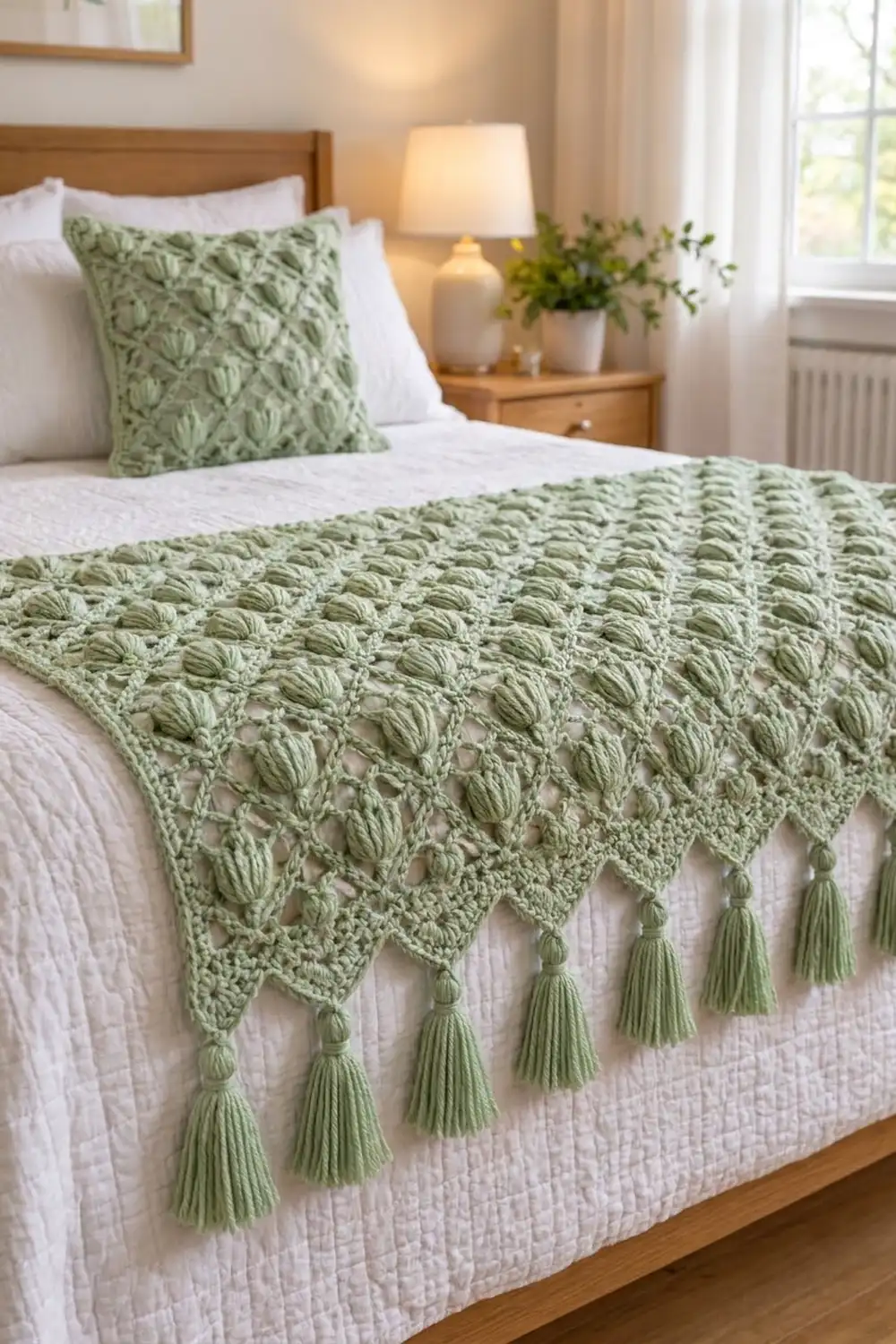
The Sage Tulip Lattice Bed Runner is an open, airy piece in soft sage green. A diagonal mesh of chain loops forms a diamond lattice. Plump puff-stitch tulip buds sit inside the diamonds in staggered rows, so the surface reads like a garden trellis.
One long edge has ten crisp triangular points, and a tassel with a wrapped head hangs from each tip. Lay the runner across the foot of a bed with the points hanging over the edge so the tassels swing free.
The pattern uses US crochet terms. The finished runner measures 60.5 in (153.7 cm) long and 18.5 in (47.0 cm) deep, plus 4 in (10.2 cm) tassels.
Construction is simple. You work one long rectangle in rows, add the triangles one at a time along the last row, work one edging round around the whole piece, and then attach the tassels. There is no seaming.
Finished Size and Construction
- Finished size: 60.5 in x 18.5 in (153.7 cm x 47.0 cm), not counting tassels
- Skill level: Intermediate
- Terminology: US crochet terms
- Yarn weight: Worsted (#4)
- Hook: 5.0 mm (H-8)
- Number of pieces: 1
- Layout: One rectangle with a pointed border on one long edge
- Body size before border: 60 in x 15 in (152.4 cm x 38.1 cm)
- Point depth: 3 in (7.6 cm)
- Edging round depth: 0.25 in (0.6 cm) on every side
- Tassels: 10, each 4 in (10.2 cm) long
Materials
Yarn: Use a smooth worsted-weight yarn with good stitch definition. Cotton blends or soft acrylic both work. Avoid fuzzy or very splitty yarns, because the tulip puffs need clean loops to look full.
- Sage green: 600 g, about 1,200 m (1,312 yd)
This amount includes a margin of about 15% for your gauge swatch, tension differences, and tassels.
Tools:
– 5.0 mm (H-8) crochet hook
– 6.0 mm (J-10) hook for the foundation chain (optional)
– Tapestry needle
– Scissors
– Stiff card cut to 4.5 in (11.4 cm) tall, for the tassels
– Locking stitch markers
– Rust-proof pins and blocking mats
– Measuring tape
Abbreviations (US Terms)
- ch – chain
- sc – single crochet
- sc2tog – single crochet 2 together
- sc3tog – single crochet 3 together
- dc – double crochet
- sk – skip
- sp – space
- st(s) – stitch(es)
- RS / WS – right side / wrong side
- TP – tulip puff (see below)
Tulip Puff (TP): (Yo, insert hook in st, yo, pull up a loop to 0.75 in (1.9 cm)) 5 times. That leaves 11 loops on the hook. Yo and draw through all 11 loops, then ch 1 to close. The closing ch-1 is the top of the TP.
Unit: In the tulip rows, each space between two sc is either a ch-5 unit (ch 5) or a tulip unit (ch 2, TP in next sc, ch 2). Both units span the same width.
Gauge and Checkpoints
Gauge: 16 sc = 4 in (10.2 cm). In the lattice, each ch-5 loop spans 1 in (2.5 cm) and 4 pattern rows measure 2 in (5.1 cm).
Test swatch: Ch 34. Work Row 1 (33 sc), Row 2, then Rows 3–6 once, then the trim row (Row 31). The swatch has 8 loops across and should measure 8 in x 3 in (20.3 cm x 7.6 cm) after light blocking. In the swatch, Row 3 has 4 TP and Row 5 has 3 TP.
Checkpoints:
– After Row 1: the first 16 sc measure 4 in (10.2 cm)
– After Row 6: depth is 2.75 in (7.0 cm)
– After Row 30: depth is 14.75 in (37.5 cm)
– After Row 31: the body measures 60 in x 15 in (152.4 cm x 38.1 cm)
If your work is too big, go down a hook size, or work ch 4 instead of ch 5 in the loops. If it is too small, go up a hook size. Check the swatch again before you commit to the long foundation.
Body
The repeat is 8 sts + 1. The runner uses 30 repeats.
Foundation: Ch 242. Using the larger hook for the chain keeps the bottom edge from pulling in.
Row 1 (RS): Switch to the 5.0 mm hook. Sc in the 2nd ch from the hook and in each ch across. Turn. (241 sc)
Row 2 (WS): Ch 1, sc in the first st, ch 5, sk 3 sts, sc in the next st; repeat from * across. Turn. (61 sc, 60 ch-5 loops)*
Row 3 (RS, Tulip Row A): Ch 5 (counts as dc + ch 2), sc in the first ch-5 loop.
Tulip unit (ch 2, TP in next sc, ch 2), sc in next loop, ch-5 unit, sc in next loop; repeat from * 28 more times.
Tulip unit, sc in the last loop, ch 2, dc in the last sc. Turn.
(60 sc, 59 units: 30 TP and 29 ch-5 units, plus a half loop at each end)*
Each TP grows up from the sc at the bottom of a diamond. The TPs fall in units 1, 3, 5, and so on through 59.
Row 4 (WS, Net Row): Ch 1, sc in the first dc, ch 5, sc in the next unit (into the ch-5 sp, or into the ch-1 top of a TP); repeat from * 58 more times. Ch 5, sc in the 3rd ch of the turning ch. Turn. (61 sc, 60 ch-5 loops)*
The TP top is now anchored by a sc, which closes the diamond.
Row 5 (RS, Tulip Row C): Ch 5 (counts as dc + ch 2), sc in the first loop.
Ch-5 unit, sc in next loop, tulip unit, sc in next loop; repeat from * 28 more times.
Ch-5 unit, sc in the last loop, ch 2, dc in the last sc. Turn.
(60 sc, 59 units: 29 TP and 30 ch-5 units, plus half loops)*
The TPs now fall in units 2, 4, and so on through 58. They sit diagonally between the buds of Row 3, which creates the staggered layout.
Row 6 (WS, Net Row): Repeat Row 4. (61 sc, 60 ch-5 loops)
Rows 7–30: Repeat Rows 3–6 six more times. That makes 7 tulip repeats in total. Row 30 ends with 61 sc and 60 ch-5 loops. Check that the depth is 14.75 in (37.5 cm).
Row 31 (RS, Trim Row): Ch 1, sc in the first sc, 3 sc in the next loop, sc in the next sc; repeat from * across. Turn.
Count: 61 sc worked into existing sc + 180 sc worked into the 60 loops = 241 sc.*
The body now measures 60 in x 15 in (152.4 cm x 38.1 cm). The 241 sts match Row 1 exactly, so the top and bottom edges are the same length.
Border
Border gauge: 4 sc per 1 in (2.5 cm) along every edge, the same as the body gauge.
Part 1: Pointed Edge (10 Triangles)
You work each triangle separately on Row 31. Each triangle sits on 25 sts. Neighboring triangles share their valley stitch, so each triangle’s Row 1 works one sc into that shared stitch.
Triangle k sits on sts 24(k−1)+1 through 24k+1. So Triangle 1 uses sts 1–25, Triangle 2 uses sts 25–49, and so on. Triangle 10 uses sts 217–241. Place a marker in every 24th st before you begin.
Triangle Row 1 (WS): With the WS facing, join yarn in the first st of the section. Sc in each of the 25 sts. Turn. (25 sc)
Triangle Row 2: Ch 1, sc2tog, sc to the last 2 sts, sc2tog. Turn. (23 sc)
Triangle Rows 3–11: Repeat Row 2 each row. The counts are 21, 19, 17, 15, 13, 11, 9, 7, and 5.
Triangle Row 12: Ch 1, sc2tog, sc 1, sc2tog. Turn. (3 sts)
Triangle Row 13: Ch 1, sc3tog. Fasten off. (1 st)
Repeat for all 10 triangles. Each one is 6 in (15.2 cm) wide at the base and 3 in (7.6 cm) deep.
Part 2: Edging Round
With the RS facing, join yarn at the top right corner, which is the foundation edge. Work around the whole runner as follows:
- Top edge: Sc in each of the 241 foundation ch. Ch 1 at the corner. (241 sc)
- Short side: Work 1 sc in the row-end of Row 1, 2 sc in each row-end of Rows 2–30, and 1 sc in the row-end of Row 31. (1 + 58 + 1 = 60 sc)
- Each triangle: On the first slanted side, work 1 sc in each of the 12 row-ends of Rows 1–12, plus 1 extra sc in the row-ends of Rows 3, 6, 9, and 12, for 16 sc. Work (sc, ch 3, sc) in the Row 13 tip. Work 16 sc down the second side in the same way. (34 sc + one ch-3 tip per triangle; 340 sc and 10 tips in total)
- Second short side: 60 sc, worked as before. Ch 1 at the corner.
- Sl st in the first sc to join. Fasten off.
Round total: 241 + 60 + 340 + 60 = 701 sc, plus 2 ch-1 corners and 10 ch-3 tips. The valleys need no decrease, because the two slanted sides meet at the shared base stitch.
Why the Math Works
- Points: 241 = (10 x 24) + 1, so ten 24-st spans plus one closing stitch fill the edge exactly. At 4 sts per 1 in (2.5 cm), 24 sts = 6 in (15.2 cm), and 10 points = 60 in (152.4 cm).
- Short sides: 15 in x 4 sc = 60 sc, which equals 1 + 58 + 1.
- Slanted sides: Each side runs about 4.24 in (10.8 cm), which works out to about 17 sc at gauge. That equals the 16 side sc plus the tip sc, so the triangle edges lie flat.
Tassels (Make 10)
- Wrap yarn 20 times around the 4.5 in (11.4 cm) card.
- Thread a 10 in (25.4 cm) tie strand under the loops at the top and knot it tightly.
- Cut the loops at the bottom.
- Wrap a second strand 6 times around the bundle, 0.75 in (1.9 cm) below the top, to form the round head. Knot it and bury the ends inside the tassel.
- Trim the bottom evenly to 4 in (10.2 cm).
- Pull the tie strands through a ch-3 tip, knot them firmly on the WS, and weave in the ends.
Final Blocking
- Weave in all ends before you block, but do not trim them closely yet.
- Pin the runner to blocking mats, RS up, at 60.5 in x 18.5 in (153.7 cm x 47.0 cm).
- Pin the top edge straight first, then the two short sides.
- Pin each triangle tip so the points sit 6 in (15.2 cm) apart and 3 in (7.6 cm) deep.
- Gently open each diamond with your fingers so the loops form even diagonals.
- Mist with water until the piece is damp. For acrylic, steam lightly instead, holding the iron above the fabric without touching it.
- Let it dry fully, then unpin it and trim the yarn ends.
- Fluff the tassels and trim any uneven strands.
Final Quality-Control Checklist
- The body measures 60 in x 15 in (152.4 cm x 38.1 cm) before the border
- The finished size is 60.5 in x 18.5 in (153.7 cm x 47.0 cm)
- 7 tulip repeats with 413 TP in total (7 x 30 + 7 x 29)
- TPs are staggered diagonally, with none stacked directly on top of each other
- 10 triangles of equal size, each 13 rows tall
- The edging round has 701 sc with no ruffling
- 10 tassels, all trimmed to 4 in (10.2 cm)
- All ends are woven in securely
Troubleshooting
Loop count is wrong in a net row. Count the units from the last row and make sure every TP top got a sc.
TPs look flat. Pull the loops up to the full 0.75 in (1.9 cm) and keep the 5 loops even.
The diamonds slant. Make sure Rows 3 and 5 both start with ch 5 and end with ch 2, dc.
Triangles are uneven. Check the 25-st count in Triangle Row 1 and the markers at the valleys.
Points curl. Your edging is too tight. Use the extra sc on Rows 3, 6, 9, and 12 and block firmly.
Foundation pulls in. Redo it with the larger hook, or use foundation single crochet.
Care
Hand wash in cool water and lay flat to dry, reshaping the points and tassels. Do not hang it while wet, because the open lattice will stretch.
Final Notes
Here is the measurement chain. A 4 in (10.2 cm) gauge of 16 sc gives 1 in (2.5 cm) loops. Sixty loops make a 60 in (152.4 cm) body, and 31 rows bring it to 15 in (38.1 cm) deep. Ten 6 in (15.2 cm) triangles add 3 in (7.6 cm), and the edging round adds 0.25 in (0.6 cm) on every side. That gives a finished runner of 60.5 in x 18.5 in (153.7 cm x 47.0 cm), with ten tassels to finish it.
Happy crocheting!