
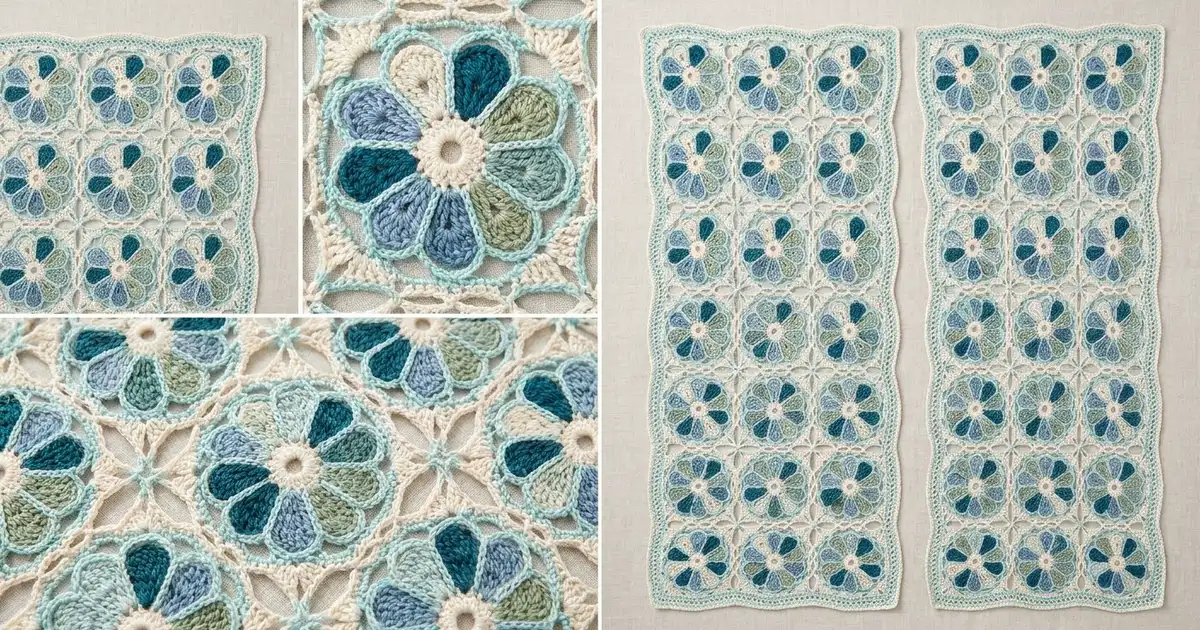
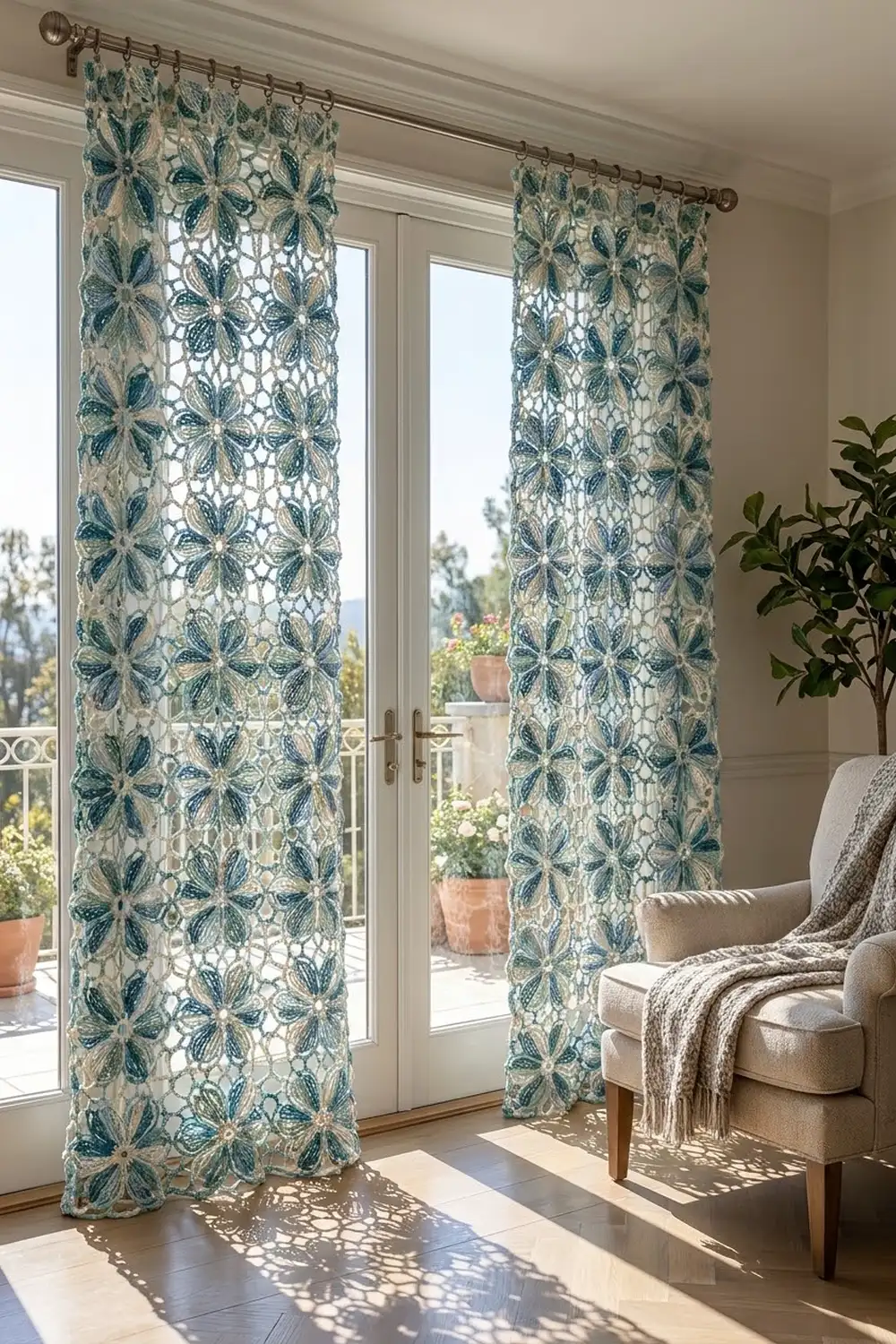
The Seaglass Bloom Lace Curtain is made of eight-petal flowers joined by an airy chain mesh. Light comes through every gap. Each flower has a small open cream center ringed with solid petals in deep teal, light denim blue, sage green, and cream. A pale aqua chain outline frames every petal. Cream mesh loops link the flowers into a lacy grid.
The palette is cool and coastal, and the style sits between vintage motif lace and modern boho. Each panel hangs from clip rings on a standard curtain rod. The pattern uses US crochet terms throughout.
Each finished panel measures 36 x 85 inches (91.4 x 215.9 cm). The pattern makes two panels, which is a standard pair for a window or French door.
Each flower is worked from the center out. You make a cream ring, then work eight separate petals in rows straight off that ring, then add an aqua outline round. A cream mesh round squares the motif off, and you join it to its neighbors as you go. A three-round single crochet border finishes each panel.
Finished Size and Construction
- Finished size: 36 x 85 in (91.4 x 215.9 cm) per panel
- Skill level: Intermediate
- Terminology: US crochet terms
- Yarn weight: DK / light worsted cotton (CYC 3)
- Hook: 3.5 mm (E-4)
- Number of pieces: 60 flower motifs per panel, 120 for the pair
- Layout: 5 motifs across x 12 motifs down per panel
- Motif size: 7 x 7 in (17.8 x 17.8 cm) after blocking
- Size before border: 35 x 84 in (88.9 x 213.4 cm)
- Border depth: 0.5 in (1.3 cm) on each side
Materials
Choose a smooth mercerized or combed cotton in DK weight. Cotton shows off the stitch definition and hangs without stretching much. It also handles sunlight and washing better than acrylic. The amounts below assume about 2.3 m of yarn per gram, which is typical for DK cotton.
Yarn (for two panels):
- Color A, Cream: 1,350 g / approx. 3,105 m (centers, cream petals, mesh, border)
- Color B, Deep Teal: 450 g / approx. 1,035 m
- Color C, Light Denim Blue: 450 g / approx. 1,035 m
- Color D, Sage Green: 450 g / approx. 1,035 m
- Color E, Pale Aqua: 500 g / approx. 1,150 m (petal outlines)
All quantities include a margin of roughly 10–15% for your gauge swatch, tension differences, and weaving in ends.
Tools:
- 3.5 mm (E-4) crochet hook
- Tapestry needle
- Stitch markers
- Scissors
- Measuring tape
- Blocking mats and rust-proof pins
- Spray bottle
- 20 curtain clip rings (10 per panel)
Abbreviations (US Terms)
- ch – chain
- sl st – slip stitch
- sc – single crochet
- dc – double crochet
- sp – space
- st(s) – stitch(es)
- rnd – round
- sc2tog (petal join) – insert hook in the side of Row 1 of the current petal, yarn over and pull up a loop. Insert hook in the side of Row 1 of the next petal, yarn over and pull up a loop. Yarn over and draw through all 3 loops on hook.
- dc2tog – (yarn over, insert in next st, yarn over and pull up a loop, yarn over and draw through 2) twice, yarn over and draw through all 3 loops.
- dc5tog – work as dc2tog, but over 5 sts; you end with 6 loops on the hook and draw through all 6.
- Joining loop – in place of a ch-6 loop, ch 3, sl st into the matching ch-6 loop of the neighboring motif, ch 3.
Gauge and Checkpoints
Make one complete motif first and block it before you start the rest. Every later measurement depends on this one square.
- Motif gauge: 1 blocked motif = 7 x 7 in (17.8 x 17.8 cm)
- Border gauge: 19 sc = 3.5 in (8.9 cm)
Checkpoints for the test motif:
- After Rnd 2, the center is 1.5 in (3.8 cm) across.
- After the petals, the flower is 5.5 in (14.0 cm) from tip to opposite tip.
- After Rnd 3 (outline), it is 6 in (15.2 cm) from tip to tip.
- After Rnd 4 (mesh), the blocked motif is 7 in (17.8 cm) square.
If the motif is more than 0.25 in (0.6 cm) too big, go down to a 3.25 mm hook. If it is too small, go up to a 3.75 mm hook. The petals control the size most, so if only the mesh is off, change just the chain tension in Rnd 4 and keep the petals as they are.
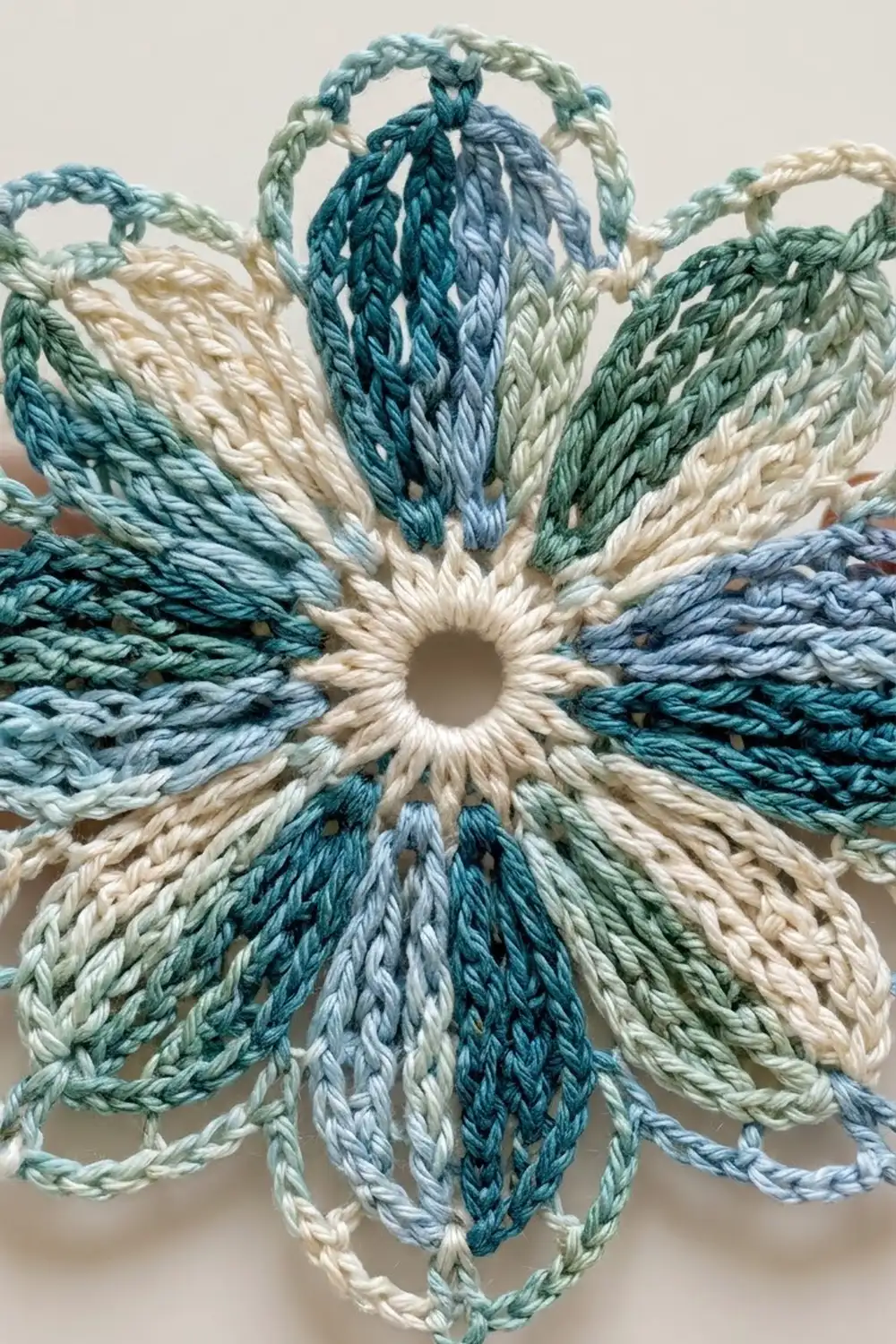
Flower Motif
Rnd 1 (Color A): Ch 8, sl st in first ch to form a ring. Ch 1, work 24 sc in the ring, sl st in first sc. (24 sc)
Rnd 2: Ch 1, sc in each st around, sl st in first sc. Fasten off. (24 sc)
The ring stays open. This gives the flower its small center hole.
Petals (make 8)
Each petal is worked in rows on 3 sts of Rnd 2. The petals sit side by side and use all 24 sts. Colors go in this order around the flower: B, A, C, D, B, A, C, D. That gives two petals of each color, with matching colors opposite each other.
Row 1: Join petal color in the first of 3 sts. Ch 3 (counts as dc), dc in same st, dc in next st, 2 dc in next st, turn. (5 dc)
Row 2: Ch 3, dc in same st, dc in next 3 sts, 2 dc in top of turning ch, turn. (7 dc)
Row 3: Ch 3, dc in each st across, turn. (7 dc)
Row 4: Ch 3, dc2tog, dc in next st, dc2tog, dc in top of turning ch, turn. (5 sts)
Row 5: Ch 2 (does not count), dc5tog over all 5 sts. Fasten off. (1 st, the petal tip)
Join the next color in the next unworked st of Rnd 2 and repeat until all 8 petals are done. Weave in the petal ends now. The finished petal is a teardrop that is wide in the middle and pointed at the tip.
Rnd 3: Outline (Color E)
Join E in the tip of any petal.
*(Sc, ch 3, sc) in the petal tip, ch 6, sc2tog (petal join) across the gap between this petal and the next, ch 6; repeat from * around. Sl st in first sc. Fasten off.
Count: 16 sc + 8 sc2tog = 24 sts, with 8 ch-3 tip spaces and 16 ch-6 spaces.
The sc2tog pulls the petals together at their bases. Each ch-6 then follows a petal edge, which makes the aqua outline loop around every petal.
Rnd 4: Mesh (Color A)
This round turns the round flower into a square. Four petal tips become the corners, and the four tips between them become the side midpoints.
Join A in any ch-3 tip space; this is your first corner.
*(Sc, ch 9, sc) in corner tip sp, [ch 6, sc in next ch-6 sp] twice, ch 6, sc in next ch-3 tip sp (side middle), [ch 6, sc in next ch-6 sp] twice, ch 6; repeat from * 3 more times. Sl st in first sc. Fasten off.
Count: 28 sc, 4 ch-9 corner loops, and 24 ch-6 loops (6 per side).
Block the first motif and check it against the checkpoints before you make more.
Make All Pieces
Make the first motif of each panel as written. Every motif after that is joined during Rnd 4. Per panel:
- 60 complete flowers through Rnd 3
- Petals per panel: 120 in B, 120 in A, 120 in C, 120 in D
- Rnd 4 and centers in A on all 60
For the pair, double everything: 120 motifs.
Layout grid (one panel, 5 across x 12 down):
Row 1:  [M] [M] [M] [M] [M]   <- top (clip rings)
Row 2:  [M] [M] [M] [M] [M]
Row 3:  [M] [M] [M] [M] [M]
 ...     (repeat)
Row 12: [M] [M] [M] [M] [M]   <- hem
Turn every motif the same way so the colors repeat evenly down the panel.
Joining (Join-As-You-Go)
Join motifs while you work Rnd 4. Work across the grid left to right, one row at a time.
Along a shared side: replace each of the 6 ch-6 loops on that side with a joining loop (ch 3, sl st into the matching ch-6 loop of the neighbor, ch 3). Loop 1 joins to loop 1, loop 2 to loop 2, and so on. That makes 6 joins per shared side, with nothing added or skipped.
At a shared corner: replace ch 9 with ch 4, sl st into the neighbor’s corner loop, ch 4. If three or four motifs meet at that point, sl st into the existing join sl st instead, so all corners lock at a single point.
Tension: keep the chains the same size as in your test motif. If your joining chains are tight, the mesh will pucker and the panel will come out short. If they are loose, the panel will sag between flowers.
Size checkpoints: two joined motifs should measure 14 in (35.6 cm) across. A finished row of 5 should measure 35 in (88.9 cm). After 3 rows, the length is 21 in (53.3 cm). The joined panel should measure 35 x 84 in (88.9 x 213.4 cm) before the border.
Border
Border gauge: 19 sc = 3.5 in (8.9 cm), so one motif side takes 38 sc.
Per-motif side count (38 sc): 4 sc in the corner loop at each end + 5 sc in each of the 6 ch-6 loops. That is 4 + 30 + 4 = 38. Both corner-loop halves are already part of the 38.
Along an edge where two motifs meet, the 4 sc go into the outer part of each motif’s corner loop. You add nothing at the seams.
Rnd 1 (Color A): Join A in any outer panel corner loop. Work the sc counts above along each motif side. In each of the four outer panel corner loops, work (4 sc, ch 2, 4 sc); the 4 sc on each side belong to that side’s count. Sl st in first sc.
- Long sides: 12 x 38 = 456 sc each
- Short sides: 5 x 38 = 190 sc each
- Total: 2 x 456 + 2 x 190 = 1,292 sc, plus 4 ch-2 corners
Rnd 2: Ch 1, sc in each st around, working (sc, ch 2, sc) in each ch-2 corner sp. Sl st in first sc.
- Long sides: 456 + 2 = 458 sc
- Short sides: 190 + 2 = 192 sc
- Total: 1,300 sc
Rnd 3: Repeat Rnd 2. Fasten off.
- Long sides: 458 + 2 = 460 sc
- Short sides: 192 + 2 = 194 sc
- Total: 1,308 sc
Why the math works: 38 sc at a gauge of 19 sc per 3.5 in (8.9 cm) measures exactly 7 in (17.8 cm), which is one motif width. So 456 sc covers 84 in (213.4 cm) and 190 sc covers 35 in (88.9 cm). The border lies flat because it neither stretches nor gathers the mesh. Three rounds add 0.5 in (1.3 cm) per side, which brings the panel to 36 x 85 in (91.4 x 215.9 cm).
Final Blocking
- Weave in any remaining ends along the petal backs, where they won’t show.
- Spread the panel on blocking mats, or pin it in halves if your space is limited.
- Pin the four corners to 36 x 85 in (91.4 x 215.9 cm).
- Pin along each edge every 3.5 in (8.9 cm), lining up the pins with the motif seams and midpoints.
- Open every corner loop so the mesh makes clean squares.
- Mist the panel until it is damp but not soaked.
- Smooth each petal flat with your fingers so it keeps its teardrop shape.
- Let it dry completely, at least 24 hours, before unpinning.
- Clip 10 rings evenly across the top edge, about 4 in (10.2 cm) apart, starting at the corners.
Final Quality-Control Checklist
- Each panel has 60 motifs in a 5 x 12 grid.
- Petal colors run in the same order on every flower.
- Every shared side has exactly 6 joins.
- All corner joins meet at a single point.
- There are no twisted or skipped mesh loops.
- Border Rnd 3 has 460 sc on each long side and 194 sc on each short side.
- The blocked panel measures 36 x 85 in (91.4 x 215.9 cm).
- Both panels match in length to within 0.5 in (1.3 cm).
Troubleshooting
Petals ruffle or overlap: Your dc tension is loose. Go down a hook size for the petals only.
The center hole closes up: Work Rnd 1 more loosely, or use ch 10 for the ring.
The motif is round instead of square: Block more firmly at the corners, and check that each corner loop has the full 9 chains.
The mesh puckers at joins: Your joining chains are tighter than your plain chains. Loosen the ch 3 on each side of the sl st.
The border waves: You have too many sc. Count each motif side again and make sure it is 38.
The border pulls in: Your sc are too tight. Use a 3.75 mm hook for the border only.
The panel is too long after hanging: Cotton relaxes a little. Re-block the panel, or remove one motif row before you add the border.
Care
Hand wash or machine wash on a cold delicate cycle in a mesh laundry bag, then lay flat to dry and reshape. Do not tumble dry. The lace can stretch and the petal colors can fade.
Final Notes
Everything in this curtain depends on one measurement. A 7 in (17.8 cm) motif makes a row of 5 that is 35 in (88.9 cm) across and a column of 12 that is 84 in (213.4 cm) long. That gives 38 border sc per motif side, and three border rounds add 0.5 in (1.3 cm) per side for a final 36 x 85 in (91.4 x 215.9 cm) panel. Check your first motif, keep your chain tension steady, and the pair will hang straight and match.
Happy crocheting!