

This hanging holder stores three spare rolls in a small space. A solid beige backing panel hangs from a wooden ring, and three turquoise pockets in a shell lace pattern hold the rolls upright with the tops showing.
The colors are calm and beachy: sandy beige, sea turquoise and crisp white. The white shows up twice, as the rolled edging around the panel and as the thick rim on each pocket. It frames the lace and gives the piece a tidy finish.
This pattern uses US crochet terms. The finished panel measures 7 in × 25.4 in (17.8 cm × 64.5 cm) including the border. With the tab and ring, it hangs about 28 in (71.1 cm) long.
You’ll work the panel flat in single crochet rows, with a tapered top. The pockets are oval-based baskets worked in joined rounds. Each pocket is sewn flat against the panel stitch to stitch. A crab-stitch border and a wrapped turquoise tab finish the piece.
Finished Size and Construction
- Finished size: 7 in × 25.4 in (17.8 cm × 64.5 cm) panel; about 28 in (71.1 cm) hanging length
- Skill level: Intermediate
- Terminology: US
- Yarn weight: Worsted (#4) cotton
- Hook: 5 mm (H-8)
- Number of pieces: 5 (1 panel, 3 pockets, 1 hanging tab)
- Layout: 3 pockets stacked in a single column on the panel
- Panel size before border: 6 in × 24.4 in (15.2 cm × 62.0 cm)
- Pocket size: 9 in (22.9 cm) wide laid flat, about 4 in (10.2 cm) tall, base 5.9 in × 4.4 in (15.0 cm × 11.2 cm)
- Border depth: 0.5 in (1.3 cm)
Materials
Use a smooth, mercerized or combed worsted-weight cotton, about 180 m per 100 g. Cotton holds its shape, shows the shell detail clearly and doesn’t shed lint onto the paper.
- Beige (panel): 70 g / 126 m
- Turquoise (pockets, tab, wrap): 100 g / 180 m
- White (border and pocket rims): 35 g / 63 m
All quantities include a margin of about 25% for swatching and tension differences.
Tools:
– 5 mm (H-8) crochet hook
– 2 in (5.1 cm) wooden ring
– Tapestry needle
– 6 locking stitch markers
– Rust-proof pins
– Measuring tape
– Blocking mat and spray bottle
Abbreviations (US Terms)
- ch – chain
- sl st – slip stitch
- sc – single crochet
- dc – double crochet
- sc2tog – single crochet 2 together
- BLO – back loop only
- st(s) – stitch(es)
- sp – space
- sk – skip
- RS – right side
Special stitches:
– Shell: 7 dc worked in the same stitch.
– Crab stitch (reverse sc): Work from left to right (right-handed). Insert the hook in the next stitch to the right, yarn over, pull up a loop, then yarn over and draw through both loops.
Gauge and Checkpoints
Gauge: 16 sc and 18 rows = 4 in (10.2 cm) in sc with the 5 mm hook. That works out to 4 sts and 4.5 rows per inch.
Test one piece first. Work one pocket base (Rounds 1–10) before starting anything else. It checks your gauge in rounds and costs very little yarn.
Checkpoints:
– Pocket base after Round 10: 5.9 in × 4.4 in (15.0 cm × 11.2 cm), with an outer edge of 18 in (45.7 cm)
– Finished pocket: about 4 in (10.2 cm) tall
– Panel after Row 18: 6 in (15.2 cm) wide and 4 in (10.2 cm) tall
– Panel after Row 90: 20 in (50.8 cm) long
– Panel after Row 110: 24.4 in (62.0 cm) long
– After the border: 7 in × 25.4 in (17.8 cm × 64.5 cm)
If your piece is too big, go down a half or full hook size. If it’s too small, go up a size. Don’t change the stitch counts. The pocket spacing and the border math both depend on them.
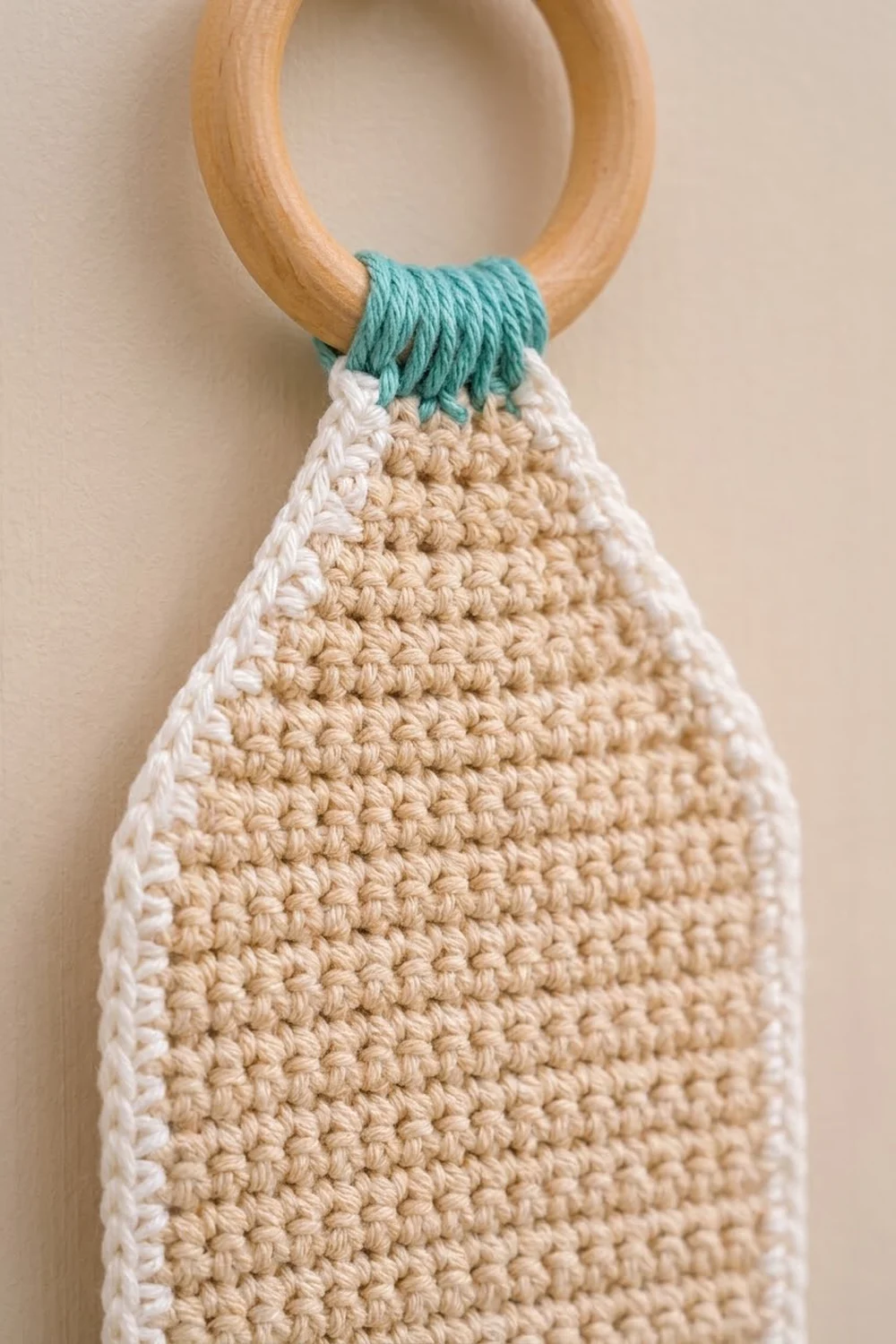
Backing Panel (Beige)
Ch 25.
Row 1: Sc in the 2nd ch from the hook and in each ch across. (24 sts)
Rows 2–90: Ch 1, turn, sc in each st across. (24 sts)
Checkpoint: 6 in × 20 in (15.2 cm × 50.8 cm).
Tapered Top
Row 91 (decrease): Ch 1, turn, sc2tog, sc in each st to the last 2, sc2tog. (22 sts)
Row 92: Ch 1, turn, sc in each st across. (22 sts)
Rows 93–110: Repeat Rows 91–92 nine more times. Each odd row decreases by 2 sts, and each even row keeps the count.
Stitch counts after each decrease row:
– Row 93: 20
– Row 95: 18
– Row 97: 16
– Row 99: 14
– Row 101: 12
– Row 103: 10
– Row 105: 8
– Row 107: 6
– Row 109: 4
Row 110 ends with 4 sts. Fasten off.
Checkpoint: The taper adds 20 rows, about 4.4 in (11.2 cm). The panel now measures 24.4 in (62.0 cm) long.
Pocket (Make 3)
Oval Base (Turquoise)
Ch 9.
Round 1: Sc in the 2nd ch from the hook, sc in the next 6 ch, 3 sc in the last ch. Rotate and work along the other side of the chain: sc in the next 6 ch, 2 sc in the same ch as the first sc. Sl st to the first sc. (18 sts)
Round 2: Ch 1, 2 sc in the first st, sc in the next 6, 2 sc in each of the next 3, sc in the next 6, 2 sc in each of the last 2. Sl st to the first sc. (24 sts)
Rounds 3–10: Let X = the round number minus 2.
Ch 1, sc in the first X sts, 2 sc in the next st, sc in the next 6. Then work [sc in the next X sts, 2 sc in the next st] 3 times, sc in the next 6, and [sc in the next X sts, 2 sc in the next st] twice. Sl st to the first sc.
Each of these rounds adds 6 sts, 3 at each curved end. The two straight sides stay at 6 sts.
Stitch count at the end of each round:
– Round 3: 30
– Round 4: 36
– Round 5: 42
– Round 6: 48
– Round 7: 54
– Round 8: 60
– Round 9: 66
– Round 10: 72
Checkpoint: The base is 5.9 in × 4.4 in (15.0 cm × 11.2 cm) and lies flat.
Walls
Round 11: Ch 1, sc in the BLO of each st. Sl st to the first sc. (72 = 72 worked 1 per st + 0 added)
This round leaves a ridge that turns the wall upward.
Round 12: Ch 1, sc in each st. Sl st to the first sc. (72 sts)
Round 13 (shells): Ch 1, sc in the same st. Sk 2, 7 dc in the next st, sk 2, sc in the next st. Repeat from * 10 more times. Sk 2, 7 dc in the next st, sk 2, sl st to the first sc.
Count: 12 shells. That’s 84 dc + 12 sc = 96 sts, worked into 24 of the 72 sts (48 skipped).
Round 14 (mesh): Ch 5 (counts as dc + ch 2). Sc in the center (4th) dc of the next shell, ch 2, dc in the next sc, ch 2. Repeat from * 10 more times. Sc in the center dc of the last shell, ch 2, sl st to the 3rd ch of the beginning ch-5.
Count: 12 dc + 12 sc, with 24 ch-2 sps.
Round 15 (offset shells): Ch 3 (counts as dc), 3 dc in the same st. Sk the ch-2 sp, sc in the next sc, sk the ch-2 sp, 7 dc in the next dc. Repeat from * 10 more times. Sk the ch-2 sp, sc in the next sc, sk the ch-2 sp, 3 dc in the same st as the beginning ch-3. Sl st to the top of the ch-3.
Count: 12 shells. The split shell at the start of the round counts as 1. That’s 84 dc + 12 sc = 96 sts.
Round 16 (mesh): Ch 1, sc in the same st, which is the center of the split shell. Ch 2, dc in the next sc, ch 2. Sc in the center dc of the next shell, ch 2, dc in the next sc, ch 2. Repeat from * 10 more times. Sl st to the first sc.
Count: 12 sc + 12 dc, with 24 ch-2 sps.
Round 17 (shells): Ch 1, sc in the same st. Sk the ch-2 sp, 7 dc in the next dc, sk the ch-2 sp, sc in the next sc. Repeat from * 10 more times. Sk the ch-2 sp, 7 dc in the last dc, sk the ch-2 sp, sl st to the first sc. Fasten off.
Count: 96 sts (84 dc + 12 sc).
The shells in Rounds 13 and 17 line up, and Round 15 sits between them. Together with the ch-2 sps, this staggering makes the open diamonds.
Rim (White)
Round 18: Join white in the sc at the join. Ch 1, sc in the same st. Sk 1 dc, sc in the next 5 dc, sk 1 dc, sc in the next sc. Repeat around, but leave out the final sc on the last repeat. Sl st to the first sc.
Count: 72 = 12 worked into sc + 60 worked into dc. The first and last dc of each shell are skipped (24 dc).
Round 19: Ch 1, sc in each st. Sl st to the first sc. (72 sts)
Round 20: Ch 1, crab stitch in each st. Sl st to the first st. (72 sts)
Fasten off and weave in the ends.
Checkpoint: The pocket is about 4 in (10.2 cm) tall and 9 in (22.9 cm) wide when flattened.
Hanging Tab (Turquoise)
Ch 5.
Row 1: Sc in the 2nd ch from the hook and in each ch across. (4 sts)
Rows 2–16: Ch 1, turn, sc in each st across. (4 sts)
Fasten off and leave a 24 in (61.0 cm) tail.
Checkpoint: 1 in × 3.6 in (2.5 cm × 9.1 cm).
Make All Pieces
- Beige: 1 backing panel
- Turquoise + white: 3 pockets
- Turquoise: 1 hanging tab
Layout (front view, rows counted from the bottom of the panel):
         (ring)
          [tab]
           /\
          /  \        rows 91–110 taper
         |    |       rows 77–90 plain
         | P3 |       rows 59–76
         |    |       rows 50–58 gap
         | P2 |       rows 32–49
         |    |       rows 23–31 gap
         | P1 |       rows 5–22
         |____|       rows 1–4 margin
Joining
Method: Whipstitch with the matching turquoise yarn, joining stitch to stitch.
- Flatten one empty pocket so it has 36 sts at the front and 36 at the back. On the back half, place markers to set off the center 24 sts, leaving 6 sts unmarked at each fold.
- Pin the back half to the panel so the 24 marked sts of the Round 11 ridge sit on the 24 sts of panel Row 5.
- Whipstitch each ridge stitch to the panel stitch directly behind it, 24 to 24. Pass through both loops of the panel stitch each time.
- Smooth the back wall upward. Whipstitch the same 24 marked sts of Round 19, just below the crab edge, to the 24 sts of panel Row 22.
- Tack each side edge of the back section to the panel at the sc of every mesh round, about 2 stitches per round.
- Repeat for the second pocket at Rows 32 and 49, and for the third at Rows 59 and 76.
Tension: Keep the stitches snug but don’t pull the panel. The beige should stay flat behind each seam.
Checkpoint: Each pocket covers 17 rows, about 3.8 in (9.7 cm) of panel. The gaps between pockets are 9 rows, 2 in (5.1 cm). The panel width is still 6 in (15.2 cm).
Border (White, on the Panel)
Border gauge: 4 sc per inch along every edge, which matches your stitch gauge. That means 8 sc for every 9 row-ends on the straight sides.
Round 1: With RS facing, join white in the first st of Row 110.
- Top edge: (Sc, ch 2, sc) in the first st, sc in the next 2 sts, (sc, ch 2, sc) in the last st.
- Side, going down:
- Along the taper (Rows 110–91), work 1 sc in each row-end: 20 sc.
- Along Rows 90–1, work [sc in each of the next 8 row-ends, sk 1 row-end] 10 times: 80 sc.
- Bottom edge: Work along the foundation ch. (Sc, ch 2, sc) in the first st, sc in the next 22 sts, (sc, ch 2, sc) in the last st.
- Other side, going up: 80 sc along Rows 1–90, then 20 sc along the taper.
- Sl st to the first sc.
Counts per side, between the ch-2 corners:
– Top: 4 sc. That’s 1 + 2 + 1, including both corner sc.
– Each long side: 102 sc. That’s 1 corner sc + 80 + 20 + 1 corner sc.
– Bottom: 24 sc. That’s 1 + 22 + 1.
Round 1 total: 4 + 102 + 24 + 102 = 232 sc, plus 4 ch-2 corners.
Round 2: Ch 1, crab stitch in each sc, and work 2 crab stitches in each ch-2 corner. Sl st to the first st. Count: 232 + 8 = 240 sts. Fasten off.
Why the math works:
– The 80 sc along 90 rows equals 20 in (50.8 cm) at 4 sc per inch, which matches the 20 in (50.8 cm) of rows. The edge lies flat without rippling or pulling in.
– The taper edge slants about 5 in (12.7 cm), and 20 sc covers it at 4 sc per inch.
– The 2 border rounds add 0.5 in (1.3 cm) all around. The width goes from 6 in to 7 in (15.2 cm to 17.8 cm), and the length goes from 24.4 in to 25.4 in (62.0 cm to 64.5 cm).
Attach the Hanging Tab
- Slide the tab through the wooden ring and fold it in half.
- Lay one end over the front of the panel tip and the other over the back. Each end should overlap the tip by about 1 in (2.5 cm).
- Sew both ends through all layers.
- Use the long tail to wrap tightly 10 times around the tip just below the ring, forming a 0.5 in (1.3 cm) band.
- Secure the tail by passing the needle under the band, and weave in the end.
Final Blocking
- Lightly mist the whole holder with water.
- Lay the panel face up and pin it to 7 in × 25.4 in (17.8 cm × 64.5 cm).
- Push a rolled towel or a spare roll into each pocket so the lace opens into even diamonds.
- Pinch each shell so its fan spreads out evenly.
- Smooth the white crab edges so the ridge rolls outward.
- Let it dry fully, at least 24 hours, before removing the pins.
Final Quality-Control Checklist
- The panel measures 7 in × 25.4 in (17.8 cm × 64.5 cm).
- The border has 240 crab stitches with no gaps at the corners.
- Each pocket has 12 shells per shell round and 72 sts in each rim round.
- The pockets are centered and level, 2 in (5.1 cm) apart.
- Each pocket’s back is sewn to the panel at the Round 11 ridge and at Round 19.
- The tab is secure and the wrap band is tight.
- All ends are woven in through solid stitches, not the lace.
Troubleshooting
- Pocket base cups or ruffles: Check your counts. Each round from 2 to 10 adds exactly 6 sts.
- Shells lean or the diamonds look uneven: Make sure you’re skipping the ch-2 sps, not working into them.
- Panel border waves: You’ve worked too many sc along the side. Keep the skip after every 8 row-ends.
- Panel border pulls in: Use a larger hook for the border only.
- Pocket sags off the panel: Add tacking stitches at each mesh round.
- Roll won’t fit: Block the pocket with a roll inside so the lace stretches.
Care
Hand wash in cool water with mild soap, gently press out the water, and dry flat. Reshape the pockets with rolls inside while damp.

Final Notes
Every measurement depends on the 4 sts per inch gauge:
– Panel: 24 sts make it 6 in (15.2 cm) wide, and 110 rows make it 24.4 in (62.0 cm) long.
– Pockets: Each 72-st base is 18 in (45.7 cm) around, enough to hold a roll upright. The pockets are joined stitch to stitch in a 24-st section.
– Border: 102 + 24 + 102 + 4 sc keeps every edge flat, for a finished size of 7 in × 25.4 in (17.8 cm × 64.5 cm).
Check your gauge once and the rest follows. Happy crocheting!