

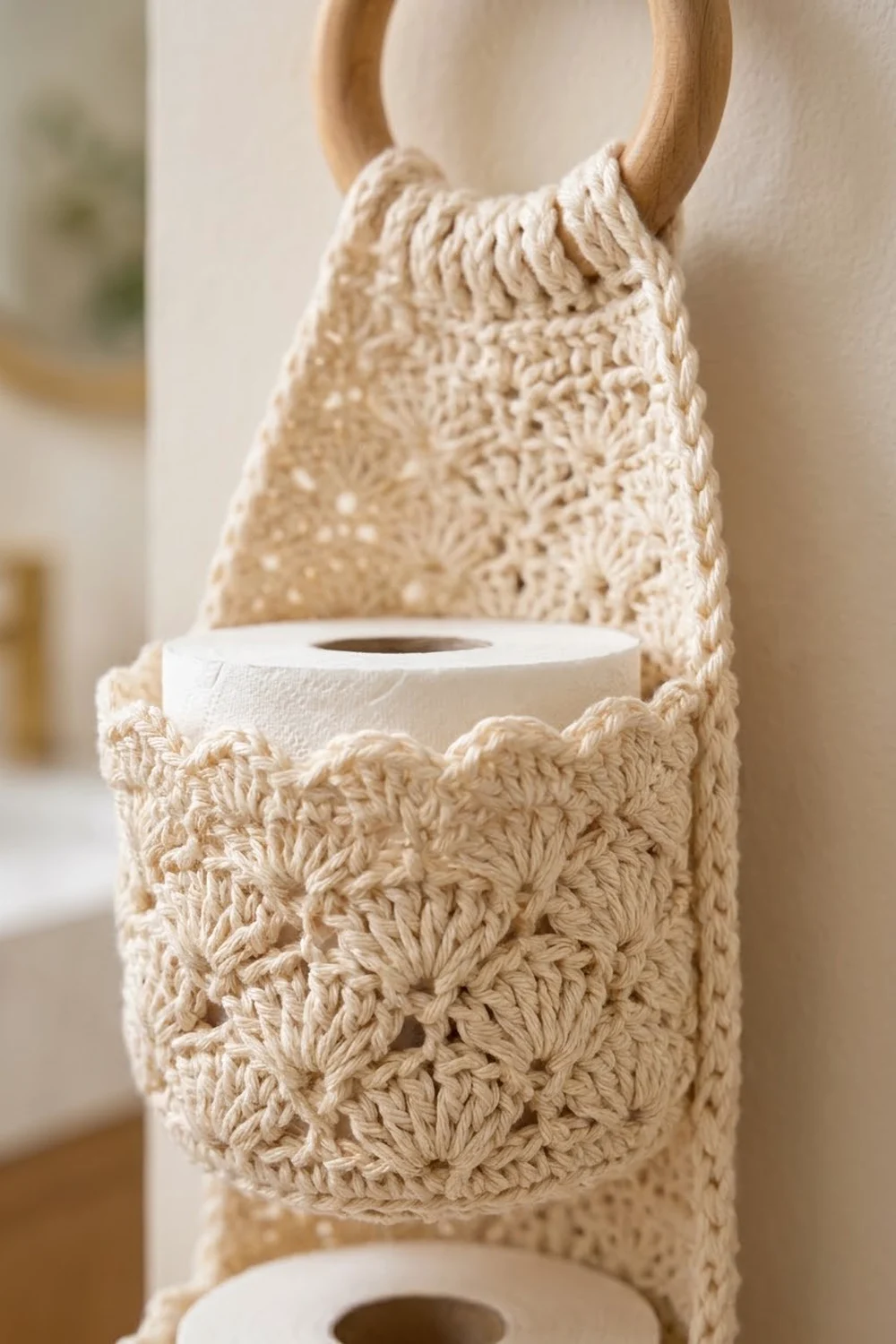
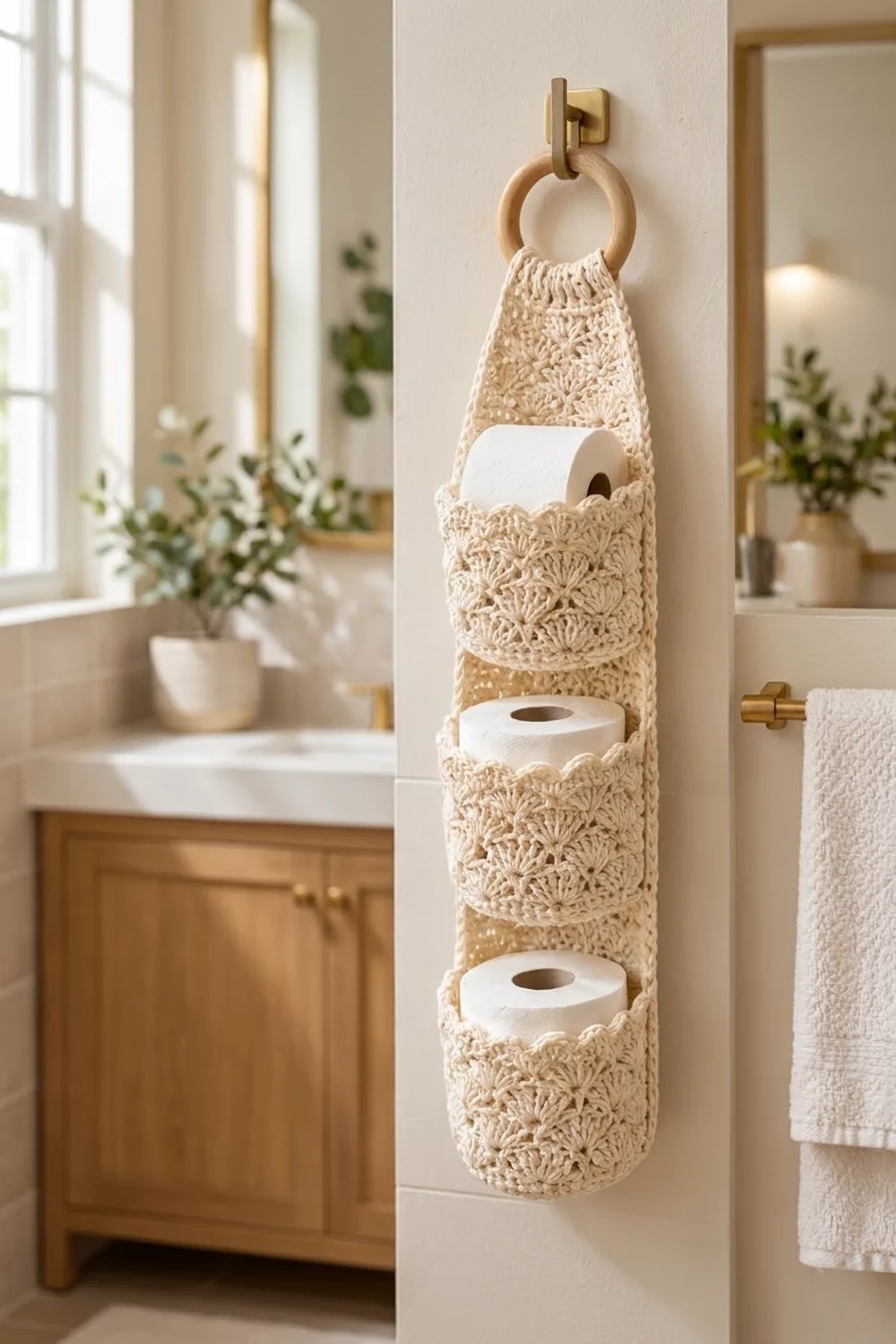
The Seashell Tower is a hanging toilet paper holder that keeps three spare rolls tidy and in easy reach. A long shell-stitch panel hangs from a wooden ring, and three round pockets with scalloped rims are sewn down its front, one above the other.
Everything is worked in one cream cotton yarn, so the stitch texture does the decorating. The shells give it a soft, coastal, farmhouse look that suits a light bathroom with natural wood and brass.
This pattern uses US crochet terms. The finished holder is 6.75 in (17.1 cm) wide and 29.75 in (75.6 cm) long from the bottom edge to the base of the strap. Measured from the top of the ring, it hangs about 33.5 in (85.1 cm).
You make one flat panel in rows, ending with a tapered top and a narrow strap. Then you make three pockets in the round, starting from a flat base. The pockets are sewn onto the panel, a single crochet border goes around the panel, and the strap is folded over the ring and stitched down.
Finished Size and Construction
- Finished size: 6.75 in (17.1 cm) wide x 29.75 in (75.6 cm) long, plus strap and ring
- Skill level: Intermediate
- Terminology: US
- Yarn weight: #4 worsted, 100% cotton
- Hook: 5.0 mm (H-8)
- Number of pieces: 4 (1 backing panel + 3 pockets)
- Layout: 3 pockets stacked in a single vertical column on 1 panel
- Panel size before border: 6.25 in (15.9 cm) x 29.5 in (74.9 cm), plus a 4 in (10.2 cm) strap
- Pocket size: 4.75 in (12.1 cm) base diameter, 3.25 in (8.3 cm) wall height, 15 in (38.1 cm) around
- Border depth: 0.25 in (0.6 cm) on every edge
Materials
Yarn: Pick a smooth worsted-weight cotton or cotton blend. Cotton holds the pocket shape, copes with bathroom humidity, and shows the shell texture clearly. Acrylic will work, but the pockets will be floppier.
- Cream: 220 g / 350 m
That amount includes about a 25% margin over what the sample used, so you have extra for your gauge swatch, sewing, and any small tension differences.
Tools:
- 5.0 mm (H-8) crochet hook
- Wooden ring, 2.75 in (7.0 cm) outer diameter
- Tapestry needle
- 6–8 locking stitch markers
- Measuring tape
- Rust-proof blocking pins and a blocking mat
- Scissors
- One toilet paper roll, to shape the pockets
Abbreviations (US Terms)
- ch – chain
- sl st – slip stitch
- sc – single crochet
- dc – double crochet
- sc2tog – single crochet 2 together
- sk – skip
- st(s) – stitch(es)
- rep – repeat
- BLO – back loop only
- MR – magic ring
- RS – right side
Special stitch: Shell – 5 dc worked into the same stitch.
Center dc – the 3rd dc of a 5-dc shell.
Gauge and Checkpoints
Shell gauge: 1 shell repeat (6 sts) = 1.5 in (3.8 cm), and 8 rows = 5 in (12.7 cm). That works out to 4 sts per inch across and 0.625 in (1.6 cm) per row.
Sc gauge: 16 sc = 4 in (10.2 cm), and 18 rows = 4 in (10.2 cm).
Test one piece first. Make one pocket before you start the panel. It’s small and checks both your dc tension and your shell tension.
- After Pocket Rnd 5: the base is 4.75 in (12.1 cm) across.
- After Pocket Rnd 9: the walls are 2.5 in (6.4 cm) tall.
- Finished pocket: a roll slides in easily, and about 0.75 in (1.9 cm) of the roll shows above the scallops.
Panel checkpoints:
- After Row 1: 6.25 in (15.9 cm) wide
- After Row 16: 10 in (25.4 cm) long
- After Row 44: 27.5 in (69.9 cm) long
- After Row 53: 29.5 in (74.9 cm) long
- After Row 71: the strap is 4 in (10.2 cm) long and 2.25 in (5.7 cm) wide
If your work is too big, go down a hook size (to 4.5 mm). If it’s too small, go up a hook size (to 5.5 mm). Don’t change the stitch counts. The pocket spacing and border math depend on them.
Backing Panel
Work in rows. The ch-3 at the start of a row counts as a dc. The ch-1 does not count as a stitch.
Foundation: Ch 26.
Row 1 (RS): Sc in 2nd ch from hook, sk 2 ch, shell in next ch, sk 2 ch, sc in next ch; rep from * 3 more times. Turn. (25 sts: 4 shells + 5 sc)*
Row 2: Ch 3, 2 dc in first sc, sk 2 dc, sc in center dc, sk 2 dc, shell in next sc; rep from * 2 more times, sk 2 dc, sc in center dc of last shell, sk 2 dc, 3 dc in last sc. Turn. (25 sts: 3 dc + 3 shells + 4 sc + 3 dc)*
Row 3: Ch 1, sc in first dc, sk 2 dc, shell in next sc, sk 2 dc, sc in center dc; rep from * across, working the last sc into the top of the turning ch-3. Turn. (25 sts: 4 shells + 5 sc)*
Rows 4–44: Rep Rows 2 and 3 in turn, ending with a Row 2 repeat on Row 44. (25 sts in every row)
Checkpoint: the panel measures 27.5 in (69.9 cm) long. Every row has 25 sts, so the edges should run straight.
Row 45 (leveling row): Ch 1, sc in each of first 3 dc, dc in next sc, sc in each of next 5 dc; rep from * 2 more times, dc in next sc, sc in each of last 3 sts. Turn. (25 sts: 21 sc + 4 dc)*
The dc stitches fill the dips over the sc points, so the top edge comes out level for the taper.
Taper
Row 46: Ch 1, sc2tog, sc in each st to last 2 sts, sc2tog. Turn. (23 sts)
Rows 47–53: Rep Row 46. The counts for Rows 47 to 53 are 21, 19, 17, 15, 13, 11, and 9 sts. (Row 53: 9 sts)
Checkpoint: the panel measures 29.5 in (74.9 cm) long. The taper (Rows 45–53) is 2 in (5.1 cm) tall and gives the rounded top shoulders.
Strap
Rows 54–71: Ch 1, sc in each st across. Turn. (9 sts)
Fasten off. The strap is 4 in (10.2 cm) long and 2.25 in (5.7 cm) wide.
Pockets (Make 3)
Work in joined rounds with the RS facing. Don’t turn. Ch-3 counts as a dc, and ch-1 does not count as a stitch.
Base
Rnd 1: In MR, ch 3, 11 dc. Sl st to top of ch-3. (12 sts)
Rnd 2: Ch 3, dc in same st, 2 dc in each st around. Sl st to join. (24 sts)
Rnd 3: Ch 3, 2 dc in next st, dc in next st, 2 dc in next st; rep from * around. Sl st to join. (36 sts)*
Rnd 4: Ch 3, dc in next st, 2 dc in next st, dc in next 2 sts, 2 dc in next st; rep from * around. Sl st to join. (48 sts)*
Rnd 5: Ch 3, dc in next 2 sts, 2 dc in next st, dc in next 3 sts, 2 dc in next st; rep from * around. Sl st to join. (60 sts)*
Checkpoint: the base is flat and 4.75 in (12.1 cm) across.
Walls
Rnd 6 (BLO): Working in the BLO, ch 1, sc in same st, sk 2 sts, shell in next st, sk 2 sts, sc in next st; rep from * around, leaving out the last sc. Sl st to first sc. (60 sts: 10 shells + 10 sc)*
Working in the back loops turns the edge up sharply into the walls. It also leaves a ring of free front loops around the edge of the base, which you’ll use for sewing.
Rnd 7: Sl st in next 3 dc to reach the center dc. Ch 1, sc in same st, shell in next sc, sc in center dc of next shell; rep from * around, leaving out the last sc. Sl st to first sc. (60 sts: 10 shells + 10 sc)*
Rnds 8–9: Rep Rnd 7. (60 sts)
Checkpoint: the walls are 2.5 in (6.4 cm) tall. Because the count stays at 60, the walls go straight up and don’t flare.
Rnd 10 (leveling round): Ch 1, sc in each of next 5 dc, dc in next sc; rep from * around. Sl st to first sc. (60 sts: 50 sc + 10 dc, one st worked into each existing st, 0 added)*
Rnd 11 (scallop rim): Ch 1, sc in same st, sk 1 st, shell in next st, sk 1 st, sc in next st; rep from * around, leaving out the last sc. Sl st to first sc. (15 scallops, 90 sts total: 15 sc + 75 dc, worked into 30 of Rnd 10’s 60 sts)*
Fasten off and leave a 30 in (76.2 cm) tail for sewing.
Checkpoint: the walls are 3.25 in (8.3 cm) tall and 15 in (38.1 cm) around.
Make All Pieces
All pieces are cream:
- Backing panel: 1
- Pockets: 3
Layout (bottom to top, on the panel’s RS):
        [ ring ]
        [strap ]
       /  taper \
      | panel    |
      | POCKET 3 |  base at 17.5 in (44.5 cm)
      | panel    |
      | POCKET 2 |  base at 8.75 in (22.2 cm)
      | panel    |
      | POCKET 1 |  base at bottom edge
       \________/
Pocket base heights are measured from the foundation edge, before the border.
Joining
Sew the pockets on before you work the border. Use the matching pocket tail and a whipstitch.
Place markers on the panel:
- Pocket 1: base line along Row 1, rim line 2.75 in (7.0 cm) up from there
- Pocket 2: base line along the top of Row 14, which is 8.75 in (22.2 cm) up. Rim line 2.75 in (7.0 cm) above that.
- Pocket 3: base line along the top of Row 28, which is 17.5 in (44.5 cm) up. Rim line 2.75 in (7.0 cm) above that.
On each line, mark panel sts 3 and 23. That leaves 2 sts free at each side edge for the border.
Stitch-to-stitch logic:
- On the pocket, count off 21 consecutive sts of Rnd 10 and mark the first and last. Directly below them, mark the matching 21 free front loops of Rnd 5.
- Rim seam: Whipstitch the 21 marked Rnd 10 sts to panel sts 3–23 along the rim line, one pocket st to one panel st. Sew behind the scallops so they stay free.
- Base seam: Whipstitch the 21 marked Rnd 5 front loops to panel sts 3–23 along the base line, one to one.
- Close the sides by whipstitching up each side of the flattened back wall, from base to rim.
Both seams are 21 sts, which is 5.25 in (13.3 cm) at 4 sts per inch. The panel row has the same gauge, so the seams lie flat without easing. The remaining 39 sts bow out at the front, so the pocket’s full 15 in (38.1 cm) still wraps around a roll.
Tension: Pull each whipstitch snug but not tight. If the panel puckers between markers, the stitches are too tight.
Size checkpoint: After all three pockets are on, the panel should still measure 6.25 in (15.9 cm) wide on every seam line.
Border
Border gauge: 4 sc per inch along every edge, which matches the sc gauge.
With the RS facing, join yarn in the bottom-right corner stitch of the foundation edge. Work 1 round:
Bottom edge: Work into the foundation chain. 3 sc in the first st, sc in each of the next 23 sts, 3 sc in the last st. (29 sc, including both corner groups)
Left long side (from bottom up, corners not included):
- Shell section, Rows 1–44: 5 sc for every 2 rows, so 22 pairs x 5 = 110 sc
- Taper, Rows 45–53: 1 sc per row end = 9 sc
- Strap, Rows 54–71: 1 sc per row end = 18 sc
- Side total: 137 sc
Strap top edge: 3 sc in the first st, sc in each of the next 7 sts, 3 sc in the last st. (13 sc, including both corner groups)
Right long side: Work as for the left side, from the top down. (137 sc)
Sl st to the first sc and fasten off.
Round total: 29 + 137 + 13 + 137 = 316 sc. The corner groups are counted only once, in the two short edges.
Why the math works: Two shell rows are 1.25 in (3.2 cm) tall, and 5 sc at 4 per inch also covers 1.25 in, so the sides neither ruffle nor pull in. Along the bottom, 25 sts plus 4 extra corner sts squares the corners without stretching the 6.25 in (15.9 cm) edge. The border adds 0.25 in (0.6 cm) on each side, so the panel goes from 6.25 in (15.9 cm) to 6.75 in (17.1 cm) wide and from 29.5 in (74.9 cm) to 29.75 in (75.6 cm) long. The strap becomes 2.75 in (7.0 cm) wide.
Attach the ring: Fold the strap over the wooden ring toward the back of the panel. Whipstitch the strap’s top edge to the back of the panel at the strap’s base (Row 54). Then sew down both sides of the fold.
Final Blocking
- Soak the holder in cool water for 10 minutes. Press out the water without wringing.
- Roll it in a towel to remove more water.
- Lay it face up and pin the panel to 6.75 in (17.1 cm) x 29.75 in (75.6 cm). Pin the long edges straight.
- Put a toilet paper roll in each pocket, or a rolled towel the same size, so the cups dry round.
- Open each scallop on the rims with your fingers.
- Let it dry completely, usually 24–36 hours, before you unpin it.
Final Quality-Control Checklist
- Panel is 6.75 in (17.1 cm) wide all the way down
- Panel is 29.75 in (75.6 cm) long below the strap
- All three pockets are centered, with 2 sts of panel free on each side
- Pocket bases are 8.75 in (22.2 cm) apart
- Each roll slides in and out without a struggle
- All 15 scallops on each rim are open and even
- Border lies flat with neat corners
- Strap is sewn securely and the ring hangs level
- All tails are woven in and trimmed
Troubleshooting
Panel edges wave or pull in: Check your border count of 5 sc per 2 rows. Add or remove a few sc evenly.
Pocket base cups before Rnd 6: Your dc rounds are too tight. Go up a hook size for the base only.
Pocket walls flare: You probably added stitches in a shell round. Recount to 60.
Roll won’t fit: The pocket is too small. Remake it with a larger hook, or block it stretched over a roll.
Pocket sags forward: Pull the base seam firmer and make sure all 21 front loops are sewn down.
Holder leans to one side: The strap is twisted or sewn off-center. Unpick it and refold it squarely.
Care
Hand wash cool or machine wash on a gentle cycle in a mesh bag, then reshape the pockets around a roll and dry flat.
Final Notes
Here is the measurement chain:
- Shell gauge of 6 sts = 1.5 in (3.8 cm) gives a 25-st panel 6.25 in (15.9 cm) wide.
- 44 shell rows give 27.5 in (69.9 cm), and the taper brings the panel to 29.5 in (74.9 cm).
- Each 60-st pocket is 15 in (38.1 cm) around and holds a standard roll.
- The 21-st seams match 21 panel sts exactly.
- A 316-st border adds 0.25 in (0.6 cm) on each edge, for a finished 6.75 in (17.1 cm) x 29.75 in (75.6 cm).
Check your gauge, keep the counts, and the pieces will fit together.
Happy crocheting!