

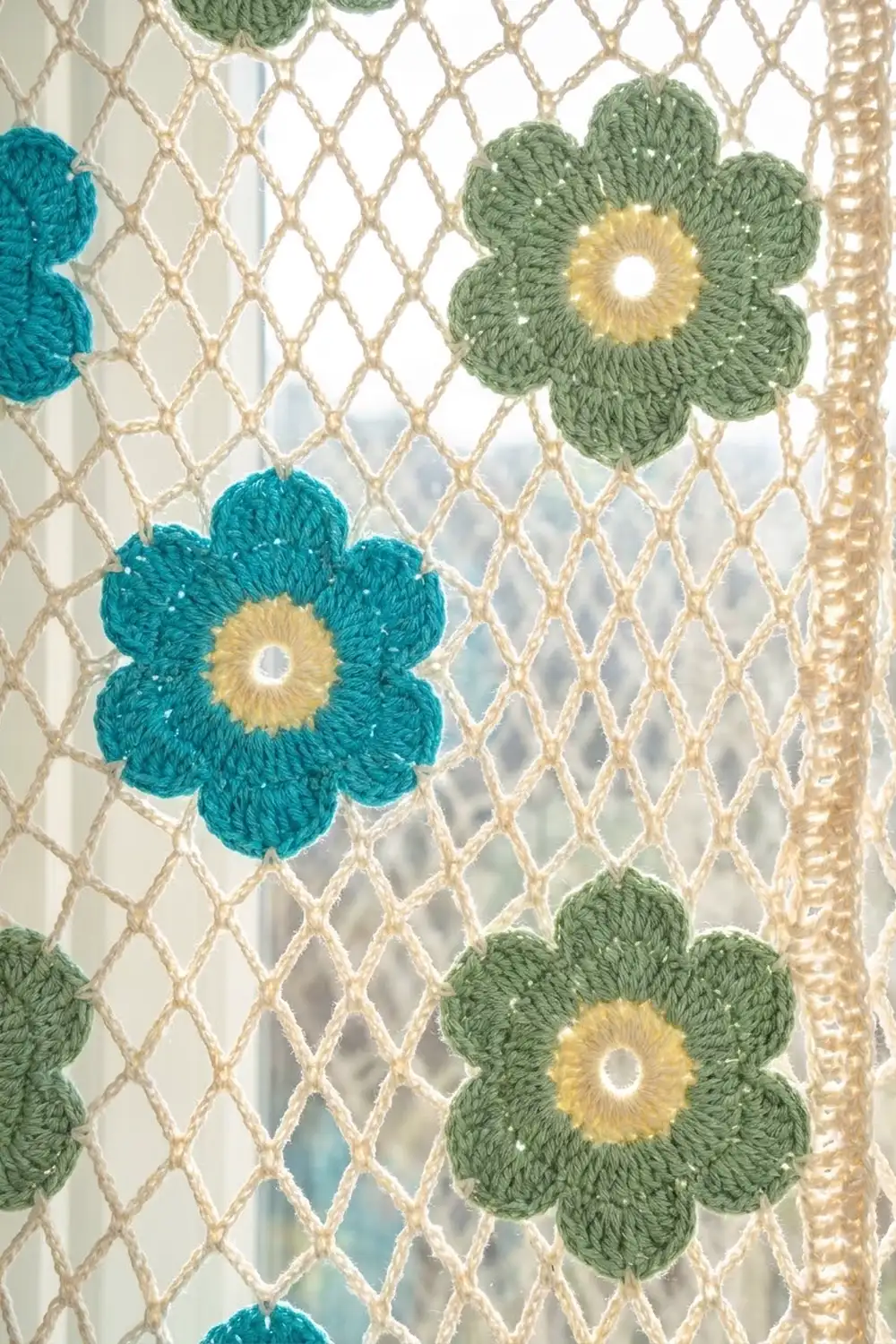
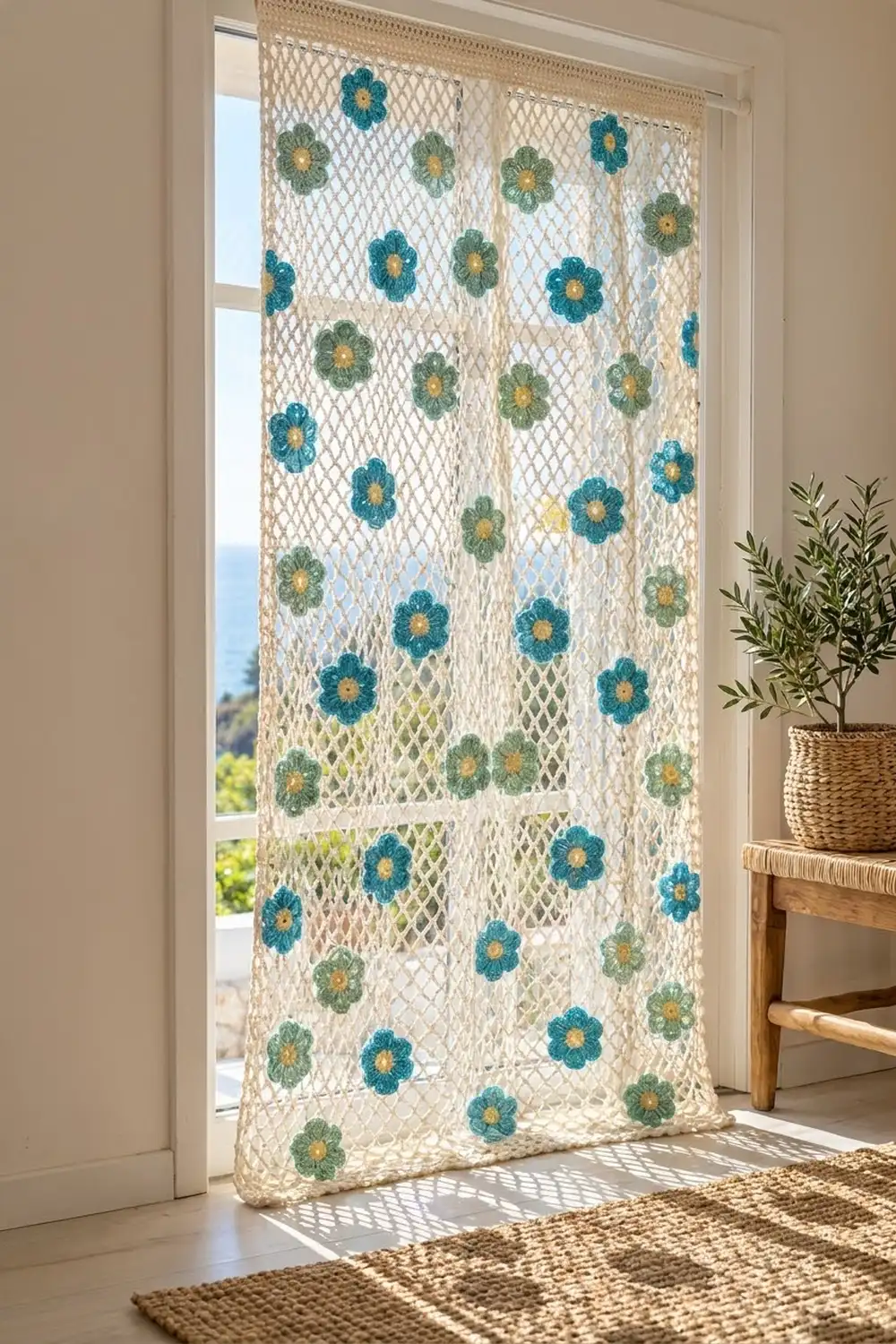
The Seaside Bloom Mesh Curtain is a light, airy window panel made from an open cream diamond net. Small six-petal flowers in turquoise and sage green, each with a butter-yellow center, are spread across it in neat staggered rows. When the sun comes through, the mesh almost disappears and the flowers look like they are floating.
The style is coastal and relaxed. Cream forms the background, two cool blue-greens make the petals, and a soft yellow warms the centers. Plain cotton yarn keeps the stitches crisp and helps the panel hang straight.
This pattern uses US crochet terms. The finished panel measures 31 x 71 in (78.7 x 180.3 cm) after blocking.
The construction is simple. You work one mesh panel in rows from the bottom up and add a two-round single crochet border. Then you crochet 46 small flowers and sew them on following a placement grid. There are no seams and no joined panels: one mesh body, many appliqués.
Finished Size and Construction
- Finished size: 31 x 71 in (78.7 x 180.3 cm)
- Skill level: Easy / advanced beginner
- Terminology: US crochet terms
- Yarn weight: Worsted weight (#4) cotton
- Hook: 5 mm (H-8)
- Number of pieces: 1 mesh panel plus 46 appliqué flowers (sewn on, not joined)
- Layout: 13 staggered flower rows, alternating 4 and 3 flowers
- Flower size: 3 in (7.6 cm) across
- Mesh size before border: 30 x 70 in (76.2 x 177.8 cm)
- Border depth: 0.5 in (1.3 cm) on every side
Materials
Use a smooth worsted weight cotton or cotton blend at about 190 m per 100 g. Cotton holds the mesh shape, handles sunlight better than acrylic, and blocks well. Avoid fuzzy yarns, because they blur the net.
- Cream (mesh and border): 350 g, about 665 m (727 yd)
- Turquoise (petals): 60 g, about 114 m (125 yd)
- Sage green (petals): 60 g, about 114 m (125 yd)
- Pale yellow (centers): 40 g, about 76 m (83 yd)
Quantities include a margin of roughly 15–20% for gauge differences and sewing tails.
Tools:
- 5 mm (H-8) crochet hook
- Tapestry needle with a bent tip
- Stitch markers (at least 10)
- Tape measure
- Rust-proof pins and a large blocking surface (foam mats or a bed with a sheet)
- Scissors
- Curtain rod with clip rings, or a tension rod
Abbreviations (US Terms)
- ch – chain
- sl st – slip stitch
- sc – single crochet
- hdc – half double crochet
- dc – double crochet
- sk – skip
- sp – space
- st(s) – stitch(es)
- rep – repeat
Special term – mesh loop: one ch-5 arch anchored by an sc at each end. On full-loop rows, the panel has 30 mesh loops across.
Gauge and Checkpoints
Mesh gauge (blocked): 6 mesh loops = 6 in (15.2 cm) wide; 6 rows = 4 in (10.2 cm) tall. That is 1 loop per inch and 1.5 rows per inch.
Border gauge: 4 sc = 1 in (2.5 cm); 2 sc rounds = 0.5 in (1.3 cm).
Flower gauge: Round 1 center = 1.25 in (3.2 cm) across; finished flower = 3 in (7.6 cm) across.
Test first. Before starting the panel, make one flower and a mesh swatch. For the swatch, ch 26 and work Rows 1–3, then repeat Rows 2–3 until you have 9 rows. Wet it, pin it gently, and let it dry. Measure 6 loops across and 6 rows up in the center.
If the swatch is too big, go down 0.5 mm. If it is too small, go up 0.5 mm. Mesh stretches a lot, so always measure after blocking, never while it is still on the hook.
Checkpoints during the panel (lightly stretched flat):
- After Row 1: about 30 in (76.2 cm) wide
- After Row 30: about 20 in (50.8 cm) tall
- After Row 60: about 40 in (101.6 cm) tall
- After Row 90: about 60 in (152.4 cm) tall
- After Row 105: 70 in (177.8 cm) tall
Part 1: Mesh Panel
The net is worked back and forth. Odd rows have 30 full loops. Even rows have 29 full loops plus a half-loop (ch 2 and dc) at each edge, which keeps the sides straight.
With cream, ch 122 (multiple of 4 + 2).
Row 1: Sc in 2nd ch from hook, *ch 5, sk 3 ch, sc in next ch; rep from * across. (30 ch-5 loops, 31 sc)
Row 2: Ch 5 (counts as dc + ch 2), turn, sc in first ch-5 sp, *ch 5, sc in next ch-5 sp; rep from * across, ch 2, dc in last sc. (29 ch-5 loops, 2 half-loops, 30 sc)
Row 3: Ch 1, turn, sc in first dc, *ch 5, sc in next ch-5 sp; rep from * across, working the last sc in the 3rd ch of the turning ch-5. (30 ch-5 loops, 31 sc)
Rows 4–105: Rep Rows 2–3 fifty-one times. You finish on Row 105, a full-loop row with 30 loops and 31 sc.
Do not fasten off. Go straight into the border.
Tip: Work each sc around the center of the ch-5 loop below, not into a single chain. This centers the diamond and keeps the net even.
Part 2: Border
The border tidies the edges and gives the curtain a firm frame for hanging. You make corners by working 3 sc into one stitch. The middle sc of that group is the corner stitch.
Round 1: Ch 1, do not turn. Work across Row 105 (top edge) as follows:
- 3 sc in the first sc (corner).
- Top: 4 sc in each of the 30 ch-5 loops, skipping the sc between loops = 120 sc.
- 3 sc in the last sc (corner).
- Side: Working down the row ends, work 3 sc, 3 sc, 2 sc across each group of 3 row ends, 35 times = 280 sc.
- Bottom: 3 sc in the base of the first sc of Row 1 (corner). Work into the underside of the foundation chain, skipping the base chs where the Row 1 sc sit. In each of the 30 groups of 3 skipped chs, work sc in the first ch, sc in the second ch, and 2 sc in the third ch = 120 sc. Then work 3 sc in the base of the last sc of Row 1 (corner).
- Side: Working up the row ends, work 3 sc, 3 sc, 2 sc across each group of 3 row ends, 35 times = 280 sc.
- Sl st to the first sc.
Round 1 total: 120 + 280 + 120 + 280 between corners, plus 4 corner groups of 3 = 800 + 12 = 812 sc.
Counted corner-center to corner-center inclusive, the top and bottom each have 124 sts and each long side has 284 sts. Check: (2 x 124) + (2 x 284) − 4 shared corners = 812.
Round 2: Ch 1, sc in each sc around, working 3 sc in each corner center sc. Sl st to the first sc. (820 sc)
Per side, corner-center to corner-center inclusive: top and bottom 126 sts each, long sides 286 sts each. Check: (2 x 126) + (2 x 286) − 4 = 820.
Fasten off and weave in the ends.
Why the math works: The border gauge is 4 sc per inch. The top and bottom are 30 in (76.2 cm), so 30 x 4 = 120 sc. The long sides are 70 in (177.8 cm), so 70 x 4 = 280 sc. Because 105 rows make 35 groups of 3, the 3-3-2 pattern gives exactly 35 x 8 = 280. Each of the two rounds adds 0.25 in (0.6 cm). That gives 0.5 in (1.3 cm) per edge and a finished panel of 31 x 71 in (78.7 x 180.3 cm).
Part 3: Flowers (make 46)
Each flower is a single flat layer: a yellow center ring with six rounded petals.
Round 1 (yellow): Make a magic ring and ch 3 (counts as dc). Work 11 dc in the ring. Pull the ring snug but leave a small hole, then sl st to the top of the ch-3. (12 dc) Fasten off.
Checkpoint: 1.25 in (3.2 cm) across.
Round 2 (petal color): Join turquoise or sage with sl st in any dc. Ch 1, sc in same st, ch 3, sk next dc, *sc in next dc, ch 3, sk next dc; rep from * 4 more times. Sl st to first sc. (6 sc, 6 ch-3 sps)
Round 3 (petal color): In each ch-3 sp work (sc, hdc, 3 dc, hdc, sc). Sl st to the first sc. (6 petals, 42 sts)
Fasten off, leaving a 12 in (30.5 cm) tail for sewing. Weave in the yellow tail on the back.
Checkpoint: 3 in (7.6 cm) across, lying flat.
Quantities: 23 flowers with turquoise petals and 23 flowers with sage petals, all with yellow centers.
Part 4: Flower Placement
Block the mesh panel and the flowers first (see Final Blocking). Placing flowers on a stretched, dry panel keeps the spacing accurate.
Lay the panel flat. Measure from the bottom edge of the mesh, not from the border.
Vertical spacing: Make 13 flower rows, centered at 5, 10, 15 … 65 in (12.7, 25.4, 38.1 … 165.1 cm) from the bottom. That is 12 gaps of 5 in (12.7 cm), with a 5 in (12.7 cm) margin at the top and bottom: 5 + 60 + 5 = 70 in (177.8 cm). A flower row falls about every 7–8 mesh rows.
Horizontal spacing (count loops from the right edge):
- 4-flower rows (odd flower rows 1, 3, 5 … 13): Center the flowers on loops 5, 12, 19, and 26. That is 4.5, 11.5, 18.5, and 25.5 in (11.4, 29.2, 47.0, and 64.8 cm) from the edge, 7 in (17.8 cm) apart.
- 3-flower rows (even flower rows 2, 4 … 12): Center the flowers on the sc points between loops 8/9, 15/16, and 22/23. That is 8, 15, and 22 in (20.3, 38.1, and 55.9 cm) from the edge, midway between the flowers above and below.
Color layout (T = turquoise, S = sage). Row 13 is the top row and Row 1 is the bottom row:
Row 13:  T . S . T . S
Row 12:  . T . S . T .
Row 11:  T . S . T . S
Row 10:  . S . T . S .
Row  9:  T . S . T . S
Row  8:  . T . S . T .
Row  7:  T . S . T . S
Row  6:  . S . T . S .
Row  5:  T . S . T . S
Row  4:  . T . S . T .
Row  3:  T . S . T . S
Row  2:  . S . T . S .
Row  1:  T . S . T . S
Totals: 7 rows x 4 = 28 flowers, plus 6 rows x 3 = 18 flowers, for 46. Color count: 23 T and 23 S.
Sewing: Pin each flower with its center over the marked spot. Using the petal-color tail, whipstitch through the base of each petal (the Round 2 sc) into the nearest mesh strand. Then make one small stitch at each petal tip. Keep the stitches loose enough that the mesh does not pucker. Knot on the back and hide the tail inside the petal.
Final Blocking
- Weave in all remaining ends.
- Soak the curtain in cool water with a little wool wash for 15 minutes.
- Gently press out the water without wringing. Roll the curtain in towels to remove more moisture.
- Lay it flat on the blocking surface and shape it to 31 x 71 in (78.7 x 180.3 cm).
- Pin the border every 2 in (5.1 cm), keeping the corners square and the sides straight.
- Open each diamond with your fingers so the net is even across the panel.
- Pat each flower flat and round, about 3 in (7.6 cm) across.
- Let it dry completely, then unpin and hang.
Final Quality-Control Checklist
- The panel measures 31 x 71 in (78.7 x 180.3 cm).
- The mesh has 30 loops on full-loop rows and 105 rows in total.
- Border Round 2 has 820 sc, with crisp corners.
- The side edges are straight, with no waves or pulling.
- There are 46 flowers, each 3 in (7.6 cm) across with 6 even petals.
- There are 23 turquoise and 23 sage flowers in the staggered layout.
- Flower rows are level and spaced 5 in (12.7 cm) apart.
- Nothing puckers under any flower, and all ends are hidden.
Troubleshooting
Diamonds look slanted. You are working the sc into a chain instead of around the loop. Work into the loop space.
Sides curve inward. The ch-2 and dc half-loops on even rows are too tight. Keep the turning ch-5 relaxed and match its height to the loops.
Border ruffles. There are too many sc on the sides. Recheck the 3-3-2 rhythm and the 280 count.
Border pulls the mesh in. There are too few sc, or your tension is tight. Go up 0.5 mm for the border only.
Flowers cup. The Round 1 ring is pulled too tight, or Round 3 is tight. Leave a small hole and relax your tension.
Panel puckers around flowers. The sewing stitches are too tight. Take them out and sew again with a lighter hand.
Panel seems too short after hanging. Cotton mesh may stretch slightly as it hangs. Measure after it has hung for a day before adding rows.
Care
Hand wash in cool water and dry flat, reshaping to size. Avoid the dryer and hard wringing, because both distort the mesh.
Final Notes
The measurement chain is simple. One loop per inch gives a 30 in (76.2 cm) wide mesh, and 105 rows at 1.5 rows per inch give 70 in (177.8 cm). Two sc rounds at 4 sc per inch add 0.5 in (1.3 cm) per edge, for a finished panel of 31 x 71 in (78.7 x 180.3 cm). The flowers are 3 in (7.6 cm) across, and all 46 go into 13 staggered rows spaced 5 in (12.7 cm) apart.
Check your gauge, count your border, and measure the flower placement on the blocked panel. Then hang it in a sunny window.
Happy crocheting!