

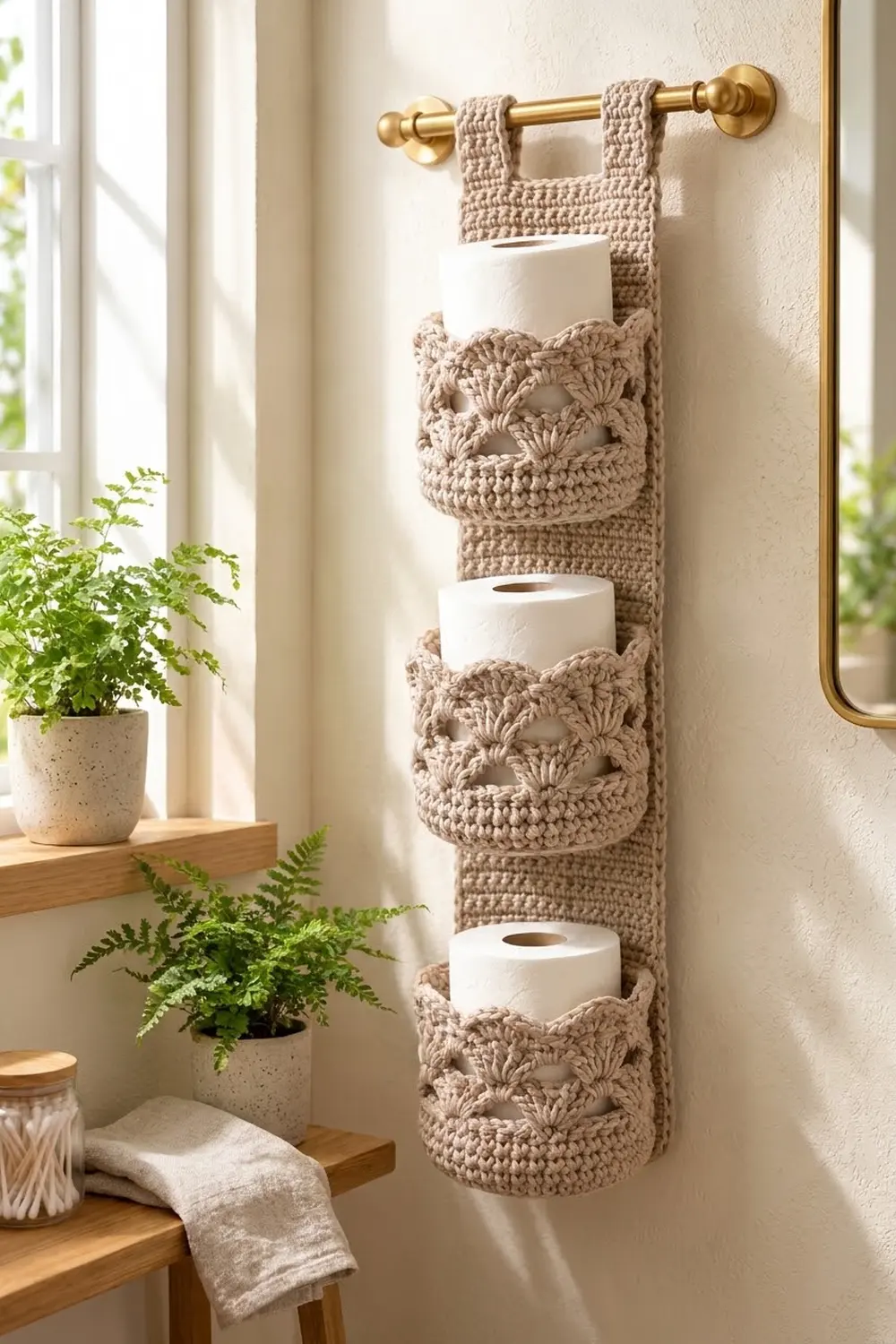
This hanging holder stores three spare rolls in a narrow strip of wall space. A long single-crochet panel hangs from a towel bar by two strap loops. Three round baskets with lace tops are sewn down its front, and each one holds one standard roll.
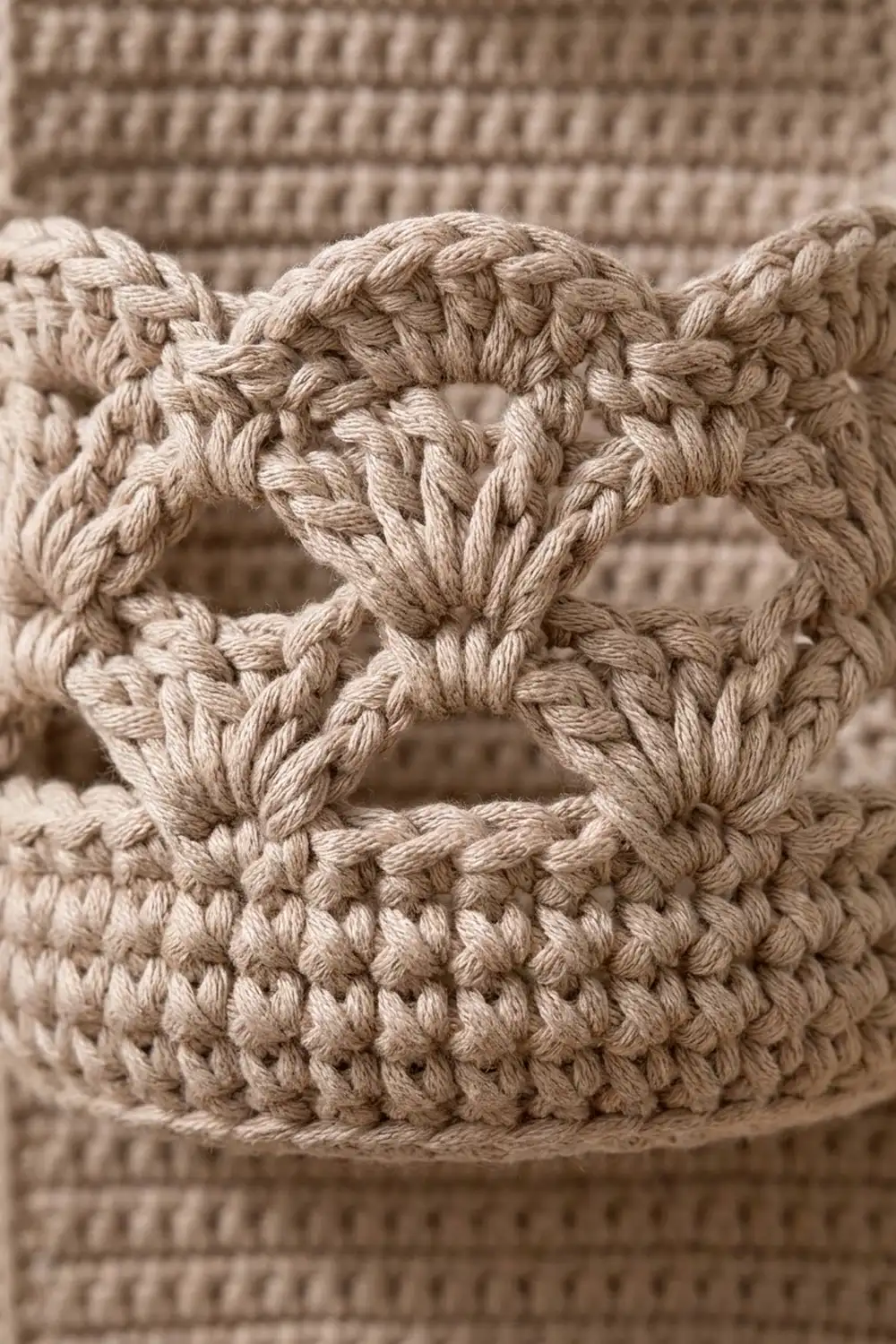
The holder is worked in one warm taupe cotton, which suits a calm, natural bathroom. The solid panel and the solid lower walls of the baskets give it structure. The shell band at the top of each basket adds texture: two rounds of fans, small eye-shaped openings, and a pointed scalloped rim.
This pattern uses US crochet terms. The bordered panel measures 6 2/3 in x 30 2/3 in (16.9 cm x 77.9 cm). The total hanging length, including the strap loops, is about 32 2/3 in (83.0 cm). Each basket is about 5 in (12.7 cm) across and 3 3/4 in (9.5 cm) tall.
The construction is simple. You crochet the panel in rows, add one round of border, and work the two straps straight off the top edge. Then you make three baskets in the round from the base up and whip stitch them to the panel at fixed row positions.
Finished Size and Construction
- Finished size: panel 6 2/3 in x 30 2/3 in (16.9 cm x 77.9 cm); about 32 2/3 in (83.0 cm) hanging length
- Skill level: Easy-Intermediate
- Terminology: US crochet terms
- Yarn weight: Bulky (#5) cotton or cotton-blend
- Hook: 6.0 mm (US J-10)
- Number of pieces: 4 (1 panel with straps, 3 baskets)
- Layout: 3 baskets stacked vertically on 1 panel
- Panel size before border: 6 in x 30 in (15.2 cm x 76.2 cm)
- Border depth: 1/3 in (0.8 cm), 1 round
- Basket size: about 5 in (12.7 cm) across x 3 3/4 in (9.5 cm) tall
- Strap size: 1 2/3 in x 6 in (4.2 cm x 15.2 cm) each
Materials
Yarn: Use a firm, matte bulky cotton, such as a cotton cord or a chunky cotton blend. Cotton holds the basket shape and resists stretching under the weight of the rolls. Avoid soft acrylics and fluffy yarns, because they sag and hide the lace.
- Taupe/greige: about 330 g / 310 m total
- Panel, border and straps: about 140 g / 130 m
- Three baskets: about 165 g / 155 m (about 55 g / 52 m each)
- Sewing: about 25 g / 25 m
These quantities include a margin of about 15%.
Tools:
– 6.0 mm (US J-10) crochet hook
– Large-eye tapestry needle
– Stitch markers (at least 6)
– Scissors
– Measuring tape
– Rust-proof pins
– Blocking mat or towel, and a spray bottle
Abbreviations (US Terms)
- ch – chain
- sl st – slip stitch
- sc – single crochet
- dc – double crochet
- inc – 2 sc in the same stitch
- BLO – back loop only
- MR – magic ring
- st(s) – stitch(es)
- sp – space
- sk – skip
- RS – right side
- rep – repeat
Special stitch – Fan: 7 dc worked into the same stitch. The 4th dc is the center dc.
Gauge and Checkpoints
Gauge: 12 sc x 12 rows = 4 in (10.2 cm) in sc worked in rows with the 6.0 mm hook. This works out to 3 sts and 3 rows per inch (2.5 cm). Every measurement in this pattern depends on this gauge.
Make one basket before you start the panel. It uses less yarn and tests your gauge both in the round and in the lace.
Checkpoints:
– Basket base after Round 8: about 5 in (12.7 cm) across and lying flat
– Basket after Round 14: about 2 in (5.1 cm) of straight wall
– Finished basket: a standard roll, about 4.5 in (11.4 cm) wide, drops in easily
– Panel after Row 15: 6 in wide x 5 in tall (15.2 cm x 12.7 cm)
– Panel after Row 90: 6 in x 30 in (15.2 cm x 76.2 cm)
If your piece is too big, go down 0.5 mm in hook size. If it is too small, go up 0.5 mm. If the base ruffles, your increases are too tight for the yarn, so go up a hook size for Rounds 1–8 only. If the base cups, go down one size.
Backing Panel
Work in rows, using sc throughout. The ch 1 at the start of each row does not count as a stitch.
Foundation: Ch 19.
Row 1 (RS): Sc in 2nd ch from hook and in each ch across. (18 sts)
Rows 2–90: Ch 1, turn, sc in each st across. (18 sts)
Do not fasten off. Continue straight into the border.
Checkpoint: 6 in x 30 in (15.2 cm x 76.2 cm). Place a marker in the row-end on the right edge at Row 3, Row 33 and Row 63. These are the basket base lines.
Basket (Make 3)
Work in continuous spiral rounds for Rounds 1–8 and move a marker up each round. From Round 9 on, join each round with a sl st to the first st.
Base
Round 1: 6 sc in MR. (6)
Round 2: Inc in each st. (12)
Round 3: Sc in next st, inc; rep from * around. (18)
Round 4: Sc in next 2 sts, inc; rep from * around. (24)
Round 5: Sc in next st, inc, sc in next 3 sts, inc; rep from * 4 more times, sc in next 2 sts. (30)
Round 6: Sc in next 4 sts, inc; rep from * around. (36)
Round 7: Sc in next 2 sts, inc, sc in next 5 sts, inc; rep from * 4 more times, sc in next 3 sts. (42)
Round 8: Sc in next 6 sts, inc; rep from * around. Sl st to the next st. (48)
Rounds 5 and 7 stagger the increases so the base stays round instead of turning into a hexagon.
Checkpoint: about 5 in (12.7 cm) across and flat.
Wall
Round 9 (turning round): Ch 1, sc in BLO of each st around, then join. Count: 48 sts worked 1 per existing st + 0 added = 48. The unused front loops make the visible ridge at the base.
Rounds 10–14: Ch 1, sc in each st around, then join. (48)
Checkpoint: a straight wall about 2 in (5.1 cm) tall above the ridge.
Shell Lace Band
Round 15 (lower fans): Ch 1, sc in the first st, sk 3 sts, fan in next st, sk 3 sts. Sc in next st, sk 3 sts, fan in next st, sk 3 sts; rep from * 4 more times. Join to the first sc. Count: 6 repeats x (1 sc + 7 dc) = 48, using all 48 sts of Round 14 (6 repeats x 8 sts).
Round 16 (upper fans and openings): Sl st in the first 3 dc of the first fan. Ch 1, sc in the center dc. Ch 2, fan in the next sc of Round 15, ch 2, sc in the center dc of the next fan; rep from * 4 more times. Ch 2, fan in the last sc, ch 2, then join to the first sc. Count: 6 repeats x (1 sc + 2 ch + 7 dc + 2 ch) = 72.
Each new fan sits in the gap between two lower fans. The ch-2 bridges stretch over the outer dc of the lower fans, which leaves the eye-shaped openings between the two rounds.
Round 17 (scalloped edge, trim round): Ch 1, sc in the same sc. 2 sc in the ch-2 sp, sc in the next 3 dc, 3 sc in the center dc, sc in the next 3 dc, 2 sc in the ch-2 sp, sc in the next sc; rep from * around. Omit the final sc and join to the first sc instead.
Count: 72 sts worked 1 per existing st (6 sc + 42 dc + 24 ch, where each ch-2 sp takes 2 sc) + 12 extra sts (2 extra at each of the 6 center dc) = 84.
The 3-sc groups make the points of the scalloped rim. Fasten off and leave a 24 in (61.0 cm) tail for sewing.
Checkpoint: the basket stands about 3 3/4 in (9.5 cm) tall, and a roll slides in without stretching it.
Make All Pieces
- Panel: 1, in taupe (with the border and straps added later)
- Baskets: 3, in taupe
Layout (front view, top to bottom):
   [strap]          [strap]
 +---------------------------+
 |  panel top, Row 90        |
 |                           |
 |  [ BASKET 3 ] base Row 63 |
 |                           |
 |  [ BASKET 2 ] base Row 33 |
 |                           |
 |  [ BASKET 1 ] base Row 3  |
 |  panel bottom, Row 1      |
 +---------------------------+
The baskets are spaced 30 rows, or 10 in (25.4 cm), base to base.
Border (Panel)
Border gauge: 3 sc per inch (2.5 cm) on every edge. Along the top and bottom you work 1 sc per stitch. Along the sides you work 1 sc per row-end. Because the gauge is 3 sts and 3 rows per inch, both rules give the same density and the edges stay flat.
Border Round: After Row 90, ch 1 and do not turn. Work around the whole panel:
- Top edge: 3 sc in the first st (corner), sc in the next 16 sts, 3 sc in the last st (corner).
- Left side: 1 sc in each of the 88 row-ends from Row 89 down to Row 2. The Row 90 and Row 1 row-ends are covered by the corners.
- Bottom edge (in the free loops of the foundation ch): 3 sc in the first st (corner), sc in the next 16 sts, 3 sc in the last st (corner).
- Right side: 1 sc in each of the 88 row-ends.
- Join to the first sc. Total: 220 sts.
Per-side counts with corners: Each 3-sc corner gives 1 st to each neighboring side and keeps its middle st as the corner center.
- Top and bottom: 1 + 16 + 1 = 18, plus 2 corner centers = 20 per side
- Left and right: 1 + 88 + 1 = 90, plus 2 corner centers = 92 per side
- Check: 2 x 18 + 2 x 90 + 4 corner centers = 220 ✓
Why the math works: 20 sts at 3 sts/in = 6 2/3 in (16.9 cm), and 92 sts at 3 sts/in = 30 2/3 in (77.9 cm). The border adds 1/3 in (0.8 cm) on every side, without ruffling or pulling.
Straps
With RS facing, join the yarn in the top-right corner center st.
Strap 1, Rows 1–18: Sc in this st and the next 4 sts (5 sts). Ch 1, turn. Continue in 5 sc for 18 rows in total, then fasten off with a 12 in (30.5 cm) tail.
Strap 2: Count 10 sts to the left and leave them unworked. These 10 open sts give a 3 1/3 in (8.5 cm) gap. Join the yarn in the next st and work Rows 1–18 as for Strap 1 over the last 5 top-edge sts, ending in the top-left corner center.
Top-edge check: 5 + 10 + 5 = 20 ✓
Each strap measures 1 2/3 in x 6 in (4.2 cm x 15.2 cm).
Joining
Method: Whip stitch with a tapestry needle and the basket’s tail, through both layers.
Positioning: Turn the basket so its round joins face the panel. Find the 16 front loops of the Round 9 ridge that sit at the back. These are 2 pattern repeats, about 5 1/3 in (13.5 cm). Mark each end. The back of the basket flattens against the panel and the remaining 32 sts curve out to the front.
Stitch-to-stitch logic:
- Base line: Whip stitch the 16 ridge loops one-to-one to the 16 center sc of the marked panel row (Row 3, 33 or 63). This leaves 1 body st plus the border st free on each side.
- Sides: Sew from each end of the base line straight up. Match 1 basket round to 1 panel row, because both are 3 per inch. Rounds 9–15 meet 7 panel rows.
- Top: Tack the back points of Round 17 to the panel with 2–3 small stitches each so the rim doesn’t flop forward.
Tension advice: Pull each stitch snug but not tight. The panel should stay flat behind the basket without puckering. Check from the front every 4–5 stitches.
Finish the straps: Fold each strap to the back so that 2 in (5.1 cm) of strap overlaps the back of the panel, and whip stitch the last row down. Each loop then stands about 2 in (5.1 cm) above the panel. If your rod can’t be removed, sew a button to the panel back and use a gap between stitches near the end of the strap as the buttonhole.
Size checkpoint: The joined holder measures 6 2/3 in (16.9 cm) wide and about 32 2/3 in (83.0 cm) long including the loops. The basket bases sit 10 in (25.4 cm) apart.
Final Blocking
- Weave in all ends along stitches of the same color, working into the panel’s back.
- Lay the holder face up on a blocking mat or folded towel.
- Pin the panel to 6 2/3 in x 30 2/3 in (16.9 cm x 77.9 cm), keeping the edges straight.
- Stuff each basket loosely with a dry roll in a plastic bag, or a rolled towel, to hold its round shape.
- Spray everything evenly until damp, not soaked.
- Pull each fan open gently with your fingers and pinch each Round 17 point into shape.
- Leave it to dry completely, usually 24 hours, before removing the pins.
Final Quality-Control Checklist
- [ ] The panel is 18 sts x 90 rows before the border
- [ ] The border round is 220 sts, with 20 on the short sides and 92 on the long sides
- [ ] Each strap is 5 sts x 18 rows, with a 10-st gap between the straps
- [ ] Each basket base is 48 sts and about 5 in (12.7 cm) across
- [ ] Each basket shows 6 lower fans, 6 upper fans, 12 openings and 6 points
- [ ] The Round 17 count is 84 in every basket
- [ ] The basket bases sit on Rows 3, 33 and 63
- [ ] The baskets sit centered and level
- [ ] All ends are woven in securely
- [ ] A roll fits each basket easily
Troubleshooting
The base cups or ruffles. Recount the increases, which should add 6 per round. Change hook size for the base only.
Round 15 doesn’t come out even. You need exactly 48 sts from Round 14. Recount, and remember that the sl st join is not a stitch.
The fans lean to one side. Make sure each Round 16 fan sits in the Round 15 sc, not in a dc.
The openings are closed up. Your ch-2 bridges are too tight. Work them more loosely or use ch 3.
The basket sags forward under a roll. Sew all of Rounds 9–15 at both sides, not just the base line, and tack the rim points.
The panel stretches over time. Use cotton, not acrylic. Sew the straps with doubled yarn.
The border waves. You worked more than 1 sc per row-end. Rework it at exactly 88 per side.
Care
Hand wash in cool water with mild soap and press out the water in a towel. Reshape the baskets and lay the holder flat to dry.
Final Notes
Each measurement in this pattern builds on the one before it. A gauge of 12 sc x 12 rows = 4 in (10.2 cm) gives a 48-st base that measures 5 in (12.7 cm) across. The 48 wall sts divide into 6 lace repeats of 8 sts, which grow to 72 sts and then 84 sts at the scalloped rim. The 18 x 90 panel measures 6 in x 30 in (15.2 cm x 76.2 cm). Its 220-st border makes it 6 2/3 in x 30 2/3 in (16.9 cm x 77.9 cm), and the two 6 in (15.2 cm) straps bring the hanging length to about 32 2/3 in (83.0 cm). Check each stage against its checkpoint and the finished holder will fit together and hang straight.
Happy crocheting!