

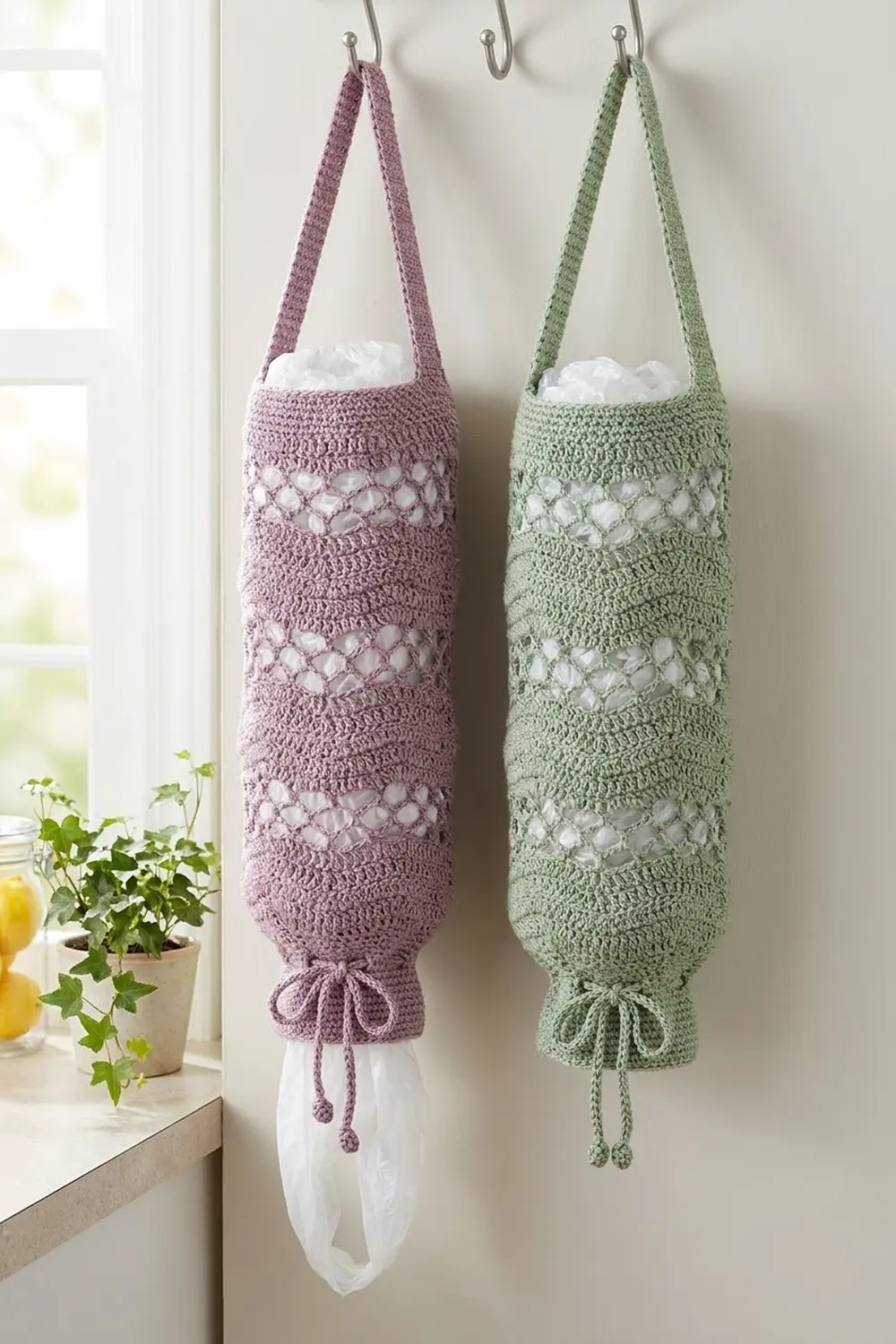
The Soft Ripple Plastic Bag Holder is a tall, slim tube that keeps loose grocery bags in one tidy place. You push bags in at the top and pull them out one at a time through the cinched bottom. A solid top rim keeps its shape, and the body alternates wavy solid bands with airy open rounds, so the holder looks light and pretty on the wall.
The sample is shown in two colorways: dusty mauve and soft sage green. Each holder is made in one color only. Make one, or make a pair and hang them side by side the way they’re shown here.
This pattern uses US crochet terms. The finished holder measures 6 in (15.2 cm) wide laid flat and 17 in (43.2 cm) long, not counting the hanging strap.
You work the whole holder in joined rounds from the top down. First comes a solid single crochet band, then 9 repeats of a two-round wave pattern, then a narrower bottom band with eyelets. A chain drawstring goes through the eyelets, and a two-row strap attached across the rim makes the hanging loop.
Finished Size and Construction
- Finished size: 6 in (15.2 cm) wide flat x 17 in (43.2 cm) long
- Circumference: 12 in (30.5 cm)
- Skill level: Easy-intermediate
- Terminology: US
- Yarn weight: Worsted (category 4) cotton or cotton blend
- Hook: 5.0 mm (H-8)
- Number of pieces: 1 tubular body plus 1 drawstring cord
- Layout: Single seamless tube worked top-down in joined rounds
- Top band: 2 in (5.1 cm) deep
- Body: 13.5 in (34.3 cm) deep
- Size before bottom band: 15.5 in (39.4 cm) long
- Bottom band depth: 1.5 in (3.8 cm)
Materials
Choose a smooth worsted cotton or a cotton blend. Cotton holds its shape when the holder is stuffed and is easy to wash. Avoid fuzzy or very stretchy acrylics, because the tube can sag under the weight of the bags.
Yarn (per holder, one color):
– Dusty mauve version: 120 g (about 190 m)
– Sage green version: 120 g (about 190 m)
The amounts include a margin of about 15% for your gauge swatch and the drawstring. If you make both holders, buy 120 g of each color.
Tools:
– 5.0 mm (H-8) crochet hook
– 1 stitch marker
– Tapestry needle
– Scissors
– Measuring tape
– Rust-proof pins and a cardboard tube or rolled towel for blocking
Abbreviations (US Terms)
- ch – chain
- sl st – slip stitch
- sc – single crochet
- hdc – half double crochet
- dc – double crochet
- tr – treble crochet
- sk – skip
- sc2tog – single crochet 2 together
- st(s) – stitch(es)
- rnd(s) – round(s)
Special stitch: Bobble knot. Work 4 dc into the same chain, leaving the last loop of each dc on the hook (5 loops on hook). Yarn over and pull through all 5 loops, then ch 1 to close.
Chains count as stitches. In the openwork rounds, every chain counts as 1 stitch. On the next round you work into each chain itself, not into the space around it.
Gauge and Checkpoints
Gauge: 16 sc and 16 rnds = 4 in (10.2 cm) in sc worked in the round.
Pattern gauge: 1 wave repeat (2 rnds) = 1.5 in (3.8 cm) tall, and 12 sts = 3 in (7.6 cm) wide.
Check your gauge on the holder itself. Work the foundation and the first 4 rounds of the top band, then lay the ring flat and measure.
Checkpoint 1 (after Rnd 4): The flat width should be 6 in (15.2 cm), and the band should be 1 in (2.5 cm) tall.
Checkpoint 2 (after the top band): 2 in (5.1 cm) tall.
Checkpoint 3 (after 4 wave repeats): 8 in (20.3 cm) from the top edge.
Checkpoint 4 (after 9 wave repeats): 15.5 in (39.4 cm) from the top edge.
If the ring is wider than 6 in (15.2 cm), your stitches are too loose. Change to a 4.5 mm hook and start again. If it’s narrower than 6 in (15.2 cm), change to a 5.5 mm hook. If the width is right but the wave repeats come out taller than 1.5 in (3.8 cm), pull the tr stitches a little tighter, or work fewer repeats until you reach the 15.5 in (39.4 cm) checkpoint.
Top Band
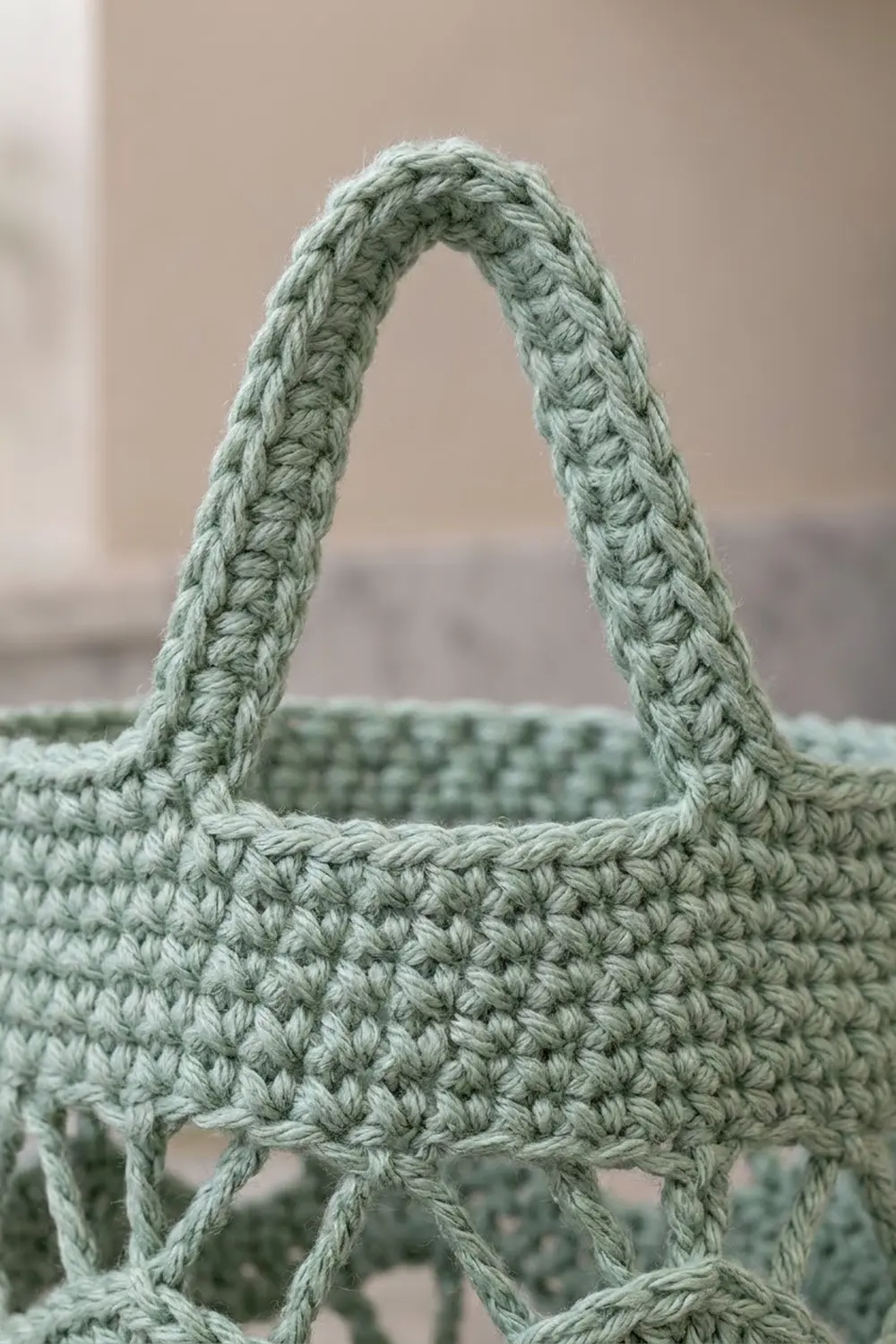
Foundation: Ch 48 and join with a sl st to the first ch to form a ring. Don’t twist the chain.
Rnd 1: Ch 1, sc in each ch around. Join with a sl st to the first sc. (48 sts)
Rnds 2–8: Ch 1, sc in each st around, join. (48 sts)
Place a marker in the first stitch of Rnd 8. Keep the joins in a straight line, because that line becomes the back side fold of the holder.
The band now measures 2 in (5.1 cm). It’s a firm, solid ring that holds the top open.
Wave Body
The body is a 12-stitch repeat that runs 4 times around (4 x 12 = 48). Every round keeps exactly 48 stitches, so the tube stays straight from top to bottom.
Rnd 9 (Wave Round): Ch 1. Sc in the next 2 sts, hdc in the next st, dc in the next st, tr in the next 4 sts, dc in the next st, hdc in the next st, sc in the next 2 sts. Repeat from * to * 3 more times. Join to the first sc. (48 sts: 4 repeats of 12)
Each repeat uses 2 + 1 + 1 + 4 + 1 + 1 + 2 = 12 stitches. The short stitches at both ends and the tall stitches in the middle make one wave crest per repeat, so there are 2 crests on each flat side.
Rnd 10 (Openwork Round): Ch 4 (counts as tr in the first st). Ch 1, sk 1 st, dc in the next st, ch 1, sk 1 st, sc in the next st, ch 2, sk 2 sts, sc in the next st, ch 1, sk 1 st, dc in the next st, ch 1, sk 1 st, tr in the next st. Then tr in the next st and repeat from * to . Do this until you have 4 repeats, ending the last repeat at . Join to the top of the beginning ch-4. (48 sts: 24 worked sts + 24 chains)**
Per repeat, you place tr, dc, sc, sc, dc, tr (6 stitches) plus 1 + 1 + 2 + 1 + 1 chains (6 chains), for 12 in total.
The tall tr stitches sit over the low ends of the wave, and the short sc stitches sit over the tall crest. That evens out the top edge again, and the skipped stitches leave the open holes between the bands.
Rnd 11: Repeat Rnd 9. Work 1 stitch in each stitch and in each chain. (48 sts)
Rnd 12: Repeat Rnd 10. (48 sts)
Rnds 13–26: Repeat Rnds 11–12 seven more times. (48 sts each round)
You now have 9 complete wave repeats (Rnds 9–26), ending with an openwork round. The body measures 13.5 in (34.3 cm), and the holder measures 15.5 in (39.4 cm) from the top edge. The crests stack straight up and down, which gives the parallel ripple lines.
Border: Bottom Band and Eyelets
The bottom band is the holder’s border. It narrows the tube and creates the eyelets for the drawstring.
Border gauge: 4 sc per 1 in (2.5 cm) and 4 sc rnds per 1 in (2.5 cm), the same as the top band.
For the per-side counts, lay the tube flat with the join line on one fold. Each flat side carries half of the stitches.
Rnd 27 (Conversion Round): Ch 1. Work 1 sc in each st and in each ch around, then join. (48 sts = 48 worked 1-per-existing-stitch + 0 added; 24 per side)
Rnd 28 (Decrease Round): Ch 1. Sc in the next 2 sts, sc2tog. Repeat around, then join. (36 sts: 12 repeats of 3; 18 per side)
Rnd 29 (Eyelet Round): Ch 3 (counts as dc), ch 1, sk 1 st. Dc in the next st, ch 1, sk 1 st. Repeat around and join to the top of the beginning ch-3. (36 sts: 18 dc + 18 chains; 9 eyelets per side)
Rnd 30: Ch 1. Work 1 sc in each dc and in each ch around, then join. (36 sts; 18 per side)
Rnd 31: Ch 1, sc in each st around, join. (36 sts; 18 per side)
Fasten off and weave in the end.
Why the math works: 48 divides evenly into twelve 4-stitch groups. Each group of 4 becomes 3 stitches, so 12 x 3 = 36. Because 36 is even, the eyelet round gives exactly 18 eyelets, 9 on each flat side. That lets the drawstring go in and come out at the same point on the front. The band adds 1.5 in (3.8 cm): 4 sc rounds at 0.25 in (0.6 cm) each plus 1 dc round at 0.5 in (1.3 cm). That brings the total length to 17 in (43.2 cm).
Hanging Strap
Hold the holder with the join line at the back. Find the two side folds of the top edge: stitch 13 and stitch 37 of the foundation ring. These are 24 stitches apart, so they sit directly opposite each other.
Row 1: With the right side facing, join yarn with a sl st in stitch 13 of the foundation edge. Ch 40, then sl st in stitch 37. Sl st in the next foundation stitch and turn. Sc in each ch across. (40 sc) Sl st in stitch 13, then sl st in the next foundation stitch and turn.
Row 2: Sc in each sc across. (40 sc) Sl st into the rim next to the end of Row 1. Fasten off.
The strap is 10 in (25.4 cm) long. When it hangs from a hook, it forms a triangle that rises about 3.5 in (8.9 cm) above the rim.
Drawstring
Cord: Leave a 4 in (10.2 cm) tail. Ch 88, which is about 22 in (55.9 cm) long. Work a bobble knot into the 4th ch from the hook, then fasten off. Leave the other end free for now.
Start at the center front. Weave the free end in and out through all 18 eyelets so it comes back out next to where it went in. Join yarn at the free end and work a matching bobble knot. Fasten off and weave the ends back into the bobbles.
Pull the cord until the bottom opening is about 1.5 in (3.8 cm) across, then tie a bow. The opening is small enough to hold the bags in and large enough to pull one out.
Final Blocking
- Turn the holder right side out and remove the drawstring.
- Soak the holder in cool water for 10 minutes, then gently press the water out with a towel. Don’t wring it.
- Slide the holder over a cardboard tube or a tightly rolled towel that’s 12 in (30.5 cm) around.
- Smooth each wave band so the crests line up vertically and the open rounds look even.
- Pin or gently pull the length to 17 in (43.2 cm), and check that the flat width is 6 in (15.2 cm).
- Shape the hanging strap flat and straight.
- Let it dry completely, then thread the drawstring back through.
Final Quality-Control Checklist
- Every round of the top band and body has 48 stitches.
- The bottom band has 36 stitches after Rnd 28.
- There are 9 wave repeats with 2 crests on each flat side.
- The crests stack straight above one another.
- The joins form a neat line at the back fold.
- The holder is 6 in (15.2 cm) wide and 17 in (43.2 cm) long.
- The strap is attached at opposite sides, 24 stitches apart.
- There are 18 eyelets, and the drawstring enters and exits at the center front.
- All ends are woven in securely.
Troubleshooting
The waves lean or spiral. You probably lost or added a stitch. Count 12 stitches per repeat at the end of each wave round.
The top edge is uneven after an openwork round. Check that the tr stitches sit over the low sc ends of the wave and the sc stitches sit over the tr crest.
The holder is getting shorter or wider toward the bottom. Your tension has drifted. Measure against the checkpoints and adjust your hook size for the remaining rounds.
The tube twisted at the start. Cut it and restart. You can’t fix a twisted foundation ring later.
The holder sags when full. Your yarn is too stretchy, or your gauge is loose. Use cotton and go down one hook size.
Bags fall out of the bottom. Pull the drawstring tighter, or go back and work Rnd 28 as sc 1, sc2tog for a smaller bottom opening.
Care
Machine wash on a gentle cool cycle in a laundry bag, or hand wash. Reshape the holder over a tube and let it air dry.
Final Notes
The measurement chain is simple to track:
– 48 stitches give a 6 in (15.2 cm) flat width.
– The top band adds 2 in (5.1 cm).
– 9 wave repeats add 13.5 in (34.3 cm), for 15.5 in (39.4 cm) so far.
– The 36-stitch bottom band adds 1.5 in (3.8 cm), for a finished length of 17 in (43.2 cm).
– The 40-stitch strap and 88-chain drawstring complete the holder.
If you check each of these numbers as you go, your holder will hang straight and hold its shape. Make one in mauve, one in sage, or one in any color that suits your kitchen.
Happy crocheting!