

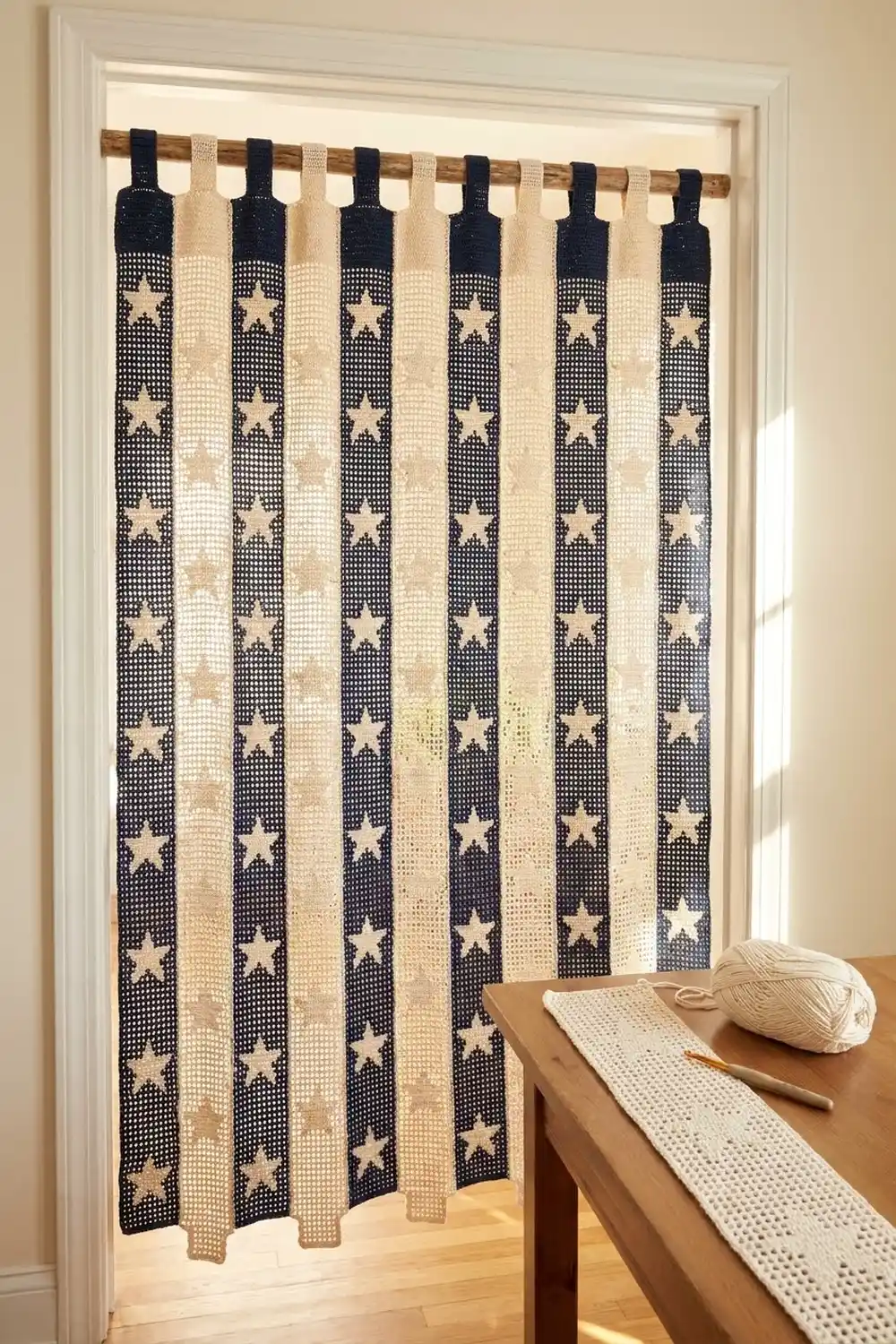
This curtain is made from 10 narrow filet crochet strips that hang side by side from a rod. Navy and cream strips alternate across the doorway. Each strip has a column of solid five-pointed stars in its own color, so the stars show up as light and shadow instead of contrast.
The look is airy and a little nautical. Light comes through the open mesh, and the stars read clearly from across a room. Each strip has a solid top band, a slim single crochet edge, a folded tab for the rod, and a shallow stepped notch at the hem. The style suits a summer porch door, a pantry opening, or a sunny window that needs soft shade.
This pattern uses US crochet terms. One finished strip measures 4.6 in (11.7 cm) wide by 71.4 in (181.4 cm) long at the hem points, plus the tab loop. Hung with 0.5 in (1.3 cm) gaps, the 10 strips cover 50.5 in (128.3 cm) of rod.
Each strip is worked top-down in rows of filet mesh, starting at the top band, and finishes with two short legs that form the notch. A single crochet border goes around each strip, and then a tab is worked up from the top edge and folded to the back. The strips are never joined to each other.
Finished Size and Construction
- Finished strip size: 4.6 in × 71.4 in (11.7 cm × 181.4 cm), measured at the hem points
- Skill level: Intermediate (filet charting, long repetitive rows)
- Terminology: US crochet terms
- Yarn weight: Sport-weight (#2) mercerized cotton
- Hook: 3.25 mm (US D/3)
- Number of pieces: 10 strips (5 navy, 5 cream)
- Layout: 10 strips in one row on a rod, not joined
- Piece size before border: 4.4 in × 71.2 in (11.2 cm × 180.8 cm)
- Border depth: 1 round of single crochet, about 0.1 in (0.3 cm) on each edge
- Total rod coverage: 50.5 in (128.3 cm) with 0.5 in (1.3 cm) gaps
Materials
Use a smooth mercerized cotton or cotton blend. It gives crisp mesh squares and sharp star edges, and it hangs straight without stretching. Fuzzy or very soft yarn blurs the filet pattern and can stretch when it hangs. Buy each color from a single dye lot, because small shade differences are easy to see when the strips hang side by side.
- Navy: 300 g, about 930 m (6 balls of 50 g / 155 m)
- Cream: 300 g, about 930 m (6 balls of 50 g / 155 m)
These amounts include about a 6% margin. One strip uses about 56 g (175 m), including the border and tab.
Tools:
– 3.25 mm (US D/3) crochet hook
– Tapestry needle
– Stitch markers
– Rust-proof pins and a blocking surface at least 24 in (61.0 cm) long
– Measuring tape
– Curtain rod up to 1.25 in (3.2 cm) in diameter, at least 54 in (137.2 cm) long
Abbreviations (US Terms)
- ch – chain
- sl st – slip stitch
- sc – single crochet
- dc – double crochet
- sp – space
- st(s) – stitch(es)
- RS / WS – right side / wrong side
Special stitches (filet mesh):
– Open mesh (O): ch 2, skip 2 sts (or the ch-2 sp), dc in the next dc. At the start of a row: ch 5 (counts as dc + ch 2), skip 2, dc in the next dc.
– Block (B): dc in each of the next 3 sts. Over an open mesh, work 2 dc in the ch-2 sp, then dc in the next dc. At the start of a row: ch 3 (counts as dc), then 2 dc into the first mesh and dc in the next dc.
Each mesh is 3 sts wide, and the meshes share their edge dc. A row of 11 meshes always has 34 sts (11 × 3 + 1).
Gauge and Checkpoints
Gauge: 10 meshes and 10 rows = 4 in (10.2 cm) in filet mesh, so one mesh is 0.4 in (1.0 cm) square.
Make one complete strip before you start the others. A small error repeats 178 times, so it’s worth testing the whole length once. Check your measurements at each of these points:
- After Row 2 (top band): 4.4 in (11.2 cm) wide, 0.8 in (2.0 cm) tall
- After Row 21 (first star repeat): 8.4 in (21.3 cm) long
- After Row 175 (before the legs): 70 in (177.8 cm) long
- After Row 178 (at the points): 71.2 in (180.8 cm) long
- After the border: 4.6 in × 71.4 in (11.7 cm × 181.4 cm)
If your strip is too wide or too tall, go down a hook size. If it’s too small, go up a hook size. If only the height is off, change how high you pull up your dc loops instead of changing hooks. Square meshes are what keep the stars from looking squashed or stretched.
Measure flat on a table, never while the strip is hanging. Long cotton strips stretch under their own weight, and a hanging measurement can read 1–2 in (2.5–5.1 cm) too long.
Strip Pattern
Make 5 strips in navy and 5 in cream. Every strip is worked from the top down.
Top Band
Foundation: Ch 37.
Row 1 (RS): Dc in the 4th ch from the hook (the skipped ch count as the first dc), then dc in each of the remaining 33 ch. Turn. (34 sts = 11 blocks)
Row 2: Ch 3 (counts as dc), dc in each st across. Turn. (34 sts)
Open Mesh Lead-In
Row 3: Ch 5 (counts as dc + ch 2), skip 2 sts, dc in the next st. Ch 2, skip 2, dc in the next st. Repeat from * 9 more times. Turn. (11 open meshes = 12 dc + 11 ch-2 sps = 34 sts)*
Rows 4–7: Work 11 open meshes. Turn at the end of each row. (34 sts each row)
Checkpoint: 7 rows = 2.8 in (7.1 cm).
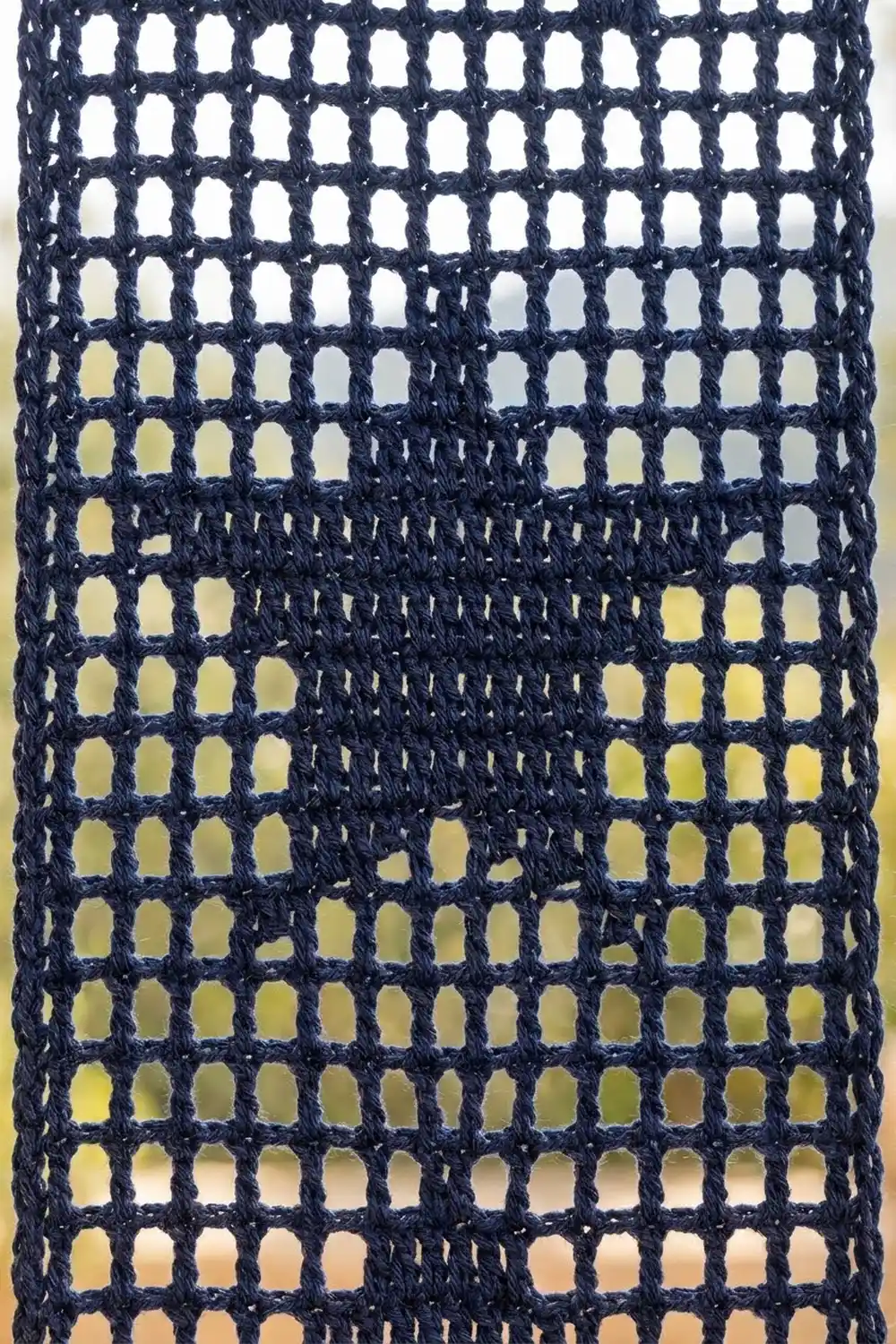
Star Repeat (14 rows)
Each row below lists its meshes from edge to edge. The star is symmetrical, so you read every row the same way in either direction. Every row has 34 sts.
Star Row 1: 5 O, 1 B, 5 O
Star Row 2: 5 O, 1 B, 5 O
Star Row 3: 4 O, 3 B, 4 O
Star Row 4: 1 O, 9 B, 1 O
Star Row 5: 2 O, 7 B, 2 O
Star Row 6: 3 O, 5 B, 3 O
Star Row 7: 3 O, 5 B, 3 O
Star Row 8: 2 O, 3 B, 1 O, 3 B, 2 O
Star Row 9: 2 O, 2 B, 3 O, 2 B, 2 O
Open Rows 10–14: 11 O
Because the strip is worked from the top down, the single center block in Star Row 1 becomes the star’s top point. Star Row 4 is the wide row of arms, and Star Row 9 forms the two feet. Each star is 9 meshes wide by 9 rows tall, which is 3.6 in (9.1 cm) square, with one open mesh on each side. One full repeat is 14 rows, or 5.6 in (14.2 cm).
Rows 8–175: Work the 14-row Star Repeat 12 times in total. Star rows fall on Rows 8–16, 22–30, and so on. Repeat 12 ends on Row 175 with an open row.
Place a stitch marker at the end of each finished star so you can count repeats at a glance.
Checkpoint: 175 rows = 70 in (177.8 cm). You should have 12 stars.
Stepped Notch Legs
The notch is made from two legs of 5 meshes each. The center mesh (mesh 6) of Row 175 is left unworked.
First leg, Row 176: Ch 5 (counts as dc + ch 2), skip the ch-2 sp, dc in the next dc. Work 4 more open meshes and turn, leaving the remaining 6 meshes unworked. (5 meshes, 16 sts)
First leg, Row 177: Sl st in each of the first 3 sts to move over the inner mesh. Ch 5, skip the ch-2 sp, dc in the next dc, then work 3 more open meshes. Turn. (4 meshes, 13 sts)
First leg, Row 178: Ch 5, skip the ch-2 sp, dc in the next dc, then work 2 more open meshes. Leave the last inner mesh unworked. (3 meshes, 10 sts) Fasten off.
Second leg: Join yarn with a sl st in the last dc at the opposite outer edge of Row 175. Work Rows 176–178 the same way as the first leg, moving toward the center, so the second leg mirrors the first. (16, 13, then 10 sts) Fasten off.
The inner edge of each leg steps back one mesh per row. That makes a notch 3 rows deep, 1.2 in (3.0 cm), and leaves a point 3 meshes wide at each lower corner.
Make All Strips
- Navy: 5 strips
- Cream: 5 strips
Layout from left to right as you face the curtain:
| N | C | N | C | N | C | N | C | N | C |
N = navy, C = cream. Make a navy strip and a cream strip one after the other so your tension stays the same between colors. Label each finished strip with its measured length on a scrap of yarn so you can pair strips of the same length.
Hanging Instead of Joining
The strips are not joined. Each one hangs from its own tab, so the curtain parts easily when you walk through it, and you can wash one strip at a time.
Slide the strips onto the rod in the order shown in the layout grid. Leave a 0.5 in (1.3 cm) gap between neighboring strips: 10 strips × 4.6 in (11.7 cm) = 46 in (116.8 cm), plus 9 gaps × 0.5 in (1.3 cm) = 4.5 in (11.4 cm), for a total of 50.5 in (128.3 cm). Line up the top bands so the stars sit at the same height across the curtain. If your doorway is wider, widen the gaps evenly instead of stretching the strips.
Border
Work the border before the tab. Each strip gets its own border.
Border gauge: 2 sc per row end (each dc row is 0.4 in / 1.0 cm tall, or 5 sc per inch), and 1 sc per st across the top and in the hem.
Round 1 (RS): Join yarn at the top right corner.
- Top edge: 1 sc in each foundation ch. (34 sc) Ch 1 for the corner.
- Long side: 2 sc in each of the 178 row ends. (356 sc) Ch 1 at the point.
- Hem: Work 1 sc in each of the 10 sts across Row 178, 2 sc in the Row 178 inner row end, 3 sc across the exposed sts of Row 177, 2 sc in the Row 177 row end, 3 sc across the exposed sts of Row 176, 2 sc in the Row 176 row end, and 2 sc in the center ch-2 sp of Row 175. Mirror this for the second leg: 2 + 3 + 2 + 3 + 2 + 10. (22 + 2 + 22 = 46 sc) Ch 1 at the point.
- Long side: 2 sc in each of the 178 row ends. (356 sc) Ch 1 for the corner, then sl st to the first sc.
Total: 34 + 356 + 46 + 356 = 792 sc, plus 4 ch-1 corners. The counts for each side do not include the corner chains. Fasten off and weave in the ends.
Why the math works: The top already has 34 sts, which set its width, so 1 sc per st keeps it at 4.4 in (11.2 cm) without flaring. A dc row is about as tall as 2 sc are wide, so 2 sc per row end lies flat: 356 sc ÷ 5 = 71.2 in (180.8 cm), which matches the strip length. The hem uses the same two rules, so the steps stay sharp.
Hanging Tab
Row 1: With RS facing, skip the first 12 sc of the top edge and sc in each of the next 10 sc. Turn, leaving 12 sc on the other side. (10 sc)
Row 2 onward: Ch 1, sc in each st across. Turn. (10 sc) Repeat until the tab measures 5 in (12.7 cm), which is about 30 rows.
The tab is 1.3 in (3.3 cm) wide. Fold it to the WS and whipstitch its last row across the back of Row 2. That leaves a loop about 4.2 in (10.7 cm) around, which fits a rod up to 1.25 in (3.2 cm) thick.
Final Blocking
- Soak one strip in cool water with a little wool wash for 15 minutes.
- Press the water out gently. Don’t wring the strip. Roll it in a towel.
- Pin it out in sections, 24 in (61.0 cm) at a time, to 4.6 in (11.7 cm) wide.
- Pin each star corner and the hem points so the meshes are square.
- Let each section dry before you move on to the next, and check the running length against 71.4 in (181.4 cm).
- Steam the tab lightly so it folds flat.
Final Quality-Control Checklist
- Every row has 34 sts and 11 meshes.
- Each strip has 12 stars, and every star is centered with 1 open mesh on each side.
- The legs measure 16, 13, and 10 sts, and the center mesh is left open.
- The border has 34 / 356 / 46 / 356 sc, plus 4 ch-1 corners.
- Each tab is centered, with 12 sc on each side.
- All 10 strips match to within 0.4 in (1.0 cm) in length.
Troubleshooting
- Meshes look like tall rectangles: Pull up shorter loops on your dc, or use a smaller hook.
- Stars lean or lose their points: Check the block placement against the row list, counting the edge meshes first.
- Edges wave after the border: Use fewer sc per row end, or use a smaller hook for the border only.
- Strip lengths don’t match: Block the strips together and measure them flat, not hanging.
- Tab twists on the rod: Make sure you started it at sc 13.
- Hem points curl: Re-pin the points while damp and let them dry fully.
Care
Hand wash cool and dry flat. If the strips stretch a little after hanging, re-block them to 4.6 in × 71.4 in (11.7 cm × 181.4 cm).
Final Notes
Each measurement builds on the last one. One mesh is 0.4 in (1.0 cm). Eleven meshes make a 4.4 in (11.2 cm) strip, and 178 rows make it 71.2 in (180.8 cm) long. The border brings each strip to 4.6 in × 71.4 in (11.7 cm × 181.4 cm), and 10 strips with small gaps cover 50.5 in (128.3 cm) of rod. If your gauge is right, everything else lines up.
Happy crocheting!