

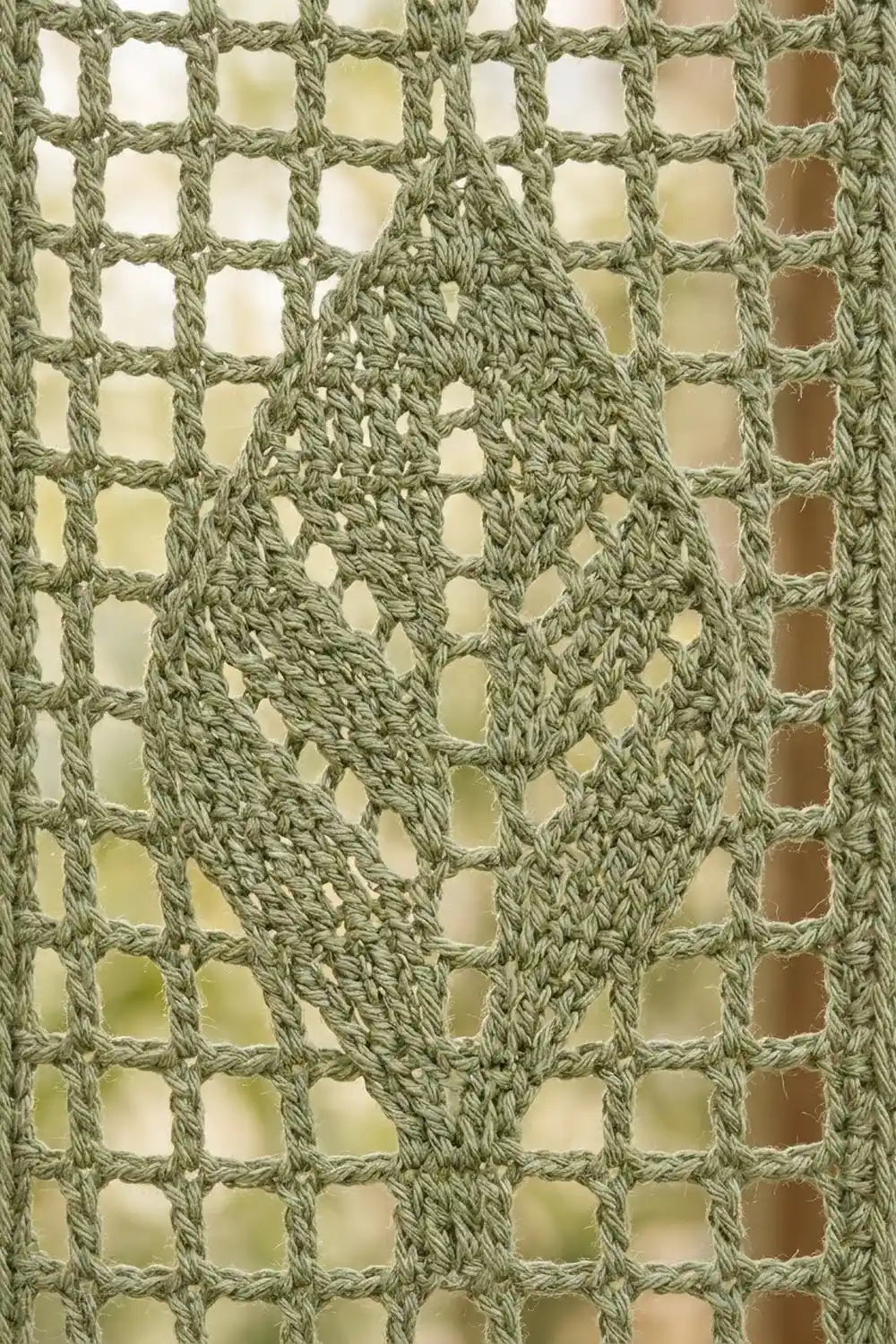
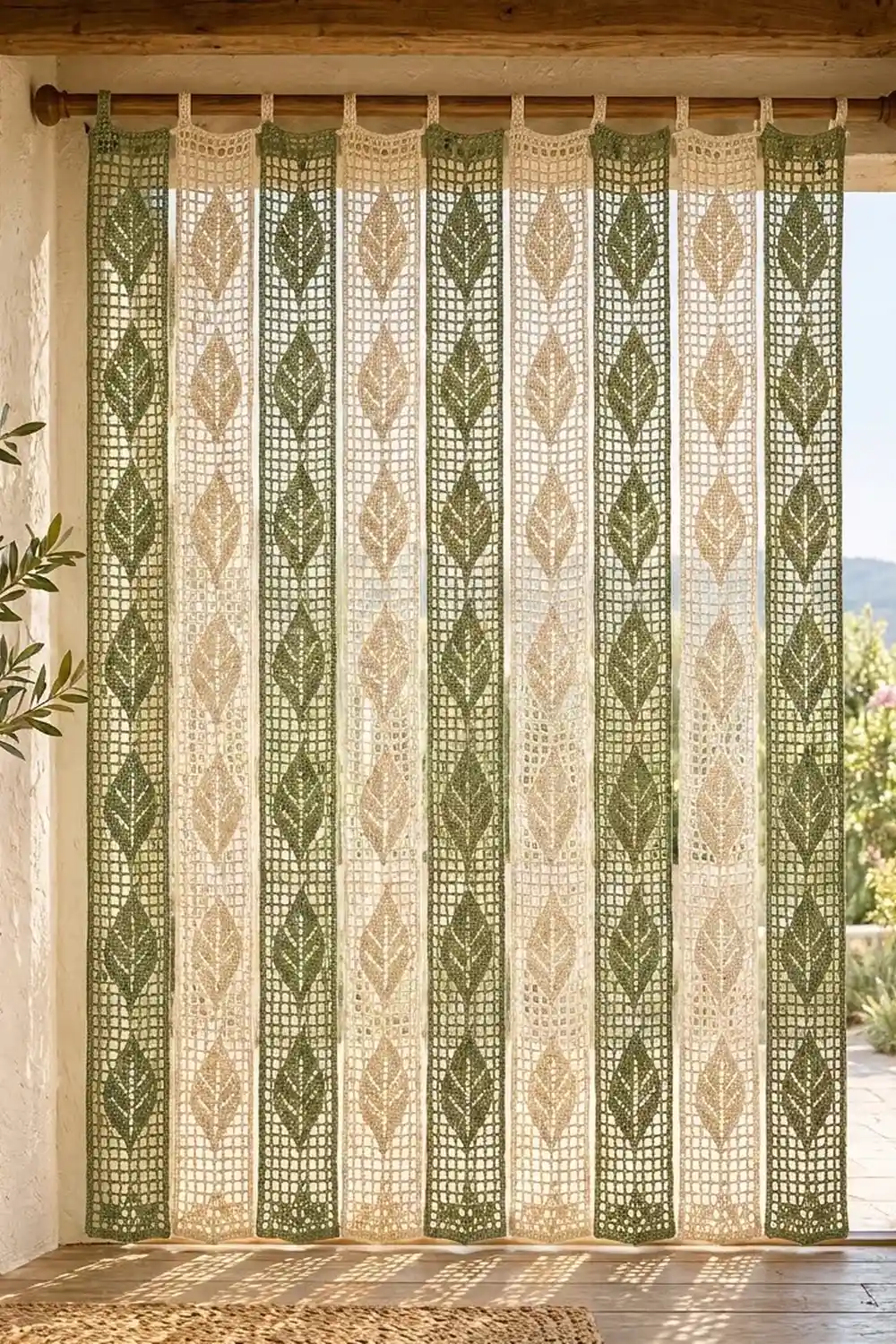
This curtain is made of nine long, narrow filet crochet strips that hang side by side from a wooden rod. Each strip has a column of solid leaves running down its center. Every leaf is a pointed diamond with an open center vein, two pairs of slanted side veins, and a short stem, set against an even open mesh.
The colors alternate between soft sage green and warm natural cream: five green strips and four cream strips, with green at both outer edges. In a sunny doorway the mesh lets in light and the solid leaves show up as soft silhouettes. The look is calm, botanical, and a little bohemian.
This pattern uses US crochet terms. Each finished strip measures 4.1 in (10.4 cm) wide by 72.2 in (183.4 cm) long, plus a 3 in (7.6 cm) hanging loop. Hung with 0.5 in (1.3 cm) gaps between strips, the full curtain is about 40.9 in (103.9 cm) wide.
Each strip is worked flat in filet rows from the bottom up, 13 blocks wide, with a solid block at each edge. Next comes one round of single crochet border, and last, a single crochet tab is worked from the top edge, folded to the back, and sewn down. The strips are never joined to each other. Each one hangs from the rod on its own.
Finished Size and Construction
- Strip size: 4.1 in (10.4 cm) wide x 72.2 in (183.4 cm) long, plus a 3 in (7.6 cm) loop
- Strip size before border: 3.9 in (9.9 cm) x 72 in (182.9 cm)
- Border depth: 0.1 in (0.3 cm), one round of sc
- Skill level: Intermediate
- Terminology: US
- Yarn weight: Size 3 mercerized cotton crochet thread (about fingering weight)
- Hook: 2.25 mm (US B-1)
- Number of pieces: 9 separate strips (5 green, 4 cream)
- Layout: 9 strips in a single row, alternating green and cream, not joined
- Full curtain: about 40.9 in (103.9 cm) wide with 0.5 in (1.3 cm) gaps
Materials
Choose a firm, mercerized cotton thread. Mercerized cotton keeps the mesh crisp, holds the leaf shapes clearly, and resists sagging over a long drop. Do not use acrylic or soft cotton blends, which stretch lengthwise once they hang.
- Sage green: 500 g, about 1,370 m (10 balls of 50 g / 137 m each)
- Natural cream: 400 g, about 1,096 m (8 balls of 50 g / 137 m each)
Each strip uses about 85 g, which covers the filet body, the border, and the tab. The quantities above include a margin for gauge swatches and weaving in ends.
Tools:
– 2.25 mm (US B-1) crochet hook
– Tapestry needle
– Stitch markers
– Rust-proof pins and a long blocking surface
– Tape measure
– Spray bottle or steamer
– Wooden curtain rod, up to 1.5 in (3.8 cm) in diameter
Abbreviations (US Terms)
- ch – chain
- dc – double crochet
- sc – single crochet
- sl st – slip stitch
- sk – skip
- st(s) – stitch(es)
- sp – space
- RS / WS – right side / wrong side
- O – open block
- S – solid block
Special stitches (filet blocks):
– Open block (O): ch 2, sk 2 sts (or the ch-2 sp), dc in next dc.
– Solid block (S): dc in next 3 sts. If the block below is open, work 2 dc in the ch-2 sp and 1 dc in the next dc.
Every block shares its first dc with the block before it. So a row of 13 blocks has 13 x 3 + 1 = 40 sts, counting a ch-2 as 2 sts.
Gauge and Checkpoints
Filet gauge: 10 blocks and 10 rows = 3 in (7.6 cm), so one block is 0.3 in (0.8 cm) square.
Single crochet gauge: 10 sc and 10 rows = 1 in (2.5 cm).
Before you commit to a full strip, make a swatch of the first 20 rows (one leaf repeat) and steam it lightly. Check it:
- Width after any row: 3.9 in (9.9 cm)
- Height after Row 10: 3 in (7.6 cm)
- Height after Row 20: 6 in (15.2 cm)
If your swatch is too big, go down to a 2 mm hook. If it is too small, go up to a 2.5 mm hook. Height matters more than usual here. Being 0.1 in (0.3 cm) off per leaf adds up to 1.2 in (3.0 cm) over the full strip. If only your rows are too tall, try shortening your dc by pulling the first loop up a little less.
You can unravel the swatch and keep going, or simply keep it as Rows 1–20 of your first strip.
Strip (Make 9)
Each row has 13 blocks. Block 1 and block 13 are always solid; they make the firm edge columns. The leaf chart is symmetrical, so every row reads the same from either end, and you can follow the rows without tracking RS and WS.
Foundation: Ch 42.
Row 1: Dc in 4th ch from hook and in next 2 ch (skipped ch count as dc; first S made). Ch 2, sk 2 ch, dc in next ch 11 times. Dc in last 3 ch. (40 sts: S, 11 O, S)
Row 2 and all following rows: Ch 3 (counts as dc), turn. Work the blocks as shown in the chart, and put the last dc in the top of the turning ch. (40 sts every row)
Leaf Repeat (20 rows)
Each line lists all 13 blocks from edge to edge. The edge S blocks are included.
- Row 1: S, 11 O, S
- Row 2: S, 11 O, S
- Row 3 (stem): S, 5 O, 1 S, 5 O, S
- Row 4 (stem): S, 5 O, 1 S, 5 O, S
- Row 5: S, 4 O, 3 S, 4 O, S
- Row 6: S, 3 O, 5 S, 3 O, S
- Row 7: S, 2 O, 3 S, 1 O, 3 S, 2 O, S
- Row 8: S, 1 O, 4 S, 1 O, 4 S, 1 O, S
- Row 9: S, 1 O, 2 S, 1 O, 1 S, 1 O, 1 S, 1 O, 2 S, 1 O, S
- Row 10: S, 1 O, 1 S, 1 O, 2 S, 1 O, 2 S, 1 O, 1 S, 1 O, S
- Row 11: S, 1 O, 4 S, 1 O, 4 S, 1 O, S
- Row 12: repeat Row 9
- Row 13: repeat Row 10
- Row 14: S, 2 O, 3 S, 1 O, 3 S, 2 O, S
- Row 15: S, 3 O, 2 S, 1 O, 2 S, 3 O, S
- Row 16: S, 4 O, 1 S, 1 O, 1 S, 4 O, S
- Row 17 (tip): S, 5 O, 1 S, 5 O, S
- Rows 18–20: S, 11 O, S
Check: add up the blocks on any line and you get 13. The center vein is the open block 7, from Row 7 up to Row 16. The open blocks at positions 5 and 9 (Rows 9 and 12) and at 4 and 10 (Rows 10 and 13) form the two pairs of side veins, which slant up and outward.
Row 1 of the first repeat is the foundation row above. Work the 20-row repeat 12 times in total, for 240 rows. Do not fasten off.
Checkpoints:
– After 1 repeat (20 rows): 6 in (15.2 cm)
– After 6 repeats (120 rows): 36 in (91.4 cm)
– After 12 repeats (240 rows): 72 in (182.9 cm)
Lay the strip flat (do not let it hang) and measure. Row 240 is an all-open row, which mirrors Row 1, so both ends of the strip have a clean mesh band.
Make All Pieces
- Sage green: 5 strips
- Natural cream: 4 strips
Layout (left to right, as seen from the room):
| G | C | G | C | G | C | G | C | G |
G = sage green, C = natural cream. Green sits at both outer edges, which frames the curtain.
Hanging the Strips (No Joining)
The strips are not sewn or crocheted together. Each one gets its own border and its own tab and hangs freely. This lets the curtain move in a breeze and lets people walk through it. Because there is no seam, the border does not need any shared-edge math. Each strip’s border counts below are based only on that strip’s own 40 sts across and 240 rows down.
Slide the tabs onto the rod in the layout order. Leave about 0.5 in (1.3 cm) between strips, so 9 x 4.1 in + 8 x 0.5 in = 40.9 in (103.9 cm). If your doorway is wider, open the gaps evenly, or add strips in pairs (one green, one cream) to keep green on both ends.
Size checkpoint: before you buy or cut a rod, lay all nine blocked strips on the floor in order, with the gaps, and measure the full width.
Border
Border gauge: 3 sc per dc row-end. One dc row is 0.3 in (0.8 cm) tall, and 3 sc at 10 sc per inch also measure 0.3 in (0.8 cm). Along the top and bottom, 1 sc per st matches the 40 sts across 3.9 in (9.9 cm).
Round 1: Ch 1, turn, and work across the top of Row 240. The side facing you now is the RS. Work around the strip:
- Top edge: 3 sc in first st (corner), sc in each of next 38 sts, 3 sc in last st (corner). (44 sc: 40 + 4 extra)
- First long side: 3 sc around the post of each edge dc or turning ch, down all 240 rows. (720 sc)
- Bottom edge: working into the foundation ch, 3 sc in first st (corner), sc in each of next 38 sts, 3 sc in last st (corner). (44 sc: 40 + 4 extra)
- Second long side: 3 sc in each row-end, up all 240 rows. (720 sc)
Sl st to the first sc. (1,528 sc total: 44 + 720 + 44 + 720)
Why the math works: the corner groups belong to the top and bottom counts, not to the sides, so no corner is counted twice. The 720 side sc at 10 sc per inch measure 72 in (182.9 cm), the same as the body, so the long edges neither ruffle nor pull in. The border adds 0.1 in (0.3 cm) on every side: 3.9 + 0.2 = 4.1 in (10.4 cm) wide and 72 + 0.2 = 72.2 in (183.4 cm) long.
Hanging Tab
Row 1: With the RS facing, count along the 44 top-edge sc from the first sc of the right corner group. Place markers in sc 13 and sc 32. Join yarn in sc 13, ch 1, sc in same st and in each st across to the marker. (20 sc; 12 sc are left free on each side: 12 + 20 + 12 = 44)
Rows 2–60: Ch 1, turn, sc in each st across. (20 sc)
The tab measures 2 in (5.1 cm) wide x 6 in (15.2 cm) long. Fasten off and leave a 12 in (30.5 cm) tail. Fold the tab to the WS and whipstitch Row 60 to the back of Row 240 across the same 20 sts. You now have a 3 in (7.6 cm) loop. Keep your stitches out of sight on the RS.
Final Blocking
- Weave in all ends along the solid edge columns or inside solid leaf blocks, where they stay hidden.
- Soak each strip in cool water for 10 minutes. Press the water out gently in a towel; do not wring.
- Pin the strip flat to 4.1 in (10.4 cm) wide. Because it is long, block it in three sections of about 24 in (61.0 cm) each.
- Pin each leaf’s tip and stem in line with the center column, so the leaves stay straight.
- Ease the long sides straight, measuring to 72.2 in (183.4 cm) overall.
- Let each section dry completely before you move on to the next one.
- Block the tab flat, then steam the fold lightly so the loop holds its shape.
Final Quality-Control Checklist
- Every row has 40 sts and 13 blocks.
- All 12 leaves sit on center block 7, with their veins lined up.
- Each strip measures 4.1 in (10.4 cm) x 72.2 in (183.4 cm).
- Each border round has 1,528 sc and lies flat.
- Each tab is centered, with 12 free sc on each side.
- All nine strips match in length within 0.5 in (1.3 cm).
- Order is G-C-G-C-G-C-G-C-G.
Troubleshooting
- Strip is wider than 3.9 in (9.9 cm): your ch-2 spaces are loose. Pull the chains snug or go down a hook size.
- Leaves look lopsided: check that each solid block over an open block uses 2 dc in the space plus 1 dc, not 3 dc in the space.
- Strips are different lengths: count rows rather than relying on measurements, and then block all the strips to the same length.
- Long sides ruffle: you worked more than 3 sc per row-end. Rework them at exactly 3.
- Long sides pull in: you worked fewer than 3 sc in some row-ends, or your sc are tight. Use a 2.5 mm hook for the border only.
- Tab twists: whipstitch it straight, then steam it.
- Strips stretch while hanging: use mercerized cotton, and re-block if needed.
Care
Hand wash in cool water with mild soap, press out the water in a towel, and dry the strips flat, re-pinning them to size. Do not tumble dry, and do not hang the strips while they are wet.
Final Notes
The measurement chain is simple. One block is 0.3 in (0.8 cm). Thirteen blocks give 3.9 in (9.9 cm). Twenty rows make one 6 in (15.2 cm) leaf repeat, and 12 repeats make 72 in (182.9 cm). The sc border brings each strip to 4.1 in (10.4 cm) x 72.2 in (183.4 cm), and nine strips with gaps fill 40.9 in (103.9 cm). Check the swatch, count your rows, and the leaves will line up across the doorway.
Happy crocheting!