

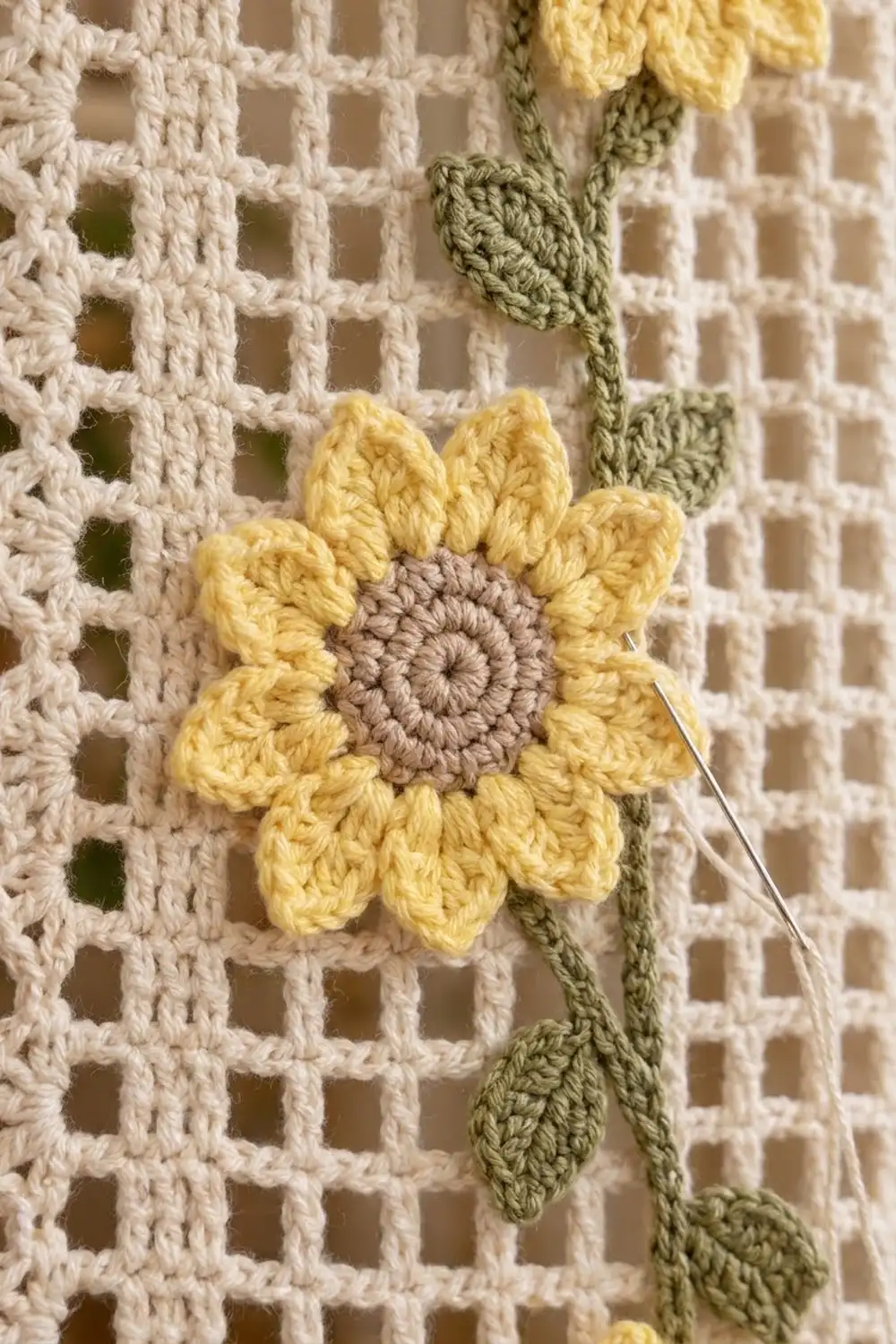
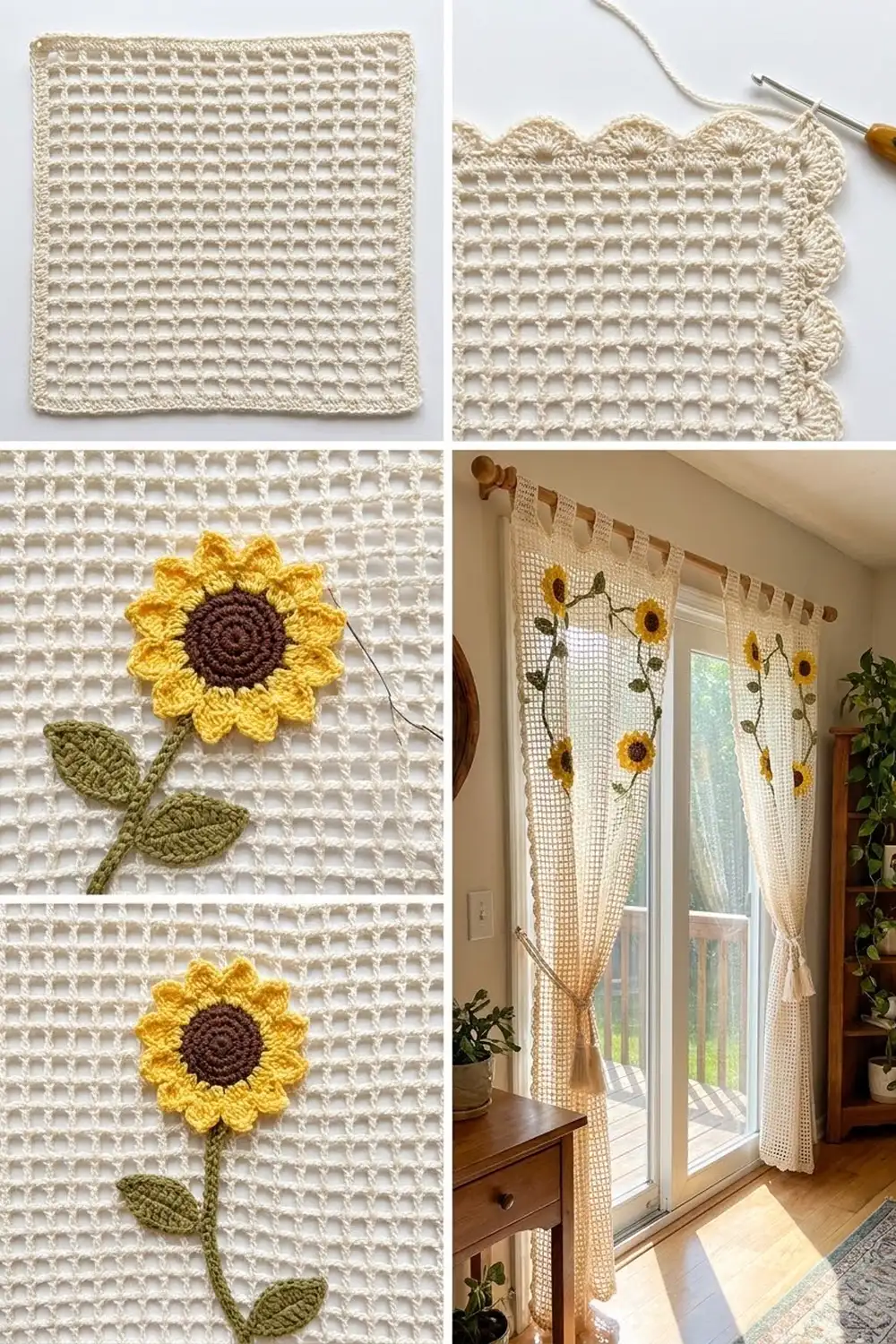
The Sunflower Trellis Curtain Panel is a tall, airy filet mesh curtain in soft cream cotton. It has a scalloped shell edge and two climbing sunflower vines. The sunflowers are bright yellow with latte-brown centers, and the leaves and stems are olive green. Light filters through the open grid, so the panel suits a glass door or a sunny window.
The style is cottage-garden with a gentle vintage feel. The mesh is made of simple open squares, with one solid column near each side edge that gives the scallop border a crisp line to sit against.
This pattern uses US crochet terms. One finished panel measures 42.5 in (108.0 cm) wide and 84.45 in (214.5 cm) long, measured from the top of the tab loops to the bottom scallops. The photo shows a matching pair, so the materials list covers two identical panels.
You work the mesh body flat in rows. Then you add a three-row shell border down both sides and across the bottom, and work nine tabs from the top edge. The sunflowers, leaves, and stems are made separately and sewn on last.
Finished Size and Construction
- Finished panel size: 42.5 in x 84.45 in (108.0 cm x 214.5 cm)
- Skill level: Intermediate
- Terminology: US crochet terms
- Yarn weight: DK cotton (weight 3)
- Hook: 4.0 mm (G-6)
- Number of pieces: 2 identical panels, each worked as one piece. The appliqués are small separate pieces sewn on.
- Layout: 50 mesh wide x 100 rows tall, with 2 vines of 10 sunflowers each
- Mesh size: 0.8 in (2.0 cm) square
- Size before border: 40 in x 80 in (101.6 cm x 203.2 cm)
- Border depth: 1.25 in (3.2 cm), on the sides and bottom
- Tab loops: 3.2 in (8.1 cm) tall
Materials
Choose a smooth combed or mercerized DK cotton. Cotton holds the square mesh shape and blocks crisply. It also sags less than acrylic on a long hanging piece. The amounts below are for two panels and assume about 2.2 m per gram.
- Cream (main color): 750 g / 1,650 m
- Sunflower yellow: 180 g / 400 m
- Latte brown: 100 g / 220 m
- Olive green: 150 g / 330 m
All quantities include a margin of about 10%. Buy all of the cream from one dye lot.
Tools: 4.0 mm (G-6) hook, tapestry needle, 20 locking stitch markers, measuring tape, rust-proof pins, blocking mats or a clean sheet, spray bottle, and a 5 in (12.7 cm) piece of cardboard for the tassels.
Abbreviations (US Terms)
- ch – chain
- sl st – slip stitch
- sc – single crochet
- hdc – half double crochet
- dc – double crochet
- tr – treble crochet
- sk – skip
- sp – space
- st(s) – stitch(es)
- RS / WS – right side / wrong side
- BLO – back loop only
Special stitches:
- Open mesh: ch 2, sk 2 sts (or the ch-2 sp), dc in the next st.
- Block: dc in each of the next 3 sts. This replaces one open mesh with solid fabric.
- Shell: 7 dc in the same st.
- Petal: (hdc, dc, tr, ch 2, sl st in top of the tr just made, dc, hdc) all in the same st.
Gauge and Checkpoints
Gauge: 5 mesh and 5 rows = 4 in (10.2 cm) in open mesh, after light blocking.
Make a test swatch first. Ch 35, dc in the 8th ch from hook, *ch 2, sk 2, dc in next ch; repeat from * across. That gives 10 mesh. Work 9 more rows. After blocking, the swatch should measure 8 in x 8 in (20.3 cm x 20.3 cm).
Also make one test sunflower. Its center should measure 1.75 in (4.4 cm) after Round 4, and the finished flower should be 3.5 in (8.9 cm) across.
Panel checkpoints:
- Row 1 width: 40 in (101.6 cm)
- After Row 25: 20 in (50.8 cm)
- After Row 50: 40 in (101.6 cm)
- After Row 75: 60 in (152.4 cm)
- After Row 100: 80 in (203.2 cm)
- After the border: 42.5 in x 81.25 in (108.0 cm x 206.4 cm)
If the swatch is too big, go down to a 3.75 mm hook. If it is too small, go up to 4.5 mm. Check the row height as well as the width, because the border math depends on 3 sc fitting along each row end.
Panel Body
Make two panels. Each row is 50 mesh wide, with a block at mesh 2 and mesh 49.
Row 1 (RS): With cream, ch 155. Dc in the 8th ch from hook (mesh 1), dc in the next 3 ch (block, mesh 2), *ch 2, sk 2 ch, dc in next ch; repeat from * 45 more times (mesh 3–48), dc in the next 3 ch (block, mesh 49), ch 2, sk 2 ch, dc in the last ch (mesh 50). Turn.
Count: 151 sts (55 dc + 48 ch-2 sps). Check: 50 mesh x 3 + 1 = 151.
Row 2: Ch 5 (counts as dc + ch 2), sk the first ch-2 sp, dc in next dc, dc in next 3 dc (block), *ch 2, sk ch-2 sp, dc in next dc; repeat from * 45 more times, dc in next 3 dc (block), ch 2, sk 2 ch, dc in the next ch of the foundation chain. Turn.
Count: 151 sts.
Rows 3–100: Repeat Row 2. Work the last dc of each row into the 3rd ch of the previous row’s ch-5. Fasten off after Row 100.
Count: 151 sts on every row.
Place a marker every 25 rows and check the height checkpoints as you go. The blocks should stack into two straight vertical bars, each sitting one mesh in from the side edge.
Tabs
With RS facing, work 9 tabs across Row 100. Each tab is 2 mesh (7 sts) wide, with 4 open mesh (3.2 in / 8.1 cm) between tabs. Tabs begin at sts 1, 19, 37, 55, 73, 91, 109, 127, and 145, so they sit over mesh 1–2, 7–8, 13–14, and so on, ending at mesh 49–50.
Row 1: Join cream in the tab’s first st. Ch 3 (counts as dc), then dc in each of the next 6 sts, working into the chains of any ch-2 sps. Turn. (7 dc)
Rows 2–8: Ch 3 (counts as dc), dc in each of the next 6 sts. Turn. (7 dc)
Fasten off, leaving a 12 in (30.5 cm) tail. Each flat tab measures 1.6 in x 6.4 in (4.1 cm x 16.3 cm). Fold the tab to the WS and whipstitch Row 8 to the back of Row 100, making a 3.2 in (8.1 cm) loop.
Sunflowers
Make 20 per panel (40 total).
Round 1: With latte brown, make a magic ring, work 6 sc in the ring, and sl st to the first sc. (6 sc)
Round 2: Ch 1, 2 sc in each st around, sl st to the first sc. (12 sc)
Round 3: Ch 1, sc in next st, 2 sc in next st; repeat from * around, sl st to the first sc. (18 sc)*
Round 4: Ch 1, sc in next 2 sts, 2 sc in next st; repeat from * around, sl st to the first sc. Fasten off. (24 sc)* The center should measure 1.75 in (4.4 cm).
Round 5: Join yellow in the BLO of any st. *Sl st in the BLO of this st, then work a petal in the BLO of the next st; repeat from * 11 more times, sl st to the first sl st. Fasten off, leaving a 16 in (40.6 cm) tail.
Count: 12 petals, each worked over 2 sts (12 x 2 = 24). The picot gives each petal a soft point. The unused front loops leave a ridge around the center that you will sew through later.
Leaves
Make 36 per panel (72 total).
With olive green, ch 9. Sc in the 2nd ch from hook, hdc in the next ch, dc in the next 3 ch, hdc in the next ch, sc in the next ch, and 3 sc in the last ch. Then, working along the other side of the chain: sc, hdc, dc in the next 3 ch, hdc, and sc in the last ch. Sl st to the first sc and fasten off.
Count: 17 sts (7 + 3 + 7). Each leaf is 2.25 in (5.7 cm) long.
Stem Segments
For each stem segment, ch the given number, then sl st in the back bump of the 2nd ch from hook and in each ch across.
- Long segment (18 per panel): Ch 37, for 36 sl st, about 9 in (22.9 cm) long.
- Vine A base (1 per panel): Ch 27, for 26 sl st, about 6.5 in (16.5 cm) long.
- Vine B base (1 per panel): Ch 11, for 10 sl st, about 2.5 in (6.4 cm) long.
Tiebacks
Make 2. With cream, ch 91. Sc in the 2nd ch from hook and in each ch across (90 sc). Ch 1, turn, and sl st in each st across. Ch 12 and sl st into the end of the cord to make a hook loop. The cord is 22.5 in (57.2 cm) long.
For each tassel, wrap cream 40 times around the 5 in (12.7 cm) card. Tie the wraps at the top, wrap the neck, and cut the bottom loops. Sew the tassel to the middle of the cord.
Make All Pieces
Per panel: 1 cream body with border and 9 tabs, 20 sunflowers, 36 leaves, 18 long stem segments, and 2 base segments.
For the pair: 2 bodies, 40 sunflowers, 72 leaves, 36 long segments, 4 base segments, and 2 tiebacks.
Flower layout (one panel, rows counted from the bottom):
Mesh column:   13 (Vine A)    38 (Vine B)
Row 98:        A10            .
Row 93:        .              B10
Row 88:        A9             .
 ... same 10-row spacing ...
Row 8:         A1             .
Row 3:         .              B1
Row 1:         base A         base B
On each vine, the flowers are 10 rows (8 in / 20.3 cm) apart. The two vines are staggered by 5 rows. Each vine runs about 10 in (25.4 cm) in from the side edge of the mesh body.
Joining
The two panels are never joined to each other. This section covers sewing the appliqués onto each blocked panel.
- Mark each flower center with a locking marker, following the layout.
- Sew each base segment from Row 1 up to its first marker in a gentle curve.
- Sew one long segment between each pair of markers on the same vine. Each 9 in (22.9 cm) segment covers an 8 in (20.3 cm) gap, which leaves room for a soft wave.
- Whipstitch each sunflower through the front loops of Round 4 so it covers the stem ends, then tack down each petal tip.
- Sew 2 leaves to each long segment, one on each side.
Sew only through dc posts and the solid chains, never through a single loose strand of a ch-2 space. Keep your stitches snug but relaxed. If the mesh puckers, loosen them. When you finish, the panel should still measure 42.5 in (108.0 cm) wide.
Border
Work the border before blocking and before sewing on the appliqués.
Border gauge: 3 sc per row end. With 0.8 in (2.0 cm) rows, that is 3.75 sc per inch. This nearly matches the bottom edge, which has 151 sts over 40 in (3.78 per inch), so all edges stay flat.
Row 1 (RS): Join cream at the top-left corner. Ch 1 and work 3 sc in each row end down the left side (300 sc). In the bottom-left corner st, work (sc, ch 2, sc). Sc in each of the next 149 foundation sts. In the bottom-right corner st, work (sc, ch 2, sc). Work 3 sc in each row end up the right side (300 sc). Fasten off.
Count: 753 sc + 2 corner ch-2 sps. That is (300 + 300 row-end sc) + 151 worked 1 per foundation st + 2 extra sc at the corners. Per edge: left 301, bottom 151, right 301.
Row 2: With RS facing, rejoin at the top-left. Ch 1, sc in the first sc, *sk 2, shell in next sc, sk 2, sc in next sc; repeat from * 49 more times (50 shells). Work 9 dc in the corner ch-2 sp. Sc in the first bottom sc, then repeat the shell sequence 25 times. Work 9 dc in the next corner sp. Sc in the first right-side sc, then repeat the shell sequence 50 times. Fasten off.
Count: each side has 51 sc + 350 dc (401 sts). The bottom has 26 sc + 175 dc (201 sts). Each corner has 9 dc. Total: 1,021 sts.
Row 3: With RS facing, rejoin at the top-left. Sl st in each sc and sc in each dc, including all 9 corner dc. Fasten off.
Count: each side has 51 sl st + 350 sc (401). The bottom has 26 sl st + 175 sc (201). Each corner has 9 sc. Total: 1,021 sts.
Why the math works: one shell repeat uses 6 sts (sk 2, shell, sk 2, sc). Each side has 301 sts, or 6 x 50 + 1. The bottom has 151 sts, or 6 x 25 + 1. The extra 1 is the starting sc, so every edge begins and ends on an sc. The corner shells sit in the ch-2 spaces, which are outside the edge counts, so no corner stitch is counted twice.
Final Blocking
- Weave in all ends along dc posts.
- Soak the panel in cool water, then roll it in towels to press out the water.
- Lay it flat, RS up.
- Pin the body to 40 in x 80 in (101.6 cm x 203.2 cm), pinning along both block columns.
- Open each shell into a round scallop and pin it. The full size should be 42.5 in x 81.25 in (108.0 cm x 206.4 cm).
- Spot-check that the meshes are 0.8 in (2.0 cm) square.
- Let the panel dry completely, then sew on the appliqués.
Final Quality-Control Checklist
- Every row has 151 sts.
- The block columns are straight.
- The body measures 40 in x 80 in (101.6 cm x 203.2 cm).
- There are 50 shells on each side, 25 across the bottom, and 2 corner shells.
- The border lies flat.
- All 9 tabs are evenly spaced, with equal 3.2 in (8.1 cm) loops.
- Each panel has 20 sunflowers and 36 leaves, all securely tacked.
- The two panels match in length within 0.5 in (1.3 cm).
Troubleshooting
- Meshes are rectangular: adjust your hook size, or loosen the ch-2.
- The panel slants: you may be missing the last dc. Recount to 151 sts.
- The border ruffles: use a 3.75 mm hook for border Row 1.
- The border pulls in: your rows are taller than 0.8 in (2.0 cm). Recheck your gauge.
- Petals curl: pin them flat and mist before sewing.
- The panel sags after hanging: re-block it, and never machine-dry it.
Care
Hand wash in cool water with mild soap and lay flat to dry. Don’t hang the panel while it is wet, because the weight of the water stretches the mesh.
Final Notes
The measurement chain is simple. A 0.8 in (2.0 cm) mesh gives a 40 in x 80 in (101.6 cm x 203.2 cm) body. The 1.25 in (3.2 cm) border brings the panel to 42.5 in x 81.25 in (108.0 cm x 206.4 cm). The 3.2 in (8.1 cm) tab loops finish it at 84.45 in (214.5 cm). Check your gauge early and count your 151 stitches often.
Happy crocheting!