

This curtain is made of soft, rounded eight-petal flowers that hang in long strands from a rod. When light comes through a door or window, it shines through the small openings in each flower. The tan and cream flowers alternate down each strand, and neighboring strands are offset, so the colors form a gentle checkerboard.
The style is relaxed boho. The flowers are worked in cotton, so the petals keep their rounded shape. Each one has an open center ring, small gaps between the petals, and a single-crochet outline that keeps the edges crisp. The pattern uses US crochet terms throughout.
The finished curtain is about 42 in (106.7 cm) wide and 75 in (190.5 cm) long, measured from the top of the first flower to the bottom of the last. The hanging loops add about 3 in (7.6 cm), for a total hanging length of about 78 in (198.1 cm).
Construction is simple and repetitive. You work each flower in four rounds. In the last round, you link each flower to the one above it, so every strand is assembled as you go. There’s no sewing and no frame border. The rod and the strand spacing set the width.
Finished Size and Construction
- Finished size: about 42 in (106.7 cm) wide × 75 in (190.5 cm) long, plus 3 in (7.6 cm) hanging loops
- Skill level: Easy to Intermediate
- Terminology: US crochet terms
- Yarn weight: Worsted (#4) cotton
- Hook: 4.0 mm (G-6)
- Number of pieces: 160 flowers (80 tan, 80 cream)
- Layout: 10 strands × 16 flowers per strand
- Piece size: 3.75 in (9.5 cm) tip to tip
- Link length: 1 in (2.5 cm) between flowers
- Strand spacing on the rod: 4.25 in (10.8 cm) center to center
- Size before border: same as finished size, because this design has no stitched border
- Border depth: none. Only the top hanging loops, 3 in (7.6 cm), are added.
Materials
Use a smooth, mercerized or combed cotton in worsted weight. Cotton holds the petal shape, doesn’t stretch much as it hangs, and blocks crisply. Avoid acrylic for this project: a long hanging strand of acrylic flowers can slowly stretch.
Yarn:
– Color A, Tan/Camel: 400 g, about 720 m (about 90 m per 50 g)
– Color B, Natural Cream: 400 g, about 720 m (about 90 m per 50 g)
Each flower uses about 4 g (about 7.2 m). Eighty flowers per color use about 320 g. The quantities above include a margin of about 25% for gauge differences, swatching, and weaving in ends.
Tools:
– 4.0 mm (G-6) crochet hook
– Tapestry needle
– Scissors
– Stitch marker
– Rust-proof pins and a blocking mat
– Spray bottle
– Measuring tape
– Curtain rod or tension rod, at least 44 in (111.8 cm) long
Abbreviations (US Terms)
- ch – chain
- sl st – slip stitch
- sc – single crochet
- hdc – half double crochet
- dc – double crochet
- tr – treble crochet (yarn over twice, insert hook, pull up a loop, then [yarn over, pull through 2 loops] 3 times)
- sp – space
- st(s) – stitch(es)
- rep – repeat
Special technique – Link Join: At a petal tip, ch 3, sl st into the ch-6 loop of the flower above, then ch 3. This connects the two flowers with a short chain bridge.
Gauge and Checkpoints
Crochet one complete flower before you start the full set. Every measurement for the curtain depends on this one piece.
Gauge: Rounds 1–4 = 3.75 in (9.5 cm) from petal tip to opposite petal tip, without stretching.
Checkpoints for a single flower:
– After Round 1: 1.25 in (3.2 cm) across, with a center hole about 0.5 in (1.3 cm) wide
– After Round 2: 2 in (5.1 cm) across
– After Round 3: 3.5 in (8.9 cm) from petal tip to petal tip
– After Round 4: 3.75 in (9.5 cm) from petal tip to petal tip
If your flower is too big: go down to a 3.75 mm (F-5) hook, or tighten your loops. A flower that is 4 in (10.2 cm) adds about 4 in (10.2 cm) to every strand.
If your flower is too small: go up to a 4.5 mm (7) hook. Small flowers also leave wider gaps between strands.
If the petals cup or ruffle: this is usually a tension issue on the treble crochets in Round 3. Keep the tr loose and even, and let blocking settle the rest.
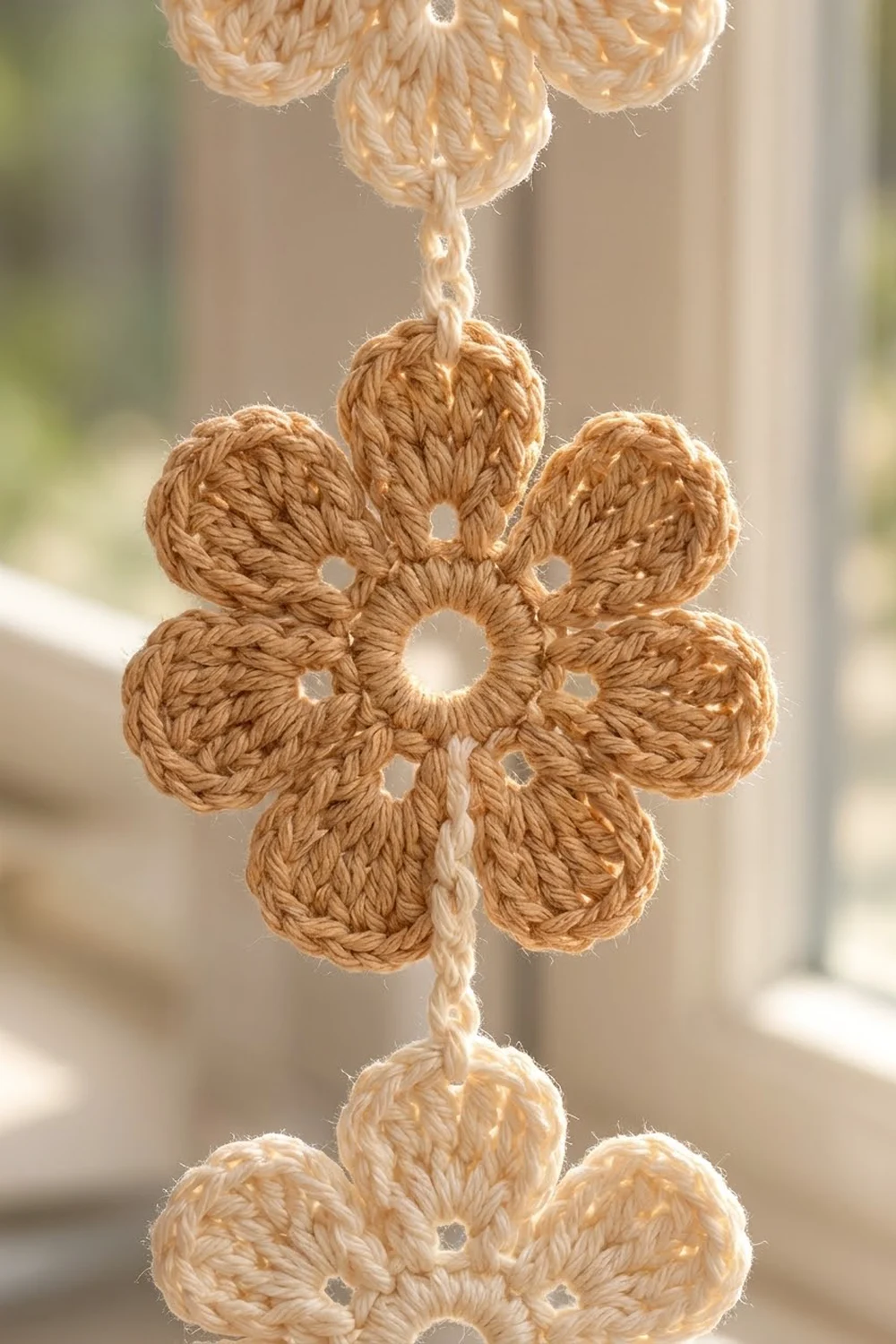
Flower Motif Pattern
Each flower is worked in the round with the right side facing you. Don’t turn between rounds.
Round 1 (center ring): Ch 6 and sl st to the first ch to form a ring. Ch 3 (counts as dc), then work 23 dc into the ring. Join with a sl st to the top of the ch-3.
Count: 24 dc.
The ch-6 ring leaves the open center hole. Don’t pull the ring closed.
Round 2 (petal bases with gaps): Ch 3 (counts as dc) and dc in the next st. Ch 1, then skip the next st. Dc in each of the next 2 sts, ch 1, skip the next st. Rep from * 6 more times. Join with a sl st to the top of the beginning ch-3.
Count: 16 dc and 8 ch-1 sps (8 pairs of dc).
Each ch-1 space is one of the small holes between petals. Each pair of dc becomes the base of one petal.
Round 3 (petals): Ch 2 (does not count as a stitch). Work (hdc, dc, 2 tr) in the same st as the join, then (2 tr, dc, hdc) in the next dc. Sl st in the next ch-1 sp. That’s your first petal.
Work (hdc, dc, 2 tr) in the next dc, (2 tr, dc, hdc) in the next dc, then sl st in the next ch-1 sp. Rep from * 6 more times. The final sl st goes into the 8th ch-1 sp.
Count: 8 petals of 8 sts each (1 hdc, 1 dc, 4 tr, 1 dc, 1 hdc), so 64 petal sts plus 8 sl sts.
The sl sts anchor in the ch-1 spaces. This keeps the small gap visible at the base of each petal.
Round 4 (outline edging): This round turns each 8-stitch petal into a 12-stitch outlined petal. In each petal you work 4 sts as 1 sc per existing st (hdc, dc, dc, hdc), plus 4 tr × 2 sc = 8 sc. That makes 4 + 8 = 12 sc per petal. The extra 4 sc go around the curve of the tip.
Ch 1. Sc in the hdc, sc in the dc, 2 sc in each of the next 4 tr, sc in the dc, sc in the hdc, then sl st in the sl st between petals. Rep from * around all 8 petals.
The tip of each petal falls between the 2 sc of the 2nd tr and the 2 sc of the 3rd tr. Petal 1 (the first petal of the round) is the top. Petal 5 is directly opposite and is the bottom.
Work the top and bottom tips as described under Strand Assembly. For a test flower, work all tips plain. Fasten off after the last sl st and weave in the ends.
Count: 96 sc (8 petals × 12 sc) plus 8 sl sts. Tip loops don’t change the sc count.
Make All Pieces
Make 160 flowers in total:
– 80 flowers in Color A (Tan)
– 80 flowers in Color B (Cream)
You won’t make the flowers separately and join them later. Rounds 1–3 are always worked the same way, and Round 4 is where the strand gets built. Work each strand from the top down, finishing every flower’s Round 4 before you start the next flower.
Layout grid (T = Tan, C = Cream; Row 1 is the top, Strand 1 is on the left):
        S1 S2 S3 S4 S5 S6 S7 S8 S9 S10
Row 1   T  C  T  C  T  C  T  C  T  C
Row 2   C  T  C  T  C  T  C  T  C  T
Row 3   T  C  T  C  T  C  T  C  T  C
Row 4   C  T  C  T  C  T  C  T  C  T
Row 5   T  C  T  C  T  C  T  C  T  C
Row 6   C  T  C  T  C  T  C  T  C  T
Row 7   T  C  T  C  T  C  T  C  T  C
Row 8   C  T  C  T  C  T  C  T  C  T
Row 9   T  C  T  C  T  C  T  C  T  C
Row 10  C  T  C  T  C  T  C  T  C  T
Row 11  T  C  T  C  T  C  T  C  T  C
Row 12  C  T  C  T  C  T  C  T  C  T
Row 13  T  C  T  C  T  C  T  C  T  C
Row 14  C  T  C  T  C  T  C  T  C  T
Row 15  T  C  T  C  T  C  T  C  T  C
Row 16  C  T  C  T  C  T  C  T  C  T
Odd-numbered strands start with Tan and even-numbered strands start with Cream. Each strand has 8 Tan and 8 Cream flowers, so the 10 strands use 80 of each color.
Joining (Strand Assembly)
Method: Join as you go in Round 4, using chain links from one petal tip to the next.
Top flower of each strand (Row 1):
– At the tip of Petal 1, work: 2 sc in tr #2, ch 20, then 2 sc in tr #3. This forms the hanging loop, about 3 in (7.6 cm) long.
– At the tip of Petal 5, work: 2 sc in tr #2, ch 6, then 2 sc in tr #3. This forms the ch-6 link loop.
Middle flowers (Rows 2–15):
– At the tip of Petal 1, work: 2 sc in tr #2, then a Link Join (ch 3, sl st into the ch-6 loop of the flower above, ch 3), then 2 sc in tr #3.
– At the tip of Petal 5, work: 2 sc in tr #2, ch 6, then 2 sc in tr #3.
Bottom flower (Row 16): Work the Petal 1 tip with a Link Join, and work the Petal 5 tip plain.
Stitch-to-stitch logic: Each link adds chains only at the tip, between the 2nd and 3rd treble pairs. Every petal still has exactly 12 sc, so every flower keeps its 96-sc outline, and the top and bottom tips sit directly opposite each other. That’s why the strands hang straight.
Tension advice: Keep link chains the same size as your edging stitches. Tight links pull the tips into points, and loose links make the strand longer. Before you sl st into the loop above, check that neither flower is twisted, and that the right sides of both flowers face the same way.
Size checkpoints:
– 2 flowers: 3.75 + 1 + 3.75 = 8.5 in (21.6 cm)
– 5 flowers: (5 × 3.75) + (4 × 1) = 22.75 in (57.8 cm)
– 16 flowers: (16 × 3.75) + (15 × 1) = 75 in (190.5 cm)
Border
This curtain has no stitched border. Each strand hangs freely, so there isn’t a frame for a border round to go around. The only finishing is at the top and bottom.
Border gauge (top hanging edge): ch 20 = about 3 in (7.6 cm) when it hangs, which is enough to fit over a rod up to 1 in (2.5 cm) thick.
Top edge: 10 hanging loops of 20 ch each, one per strand, so 200 ch across the top edge. On the rod, space the loops 4.25 in (10.8 cm) apart, measured center to center.
Bottom edge: 10 plain petal tips (Petal 5 of each Row 16 flower), with no loops or tails.
Side edges: the outer petals of Strands 1 and 10 stay unedged. Round 4 already gives them a finished outline.
Why the math works:
– Width: 9 spaces × 4.25 in = 38.25 in (97.2 cm). Add half a flower on each outer side (one full flower, 3.75 in / 9.5 cm) for a total of 42 in (106.7 cm).
– Length: 16 flowers plus 15 links = 75 in (190.5 cm), and the 3 in (7.6 cm) loops bring it to 78 in (198.1 cm).
– The 0.5 in (1.3 cm) difference between the 4.25 in spacing and the 3.75 in flower width leaves a small gap between strands. That lets light through and stops neighboring petals from catching on each other.
Final Blocking
- Before you assemble a strand, block its flowers in batches. Pin each flower to the mat, right side up.
- Pin each petal tip so the petal measures 3.75 in (9.5 cm) tip to tip, and set a pin in the center hole to keep it round.
- Mist the flowers evenly until they’re damp but not soaked.
- Shape each petal with your fingers into a rounded teardrop, and press the ch-1 gaps open.
- Let the flowers dry completely, usually 6–8 hours.
- After assembly, hang the finished curtain on the rod and mist it lightly. Gravity straightens the links as it dries.
- Measure every strand. Each one should be 75 in (190.5 cm), not counting the loops.
Final Quality-Control Checklist
- Every flower measures 3.75 in (9.5 cm) tip to tip.
- Every center hole is open and about 0.5 in (1.3 cm) wide.
- There are eight visible gaps between petals in each flower.
- Each petal has 12 sc in its outline.
- Petal 1 and Petal 5 sit directly opposite each other.
- All links are 1 in (2.5 cm) long, and none are twisted.
- Colors alternate down each strand and across each row, matching the grid.
- All 10 strands are 75 in (190.5 cm) long.
- All ends are woven in securely on the wrong side.
Troubleshooting
The center hole closed up: you pulled the ch-6 ring too tight. Keep the ring relaxed when you work Round 1.
Petals are pointed instead of rounded: you probably skipped the increases. Check for 2 sc in each of the 4 tr in Round 4.
Strand hangs crooked: the link is on the wrong petal. The links must sit at Petals 1 and 5, exactly opposite each other.
Strands are different lengths: link tension varies from strand to strand. Remake the links that are too long, or block the strands together so they even out.
The gaps between petals disappeared: the Round 3 sl st went into a dc instead of the ch-1 sp. Rework that round.
Flowers twist on the strand: make every Link Join with the right side facing you.
Care
Hand wash in cool water with a mild detergent. Roll the curtain in a towel to remove water, then rehang it to dry. Don’t tumble dry.
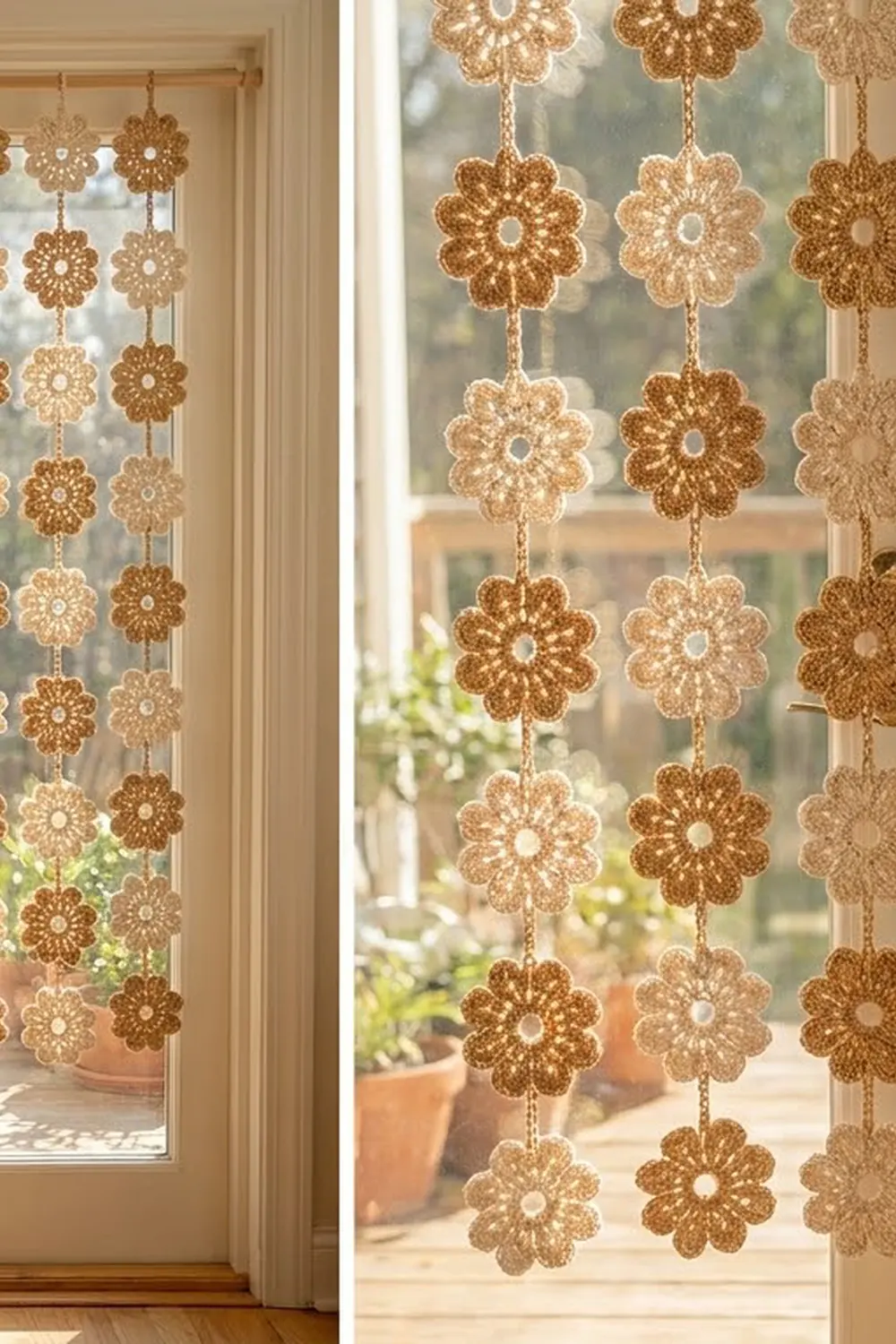
Final Notes
Each measurement depends on the one before it. The center ring is 1.25 in (3.2 cm), Round 2 is 2 in (5.1 cm), and the petals reach 3.5 in (8.9 cm). The edged flower is 3.75 in (9.5 cm). Sixteen flowers plus fifteen 1 in (2.5 cm) links make a 75 in (190.5 cm) strand. Ten strands spaced 4.25 in (10.8 cm) apart make the 42 in (106.7 cm) wide curtain. If your first flower is on gauge, the rest of the numbers will work out.
Happy crocheting!