

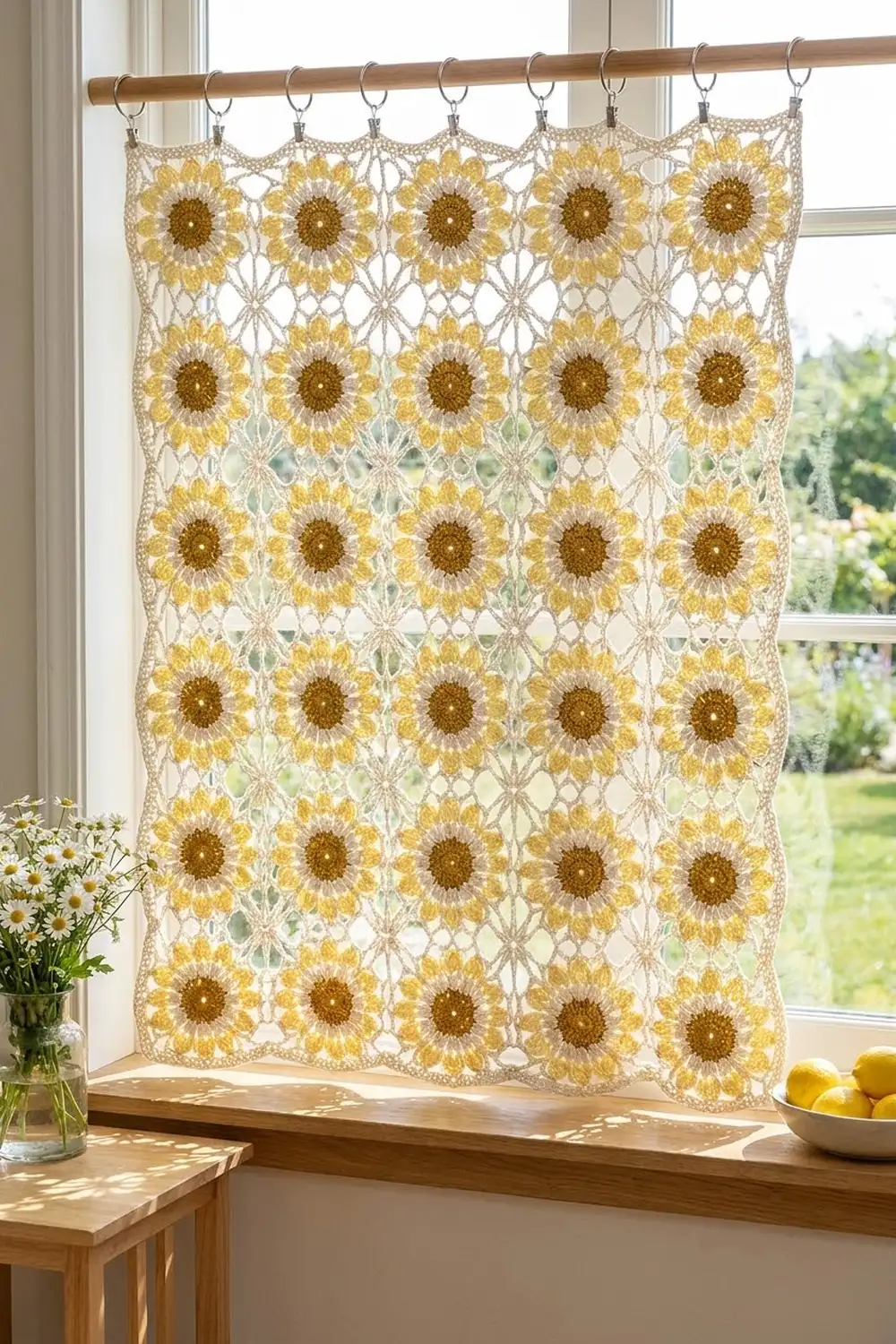
This curtain panel is made from thirty layered daisy motifs set in an airy cream mesh. In each flower, a mustard-gold center is ringed by eight cream inner petals. Behind those sit eight larger, pointed butter-yellow petals. A lattice of cream chain loops around every flower joins them all into one light, see-through panel.
The palette has three colors: mustard gold, cream, and pale butter yellow. With sunlight behind it the yellow petals glow and the cream mesh nearly disappears, which suits a kitchen or breakfast-nook window. The style is cottage-garden lace, cheerful and still simple.
The pattern uses US crochet terms. The finished panel is 36.5 x 43.5 in (92.7 x 110.5 cm) including the border, and it hangs from a standard curtain rod with clip rings.
Each motif is worked in the round. You make the center in two rounds, add the cream petals, then work two rounds of yellow petals behind them. Two cream mesh rounds finish it, and those rounds turn the round flower into a square 7 in (17.8 cm) frame. You join the motifs join-as-you-go on the last round, then add a three-round single crochet border.
Finished Size and Construction
- Finished size: 36.5 x 43.5 in (92.7 x 110.5 cm)
- Skill level: Intermediate
- Terminology: US crochet terms
- Yarn weight: DK / light worsted (#3) cotton
- Hook: 4.0 mm (US G-6)
- Number of pieces: 30 identical daisy motifs
- Layout: 5 motifs wide x 6 motifs tall
- Motif size: 7 x 7 in (17.8 x 17.8 cm) square mesh frame, blocked
- Size before border: 35 x 42 in (88.9 x 106.7 cm)
- Border depth: 0.75 in (1.9 cm) on each side
Materials
Use a smooth mercerized or combed cotton in DK weight, about 125 m per 50 g. Cotton gives the petals crisp points and keeps the mesh from stretching while it hangs. Avoid fuzzy yarns, because they blur the lace.
- Color A, mustard gold (centers): 70 g / 175 m
- Color B, cream (inner petals, mesh, border): 210 g / 525 m
- Color C, pale butter yellow (outer petals): 210 g / 525 m
These quantities include a margin of about 20 percent over the estimated use. That covers your gauge motif, yarn tails, and differences in tension.
Tools:
- 4.0 mm (US G-6) crochet hook
- Tapestry needle
- Scissors
- Stitch markers
- Rust-proof pins and blocking mats
- Spray bottle
- Measuring tape
- 6 curtain clip rings and a curtain rod
Abbreviations (US Terms)
- ch: chain
- sl st: slip stitch
- sc: single crochet
- hdc: half double crochet
- dc: double crochet
- tr: treble crochet
- sp: space
- st(s): stitch(es)
- JAYG: join-as-you-go
Special technique, JAYG loop join: When a ch-9 loop needs to join a neighbor, work ch 4, sl st into the matching ch-9 loop of the finished motif, then ch 4. That is still 9 chains (4 + 1 sl st + 4), so the loop length stays the same and joined motifs stay the same size as unjoined ones.
Gauge and Checkpoints
Make one complete motif and block it before you start the others. Check these measurements as you go:
- After Round 2: the center measures 1.75 in (4.4 cm) across.
- After Round 3: the cream petals measure 3.5 in (8.9 cm) tip to tip.
- After Round 6: the yellow petals measure 6 in (15.2 cm) tip to tip.
- After Round 8, blocked: the mesh square measures 7 x 7 in (17.8 x 17.8 cm), from corner loop to corner loop along one side.
If your motif is larger than 7 in (17.8 cm), go down to a 3.75 mm hook. If it is smaller, go up to a 4.5 mm hook. Being off by just 0.25 in (0.6 cm) per motif adds up to 1.25 in (3.2 cm) across the width and 1.5 in (3.8 cm) down the length.
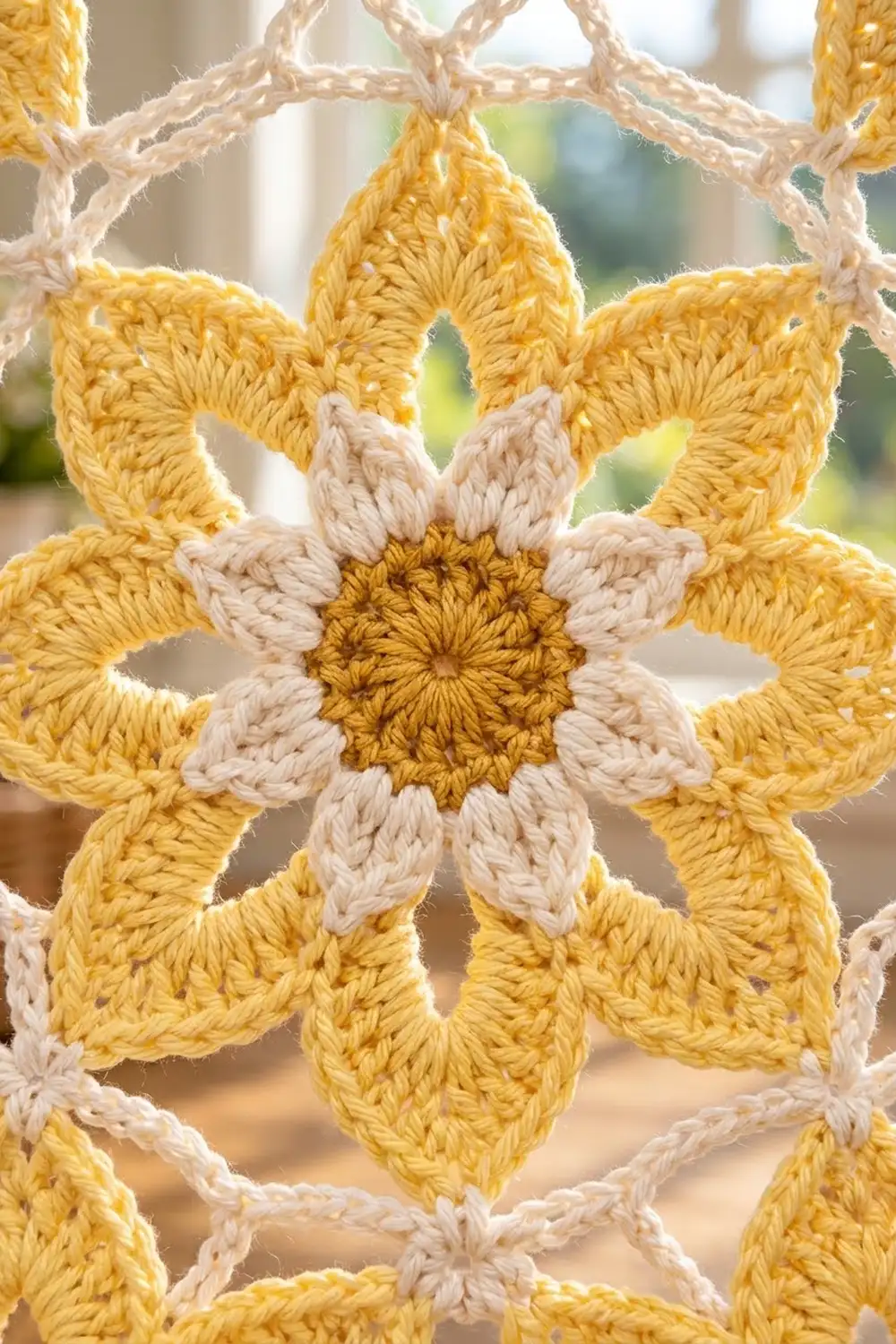
Daisy Motif (Make 30)
Center (Color A)
Round 1: Make a magic ring. Ch 3 (counts as dc), then work 15 dc into the ring. Pull the ring closed and sl st to the top of the ch-3. (16 dc)
Round 2: Ch 3 (counts as dc), dc in the same st, then work 2 dc in each st around. Sl st to the top of the ch-3. (32 dc)
Fasten off Color A.
Inner Petals (Color B)
Round 3: Join Color B with a sl st in any st. Sl st in this st, (hdc, dc, tr) in the next st, ch 2, (tr, dc, hdc) in the next st, sl st in the next st; repeat from * 7 more times. Sl st to the first sl st. (8 petals: 16 sl sts, 48 sts, 8 ch-2 tips)*
Each petal uses 4 sts of Round 2, so 8 petals x 4 sts = 32 sts and nothing is skipped. The ch-2 forms the pointed tip. Fasten off Color B.
Outer Petals (Color C)
Round 4: Join Color C with a sc in any ch-2 petal tip. Ch 6, sc in the next ch-2 tip; repeat from * 6 more times. Ch 6 and sl st to the first sc. (8 sc, 8 ch-6 loops)*
Push each ch-6 loop behind the dip between two cream petals. That way the yellow petals start behind the cream ones and sit in the gaps between them.
Round 5: Sl st into the first ch-6 loop. In this loop work (sc, hdc, 2 dc, tr, ch 3, tr, 2 dc, hdc, sc), then skip the next sc; repeat from * in each loop around. Sl st to the first sc. (8 petals: 80 sts, 8 ch-3 tips)*
Round 6: Ch 1. Sc in the sc, sc in the hdc, hdc in each of the next 2 dc, dc in the tr, (dc, ch 2, dc) in the ch-3 sp, dc in the tr, hdc in each of the next 2 dc, sc in the hdc, sc in the sc; repeat from * for each petal. Sl st to the first sc. (96 sts, 8 ch-2 tips)*
Each petal now has 12 sts: 5 up one side, 2 at the tip, and 5 down the other side. The stitches get taller toward the tip and shorter toward the base, which gives the petal its long pointed shape. Fasten off Color C.
Mesh Frame (Color B)
Pick four alternating petal tips to be corner tips. The other four are side tips.
Round 7: Join Color B in a corner-tip ch-2 sp. Ch 1, (sc, ch 9, sc) in the same sp, ch 11, sc in the next side-tip ch-2 sp, ch 11. (Sc, ch 9, sc) in the next corner tip, ch 11, sc in the next side tip, ch 11; repeat from * 2 more times. Sl st to the first sc. (12 sc, 4 ch-9 corner loops, 8 ch-11 side loops)*
The ch-9 corner loops push the corners outward, and the side tips stay near the edge. This is what turns the round flower into a square.
Round 8: Sl st into the first ch-9 corner loop. Ch 1, (sc, ch 9, sc) in the corner loop. Ch 9, sc in the next ch-11 loop, ch 9, sc in the next ch-11 loop, ch 9, then (sc, ch 9, sc) in the next corner loop; repeat from * around. After the last ch-11 loop, ch 9 and sl st to the first sc. (16 sc, 4 ch-9 corner loops, 12 ch-9 side loops)*
Each side has 3 side loops between its 2 corner loops. Fasten off on the first motif. On every other motif, Round 8 is worked with joins (see Joining).
Make All Pieces
Make 30 motifs, each using all three colors:
- Color A: 30 centers (Rounds 1–2)
- Color B: 30 inner-petal rounds (Round 3) and 30 mesh frames (Rounds 7–8)
- Color C: 30 outer-petal sets (Rounds 4–6)
Work Rounds 1–7 on all thirty motifs. Finish Round 8 on one motif, then join the other 29 to it and to each other while you work their own Round 8.
Layout grid (5 wide x 6 tall, right side facing):
Row 1:  [1]  [2]  [3]  [4]  [5]   <- top (hanging) edge
Row 2:  [6]  [7]  [8]  [9]  [10]
Row 3:  [11] [12] [13] [14] [15]
Row 4:  [16] [17] [18] [19] [20]
Row 5:  [21] [22] [23] [24] [25]
Row 6:  [26] [27] [28] [29] [30]  <- bottom edge
Joining
Join each motif as you work its Round 8, using the JAYG loop join. Work across the grid one row at a time, from left to right.
Loop-to-loop logic: Each side has a corner loop, 3 side loops, and another corner loop. Match them exactly: corner to corner, then each side loop to the side loop opposite it. Any loop that faces an open edge is worked as a plain ch 9.
- Motif 2 joins to Motif 1 along one side: 2 corner loops and 3 side loops, for 5 joins.
- Motif 6 joins to the bottom side of Motif 1 in the same way.
- Motif 7 joins to Motif 6 along its left side and to Motif 2 along its top. Its top-left corner is shared by four motifs: work ch 4, sl st into the existing join point, ch 4. All four corners meet at one sl st, and that is what makes the star-shaped junctions.
Tension: Keep the ch 4 on each side of a join at the same tension as your plain ch-9 loops. Tight joins make the mesh pucker. Loose joins make the panel sag while it hangs.
Size checkpoint: Pin Row 1 out flat. It should measure 35 in (88.9 cm) wide. With all 30 motifs joined, the panel measures 35 x 42 in (88.9 x 106.7 cm).
Border (Color B)
Border gauge: 29 sc per motif side = 7 in (17.8 cm), which is about 4.1 sc per inch (1.6 sc per cm).
Per-motif side count: 1 sc in the corner loop + 9 sc in each of the 3 side loops (27) + 1 sc in the next corner loop = 29 sc. This count includes both corner stitches for that side.
Where two motifs meet along the outer edge, work 1 sc into each motif’s corner loop, one on each side of the join. Each of those sc counts toward its own motif’s 29.
Round 1: Join Color B in the top-left corner loop. Ch 1, then (sc, ch 2, sc) in this loop. Work 29 sc along each motif side. At each of the other three panel corners, work (sc, ch 2, sc) in the corner loop. Sl st to the first sc.
- Top and bottom: 5 motifs x 29 = 145 sc each
- Left and right: 6 motifs x 29 = 174 sc each
- Total: 638 sc, plus 4 corner ch-2 sps
At each panel corner, the two sc are the corner stitches of the two sides that meet there. The ch-2 sp is not counted. No stitches are added at the seams, because the seam sc are already part of each motif’s 29.
Round 2: Sl st into the corner ch-2 sp. Ch 1, (sc, ch 2, sc) in the same sp. Sc in each sc to the next corner, and work (sc, ch 2, sc) in each corner sp. Sl st to the first sc.
- Top and bottom: 145 worked 1-per-stitch + 2 added = 147 sc each
- Left and right: 174 worked 1-per-stitch + 2 added = 176 sc each
- Total: 646 sc, plus 4 corner ch-2 sps
Round 3: Repeat Round 2.
- Top and bottom: 147 worked 1-per-stitch + 2 added = 149 sc each
- Left and right: 176 worked 1-per-stitch + 2 added = 178 sc each
- Total: 654 sc, plus 4 corner ch-2 sps
Fasten off.
Why the math works: Round 1 puts exactly 29 sc on every 7 in (17.8 cm) motif side. That is close to the natural sc gauge of DK cotton, so the edge stays flat without ruffling or pulling in. Rounds 2 and 3 add stitches only at the corners, 2 sc per side, which gives the corners the extra length they need to turn. The three rounds add 0.75 in (1.9 cm) to each side, taking the panel from 35 x 42 in (88.9 x 106.7 cm) to 36.5 x 43.5 in (92.7 x 110.5 cm).
Final Blocking
- Weave in all ends through the backs of petal stitches. Don’t weave them through the mesh chains, where they would show.
- Soak the panel in cool water for 15 minutes, then gently press the water out without wringing.
- Roll the panel in a large towel to remove more moisture.
- Lay it right side up on the mats and pin the four corners to 36.5 x 43.5 in (92.7 x 110.5 cm).
- Pin along the border every 3.5 in (8.9 cm) to keep the edges straight.
- Pin each yellow petal tip outward to a sharp point. Pin each star junction so every square measures 7 x 7 in (17.8 x 17.8 cm).
- Mist lightly and let it dry completely, about 24 hours.
Final Quality-Control Checklist
- Every motif has 8 cream petals and 8 yellow petals, and none are twisted.
- Round 8 has 12 side loops and 4 corner loops on every motif.
- Every shared side has 5 joins.
- Each four-motif junction meets at one shared sl st.
- Border Round 3 counts are 149 / 178 / 149 / 178.
- The blocked panel measures 36.5 x 43.5 in (92.7 x 110.5 cm).
- No ends show when you hold the panel up to the light.
Troubleshooting
Cream petals cup. Round 3 is too tight. Relax your tr stitches, or go up 0.25 mm for that round only.
Yellow petals crowd in front of the cream ones. The Round 4 chains are sitting in front. Push them behind the dips between the cream petals before you work Round 5.
The motif isn’t square. Check Round 7 to make sure corner tips and side tips alternate.
The mesh puckers at the seams. The joining chains are too tight. Rework those joins with a looser ch 4.
The border ruffles or pulls in. Recount for 29 sc per motif side. If the count is right, change the hook size for the border only.
Care
Hand wash in cool water with a mild detergent, then dry flat, pinned to size. Between washes, you can freshen the panel with a light steam while it hangs.
Final Notes
Each motif builds in steps: a 1.75 in (4.4 cm) center, then 3.5 in (8.9 cm) cream petals, then 6 in (15.2 cm) yellow petals, and finally a 7 in (17.8 cm) square frame. Five squares across and six down make 35 x 42 in (88.9 x 106.7 cm). The border places 29 sc on each motif side and brings the panel to 36.5 x 43.5 in (92.7 x 110.5 cm). To hang it, clip six rings along the top edge, one at each corner and one at each of the four seams.
Happy crocheting!