
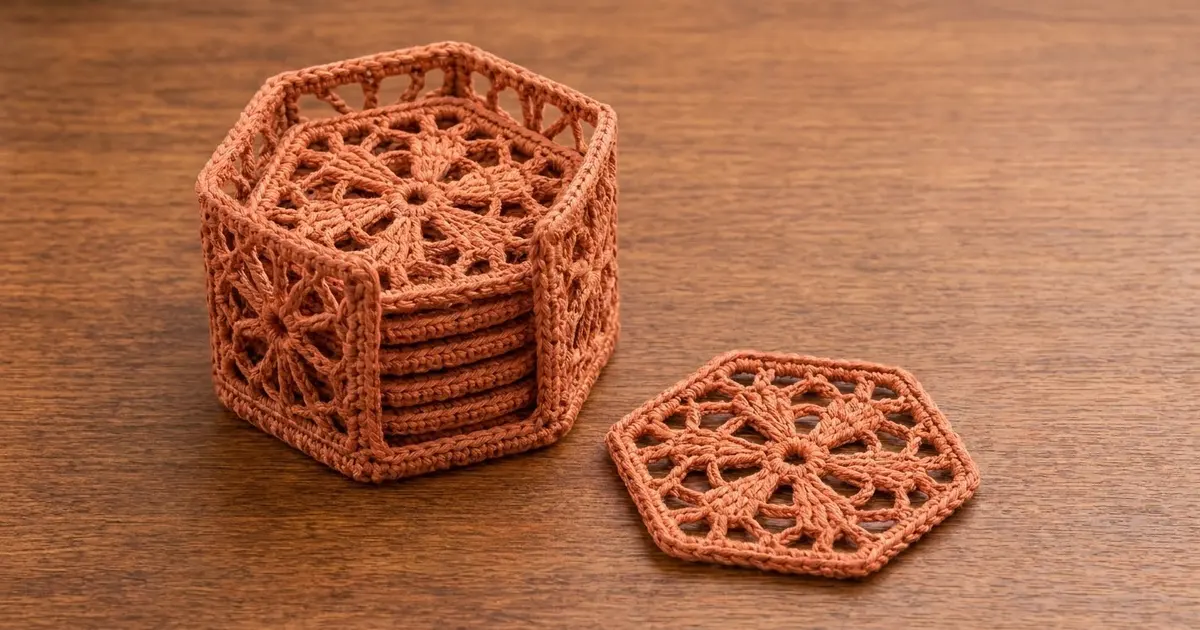
The Terracotta Bloom set is six lacy hexagon coasters plus a matching holder with an open front. Everything is worked in one warm terracotta cotton. Each coaster has a small open center with six fanned petals around it. The petal tips point into the corners of a chain-arch frame, and a crisp single crochet edge finishes it.
The holder copies the look of the coasters. It has a solid single crochet hexagon base and five openwork wall panels, each with a twelve-spoke starburst. The sixth side stays open, so coasters slide in and out easily.
This pattern uses US terms. A finished coaster measures 5.2 in (13.2 cm) flat to flat and 6 in (15.2 cm) corner to corner, with 3 in (7.6 cm) sides. The holder base is 6.6 in (16.8 cm) flat to flat, and the walls stand 2.8 in (7.1 cm) tall with the rim.
The coasters are worked in joined rounds. The base is also worked in joined rounds, and the five wall panels are worked in the round as rectangles. Next, you whipstitch the panels to the base and to each other. Last, a rim round goes all the way around the opening.
Finished Size and Construction
- Coaster: 5.2 in (13.2 cm) flat to flat; 3 in (7.6 cm) per side
- Coaster before trim: 4.8 in (12.2 cm) flat to flat
- Holder base: 6.6 in (16.8 cm) flat to flat; 3.8 in (9.7 cm) per side
- Wall panel: 3.8 in (9.7 cm) wide x 2.6 in (6.6 cm) tall
- Wall height with rim: 2.8 in (7.1 cm)
- Border depth: 0.2 in (0.5 cm) for both the coaster trim and the holder rim
- Skill level: Intermediate
- Terminology: US
- Yarn weight: DK / light worsted (#3) cotton
- Hook: 3.5 mm (E-4)
- Number of pieces: 12 (6 coasters, 1 base, 5 wall panels)
- Layout: The 5 panels stand on 5 of the 6 sides of the base. The sixth side stays open.
Materials
Use a smooth DK cotton. Cotton keeps sharp hexagon corners, blocks well, and holds up to damp glasses. Avoid acrylic, because the walls will slump.
Yarn, Terracotta (one color): 150 g, about 330 m
- Coasters: 6 x 7 g = 42 g (about 92 m)
- Base: 22 g (about 48 m)
- Wall panels: 5 x 5 g = 25 g (about 55 m)
- Seams and rim: 6 g (about 13 m)
The pieces add up to about 95 g (209 m). The 150 g total includes a margin for differences in gauge and for swatching.
Tools: 3.5 mm (E-4) hook, tapestry needle, 4 locking stitch markers, rust-proof pins, blocking mat, spray bottle, and a ruler.
Abbreviations (US Terms)
- ch – chain
- sl st – slip stitch
- sc – single crochet
- hdc – half double crochet
- dc – double crochet
- tr – treble crochet (yarn over twice)
- dtr – double treble crochet (yarn over 3 times, then work off the loops in pairs)
- BLO – back loop only
- sk – skip
- sp(s) – space(s)
Corner group: (dc, ch 3, dc) in the same stitch. You use this on coaster Round 4.
Gauge and Checkpoints
Gauge: 20 sc and 22 rows = 4 in (10.2 cm), which is 5 sc per 1 in (2.5 cm).
Make one coaster first and measure it after each of these rounds:
- After Round 1: the ring is about 1.25 in (3.2 cm) across
- After Round 3: the petals are about 3.5 in (8.9 cm) across
- After Round 4: about 4.3 in (10.9 cm) flat to flat
- After Round 5: 4.8 in (12.2 cm) flat to flat
- After Round 6: 5.2 in (13.2 cm) flat to flat, with 3 in (7.6 cm) sides
Each side has 15 sc, and 15 ÷ 5 = 3 in (7.6 cm). If a side measures more than 3.1 in (7.9 cm), go down half a hook size. If it measures less than 2.9 in (7.4 cm), go up half a size. This gauge also sets the size of the holder, so get it right before you go on.
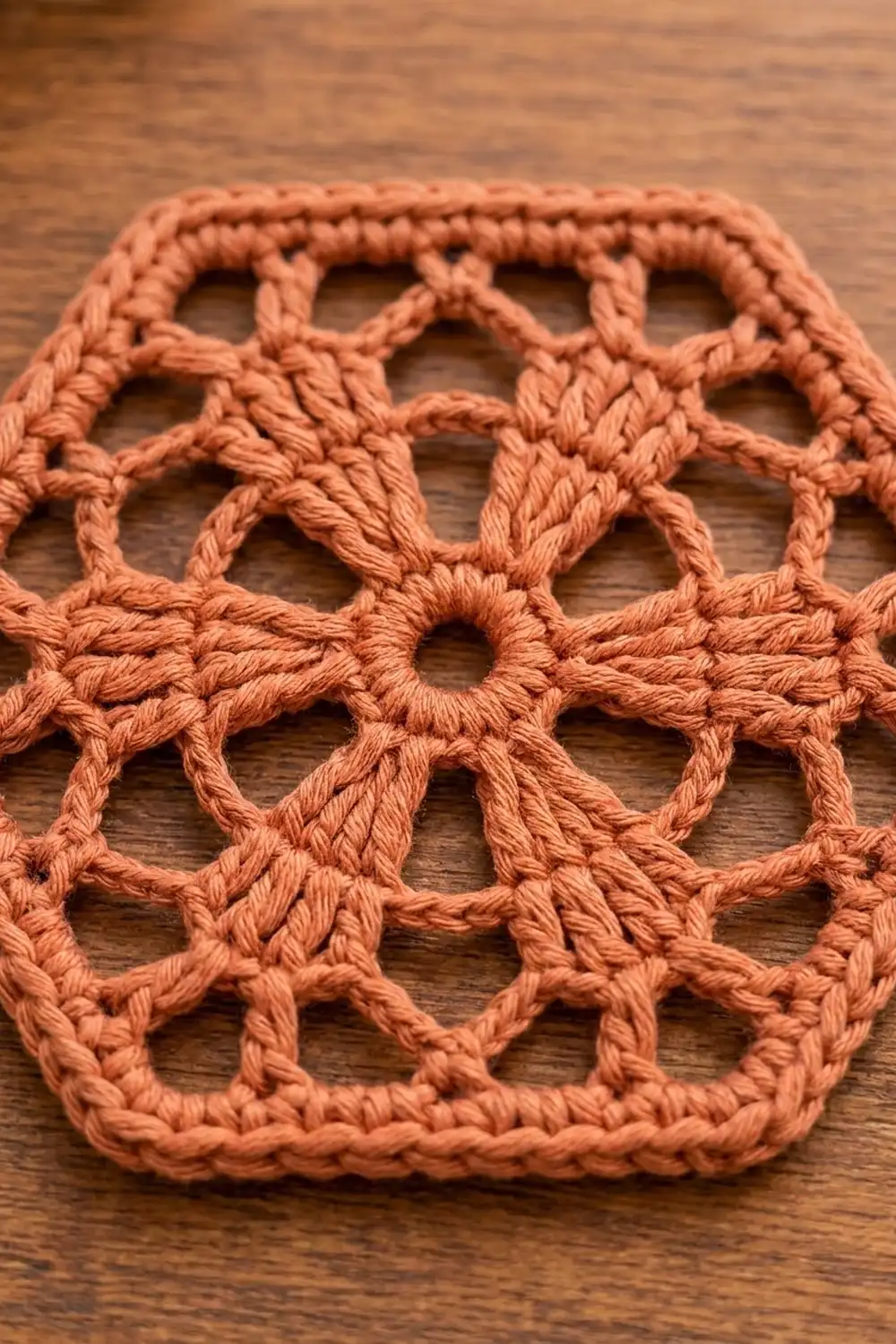
Coaster (Make 6)
Round 1: Ch 6 and sl st to the first ch to make a ring. Ch 3 (counts as dc), then work 17 dc into the ring. Sl st to the top of the ch-3. (18 dc)
Round 2 (petal bases): Ch 3 (counts as dc). Work dc in the same st, dc in the next st, 2 dc in the next st, ch 2. Work 2 dc in the next st, dc in the next st, 2 dc in the next st, ch 2. Repeat from * 4 more times. Sl st to the top of the ch-3. (30 dc in 6 groups of 5; 6 ch-2 sps)
This is a conversion round: 18 dc worked one in each stitch, plus 12 added dc, gives 30 dc.
Round 3 (petal fans): Ch 4 (counts as tr). Work (ch 1, tr in the next dc) 4 times, then ch 3 and sk the ch-2 sp. Tr in the next dc, (ch 1, tr in the next dc) 4 times, ch 3, sk the ch-2 sp. Repeat from * 4 more times. Sl st to the top of the ch-4. (30 tr, 24 ch-1 sps, 6 ch-3 sps)
Each petal is now a fan of 5 tr that opens outward.
Round 4 (chain-arch frame): Sl st into the next ch-1 sp, the next tr, the next ch-1 sp, and the next tr. You are now on the center (3rd) tr of a petal. Ch 6 (counts as dc + ch 3), then dc in the same tr. Ch 4, sc in the next ch-3 sp, ch 4. Work a corner group in the 3rd tr of the next petal, ch 4, sc in the next ch-3 sp, ch 4. Repeat from * 4 more times. Sl st to the 3rd ch of the ch-6. (12 dc, 6 sc, 6 ch-3 corner sps, 12 ch-4 sps)
The petal tips now point into the six corners, and the ch-4 arches leave open windows between the petals.
Round 5 (solid frame): Sl st into the next ch-3 sp. Ch 5 (counts as dc + ch 2), then dc in the same sp. Dc in the next dc, 4 dc in the ch-4 sp, dc in the sc, 4 dc in the ch-4 sp, dc in the next dc, then (dc, ch 2, dc) in the corner sp. Repeat from * 4 more times. Finish the last side: dc in the next dc, 4 dc in the ch-4 sp, dc in the sc, 4 dc in the ch-4 sp, dc in the next dc. Sl st to the 3rd ch of the ch-5. (78 dc, 6 ch-2 corner sps)
Each side has 11 dc between the corners, plus 1 corner dc at each end, for 13 per side. Check the total: 11 x 6 + 12 = 78.
Round 6 (trim): Sl st into the next ch-2 sp. Ch 1, then (sc, ch 1, sc) in the same sp. Sc in each of the next 13 dc, then (sc, ch 1, sc) in the next ch-2 sp. Repeat from * 4 more times. Sc in each of the last 13 dc, then sl st to the first sc. (90 sc, 6 ch-1 sps)
This is a trim round: 78 sc worked one in each stitch, plus 12 corner sc, gives 90 sc. Each side has 15 sc, including its 2 corner sc. Fasten off and weave in the ends.
Holder Base (Make 1)
Work in joined rounds. Begin each round with ch 1 (does not count as a stitch) and end it with a sl st to the first sc. The increases stack on top of each other, which gives the base six straight sides.
Round 1: Work 6 sc in a magic ring. (6 sc)
Round 2: Work 2 sc in each st. (12 sc)
Round 3: Sc in the next st, 2 sc in the next st. Repeat 6 times. (18 sc)
Rounds 4–19: In round n, sc in the next (n − 2) sts, 2 sc in the next st. Repeat 6 times. Each round has 6 x n stitches. For example, Round 4 has 24 sc, Round 10 has 60 sc, and Round 19 has 114 sc, with 19 sc on each side.
Keep a marker in each corner increase and move it up every round.
Checkpoints: After Round 6, each side is 1.2 in (3.0 cm). After Round 12, each side is 2.4 in (6.1 cm). After Round 19, each side is 3.8 in (9.7 cm), and the base is 6.6 in (16.8 cm) flat to flat.
Round 20 (wall ridge): Ch 1, then sc BLO in each st. Join. (114 sc, 19 per side) This round makes the ridge the walls stand on. Mark one side as the open front, then fasten off.
Wall Panels (Make 5)
Round 1: Ch 5 and sl st to make a ring. Ch 1, then work 12 sc into the ring. Join. (12 sc)
Round 2 (spokes): Ch 5 (counts as dc + ch 2). Dc in the next sc, ch 2. Repeat from * 10 more times. Sl st to the 3rd ch of the ch-5. (12 dc, 12 ch-2 sps)
Round 3 (rectangle): Sl st into the first ch-2 sp. Ch 5 (counts as dtr), ch 3, dtr in the same sp to make corner A. Work the top edge: 4 hdc in the next sp, 3 sc in the next sp, 4 hdc in the next sp. Work (dtr, ch 3, dtr) in the next sp for corner B. Work 5 tr in the next sp for the side. Work (dtr, ch 3, dtr) in the next sp for corner C. Work the bottom edge across the next 3 sps: 4 hdc, 3 sc, 4 hdc. Work (dtr, ch 3, dtr) in the next sp for corner D. Work 5 tr in the last sp. Sl st to the top of the ch-5. (40 sts)
Each long edge has 13 sts, including both corner dtr. Each short side has 7 sts. Check the total: 13 + 13 + 7 + 7 = 40. Short stitches on the top and bottom and tall stitches on the sides turn the circle into a wide rectangle.
Round 4: Sl st into the corner sp. Ch 1, then (2 sc, ch 2, 2 sc) in the same sp. Sc in each st along the edges and work (2 sc, ch 2, 2 sc) in each corner sp. Join. (56 sc: 17 on each long edge, 11 on each short side)
Round 5: Sl st into the corner sp. Ch 1, then (sc, ch 1, sc) in the same sp. Sc in each st along the edges and work (sc, ch 1, sc) in each corner sp. Join. (64 sc: 19 on each long edge, 13 on each short side)
Checkpoint: The panel measures 3.8 x 2.6 in (9.7 x 6.6 cm). Its 19-stitch bottom edge matches a 19-stitch side of the base exactly. Fasten off, leaving a 16 in (40.6 cm) tail.
Make All Pieces
- Coasters: 6 in Terracotta
- Base: 1 in Terracotta
- Wall panels: 5 in Terracotta
Holder layout, seen from above:
          [P3]
   [P2]          [P4]
         (BASE)
   [P1]          [P5]
         [OPEN]
Joining
Panels to base: Place panel P1 on the side to the left of the open front. Hold its bottom edge against the Round 20 stitches of that side, wrong sides together. Use the tail to whipstitch through the inside loops of both pieces, one panel stitch to one base stitch. All 19 sc on the panel meet all 19 sc on the base, and the corner sc lines up with the base corner. Repeat for panels P2 through P5.
Panel to panel: Whipstitch the short sides of neighboring panels together, 13 sts to 13 sts, working from the base upward. This makes 4 seams: P1–P2, P2–P3, P3–P4, and P4–P5. Leave the front edges of P1 and P5 free.
Tension: Pull each stitch just snug enough to close the gap without puckering the seam. Every 5 stitches, check that the seam is the same length as the edge.
Checkpoint: Each wall is 3.8 in (9.7 cm) wide, and the inside still measures 6.6 in (16.8 cm) flat to flat.
Border (Holder Rim)
Border gauge: 5 sc per 1 in (2.5 cm).
Round 1: Join the yarn in the first stitch of the base’s open front side. Work sc in each of the 19 base stitches along the front. Then sc up the 13 sts of P5’s front edge, across all 5 top edges (5 x 19 = 95 sc), and down the 13 sts of P1’s front edge. Skip every ch-1 corner sp. The corner sc are already counted in each 19-stitch or 13-stitch edge, so do not add any. Join. (19 + 13 + 95 + 13 = 140 sc)
Round 2: Sl st in each sc around. (140 sl sts) Fasten off.
Why the math works: The 95 sc across the top, at 5 sc per inch, measure 19 in (48.3 cm). That equals 5 panels x 3.8 in. The 19 front sc cover the 3.8 in (9.7 cm) front side of the base. No stitches are added at the seams, so the rim lies flat and neither ruffles nor pulls in.
Final Blocking
- Mist each coaster until it is damp but not soaked.
- Pin the corners to 6 in (15.2 cm) corner to corner and check that each side is 3 in (7.6 cm).
- Use your fingertips to open the petal fans and the arch windows.
- Let the coasters dry completely before you unpin them.
- Mist the holder. Pack it with a folded towel about 6.6 in (16.8 cm) across.
- Stand the walls up straight along the Round 20 ridge and square the corners.
- Let the holder dry overnight.
Final Quality-Control Checklist
- Each coaster has 90 sc in Round 6, with 15 sc per side
- All six coasters are within 0.1 in (0.3 cm) of each other
- The petal tips point into the corners
- The base has 114 sc and lies flat
- Each panel has 64 sc and measures 3.8 x 2.6 in (9.7 x 6.6 cm)
- The seams line up stitch for stitch, and the corners stand straight
- The rim has 140 stitches and lies flat
- A coaster slides in with about 0.7 in (1.8 cm) of space on each side
Troubleshooting
- The coaster cups: The Round 4 chains are too tight. Work them more loosely.
- The coaster ruffles: Go down half a hook size.
- The base turns round: Move the markers up every round so the increases stay stacked.
- The base cups: Relax your tension, or go up half a size for the base only.
- The panel is too tall: In Round 3, work 5 dc in place of each 5 tr.
- The walls lean: Block the holder again with the towel inside.
- The rim waves: Check that you skipped every ch-1 sp.
Care
Hand wash in cool water with a mild soap. Press the water out in a towel, reshape the pieces, and dry them flat.
Final Notes
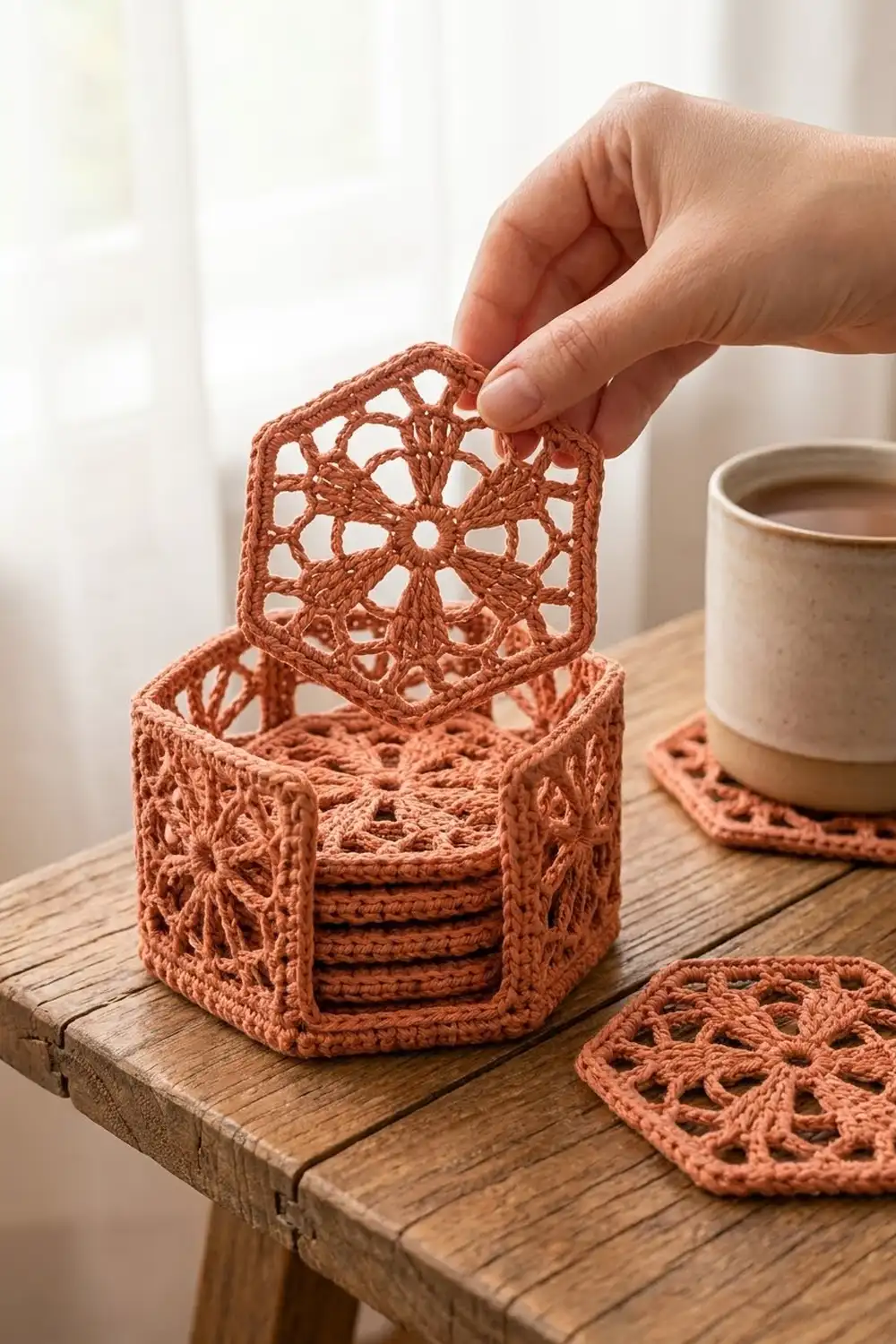
One gauge controls the whole set: 5 sc per inch. With that gauge, a 15-stitch coaster side measures 3 in (7.6 cm), so the coaster is 5.2 in (13.2 cm) across. A 19-stitch base side measures 3.8 in (9.7 cm), and the 19-stitch bottom edge of each panel matches it. Five panels then give a 95-stitch top rim. If your first coaster is on gauge, every other piece will fit.
Happy crocheting!