

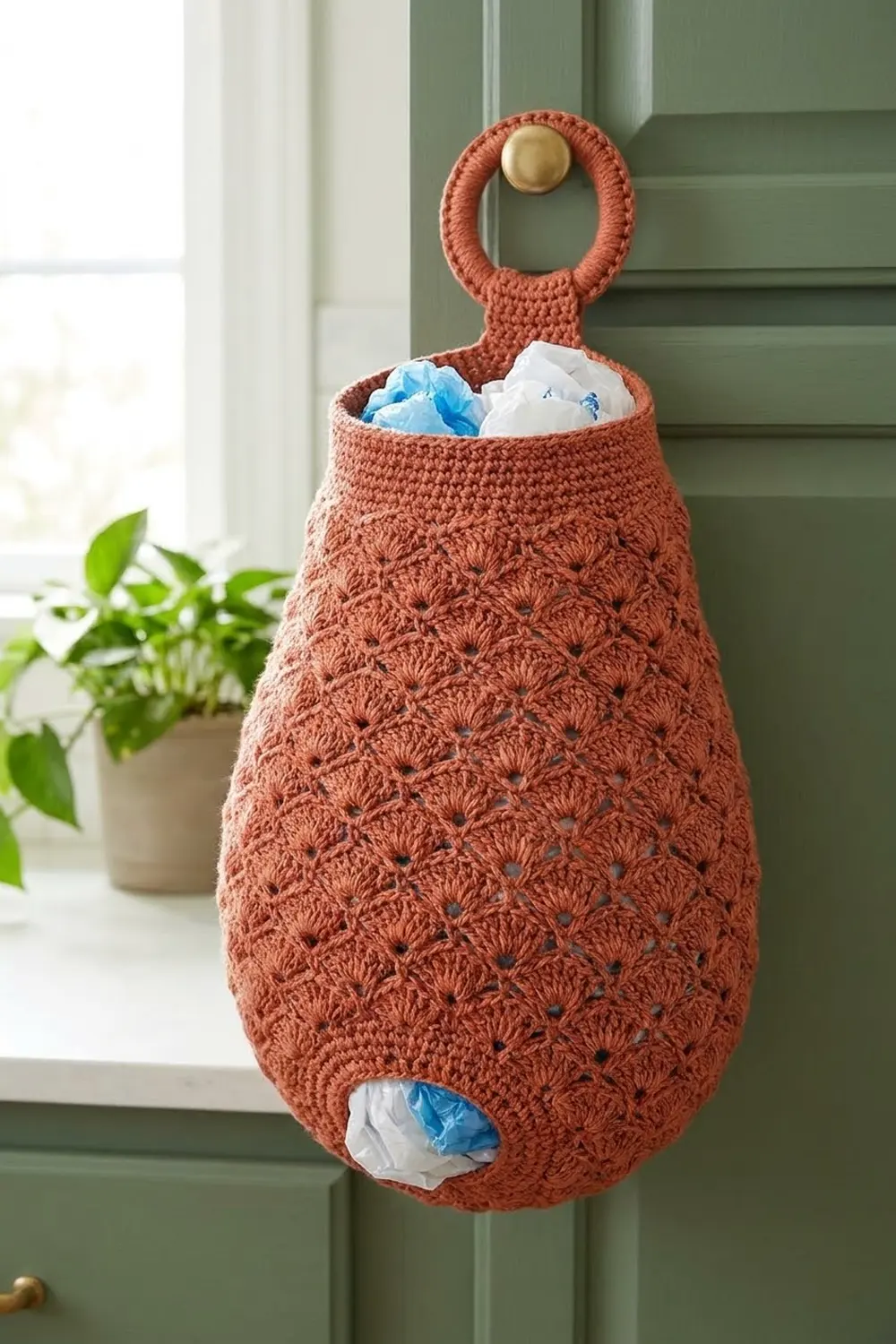
Every kitchen has that drawer stuffed with plastic grocery bags. This teardrop-shaped bag holder gives them a tidy home: stuff bags in through the top, then pull them out one at a time through the small opening at the bottom.
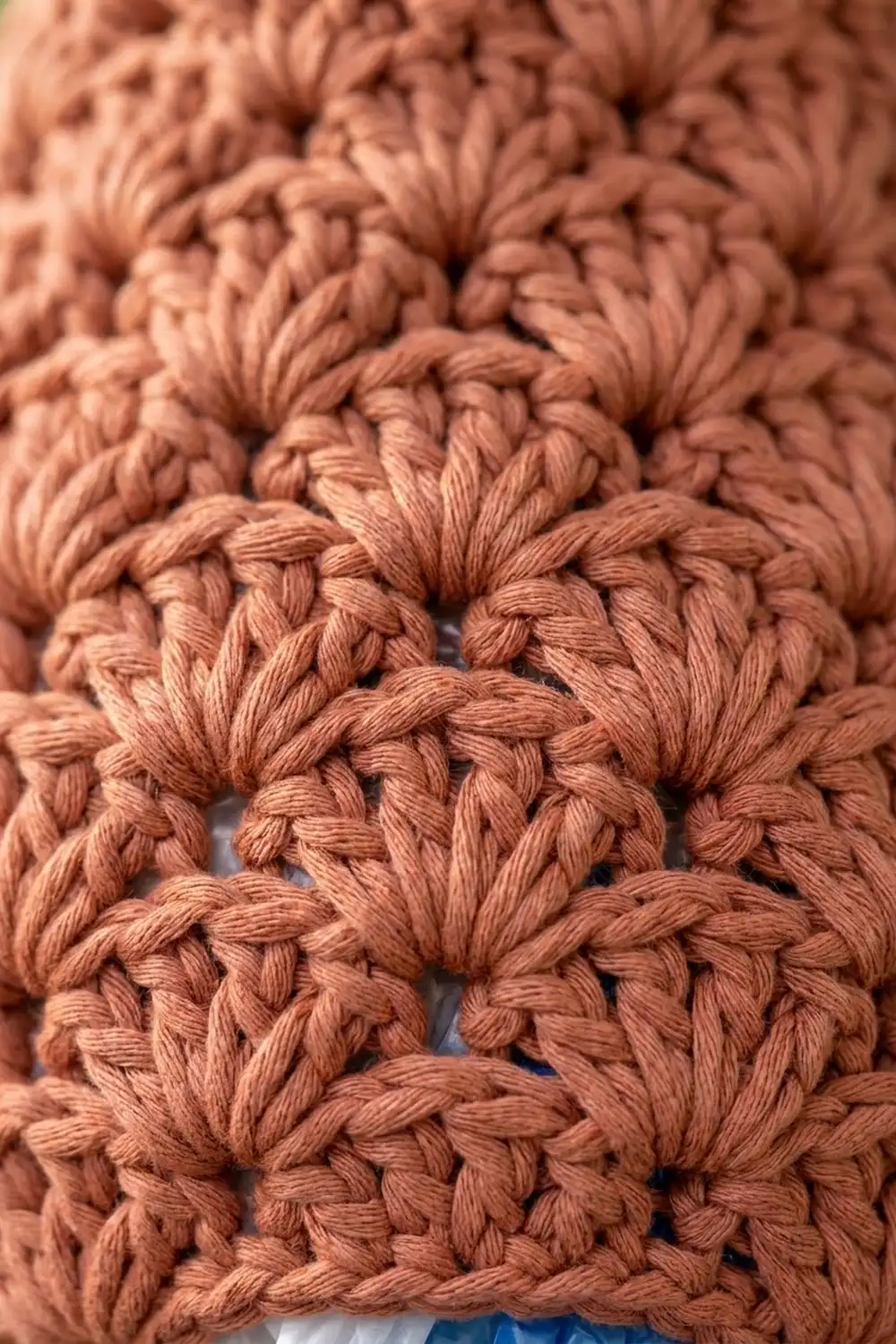
The design is worked in one warm terracotta cotton, so the shell texture does all the talking. Rows of fan-shaped shells stack in an offset pattern over the whole body and get a little smaller toward the top. That creates the soft pear silhouette without any visible decreases. A firm single crochet rim finishes the top, and a chunky covered ring lets it hang from a cabinet knob, hook or door handle.
The pattern uses US crochet terms. The finished holder measures 8.75 in (22.2 cm) wide at the belly and 12.25 in (31.1 cm) tall for the body. It is about 17.5 in (44.5 cm) tall including the hanger.
Construction is simple and seamless. You start at the bottom opening with a chain ring and work four single crochet rounds that cup into a rounded base. Then you work shell stitch in joined rounds, stepping the shells down from 5 dc to 4 dc to 3 dc to taper the shape. Finish with a single crochet rim, a short tab and a covered ring.
Finished Size and Construction
- Finished size: 8.75 in (22.2 cm) wide x 12.25 in (31.1 cm) tall (body, laid flat); about 17.5 in (44.5 cm) tall with hanger
- Skill level: Easy-intermediate
- Terminology: US crochet terms
- Yarn weight: Aran / worsted (weight 4) cotton
- Hook: 5.0 mm (H-8)
- Number of pieces: 1 (body worked in one piece; tab and ring cover worked onto it)
- Layout: Single hanging piece, no joining
- Piece size before rim: 5.75 in (14.6 cm) wide at top x 11.5 in (29.2 cm) tall
- Rim (border) depth: 0.75 in (1.9 cm), 3 rounds of sc
- Bottom opening: about 2.2 in (5.6 cm) across, unstretched
Materials
Choose a smooth, firm cotton or cotton blend in Aran or heavy worsted weight. Cotton holds the shell shape well and won’t stretch out under the weight of a full load of bags. Avoid very soft or splitty yarns, because the shells will look fuzzy and the bottom opening will sag.
- Terracotta: 200 g, about 340 m (372 yd) of Aran-weight cotton (about 100 g / 170 m per ball)
The project uses roughly 175 g. The amount listed includes extra yarn for testing gauge and small differences in tension.
Tools:
- 5.0 mm (H-8) crochet hook
- One 3 in (7.6 cm) plastic, wooden or metal ring
- Stitch markers (at least 2)
- Tapestry needle
- Scissors
- Measuring tape
- Spray bottle and an old towel for blocking
Abbreviations (US Terms)
- ch – chain
- sl st – slip stitch
- sc – single crochet
- dc – double crochet
- sc2tog – single crochet 2 together
- sk – skip
- st(s) – stitch(es)
- sp – space
- rnd(s) – round(s)
Special stitches:
- 5-dc shell: 5 dc worked in the same stitch. The 3rd dc is the center dc.
- 4-dc shell: 4 dc worked in the same stitch. There is no center dc; the “center” is the space between the 2nd and 3rd dc.
- 3-dc shell: 3 dc worked in the same stitch. The 2nd dc is the center dc.
Gauge and Checkpoints
Single crochet gauge: 14 sts and 16 rnds = 4 in (10.2 cm), which is 3.5 sts and 4 rnds per inch.
Shell gauge: one 5-dc shell repeat (6 sts) = 1.75 in (4.4 cm) wide; 2 shell rounds = 1.5 in (3.8 cm) tall.
Since this is a single piece, the base is your test piece. Work Rnds 1–5 and measure before committing to the whole body. If the base is right, the rest will follow.
Checkpoints:
- After Rnd 1: bottom opening about 6.9 in (17.5 cm) around, roughly 2.2 in (5.6 cm) across.
- After Rnd 4: outer edge about 17.1 in (43.4 cm) around. The base should cup into a shallow bowl, not lie flat.
- After Rnd 12: 8.75 in (22.2 cm) wide laid flat; about 7 in (17.8 cm) tall from the bottom.
- After Rnd 16: about 10 in (25.4 cm) tall; 7.25 in (18.4 cm) wide at the top edge.
- After Rnd 18: 11.5 in (29.2 cm) tall; 5.75 in (14.6 cm) wide at the top edge.
- After the rim: 12.25 in (31.1 cm) tall; top opening 5.7 in (14.5 cm) wide laid flat.
If your piece is too big: go down to a 4.5 mm (7) hook. If it is too small or very stiff: go up to a 5.5 mm (I-9) hook. Change hooks rather than changing stitch counts, because the shell repeats depend on exact multiples.
Pattern: Base
The base starts at the bottom opening. The foundation chain becomes the edge you pull bags through, so keep it relaxed.
Rnd 1: Ch 24, sl st to first ch to form a ring, taking care not to twist. Ch 1, sc in each ch around, sl st to first sc. (24 sc)
Rnd 2: Ch 1, sc in next st, 2 sc in next st 12 times, sl st to first sc. (36 sc)
Rnd 3: Ch 1, sc in next 2 sts, 2 sc in next st 12 times, sl st to first sc. (48 sc)
Rnd 4: Ch 1, sc in next 3 sts, 2 sc in next st 12 times, sl st to first sc. (60 sc)
The base grows by 12 sts per round. That is fewer stitches than a flat circle would need, so the base gently cups. This is what creates the rounded bottom of the teardrop.
Pattern: Body with 5-dc Shells
Rnd 5 (set-up): Ch 1, sc in first st, sk 2 sts, 5 dc in next st, sk 2 sts, sc in next st 9 times, sk 2 sts, 5 dc in next st, sk 2 sts, sl st to first sc. (10 shells and 10 sc = 60 sts)
Check the math: 1 sc + 9 repeats of 6 sts + the final 5 sts (sk 2, shell st, sk 2) = 60 sts used.
Rnd 6: Sl st in next 2 dc, ch 1, sc in next dc (center dc of the shell), 5 dc in next sc, sc in center dc of next shell 9 times, 5 dc in last sc, sl st to first sc. (10 shells and 10 sc = 60 sts)
Each new shell sits in the sc between two shells below, and each sc sits on the center of a shell below. This offset gives the staggered fan texture.
Rnds 7–12: Repeat Rnd 6. (60 sts each round)
You now have 8 rounds of 5-dc shells. Measure: 8.75 in (22.2 cm) wide flat and about 7 in (17.8 cm) tall.
Pattern: Tapering with 4-dc Shells
Rnd 13: Sl st in next 2 dc, ch 1, sc in next dc (center dc), 4 dc in next sc, sc in center dc of next shell 9 times, 4 dc in last sc, sl st to first sc. (10 shells and 10 sc = 50 sts)
Rnd 14: Sl st in next 2 dc, ch 1, sc in sp between 2nd and 3rd dc of the same shell, 4 dc in next sc, sc in sp between 2nd and 3rd dc of next shell 9 times, 4 dc in last sc, sl st to first sc. (10 shells and 10 sc = 50 sts)
Rnds 15–16: Repeat Rnd 14. (50 sts each round)
The shell count stays at 10, so the fans stay lined up. Only their width shrinks, which narrows the body to about 7.25 in (18.4 cm) flat.
Pattern: Upper Body with 3-dc Shells
Rnd 17: Sl st in next 2 dc, ch 1, sc in sp between 2nd and 3rd dc of the same shell, 3 dc in next sc, sc in sp between 2nd and 3rd dc of next shell 9 times, 3 dc in last sc, sl st to first sc. (10 shells and 10 sc = 40 sts)
Rnd 18: Sl st in next dc, ch 1, sc in next dc (center dc), 3 dc in next sc, sc in center dc of next shell 9 times, 3 dc in last sc, sl st to first sc. (10 shells and 10 sc = 40 sts)
The body now measures 11.5 in (29.2 cm) tall and 5.75 in (14.6 cm) wide at the top edge. Do not fasten off.
Border: Top Rim and Bottom Edge
Rim gauge: 3.5 sc per inch, 4 rnds per inch, the same as the base.
Rnd 19 (conversion round): Ch 1, sc in each dc and each sc around, sl st to first sc. (40 worked 1-per-existing-stitch + 0 added = 40 sc)
Each 3-dc shell gives 3 sc and each sc gives 1 sc, so each repeat gives 4 sc: 10 x 4 = 40.
Rnds 20–21: Ch 1, sc in each st around, sl st to first sc. (40 sc each round)
Fasten off and weave in the end.
Why the math works: Laid flat, the rim has 20 sts on the front and 20 sts on the back. At 3.5 sts per inch, 20 sts = 5.7 in (14.5 cm), which matches the 5.75 in (14.6 cm) top of the shell section. Because the rim matches the shells below, it neither flares nor pulls in. The three rounds add 0.75 in (1.9 cm), bringing the body to 12.25 in (31.1 cm).
Bottom edge: Hold the piece upside down. Join yarn at any ch of the foundation ring and sl st loosely in the free loop of each ch around. (24 worked 1-per-existing-stitch + 0 added = 24 sl st) Sl st to first sl st and fasten off. This firms up the opening so it springs back after each bag is pulled out.
Hanger Tab and Ring
Find the back center: Lay the holder flat with the round joins along one side fold. Counting from the join, the front holds rim sts 1–20 and the back holds sts 21–40. Place markers in sts 27 and 34; these 8 sts are the back center.
Row 1: With the inside of the bag facing you, join yarn in st 27, ch 1, sc in same st and next 7 sts. (8 sc)
Rows 2–4: Ch 1, turn, sc in each st across. (8 sc)
Row 5: Ch 1, turn, sc2tog, sc in next 4 sts, sc2tog. (6 sts)
Rows 6–8: Ch 1, turn, sc in each st across. (6 sc)
Leave a 12 in (30.5 cm) tail. The tab is 2 in (5.1 cm) long.
Ring cover: Join new yarn to the ring with a sl st and work 50 sc over the ring, pushing the stitches together so no ring shows. If 50 sc leaves gaps or bunches, adjust to anywhere between 48 and 54. Sl st to first sc. Then sl st loosely in each sc around (50 sl st) to roll the edge outward for a rope-like finish. The covered ring measures about 3.75 in (9.5 cm) across. Fasten off and weave in.
Attach: Slip the ring over the end of the tab so the ring’s seam sits at the bottom. Fold Rows 7–8 (0.5 in / 1.3 cm) over the ring toward the back, and whipstitch Row 8 to the back of Row 6 with the tail. The visible tab is now 1.5 in (3.8 cm), and the full height is 12.25 + 1.5 + 3.75 = 17.5 in (44.5 cm).
Final Blocking
- Weave in all remaining ends, running them through the solid part of the shells.
- Roll an old towel and stuff it inside the holder so it fills the pear shape.
- Spray evenly with water until the cotton is damp, not soaked.
- Shape the base into a smooth dome and gently pull the shells into even rows.
- Pat the rim into a neat circle 11.4 in (29.0 cm) around.
- Check the width at the belly: 8.75 in (22.2 cm) flat, or 17.5 in (44.5 cm) around.
- Let it dry fully, standing upright, before removing the towel.
Final Quality-Control Checklist
- Every shell round has 10 shells and 10 sc.
- Counts are 60, 50 and 40 sts in the three shell zones.
- Shells sit offset over the round below, with no doubled or missing fans.
- The rim has 40 sc and lies flat, without ruffles or puckers.
- The bottom opening is about 2.2 in (5.6 cm) across and springs back.
- The tab sits at the back center, so the ring hangs straight above the opening.
- No ring material shows through the sc cover.
- All ends are woven in securely.
Troubleshooting
The base lies flat instead of cupping. Your tension is loose. Go down a hook size for Rnds 1–4 only.
The shells lean in a spiral. You may be starting each round in the wrong place. Always sl st to the shell center before the first sc.
The stitch count is off in a shell round. Count shells, not stitches. You need 10 shells every round; if you have 9 or 11, frog back to the last correct round.
The rim flares. Go down a hook size for Rnds 19–21.
Bags fall out of the bottom. The opening is too loose. Add a second round of sl st, or work Rnd 1 with a smaller hook.
The holder tilts on the hook. The tab is off-center. Recount from the join and reattach at sts 27–34.
Care
Hand wash in cool water with mild soap, press out the water in a towel, and dry flat or stuffed with a towel to keep the shape. Avoid the dryer, which can shrink cotton and distort the shells.
Final Notes
The measurements build on each other in a short chain. A 24-ch ring gives a 2.2 in (5.6 cm) opening, and 4 base rounds grow to 60 sts and 17.1 in (43.4 cm) around. Ten 5-dc shell repeats give the 8.75 in (22.2 cm) belly. Ten 4-dc shells narrow it to 7.25 in (18.4 cm), and ten 3-dc shells bring it to 5.75 in (14.6 cm). A 40-st rim finishes the body at 12.25 in (31.1 cm) tall, and the tab and covered ring bring the total to 17.5 in (44.5 cm).
Keep the shell count at 10 every round and check your measurements at each stage. You’ll end up with a sturdy, pretty holder that keeps your bags in one place.
Happy crocheting!