

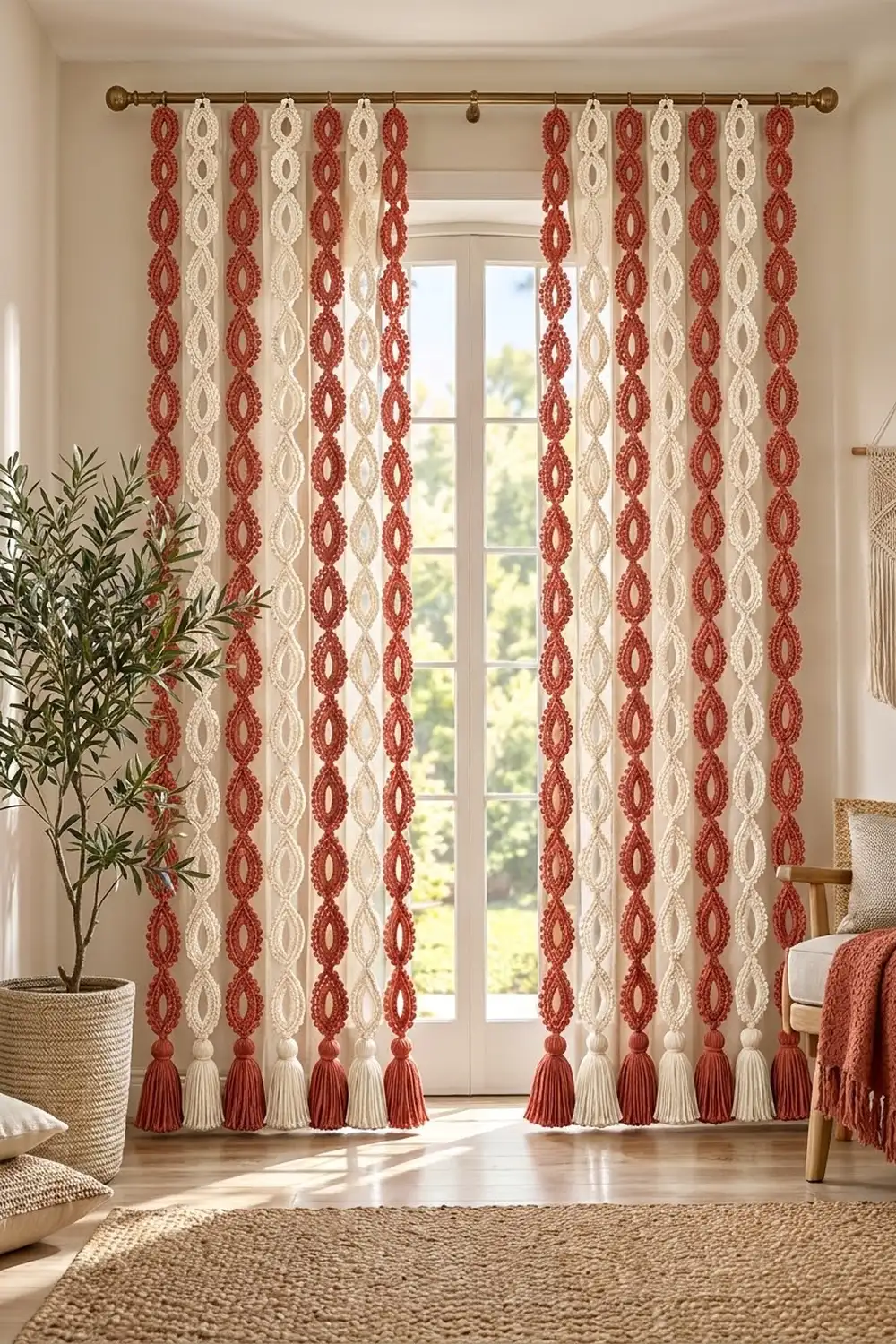
This strand curtain is built from one small motif: an almond-shaped teardrop with an open center, a dense double crochet body and a picot edge. The motifs join tip to tip into long vertical strands, and each strand ends in a full tassel with a round head.
The colors are simple and warm. Terracotta strands alternate with natural cream strands, so from across the room the curtain looks like soft stripes, and up close it looks like lace. It suits boho, farmhouse and Mediterranean-style rooms, and it filters light without blocking it.
This pattern uses US crochet terms. One finished strand is 2.75 in (7.0 cm) wide and 78 in (198.1 cm) long, including a 2 in (5.1 cm) hanging loop and a 6 in (15.2 cm) tassel. One panel of 6 strands hangs 26.5 in (67.3 cm) wide, with 2 in (5.1 cm) gaps between strands. The photo shows a pair of panels, so the materials list covers 2 panels.
Construction is simple. You make a long chain ring and work three rounds to build the teardrop. Then you work a picot round that also joins each new motif to the one above it. A hanging loop goes on top of each strand and a tassel on the bottom.
Finished Size and Construction
- Strand size: 2.75 in (7.0 cm) wide x 78 in (198.1 cm) long
- Panel size: 26.5 in (67.3 cm) wide x 78 in (198.1 cm) long, 6 strands
- Skill level: Intermediate (simple stitches, many repeats, join-as-you-go)
- Terminology: US
- Yarn weight: Worsted (#4) cotton
- Hook: 5.0 mm (H-8)
- Number of pieces: 14 motifs per strand, 84 motifs per panel, 168 motifs for the pair
- Layout: 6 strands per panel, 14 motifs tall, colors alternating
- Piece size (finished motif): 5 in (12.7 cm) long x 2.75 in (7.0 cm) wide
- Size before border (after Round 3): 4.25 in (10.8 cm) long x 2.25 in (5.7 cm) wide
- Border depth: 0.25 in (0.6 cm) along the sides, 0.375 in (1.0 cm) at each tip
Materials
Choose a smooth, firm worsted-weight cotton or cotton blend with about 170 m per 100 g. Cotton keeps the pointed tips and picots crisp and hangs straight without stretching. Avoid splitty or very soft yarns, because they blur the picots.
- Terracotta: 600 g, about 1,020 m (6 balls of 100 g)
- Cream: 600 g, about 1,020 m (6 balls of 100 g)
Each strand uses about 85 g: about 5 g for each of the 14 motifs, about 2 g for the hanging loop and about 12 g for the tassel. Six strands of each color need about 510 g. The quantities above include a margin of roughly 15% for gauge swatches and tassel trimming.
Tools:
- 5.0 mm (H-8) crochet hook
- Tapestry needle
- Scissors
- Stiff card, 6.5 in (16.5 cm) tall, for tassels
- 6 wooden beads, 1 in (2.5 cm), per panel (optional, for rounder tassel heads)
- Rustproof pins, spray bottle and a long blocking surface
- Curtain rod up to 1.25 in (3.2 cm) in diameter
Abbreviations (US Terms)
- ch – chain
- sl st – slip stitch
- sc – single crochet
- dc – double crochet
- sp – space
- st(s) – stitch(es)
Special stitch – Picot: ch 3, sl st in 3rd ch from hook.
Tip loop: (sc, ch 4, sc) worked into a tip ch-2 sp. These loops connect one motif to the next.
Gauge and Checkpoints
Gauge: 16 sc = 4 in (10.2 cm). One motif after Round 4 = 5 in (12.7 cm) x 2.75 in (7.0 cm).
Make one complete motif first, block it lightly and measure it. Every strand length in this pattern depends on that one number.
Checkpoints (measured flat, tip to tip and across the widest point):
- After Round 1: 2.75 in (7.0 cm) long, open center about 0.75 in (1.9 cm) wide
- After Round 2: 3.75 in (9.5 cm) x 1.75 in (4.4 cm)
- After Round 3: 4.25 in (10.8 cm) x 2.25 in (5.7 cm)
- After Round 4: 5 in (12.7 cm) x 2.75 in (7.0 cm)
If your motif is too big: go down to a 4.5 mm hook. If it is too small: go up to a 5.5 mm hook. A difference of only 0.25 in (0.6 cm) per motif adds or removes 3.5 in (8.9 cm) over a 14-motif strand, so match the length carefully.
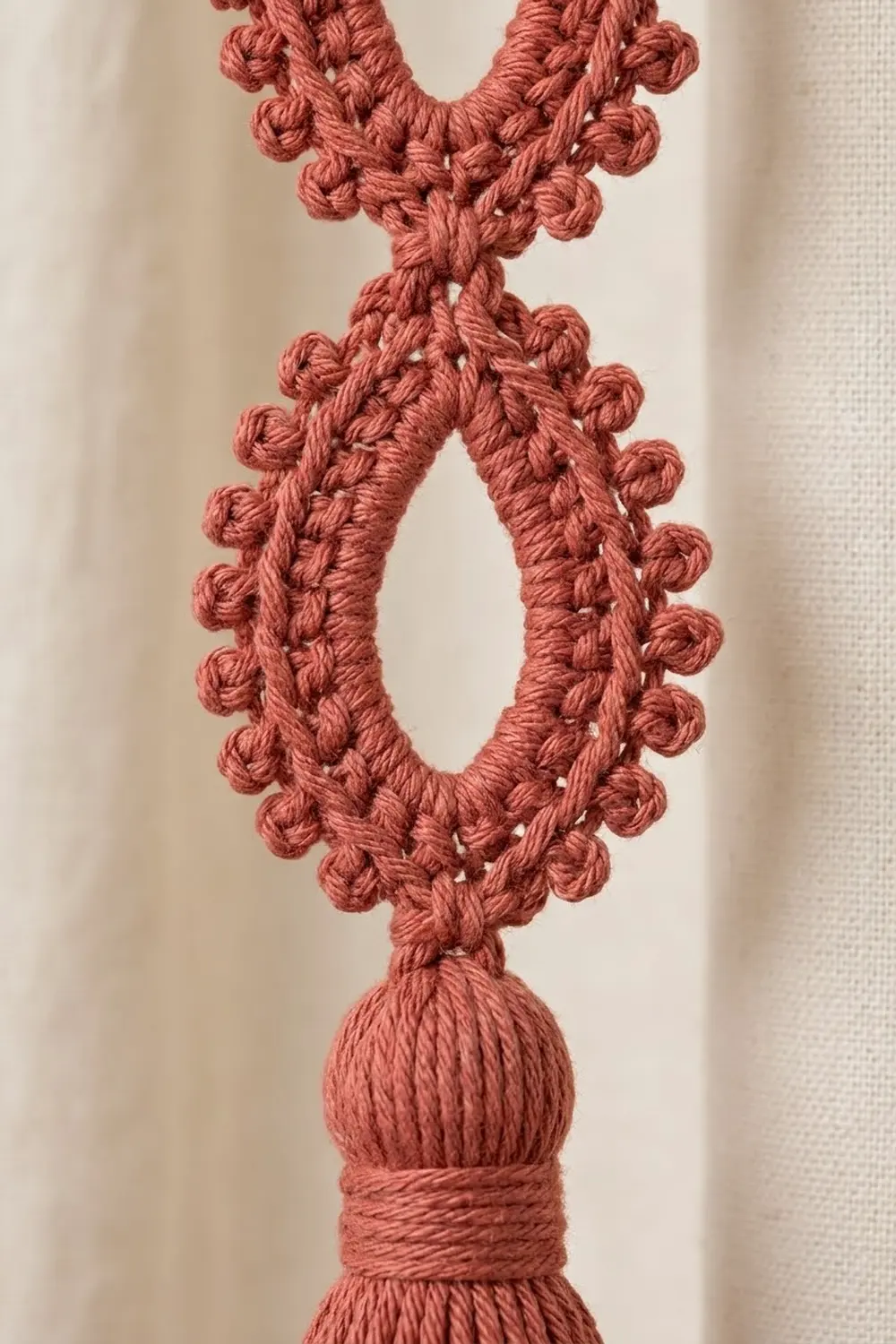
Teardrop Motif (Rounds 1–3)
You work the motif in the round around a chain ring, which you flatten into an almond shape. Stitch 1 and stitch 13 of Round 1 become the two tips.
Foundation: Ch 24, sl st in first ch to form a ring, taking care not to twist. Flatten it into a long oval.
Round 1: Ch 1, sc in each ch around, sl st in first sc. (24 sc)
Mark the 1st and 13th sc as the tips. Each long side has 11 sc between the tip stitches.
Round 2 (growth round): Ch 3 (counts as dc), (dc, ch 2, 2 dc) in same st as join, dc in next 11 sts, (2 dc, ch 2, 2 dc) in next st, dc in next 11 sts, sl st in top of ch-3. (30 dc and 2 ch-2 tip sps)
Each side now has 15 dc between the tip spaces: 2 dc from one tip, 11 dc, and 2 dc from the other tip. The (2 dc, ch 2, 2 dc) groups pull the ends into points.
Round 3 (conversion round): Sl st in next dc and in ch-2 sp, ch 1, (sc, ch 2, sc) in same sp, sc in next 15 dc, (sc, ch 2, sc) in next ch-2 sp, sc in next 15 dc, sl st in first sc. (30 sc worked 1 per dc + 4 sc in tip sps = 34 sc, and 2 ch-2 tip sps)
Each long side now has 17 sc, counting the tip sc at each end: 1 + 15 + 1 = 17. Two sides x 17 = 34 sc, so the count checks.
Check that the motif measures 4.25 in (10.8 cm) x 2.25 in (5.7 cm). Don’t fasten off. You work Round 4 straight on from here, and it is covered in the Border section.
Make All Pieces
One panel needs 84 motifs: 42 terracotta and 42 cream. For the pair, make 84 terracotta and 84 cream, 168 motifs in total.
You can work Rounds 1–3 in batches, but Round 4 joins each motif to the one before it. Many crocheters find it easiest to finish one strand at a time. Keep finished strands loosely coiled or hung so they don’t tangle.
Panel layout (T = terracotta, C = cream), viewed from the front:
Strand:     1   2   3   4   5   6
Loop:       T   C   T   C   T   C
Motif 1:    T   C   T   C   T   C
Motif 2:    T   C   T   C   T   C
  ...      (repeat for motifs 3 to 13)
Motif 14:   T   C   T   C   T   C
Tassel:     T   C   T   C   T   C
Make the second panel the same way. If you want the two panels to mirror each other, start the second panel with a cream strand.
Joining (Join-As-You-Go Tips)
Read this section and the Border section before you work Round 4.
Motifs join tip to tip during their own picot round, so there is no separate sewing. The first motif of each strand gets a free tip loop at both ends. Every motif after that replaces its top tip loop with a joining chain.
Stitch-to-stitch logic: Each motif has exactly one ch-4 loop at its bottom tip. At its top tip, the next motif works (sc, ch 2, sl st in that ch-4 loop, ch 2, sc). The ch 2 + sl st + ch 2 replaces the ch 4, so a joined tip is the same length as a free loop. That is why joined motifs keep the full 5 in (12.7 cm) spacing.
Tension: Work both ch-2 sections at the same relaxed tension as your other chains. Tight joins pinch the tips and shorten the strand. Loose joins let the motifs twist and sag. After each join, hold the strand up. The motifs should hang straight and in line.
Size checkpoint: After 4 motifs are joined, the strand should measure 20 in (50.8 cm) from the top tip loop to the bottom tip loop. After all 14, it should measure 70 in (177.8 cm).
Border: Picot Edging Round (Round 4)
Border gauge: 17 sc across each 4.25 in (10.8 cm) side, which is 4 sc per inch, the same as the main gauge. The edging lies flat without ruffling or cupping.
Round 4, first motif of a strand: Sl st in next sc and in ch-2 sp, ch 1, (sc, ch 4, sc) in same sp, sc in next sc, [picot, sc in next 2 sc] 8 times, (sc, ch 4, sc) in next ch-2 sp, sc in next sc, [picot, sc in next 2 sc] 8 times, sl st in first sc. Fasten off.
Round 4, every following motif: Work Rounds 1–3 as before. Then: sl st in next sc and in ch-2 sp, ch 1, sc in same sp, ch 2, sl st in ch-4 loop at the bottom tip of the previous motif, ch 2, sc in same sp on the current motif. Continue: sc in next sc, [picot, sc in next 2 sc] 8 times, (sc, ch 4, sc) in next ch-2 sp, sc in next sc, [picot, sc in next 2 sc] 8 times, sl st in first sc. Fasten off.
Counts for Round 4 (conversion round):
- Each long side: 17 sc worked 1 per existing sc + 8 picots added = 17 sc and 8 picots
- Each tip: 2 sc in the ch-2 sp + one ch-4 loop (or the joining chain)
- Whole round: 34 sc worked 1 per stitch + 4 sc in tip sps = 38 sc, plus 16 picots and 2 tip loops
Why the math works: Each side has an odd count of 17. One sc followed by 8 repeats of (picot, 2 sc) uses exactly 1 + 16 = 17 stitches. The picots fall evenly along the curve, and the extra sc at each tip keeps the points sharp.
Hanging loop: Join the same color to the free ch-4 loop at the top of Motif 1. Ch 18, sl st in the same ch-4 loop, ch 1, work 24 sc into the ch-18 loop, sl st in first sc. Fasten off. The loop hangs 2 in (5.1 cm) tall and fits a rod up to 1.25 in (3.2 cm) across.
Tassel: Wrap matching yarn 30 times around the 6.5 in (16.5 cm) card. Thread a 12 in (30.5 cm) tie under the top of the wraps and through the free ch-4 loop at the bottom of Motif 14, then knot it firmly. Cut the wraps along the bottom edge. If you are using a bead, place it just below the knot, inside the strands. Wrap a separate length of yarn tightly 10 times around the tassel, 1 in (2.5 cm) below the top, to form the round head. Bury the ends inside the tassel and trim the bottom so the tassel is 6 in (15.2 cm) long in total.
Final Blocking
- Weave in all ends before blocking, running them through the sc of Round 3 so they stay hidden.
- Lay each strand straight on a long blocking surface, front side up.
- Mist it evenly until it is damp but not dripping.
- Pin each top and bottom tip so the motifs measure 5 in (12.7 cm) from join to join.
- Pin the open centers into a smooth almond shape, and ease the widest point to 2.75 in (7.0 cm).
- Open the picots with your fingertip so they sit like round beads along the edge.
- Comb the tassel straight, mist it and let it dry hanging.
- Leave everything pinned until it is completely dry, usually 12 to 24 hours.
Final Quality-Control Checklist
- Each motif has 38 sc, 16 picots and 2 tip loops or joins
- Every motif measures 5 in (12.7 cm) x 2.75 in (7.0 cm)
- All joins sit at the center of the tips with no twisting
- Each strand has 70 in (177.8 cm) of motifs, not counting the loop and tassel
- All hanging loops are the same size and slide freely on the rod
- Tassels are 6 in (15.2 cm) long, with heads level from strand to strand
- Colors alternate correctly across the panel
- All ends are woven in and trimmed
Troubleshooting
Tips look rounded, not pointed. Check the tip groups in Round 2. You need (2 dc, ch 2, 2 dc) in one stitch. Block the tips firmly.
Motif cups or curls. Your dc may be too tight. Go up a hook size for Round 2 only, or relax your tension.
Edge ruffles. You may have added extra sc along the sides. Recount: 17 sc per side, no more.
Strands are different lengths. Measure every motif before joining it. Remake any motif that is too short or too long instead of stretching it during blocking.
Strand twists when hung. Tighten the joining chains slightly, and block the strand straight while it is damp.
Tassel looks thin. Add 5 to 10 more wraps. With thicker yarn, tassels look full with fewer wraps.
Care
Hand wash in cool water with mild detergent, roll in a towel to remove the water, and dry flat or pinned straight. Shake gently and hang it back up. Do not tumble dry.
Final Notes
The whole curtain rests on one chain of measurements. A gauge of 16 sc = 4 in (10.2 cm) gives a 4.25 in (10.8 cm) motif after Round 3. The picot round brings each motif to 5 in (12.7 cm) x 2.75 in (7.0 cm). Fourteen joined motifs make 70 in (177.8 cm). Add a 2 in (5.1 cm) loop and a 6 in (15.2 cm) tassel, and each strand hangs 78 in (198.1 cm). Six strands with 2 in (5.1 cm) gaps make a 26.5 in (67.3 cm) panel.
Check your first motif and keep your joins even. After that, the work is calm, steady repetition. To change the length, add or remove motifs in 5 in (12.7 cm) steps, and change the yarn by about 5 g per motif.
Happy crocheting!