

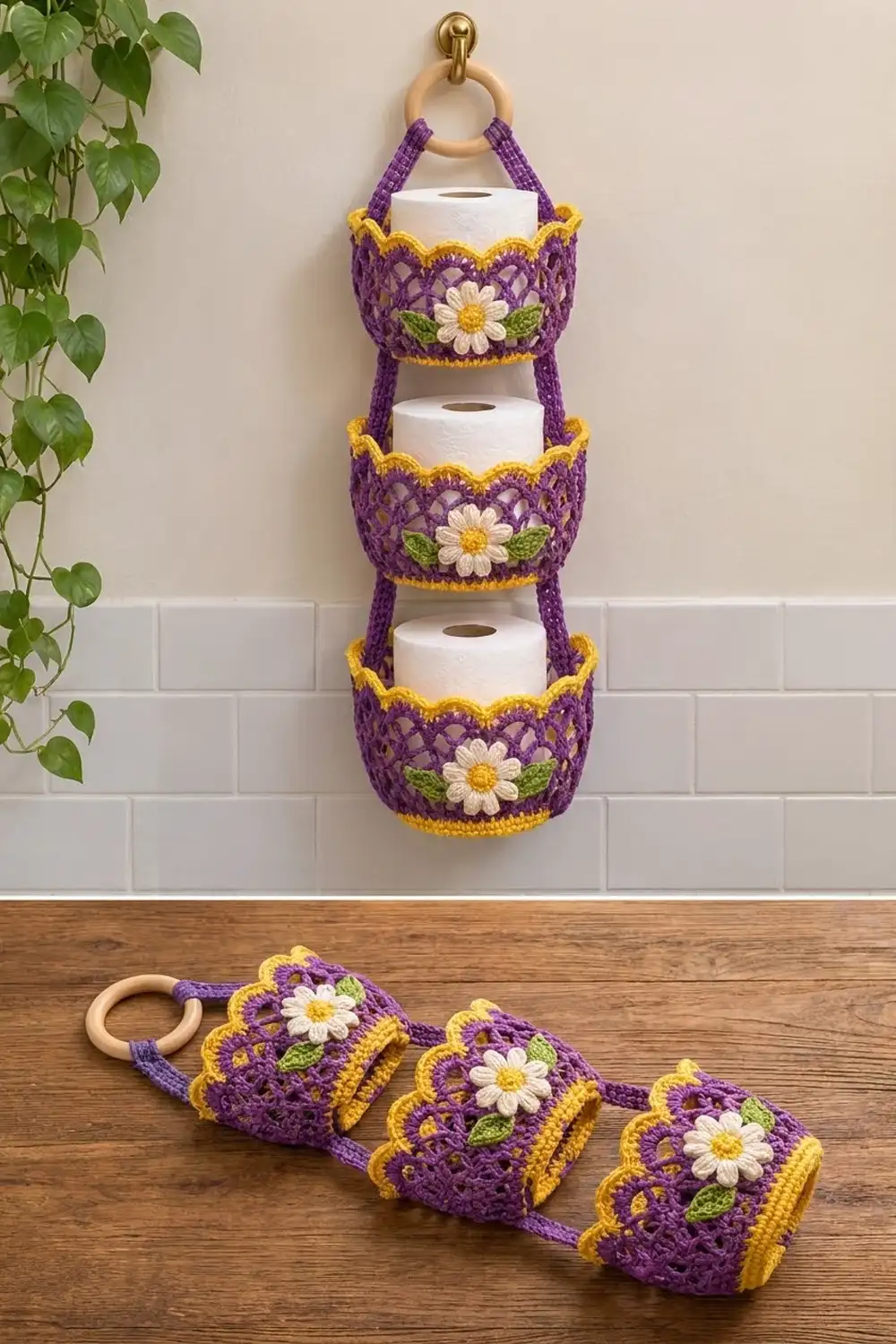
This hanging holder stores three spare rolls in a stack of small round baskets. Each basket has an open purple mesh wall, a solid golden-yellow base and a yellow scalloped rim. A cream daisy with green leaves sits on the front of each one.
The palette is purple, golden yellow, cream and leaf green, and the hanger is a plain wooden ring. The look is cottage-style and cheerful. The open mesh makes it easy to see when you are running low on rolls.
This pattern uses US crochet terms. The finished holder is about 19 in (48.3 cm) long from the ring down to the base of the bottom basket, or about 22 in (55.9 cm) including the ring. Each basket is 5.25 in (13.3 cm) across at the base, about 6 in (15.2 cm) across the rim and 4 in (10.2 cm) tall.
You will work three baskets from the bottom up in joined rounds, then add a scalloped border. Next you make two long flat straps, sew them down opposite sides of the baskets and loop them over a wooden ring. Last, you sew a daisy and two leaves to the front of each basket.
Finished Size and Construction
- Finished size: 19 in (48.3 cm) long below the ring, 22 in (55.9 cm) overall, 6 in (15.2 cm) wide at the rims
- Skill level: Intermediate
- Terminology: US
- Yarn weight: Worsted (#4) cotton
- Hook: US H-8 (5.0 mm)
- Number of pieces: 14 (3 baskets, 2 straps, 3 daisies, 6 leaves), plus 1 wooden ring
- Layout: One vertical column of 3 baskets with 1.5 in (3.8 cm) gaps
- Piece size: Each basket is 5.25 in (13.3 cm) base diameter × 4 in (10.2 cm) tall
- Size before border: 3.2 in (8.1 cm) tall
- Border depth: 0.8 in (2.0 cm)
Materials
Use a smooth worsted-weight cotton or cotton blend. Cotton holds the basket shape, handles bathroom humidity well and washes easily. Avoid very soft acrylics, which let the mesh sag under the weight of a roll.
- Purple: 100 g, about 155 m (baskets, mesh, straps)
- Golden yellow: 80 g, about 124 m (bases, rims, daisy centers)
- Cream: 15 g, about 23 m (daisy petals)
- Green: 15 g, about 23 m (leaves)
These quantities include a margin of roughly 25 percent for gauge swatches and any rounds you need to work again.
Tools:
– US H-8 (5.0 mm) crochet hook
– Wooden ring, 3 in (7.6 cm) diameter
– Tapestry needle
– 4 locking stitch markers
– Rustproof pins
– Measuring tape
– Scissors
Abbreviations (US Terms)
- ch: chain
- sl st: slip stitch
- sc: single crochet
- hdc: half double crochet
- dc: double crochet
- BLO: back loop only
- sp: space
- sk: skip
- st(s): stitch(es)
- MR: magic ring
- rep: repeat
Special stitch: Scallop. Work 7 dc into the same stitch. In the rim round, each scallop sits between two skipped stitches on each side, so it fans out flat without ruffling.
Gauge and Checkpoints
Gauge: 16 sc × 18 rows = 4 in (10.2 cm) in sc with a 5.0 mm hook. That works out to 4 sc and 4.5 rows per inch.
Make one complete basket before you start the others, and check it at each stage:
- After Round 5: Base is 2.4 in (6.1 cm) across.
- After Round 11: Base is 5.25 in (13.3 cm) across and lies flat.
- After Round 14: The yellow wall band stands upright and is 0.7 in (1.8 cm) tall.
- After Round 19: Basket is 3.2 in (8.1 cm) tall, measured with light tension on the mesh.
- After Round 22: Basket is 4 in (10.2 cm) tall and about 6 in (15.2 cm) across the rim.
If your basket is too big, go down to a 4.5 mm hook. If it is too small or the base cups up, go up to a 5.5 mm hook. Measure every checkpoint again after changing hooks. A roll should drop in easily and still leave a little room around it.

Basket (Make 3)
Base
Use golden yellow. Join each round to the first stitch with a sl st, and start each round with ch 1, which does not count as a stitch.
- Round 1: Make an MR and work 6 sc into it. (6 sts)
- Round 2: 2 sc in each st. (12 sts)
- Round 3: (sc in next st, 2 sc in next st) × 6. (18 sts)
- Round 4: (sc in next 2 sts, 2 sc in next st) × 6. (24 sts)
- Round 5: (sc in next 3 sts, 2 sc in next st) × 6. (30 sts)
- Round 6: (sc in next 4 sts, 2 sc in next st) × 6. (36 sts)
- Round 7: (sc in next 5 sts, 2 sc in next st) × 6. (42 sts)
- Round 8: (sc in next 6 sts, 2 sc in next st) × 6. (48 sts)
- Round 9: (sc in next 7 sts, 2 sc in next st) × 6. (54 sts)
- Round 10: (sc in next 8 sts, 2 sc in next st) × 6. (60 sts)
- Round 11: (sc in next 9 sts, 2 sc in next st) × 6. (66 sts)
The base should now be 5.25 in (13.3 cm) across, with a circumference of 16.5 in (41.9 cm).
Yellow Wall Band
- Round 12: sc in BLO of each st. (66 sts) The unused front loops form a ridge, and the work turns upward to start the wall.
- Rounds 13–14: sc in each st. (66 sts) On the final sl st of Round 14, pull through with purple and fasten off yellow.
Purple Diamond Mesh
- Round 15: ch 1, sc in first st, ch 5, sk 2 sts, sc in next st, ch 5, sk 2 sts; rep from * around. Finish with ch 2 and a dc into the first sc. The ch 2 plus dc makes the last loop and leaves your hook at the center of that loop. (22 loops)
- Round 16: ch 1, sc around the post of the joining dc, ch 5, sc in next ch-5 sp; rep from * 20 more times. Finish with ch 2 and a dc into the first sc. (22 loops)
- Rounds 17–18: Work as Round 16. (22 loops each)
- Round 19: ch 1, sc around the post of the joining dc, ch 5, sc in next ch-5 sp; rep from * 20 more times. Finish with ch 5 and a sl st into the first sc. (22 full-size loops)
Each sc sits at the center of a loop from the round below, which forms the diamond lattice. The mesh flares slightly from 5.25 in (13.3 cm) to about 6 in (15.2 cm), which matches the photo.
Border (Basket Rim)
Border gauge: 3 sc per ch-5 loop. Each loop is about 0.75 in (1.9 cm) wide, so 3 sc keeps the rim at 4 sc per inch, the same as the main gauge.
- Round 20 (purple, conversion round): sl st into the first ch-5 sp, ch 1, then work 3 sc in each ch-5 sp around. Join and fasten off purple. (22 loops × 3 sc = 66 sts)
- Round 21 (yellow): Join yellow with a sc in any st, then sc in each remaining st around. Join. (66 sts)
- Round 22 (yellow, scallop round): ch 1, sc in next st, sk 2 sts, 7 dc in next st, sk 2 sts; rep from * 10 more times. Join to the first sc and fasten off. (11 sc + 77 dc = 88 sts, 11 scallops)
Why the math works: The mesh has 22 loops, and 22 × 3 = 66, the same count as the base. Each scallop repeat uses 6 stitches (1 + 2 + 1 + 2), and 66 ÷ 6 = 11, so the scallops close evenly with no partial repeat. The border is one sc round (0.2 in, 0.5 cm) plus one shell round (0.6 in, 1.5 cm), for a total of 0.8 in (2.0 cm).
Marking the strap lines: On Round 21, place a marker in st 1 and another in st 34. These two points are directly opposite each other, with 33 sts between them on each side. Weave in all ends.
Straps (Make 2)
Use purple. Each strap is worked lengthwise.
- Foundation: ch 81.
- Row 1: sc in 2nd ch from hook and in each ch across. Turn. (80 sts)
- Rows 2–4: ch 1, sc in each st across. Turn. (80 sts)
Fasten off. Each strap is 20 in (50.8 cm) long and 0.9 in (2.3 cm) wide.
Count stitches from one end of the strap and place markers at these points:
| Strap sts | Length | Use |
|---|---|---|
| 1–4 | 1 in (2.5 cm) | Tab that folds around the ring |
| 5–20 | 4 in (10.2 cm) | Hanger section |
| 21–36 | 4 in (10.2 cm) | Top basket |
| 37–42 | 1.5 in (3.8 cm) | Gap |
| 43–58 | 4 in (10.2 cm) | Middle basket |
| 59–64 | 1.5 in (3.8 cm) | Gap |
| 65–80 | 4 in (10.2 cm) | Bottom basket |
That is 4 + 16 + 16 + 6 + 16 + 6 + 16 = 80 sts.
Daisy (Make 3)
- Round 1 (yellow): Make an MR and work 10 sc into it. Join and fasten off. (10 sts, about 0.6 in, 1.5 cm across)
- Round 2 (cream): Join cream with a sl st in any sc. ch 5, sc in 2nd ch from hook, hdc in next ch, dc in next 2 ch, sl st in the same sc at the base, sl st in next sc; rep from * around. (10 petals)
The finished daisy is about 2.6 in (6.6 cm) across. Pull the magic ring tight so the yellow center stands up a little above the petals.
Leaf (Make 6)
Use green.
- ch 8. Work sc in 2nd ch from hook, hdc in next ch, dc in next 3 ch, hdc in next ch, sc in last ch. (7 sts)
- ch 2 for the leaf tip.
- Working along the other side of the chain: sc, hdc, dc in next 3 ch, hdc, sc. (7 sts)
- sl st into the first sc. (14 sts plus the ch-2 tip)
Each leaf is 1.75 in (4.4 cm) long.
Make All Pieces
| Piece | Qty | Colors |
|---|---|---|
| Basket | 3 | Yellow and purple |
| Strap | 2 | Purple |
| Daisy | 3 | Yellow and cream |
| Leaf | 6 | Green |
Layout:
           ( wooden ring )
           /             \
       Strap A         Strap B
   [ Basket 1 — top     ]
          1.5 in gap
   [ Basket 2 — middle  ]
          1.5 in gap
   [ Basket 3 — bottom  ]
Joining
Method: Whipstitch with purple yarn. Lay each strap on the outside of each basket, centered over the Round 21 markers.
Stitch-to-stitch logic: Each basket is 4 in (10.2 cm) tall, and so is each 16-st strap section. Within each section, match the strap stitches to the basket like this:
- First 3 strap sts: Sew to the border (Rounds 20–22).
- Next 10 strap sts: Sew to the mesh (Rounds 15–19). That works out to 2 strap sts per mesh round.
- Last 3 strap sts: Sew to the yellow wall band (Rounds 12–14).
So for the top basket, strap st 21 sits level with the top of the scallops and strap st 36 sits at the Round 12 ridge.
Sewing: Sew down both long edges of the strap. Where the strap crosses the mesh, catch the sc at the center of each loop rather than the chains, so the wall stays firm. Repeat with Strap B at the opposite marker on all three baskets.
Ring: Pass strap sts 1–4 around the wooden ring and fold them behind sts 5–8. Whipstitch the tab down on all sides, then do the same with the second strap. Check that both straps are the same length and are not twisted.
Tension: Make your sewing stitches about as firm as your crochet. If you pull too tight, the straps pucker and the gaps get shorter. If you sew too loosely, the baskets tip forward.
Size checkpoint: Hang the holder empty. Each gap between baskets should measure 1.5 in (3.8 cm), and the distance from the ring to the base of the bottom basket should be 19 in (48.3 cm).
Appliqués: Sew one daisy to the front of each basket, centered between the two straps. The petals should overlap the lower mesh and the yellow band. Sew one leaf on each side of the daisy, angled slightly upward, with the wide end tucked under the petals.
Final Blocking
- Weave in any loose ends before you block.
- Mist the holder with water until it is evenly damp.
- Put a toilet roll or a 5.25 in (13.3 cm) round container inside each basket.
- Shape each rim by hand so the scallops fan out evenly and stand upright.
- Pin the daisy petals and leaves flat against the mesh.
- Hang the holder or lay it flat, and leave it until fully dry, usually about 24 hours.
- Remove the forms and check the measurements again.
Final Quality-Control Checklist
- Each base has 66 sts and lies flat at 5.25 in (13.3 cm).
- Each basket has 22 mesh loops in every round.
- Each rim has 11 even scallops.
- Each basket is 4 in (10.2 cm) tall.
- Both straps have 80 sts and are sewn exactly opposite each other.
- The gaps between baskets are 1.5 in (3.8 cm).
- The daisies are centered, with leaves balanced on both sides.
- All ends are woven in securely.
Troubleshooting
- Base ruffles: Your tension is loose. Go down a hook size, or check that you have exactly 6 increases per round.
- Base cups up before Round 12: Your tension is tight. Go up a hook size.
- Mesh loops slant: Make sure each sc goes into the loop’s ch-5 space, not into a chain stitch.
- Scallops do not close evenly: Count Round 21 again. It must have exactly 66 sts.
- Baskets tilt forward: The straps are not directly opposite each other. Re-sew them at the st 1 and st 34 markers.
- Holder is too long: You sewed the straps loosely, so they stretched. Re-sew the joins a little firmer.
Care
Hand wash in cool water and reshape while damp. Lay flat or hang to dry, and do not tumble dry.
Final Notes
The sizes in this pattern build on each other. A gauge of 4 sc per inch gives a 66-st base that measures 5.25 in (13.3 cm). That base carries 22 mesh loops, which become 66 border sts and 11 scallops, for a basket 4 in (10.2 cm) tall. Each 80-st strap is 20 in (50.8 cm) long and spaces the three baskets 1.5 in (3.8 cm) apart, so the holder hangs 19 in (48.3 cm) below its ring. If you check each measurement as you go, the finished holder will match. Happy crocheting!