

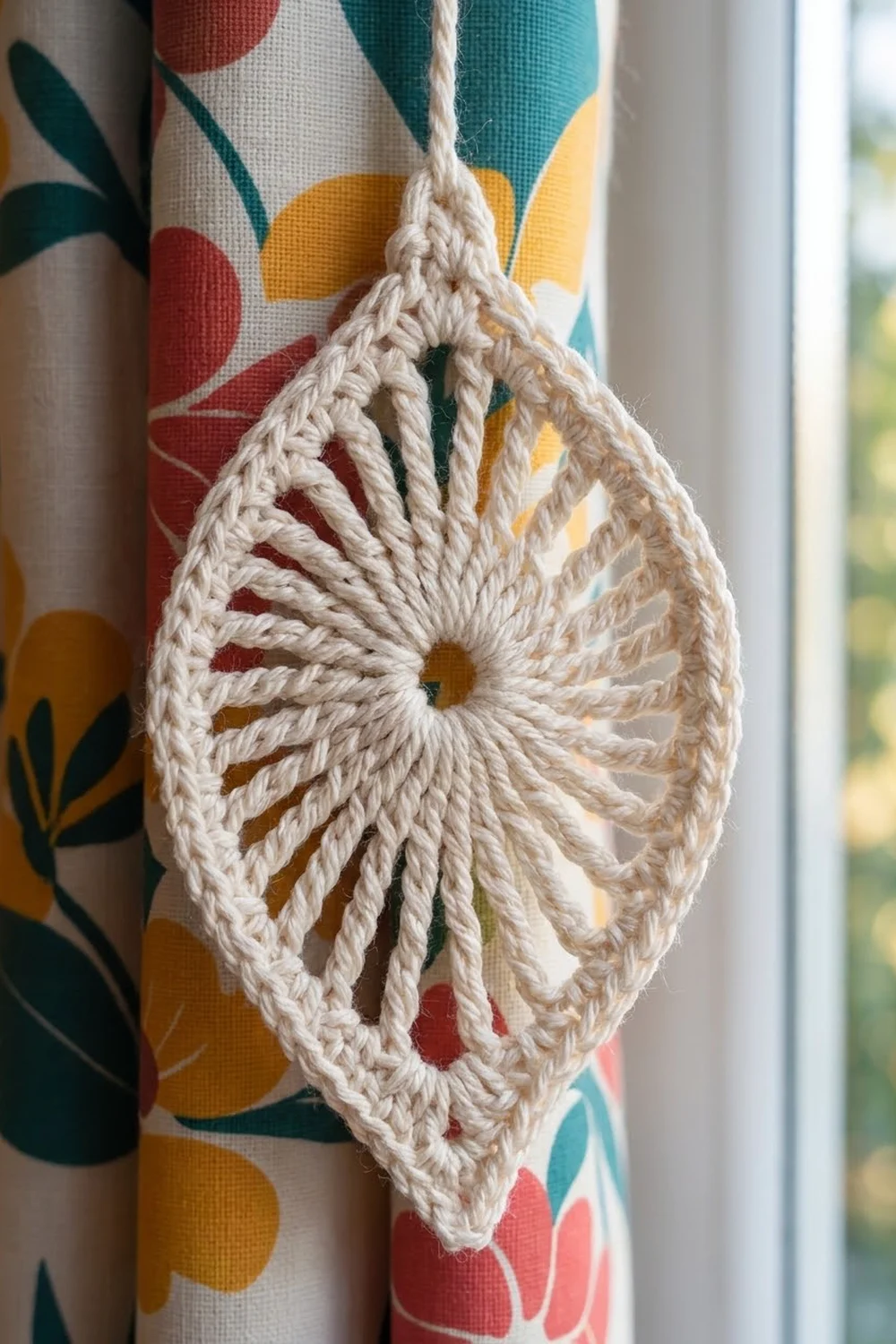
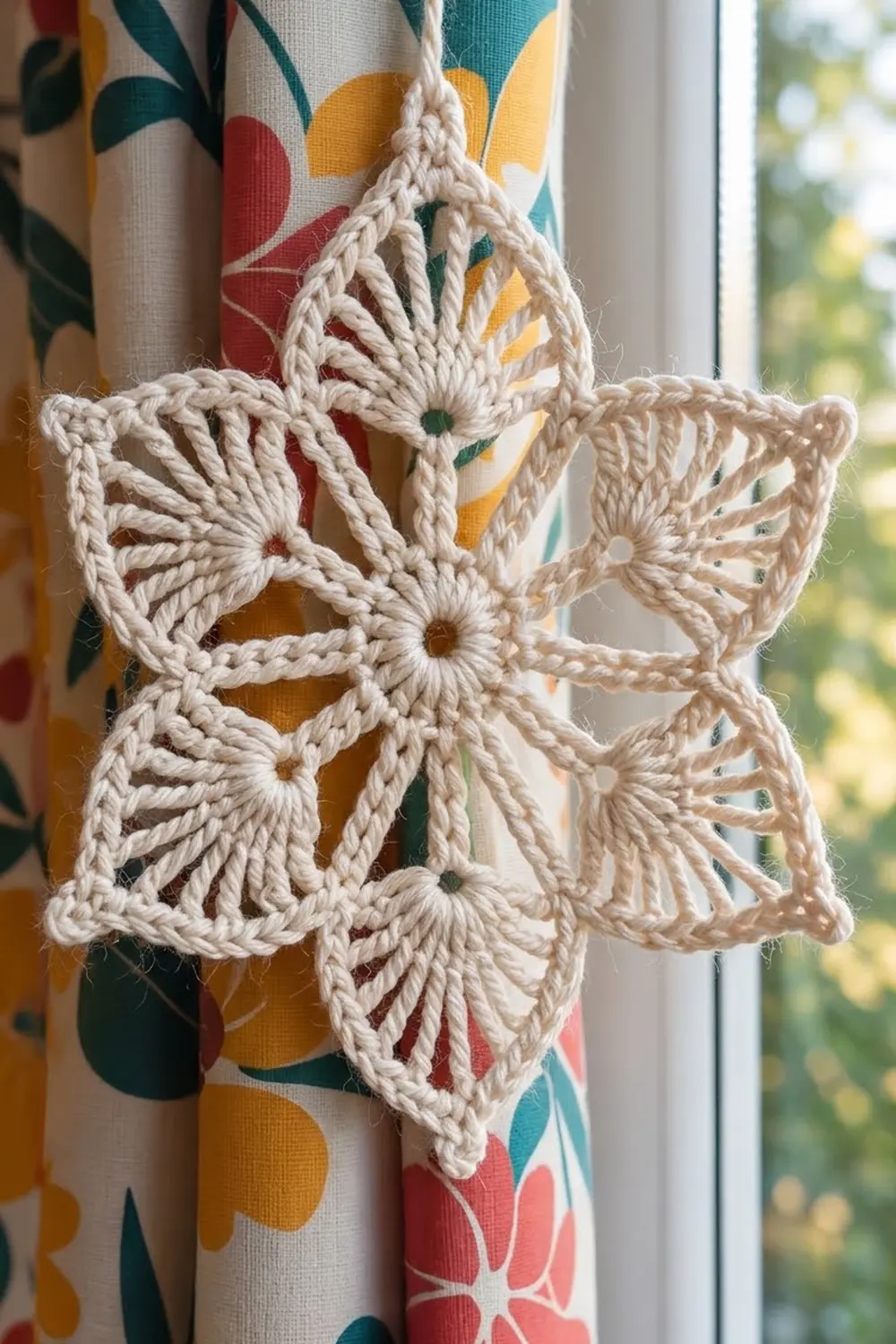
The Window Bloom Star is a single six-petal crochet motif with a light, lacy look. Each pointed petal holds a fan of tall treble stitches that spreads out from a small eyelet near the center. A crisp single crochet outline frames every fan and ends in a sharp tip.
The sample uses one color, a soft cream cotton. A single color shows off the openwork, so the motif works well hung in a window, tied to a curtain, or laid on a table as a small doily. The style is traditional and light without being fussy.
The pattern uses US crochet terms. The finished motif measures about 7 in (17.8 cm) from tip to opposite tip and about 4.75 in (12.1 cm) between opposite notches. A chain loop at one tip lets you hang it.
You work the whole motif in the round, in 5 rounds, without turning. Round 1 makes the solid center ring. Round 2 adds six chain arches. Round 3 puts a 9-treble fan in each arch. Rounds 4 and 5 form the outline: first an open chain frame, then a solid single crochet edge with a pointed tip on each petal.
Finished Size and Construction
- Finished size: 7 in (17.8 cm) tip to tip; 4.75 in (12.1 cm) notch to notch
- Skill level: Easy intermediate
- Terminology: US crochet terms
- Yarn weight: DK (light worsted, #3) cotton
- Hook: 3.5 mm (E-4)
- Number of pieces: 1 single motif
- Layout: One stand-alone six-petal star, no joining
- Piece size: 7 in (17.8 cm) tip to tip
- Size before border (after Round 3): about 4.5 in (11.4 cm) across the fan tops
- Border depth (Rounds 4–5): about 1.25 in (3.2 cm) on each side
Materials
Yarn: Use a smooth mercerized or combed DK cotton. Cotton shows the treble fans clearly and holds a crisp point after blocking. Avoid fuzzy or very soft acrylics, which blur the openwork and let the tips curl.
- Cream (main color): 20 g, about 42 m (46 yd)
The motif itself takes about 15 g. The amount listed includes a margin for a test motif, a longer hanging loop, and weaving in ends.
If you only have sport-weight cotton, the motif will finish at about 6 in (15.2 cm) tip to tip with a 3 mm hook. Use the checkpoints below to judge the result.
Tools:
- 3.5 mm (E-4) crochet hook
- Tapestry needle
- Scissors
- Rust-proof pins
- Blocking mat or folded towel
- Spray bottle of water
- Optional: fabric stiffener or light spray starch
- Optional: thin cord or ribbon for hanging, about 12 in (30.5 cm)
Abbreviations (US Terms)
- ch – chain
- sl st – slip stitch
- sc – single crochet
- dc – double crochet
- tr – treble crochet (yarn over twice, insert hook, pull up a loop, [yarn over, pull through 2 loops] 3 times)
- sk – skip
- sp – space
- st(s) – stitch(es)
- MR – magic ring
- [ ] – repeat the instructions inside the brackets as directed
Special stitch – Tip Point: (3 sc, ch 3, 3 sc), all worked into the same ch-5 space. The ch-3 sits in the middle and forms the sharp point of the petal.
Note: The ch 3 at the start of Round 1 counts as a dc. In every other round, the ch 1 at the start does not count as a stitch.
Gauge and Checkpoints
Make one test motif before you start a larger batch, such as a set of ornaments. One motif takes less than an hour and shows you exactly how your gauge compares.
Checkpoints:
- After Round 1: the solid dc ring measures 1.25 in (3.2 cm) across.
- After Round 3: the fans measure 4.5 in (11.4 cm) across, from the top of one fan to the top of the opposite fan.
- After Round 5 (unblocked): about 6.75 in (17.1 cm) tip to tip.
- After blocking: 7 in (17.8 cm) tip to tip and 4.75 in (12.1 cm) notch to notch.
If your motif is too big: go down to a 3.25 mm (D-3) hook, or work the chain arches in Round 2 a little tighter.
If your motif is too small: go up to a 3.75 mm (F-5) hook. Also make sure your trebles reach their full height, because short trebles make stubby petals.
If only the edge is off: if Rounds 1–3 match but the outline ruffles or cups, see the Border section and the Troubleshooting list.
Pattern
Round 1 – Center Ring
Make a MR. Ch 3 (counts as the first dc), then work 17 dc into the ring. Pull the tail to close the center, leaving a small hole. Join with a sl st to the top of the starting ch 3.
Stitch count: 18 dc.
Checkpoint: 1.25 in (3.2 cm) across. The ring should lie flat. If it cups, your dc are too tight. If it ruffles, they are too loose.
Round 2 – Eyelet Arches
Ch 1. Sc in the same st as the join. [Ch 5, sk 2 dc, sc in next dc] 5 times. Ch 5, sk the last 2 dc, and join with a sl st to the first sc.
Stitch count: 6 sc and 6 ch-5 spaces.
Math check: each repeat uses 3 dc from Round 1 (1 sc + 2 skipped). 6 repeats × 3 dc = 18 dc, so every stitch of Round 1 is used.
Each ch-5 arch leaves a small gap between itself and the center ring. That gap becomes the eyelet at the base of each petal. Keep the chains even and count them carefully. A ch-4 arch crowds the fans, and a ch-6 arch makes them loose.
Round 3 – Fans
Ch 1. Sc in the same st as the join. [9 tr in next ch-5 sp, sc in next sc] 5 times. Work 9 tr in the last ch-5 sp, then join with a sl st to the first sc.
Stitch count: 60 sts (54 tr + 6 sc).
Each petal now has 9 tr fanned out of one arch, with 1 sc anchoring the gap between petals. Work each tr around the whole arch, not into single chains. That way you can slide the stitches along and space them evenly so each fan opens like a shell.
Number the trebles of each fan 1 to 9 in your head, because Round 4 uses those numbers.
Checkpoint: 4.5 in (11.4 cm) from fan top to fan top. This is your size before the border.
Round 4 – Open Frame
This round puts chain loops around each fan, which creates the open gaps between the fan and the outline.
Ch 1. Sc in the same st as the join (the sc between petals). Then work the petal repeat:
[Ch 4, sk tr 1 and 2, sc in tr 3, ch 4, sk tr 4, (sc, ch 5, sc) in tr 5, ch 4, sk tr 6, sc in tr 7, ch 4, sk tr 8 and 9, sc in next sc] 6 times. On the last repeat, sl st to the first sc instead of working the final sc.
Stitch count: 30 sc (6 between-petal sc + 4 sc per petal × 6), 24 ch-4 spaces, and 6 ch-5 tip spaces.
The skips are symmetrical: 2 tr, then 1, then the center tr, then 1, then 2. This puts the tip exactly on tr 5, the middle of the fan, so each petal points straight out from the center.
Keep the chains relaxed but not sloppy. After each ch-4, give it a light tug and check that it arcs just above the fan without pulling the trebles together.
Round 5 – Solid Outline
Ch 1. Then work the petal repeat:
[Sc in the between-petal sc, 4 sc in next ch-4 sp, sc in next sc, 4 sc in next ch-4 sp, sc in next sc, Tip Point in the ch-5 sp, sc in next sc, 4 sc in next ch-4 sp, sc in next sc, 4 sc in next ch-4 sp] 6 times. Join with a sl st to the first sc.
Stitch count per petal: 27 sc + 1 ch-3 tip.
Per-petal breakdown: 1 + 4 + 1 + 4 + 1 + 3 (Tip Point) + 3 (Tip Point) + 1 + 4 + 1 + 4 = 27 sc.
Round total: 162 sc (27 × 6) + 6 ch-3 tips.
Push the 4 sc in each space snugly together as you go so the outline looks solid. If you want the chain hanging loop, don’t fasten off yet.
Hanging Loop
After the final join, sl st across the stitches to the ch-3 tip of the nearest petal, then sl st into the ch-3 sp. Ch 40, then sl st back into the same ch-3 sp to make a loop about 8 in (20.3 cm) long. Fasten off and weave in all ends.
If you prefer, skip the chain loop and thread a cord or ribbon through one ch-3 tip instead.
Border
On this motif, Rounds 4 and 5 are the border. They turn the round fans into pointed petals and add about 1.25 in (3.2 cm) on each side.
Border gauge: in Round 5, 18 sc = 4 in (10.2 cm), measured along a straight section of the outline.
Round 4 counts per petal: 4 sc on the fan (in tr 3, 2 in tr 5, and 1 in tr 7) plus 1 shared sc between petals, with 4 ch-4 spaces and 1 ch-5 tip.
Round 5 counts per petal: 27 sc, made up of two equal sides of 13 sc plus 1 between-petal sc:
- Side going up: 4 + 1 + 4 + 1 + 3 = 13 sc
- Side coming down: 3 + 1 + 4 + 1 + 4 = 13 sc
- Between-petal sc: 1
13 + 13 + 1 = 27 sc per petal, and 27 × 6 = 162 sc.
Why the math works: Each ch-4 space gets exactly 4 sc, one per chain, so the outline lies flat without stretching or ruffling. Each sc from Round 4 gets 1 sc, so the outline lines up with the frame below it. The Tip Point puts 6 sc and a ch-3 into one space, and that extra fullness in one spot forces a sharp point. The between-petal sc is worked only once, so the two edges meet in a neat V instead of a rounded curve.
Final Blocking
- Weave in all ends before blocking. Hide them along the solid outline and inside the center ring, never across the open spaces.
- Soak the motif in cool water for 10 minutes. Roll it in a towel and press out the water gently. Do not wring.
- Lay the motif face up on a blocking mat and pin the center ring flat first.
- Pin each of the 6 ch-3 tips outward until each tip is 7 in (17.8 cm) from the opposite tip. Check all three tip-to-tip lines.
- Pin each of the 6 V notches until each notch is 4.75 in (12.1 cm) from the opposite notch.
- Open each fan with your fingers so the trebles spread evenly and the eyelet at the base of each petal is round. Put a pin through each eyelet if it tends to close.
- Optional: spray lightly with fabric stiffener or starch for a crisp ornament or window piece.
- Let it dry completely, at least 12 hours, before unpinning.
Final Quality-Control Checklist
- The center ring is flat with a small, neat hole.
- 6 eyelets show, one at the base of each petal.
- Each fan has exactly 9 tr.
- Each petal points straight out from the center, with the tip in line with tr 5.
- Round 5 has 27 sc per petal and 162 sc in total.
- All 6 tips are sharp and the same length.
- All 6 notches form clean V shapes.
- Tip to tip is 7 in (17.8 cm), and notch to notch is 4.75 in (12.1 cm).
- The hanging loop is secure and all ends are hidden.
Troubleshooting
The center cups like a bowl. Your Round 1 dc are tight. Redo the round with looser stitches, or use a hook one size up for Round 1 only.
The fans look crowded or wavy. The Round 2 arches are too short. Loosen the chains, or change to ch 6 and recheck the 4.5 in (11.4 cm) checkpoint.
The eyelets close up. Your Round 2 sc are pulling the arches down onto the ring. Keep the sc relaxed, then pin the eyelets open when blocking.
The petal tips lean to one side. The Round 4 tip isn’t on tr 5. Count the trebles again. The skips should go 2, 1, tip, 1, 2.
The Round 5 count is off. Usually one ch-4 space got 3 or 5 sc. Count each petal on its own and check that it has 27 sc before moving on.
The outline ruffles. You’re working more than 4 sc in a ch-4 space, or your sc are loose. Recount and tighten your tension.
The outline pulls in and the petals curl. Your sc are too tight. Go up half a hook size for Round 5 only.
The tips are rounded instead of pointed. Make sure you work the full Tip Point (3 sc, ch 3, 3 sc) into the ch-5 space, then pin the tip firmly when blocking.
The motif comes out small. Your trebles may be short. Pull the first loop up to the full height of the hook before you finish each tr.
Care
Hand wash in cool water with mild soap, press out the water in a towel, and lay flat to dry, reshaping the tips. If you used stiffener, reapply it after washing.
Final Notes
Here is the full measurement chain. Round 1 has 18 dc and measures 1.25 in (3.2 cm) across. Round 2 turns those 18 dc into 6 arches. Round 3 has 60 sts and measures 4.5 in (11.4 cm) across the fans. Rounds 4 and 5 add 1.25 in (3.2 cm) on each side and finish with 162 sc and 6 pointed tips. After blocking, the motif measures 7 in (17.8 cm) tip to tip and 4.75 in (12.1 cm) notch to notch.
If your first motif hits these checkpoints, your next ones will match it. Hang one in a window, tie one to a curtain, or make a few as gifts.
Happy crocheting!