

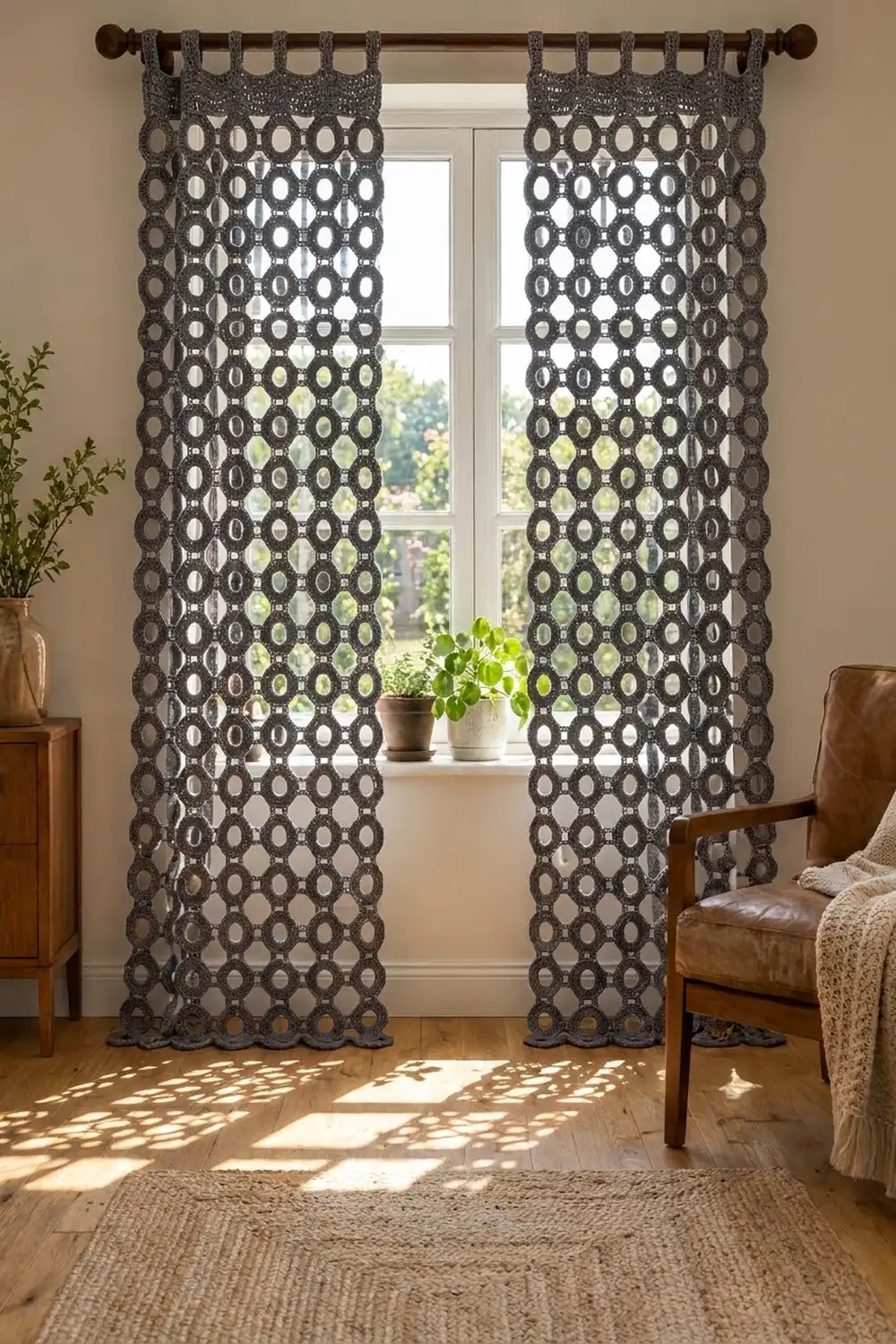
These curtain panels are made of open octagon rings joined into an airy lattice. Light passes through every ring and the small windows between them, so a plain window gets soft geometric shadows while the curtains still give some privacy.
The design uses one color: a deep charcoal gray. A tweedy yarn with faint flecks gives it a modern, slightly rustic look that works with wood, linen, and green plants. Each ring is solid and firm, so the panel hangs straight instead of sagging like a looser lace curtain.
The pattern uses US crochet terms. Each finished panel measures 31 in (78.7 cm) wide and 83.5 in (212.1 cm) long from the top of the band to the bottom row of rings. The tab loops add another 3 in (7.6 cm) above the band.
Construction is simple. You crochet the octagon rings in three rounds and join them as you go on the last round with short double chain bars. After that, you work a solid top band and six tab loops straight onto the top row of rings. Make two panels.
Finished Size and Construction
- Finished panel size: 31 in × 83.5 in (78.7 cm × 212.1 cm), plus 3 in (7.6 cm) tab loops
- Skill level: Intermediate
- Terminology: US crochet terms
- Yarn weight: Worsted (#4)
- Hook: 5.0 mm (H-8)
- Number of pieces: 252 octagon motifs (126 per panel); the bands and tabs are worked onto the panels
- Layout per panel: 7 motifs wide × 18 motifs tall
- Single motif size: 4 in (10.2 cm) from flat side to flat side
- Gap between joined motifs: 0.5 in (1.3 cm)
- Size before top band: 31 in × 80.5 in (78.7 cm × 204.5 cm)
- Top band depth: 3 in (7.6 cm); sides and bottom have no border
Materials
Yarn: Choose a smooth or lightly tweedy worsted-weight yarn made of cotton or a cotton blend. Cotton holds the octagon corners crisply and stretches less over a long drop than acrylic. Choose a dark color that won’t fade quickly in sun.
- Charcoal gray: 1,400 g / 2,380 m (2,603 yd), about fourteen 100 g balls of 170 m (186 yd) each
Each motif uses about 7 m (7.7 yd). The two bands and twelve tabs together use about 190 m (208 yd). The amount above includes a margin of about 20% for gauge differences, swatching, and weaving in ends.
Tools:
- 5.0 mm (H-8) crochet hook
- Tapestry needle
- Stitch markers
- Measuring tape
- Blocking mats and rust-proof pins
- Spray bottle
- Curtain rod up to 1.5 in (3.8 cm) in diameter
Abbreviations (US Terms)
- ch: chain
- sl st: slip stitch
- sc: single crochet
- hdc: half double crochet
- dc: double crochet
- sp: space
- st(s): stitch(es)
- RS / WS: right side / wrong side
Special stitch: Joining bar. Work an sc, then ch 2. Sl st in the indicated sc on the neighboring motif, ch 2, and sl st into the top of the sc you just made. This makes a short double chain bar between the two motifs.
Gauge and Checkpoints
Band gauge: 14 sc and 16 rows of sc = 4 in (10.2 cm).
Motif gauge: One finished motif measures 4 in (10.2 cm) from flat side to flat side.
Make one complete motif before you start joining, and measure it at each stage:
- After Round 1: the center opening is about 2.25 in (5.7 cm) across.
- After Round 2: about 3.25 in (8.3 cm) across.
- After Round 3: 4 in (10.2 cm) from flat side to flat side.
- Two motifs joined: 8.5 in (21.6 cm) from outer flat side to outer flat side.
- Three motifs joined: 13 in (33.0 cm).
If your motif is larger than 4 in (10.2 cm), go down half a hook size. If it is smaller, go up half a size. Even a 0.25 in difference per motif adds up to 4.5 in over 18 rows, so check this before you go any further.
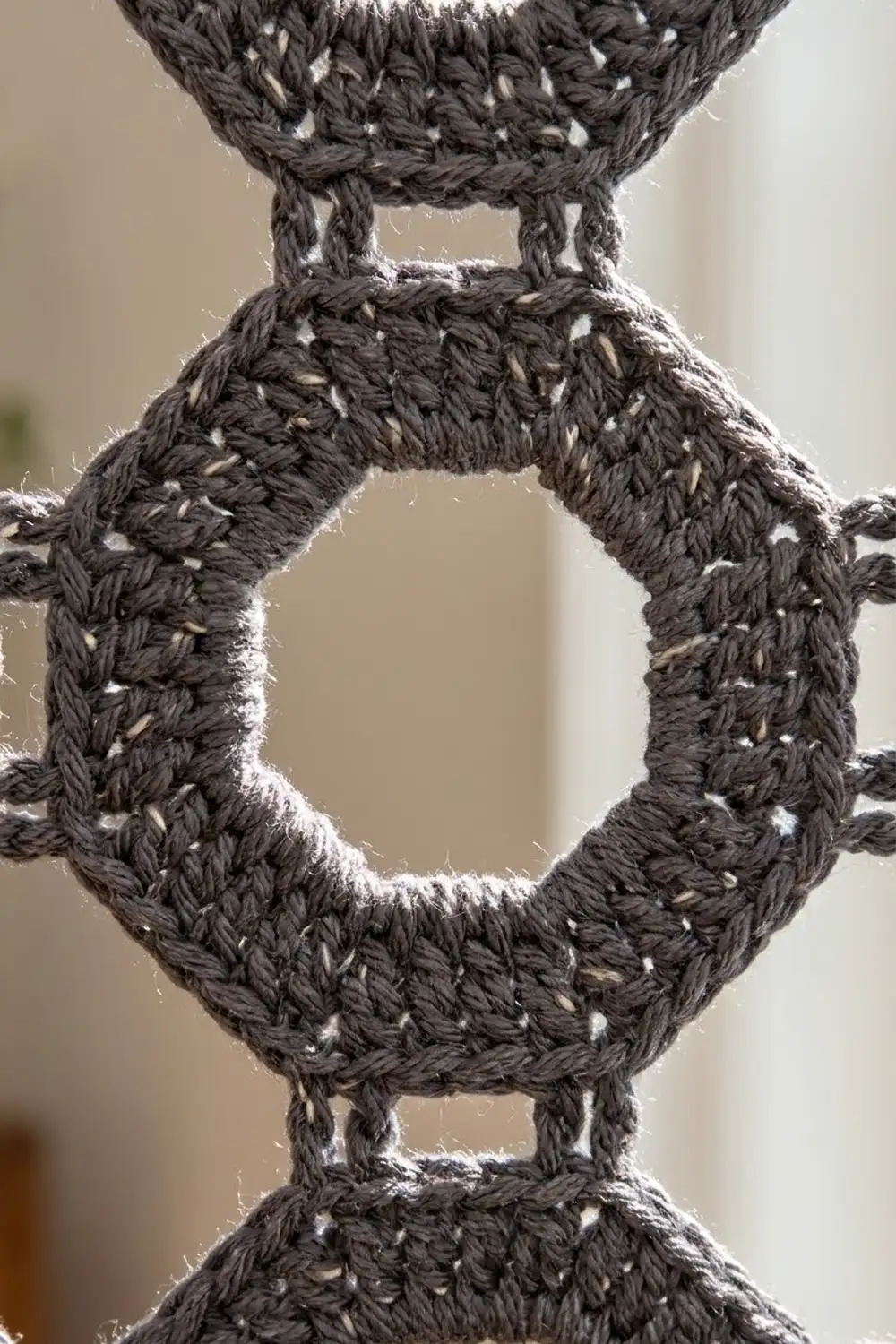
Octagon Ring Motif
Ch 24 and sl st in the first ch to form a ring. Make sure the chain isn’t twisted.
Round 1: Ch 1. Work 1 sc in each ch around. Sl st in the first sc to join. (24 sc)
Round 2 (growth round): Ch 3 (counts as dc). Work 1 dc in the same st, then 1 dc in each of the next 2 sts. Work 2 dc in the next st, then 1 dc in each of the next 2 sts. Repeat from * to * 6 more times. Sl st in the top of the beginning ch-3 to join. (32 dc: 8 groups of 4)
Round 3 (shaping round): Ch 1. Work (sc, ch 2, sc) in the next st, then 1 sc in each of the next 3 sts. Repeat from * to * 7 more times. Sl st in the first sc to join. Fasten off.
Count: 32 sc (one in each Round 2 st) + 8 extra sc (one extra in each corner) = 40 sc and 8 ch-2 corner spaces
The (sc, ch 2, sc) corners make the 8 points of the octagon. Each flat side has 5 sc between two corner spaces: the second sc of one corner, the 3 sc in the middle, and the first sc of the next corner. Number these 5 sc as positions 1 to 5 in the direction you are working.
Make All Pieces
Make 126 motifs per panel, or 252 motifs in total, all in charcoal gray. Make the first motif in full as described above. For every other motif, work Rounds 1 and 2 as written, then work Round 3 with the joins described in the Joining section.
Layout for each panel (O = motif, – and | = joined sides):
Row 1:   O–O–O–O–O–O–O
         | | | | | | |
Row 2:   O–O–O–O–O–O–O
         | | | | | | |
 ...     (repeat to Row 18)
Row 18:  O–O–O–O–O–O–O
Row 1 is the top row, where the band will go. Each motif joins to its neighbors only on flat sides: top, bottom, left, and right. The four diagonal sides are never joined. Where four motifs meet, their diagonal sides frame a larger open space.
Joining
Method: Join as you go on Round 3. Rounds 1 and 2 are perfectly symmetrical, so you can turn the motif before Round 3 until the right flat side faces the neighbor it needs to join.
Stitch-to-stitch logic: On each joining side, you make two Joining bars, at positions 2 and 4. The neighbor’s facing side is counted in the opposite direction, so:
- Your position 2 joins to the neighbor’s position 4.
- Your position 4 joins to the neighbor’s position 2.
This keeps the two bars parallel and makes a small rectangular window between them.
How to work a joining side: Work the corner (sc, ch 2, sc) as usual. Then:
- Work a Joining bar in the next st (position 2).
- Work 1 sc in the next st (position 3).
- Work a Joining bar in the next st (position 4).
- Continue Round 3 as written.
The motif’s count stays the same: 40 sc and 8 ch-2 corner spaces. The chains in the bars are not counted as stitches.
Joining order:
- The first motif of the panel has no joins.
- Each later motif in Row 1 joins on 1 side (its left side).
- The first motif in each later row joins on 1 side (its top side).
- Every other motif joins on 2 sides: left and top. On those motifs, one free diagonal side sits between the two joining sides.
Tension: Keep each ch-2 the same length as your sc are tall. If the bars are tight, the panel puckers and gets narrower. If they are loose, the rings droop and the panel stretches lengthwise when hung. Keep the motifs flat on the table while you join.
Size checkpoint: Row 1 should measure 31 in (78.7 cm) wide: 7 × 4 in plus 6 × 0.5 in. After 18 rows, the panel should measure 80.5 in (204.5 cm) long: 18 × 4 in plus 17 × 0.5 in.
Border: Top Band and Tab Loops
The side and bottom edges get no border, which keeps the octagon edge seen in the photo. Only the top edge gets a band.
Border gauge: 14 sc = 4 in (10.2 cm).
Top edge count: Each Row 1 motif adds 7 stitches along its top flat side: 1 sc in each of its 2 top corner spaces and 1 sc in each of the 5 sc between them. That gives 7 motifs × 7 sts = 49 sts.
The 6 gaps between the tops of the motifs are each bridged by 9 chains, adding 54 sts. Each end gets a 3-stitch extension to reach past the diagonal side of the end motif, adding 6 sts.
Total: 49 + 54 + 6 = 109 sts, which is about 31 in (78.7 cm) at 14 sts per 4 in. This matches the width of the panel.
Row 1 (RS): Make a slip knot and ch 4. Sc in the 2nd ch from the hook and in the next 2 ch (3 sc). For each motif from right to left:
- Sc in the top corner space.
- Sc in each of the 5 side sc.
- Sc in the next top corner space.
- Ch 9, except after the last motif.
After the last motif, ch 4 and turn.
Count: 3 sc + 49 sc + 54 ch + 3 ch = 109 sts, not counting the last ch, which is the turning chain.
Row 2: Sc in the 2nd ch from the hook and in the next 2 ch. Sc in each st and in each ch across, including the 3 sc at the end. Turn. (109 sc)
Rows 3–9: Ch 2 (does not count as a stitch). Hdc in each st across. Turn. (109 hdc each row)
Row 10: Ch 1. Sc in each st across. Do not fasten off. (109 sc)
Checkpoint: The band is 3 in (7.6 cm) deep and 31 in (78.7 cm) wide.
Tab loops: Make 6 tabs per panel, each 7 sts wide. Count the Row 10 stitches from right to left:
| Stitches | Use |
|---|---|
| 1 | Margin |
| 2–8 | Tab 1 |
| 9–21 | Gap |
| 22–28 | Tab 2 |
| 29–41 | Gap |
| 42–48 | Tab 3 |
| 49–61 | Gap |
| 62–68 | Tab 4 |
| 69–81 | Gap |
| 82–88 | Tab 5 |
| 89–101 | Gap |
| 102–108 | Tab 6 |
| 109 | Margin |
Check: 2 margin sts + 6 tabs × 7 sts + 5 gaps × 13 sts = 2 + 42 + 65 = 109.
For each tab:
- Join the yarn in the first stitch of the tab. Sc in that stitch and the next 6 sts (7 sc). Turn.
- Rows 2–24: Ch 1, sc in each of the 7 sts, turn.
The tab is 6 in (15.2 cm) long. Fold it to the WS and whipstitch its last row to the back of the band just below Row 10. This makes a 3 in (7.6 cm) loop that fits a rod up to 1.5 in (3.8 cm) across.
Final Blocking
- Weave in all ends along the solid ring stitches, never along the bars.
- Lay each panel flat on mats or a clean sheet. Work in sections if you need to.
- Pin each motif square to its neighbors, with the bars straight and 0.5 in (1.3 cm) long.
- Pin the band straight at 31 in (78.7 cm) wide.
- Mist everything until it’s damp, and let it dry completely.
- Hang the panel and check it again after 24 hours, since cotton relaxes a little under its own weight.
Final Quality-Control Checklist
- Each motif has 40 sc and 8 corner spaces, and measures 4 in (10.2 cm).
- Every joined side has two parallel bars, at positions 2 and 4.
- No diagonal sides are joined.
- Each panel is 7 motifs wide and 18 motifs tall.
- The motif area is 31 in × 80.5 in (78.7 cm × 204.5 cm).
- Every band row has 109 sts.
- The band is 3 in (7.6 cm) deep.
- There are 6 tabs per panel, each 7 sts wide with 13 sts between tabs.
- Both panels match in length to within 0.5 in (1.3 cm).
Troubleshooting
- Motif cups: Round 2 is too tight. Use a larger hook for Round 2 only.
- Motif ruffles: Round 1 stitches are too tall or the chain is loose. Make the ch-24 a little tighter.
- Octagon points are soft: Make sure every corner is (sc, ch 2, sc) in one stitch, not spread over two.
- Bars twist: Insert the hook in the neighbor’s sc from the front each time.
- Panel leans to one side: You joined a mirrored position. Check that position 2 joins to the neighbor’s position 4.
- Band pulls in or flares: Recount Row 2 (it should be 109) and adjust your hook size for the band.
- Tabs are uneven: Recount the gaps (13 sts each) before sewing the tabs down.
Care
Hand wash in cool water, or machine wash on a gentle cycle in a large laundry bag. Press out the water in a towel and dry the panels flat, because hanging them wet will stretch the length.
Final Notes
The measurements build on each other:
- One 4 in (10.2 cm) motif.
- Joined with 0.5 in (1.3 cm) bars, rows of 7 motifs make 31 in (78.7 cm) of width.
- Columns of 18 motifs make 80.5 in (204.5 cm) of length.
- The 109-stitch band adds 3 in (7.6 cm), bringing the panel to 83.5 in (212.1 cm).
- Six tabs hang the panel from the rod.
Check each stage against these numbers and the two panels will match. Happy crocheting!