

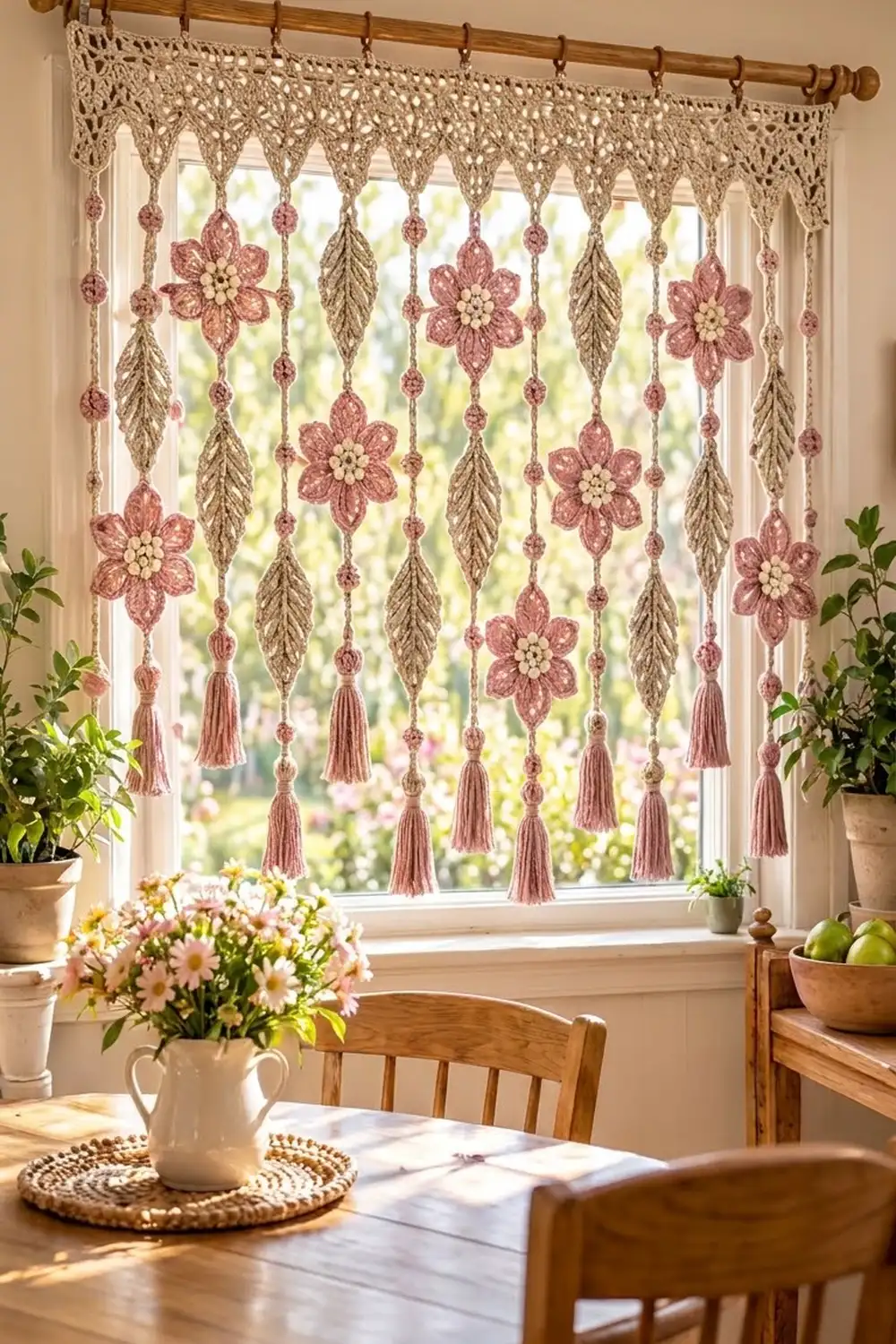
The Rosewood Garden Window Curtain is a lace header band with twelve hanging strands. The strands carry dusty-rose flowers with cream bobble centers, beige ribbed leaves, pink beads, and pink tassels. In window light, it reads like a soft garden trellis.
The colors are natural beige (header, cords, leaves), dusty rose (flowers, beads, tassels), and cream (flower centers). The style is cottage boho, with airy lace above and rich texture below.
This pattern uses US crochet terms. The finished curtain is 36.5 in (92.7 cm) wide and 37.25 in (94.6 cm) long, measured from the top of the rod tabs to the tassel tips.
You’ll work the header in rows and finish it with 12 triangular points. Then you’ll add a border all around, rod tabs along the top, and a cord down from each point tip. Flowers, leaves, beads, and tassels are made separately and sewn onto the cords.
Finished Size and Construction
- Finished size: 36.5 in (92.7 cm) wide x 37.25 in (94.6 cm) long
- Skill level: Intermediate
- Terminology: US
- Yarn weight: Worsted (#4) cotton or cotton blend
- Hook: 5.0 mm (H-8)
- Number of pieces: 85 separate pieces (1 header, 18 flowers, 18 leaves, 36 beads, 12 tassels), plus 12 cords worked directly onto the header
- Layout: 1 header with 12 strands, alternating Strand A (flower first) and Strand B (leaf first)
- Piece sizes:
- Flower: 4.5 in (11.4 cm) across
- Leaf: 5 in (12.7 cm) x 2.25 in (5.7 cm)
- Bead: 1 in (2.5 cm)
- Tassel: 3.5 in (8.9 cm)
- Strand: 30 in (76.2 cm)
- Header size before border: 36 in (91.4 cm) x 5.25 in (13.3 cm)
- Border depth: 0.25 in (0.6 cm), plus 1.5 in (3.8 cm) rod tabs on the top edge
Materials
Choose a smooth worsted-weight cotton. Cotton holds the leaf ridges and petal points crisply, and it stretches less under the weight of the strands. The amounts below assume about 200 m per 100 g.
- Natural beige (header, cords, leaves): 220 g / 440 m
- Dusty rose (flowers, beads, tassels): 200 g / 400 m
- Cream (flower centers): 30 g / 60 m
All quantities include a margin of about 15-20% for swatching and tension differences.
Tools:
- 5.0 mm (H-8) crochet hook
- Large-eye tapestry needle
- Stitch markers
- Small amount of polyester fiberfill
- 4 in (10.2 cm) piece of card, for the tassels
- Measuring tape, pins, and a blocking surface
- Curtain rod up to 0.75 in (1.9 cm) in diameter
Abbreviations (US Terms)
- ch: chain
- sl st: slip stitch
- sc: single crochet
- hdc: half double crochet
- dc: double crochet
- tr: treble crochet
- sc2tog: single crochet 2 together
- dc2tog: double crochet 2 together
- BLO: back loop only
- MR: magic ring
- sk: skip
- st(s): stitch(es)
- sp: space
Bobble (4-dc bobble): [Yarn over, insert hook in st, yarn over and pull up a loop, yarn over and draw through 2 loops] 4 times in the same st. Yarn over and draw through all 5 loops on the hook.
Picot: Ch 3, sl st in 3rd ch from hook.
Gauge and Checkpoints
Header gauge: 16 dc and 8 rows = 4 in (10.2 cm). Each dc is 0.25 in (0.6 cm) wide, and each dc row is 0.5 in (1.3 cm) tall.
Cord gauge: 4 ch = 1 in (2.5 cm).
Before you start the header, make one test flower, one leaf, and one bead, and check them against these measurements:
- Flower:
- After Rnd 2: 1.5 in (3.8 cm)
- After Rnd 3: 2 in (5.1 cm)
- After Rnd 5: 4 in (10.2 cm)
- After Rnd 6: 4.5 in (11.4 cm)
- Leaf: 4 in (10.2 cm) long after Row 1; 5 in (12.7 cm) x 2.25 in (5.7 cm) when finished
- Bead: 1 in (2.5 cm) across
- Header: 36 in (91.4 cm) wide after Row 1; 1.75 in (4.4 cm) deep after Row 4
- Each point: 3 in (7.6 cm) wide at the base and 3.5 in (8.9 cm) tall
If your pieces are too big, go down half a hook size. If they’re too small, go up half a size. Never change the stitch counts, because the strand spacing depends on the 12-stitch point repeat.
Header
With beige, ch 145.
Row 1 (RS): Sc in 2nd ch from hook and in each ch across. Turn. (144 sc)
Row 2: Ch 3 (counts as dc), dc in each st across. Turn. (144 dc)
Row 3 (mesh): Ch 4 (counts as dc + ch 1), sk next st, dc in next st, ch 1, sk next st, dc in next st; repeat from * until 1 st remains, dc in last st. Turn. (72 dc + 71 ch-1 sps + 1 final dc = 144 sts)
The last two dc sit side by side. That’s what keeps the count at 144.
Row 4: Ch 3 (counts as dc), dc in each dc and in each ch-1 sp across. Turn. (144 dc)
Checkpoint: 36 in (91.4 cm) wide x 1.75 in (4.4 cm) deep.
Points (make 12)
Each point is worked over 12 sts of Row 4: Point 1 over sts 1-12, Point 2 over sts 13-24, and so on through Point 12 over sts 133-144.
Row P1: Join beige in the first st of the section. Ch 3 (counts as dc), dc in next 11 sts. Turn. (12 dc)
Row P2: Ch 2 (does not count), dc2tog, dc in next 8 sts, dc2tog. Turn. (10 sts)
Row P3: Ch 2, dc2tog, dc in next 6 sts, dc2tog. Turn. (8 sts)
Row P4: Ch 2, dc2tog, dc in next 4 sts, dc2tog. Turn. (6 sts)
Row P5: Ch 2, dc2tog, dc in next 2 sts, dc2tog. Turn. (4 sts)
Row P6: Ch 2, dc2tog twice. Turn. (2 sts)
Row P7: Ch 2, dc2tog. (1 st, which is the tip)
Fasten off. Join in the next unworked st of Row 4 and repeat for the next point.
Checkpoint: Before the border, the header measures 36 in (91.4 cm) x 5.25 in (13.3 cm).
Flower (make 18)
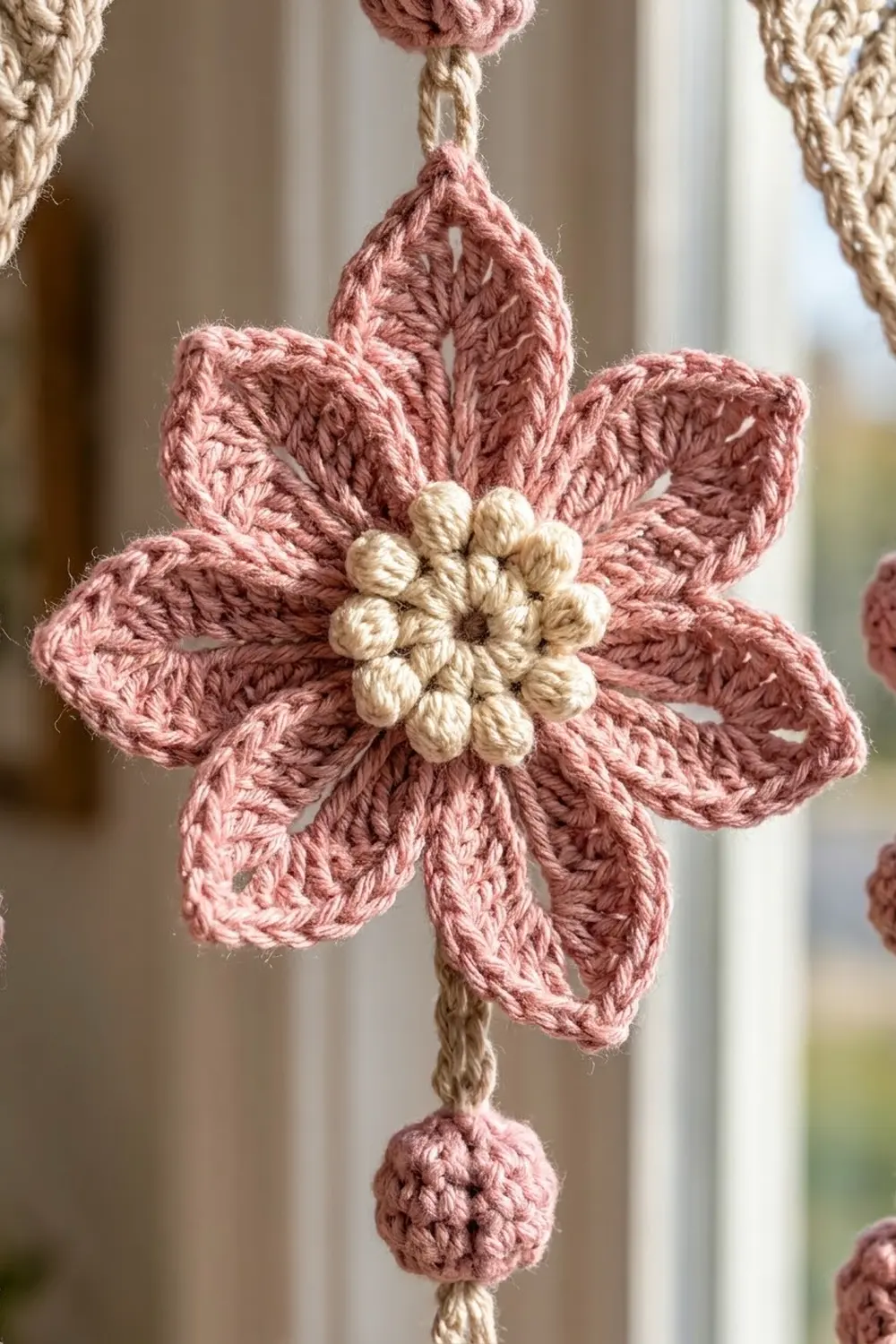
Rnd 1: With cream, MR, ch 1, 6 sc in ring, sl st to first sc. (6 sc)
Rnd 2: Ch 1, (sc, bobble) in each st around, sl st to first sc. (12 sts: 6 sc + 6 bobbles)
Push each bobble to the right side and fasten off. With the cream tail, make a French knot (3 wraps) in the center. This is the seventh “bead” of the center cluster.
Rnd 3: Join dusty rose in any sc. Ch 1, 2 sc in each sc and 1 sc in the top of each bobble, sl st to first sc. (12 sts worked 1-per-st + 6 extra = 18 sc)
Rnd 4: Ch 1, sc in same st, ch 4, sk 2, sc in next st, ch 4, sk 2; repeat from * 4 more times, sl st to first sc. (6 sc + 6 ch-4 loops)
Rnd 5 (petals): In each ch-4 loop, work (sc, hdc, dc, tr, picot, tr, dc, hdc, sc), then sl st in the next sc. (6 petals, each with 8 sts + 1 picot point)
Rnd 6 (ridged outline): Working in BLO, sl st into the first sc of the first petal. On each petal, sc in next 4 sts, (sc, ch 2, sc) in the picot, sc in next 4 sts, then sl st in the sl st between petals. Join. (60 sc + 6 ch-2 tips)
The unworked front loops form a raised line inside each petal edge. Fasten off.
Leaf (make 18)
The foundation chain becomes the center vein. The BLO turning rows build the chevron ridges, and the 3-sc group forms the pointed tip.
With beige, ch 16.
Row 1: Sc in 2nd ch from hook and next 13 ch, 3 sc in last ch (tip). Working along the opposite side of the chain, sc in next 11 ch, leaving 3 ch unworked. Turn. (14 + 3 + 11 = 28 sc)
Rows 2-5: Ch 1. Working in BLO, sc in each st up to the center st of the 3-sc tip group, 3 sc in center st, sc in each st down the other side, stopping 3 sts before the end. Turn.
Each row adds 2 sts at the tip and drops 3 at the base, for a net loss of 1:
- Row 2: 27 sc
- Row 3: 26 sc
- Row 4: 25 sc
- Row 5: 24 sc
Fasten off, leaving a 12 in (30.5 cm) tail. The stepped base is the top of the leaf, and the tip hangs down.
Bead (make 36)
With dusty rose:
Rnd 1: MR, 6 sc in ring. (6)
Rnd 2: 2 sc in each st. (12)
Rnds 3-4: Sc in each st. (12)
Stuff firmly.
Rnd 5: Sc2tog 6 times. (6)
Fasten off and close the hole, leaving a 10 in (25.4 cm) tail.
Tassel (make 12)
- Wrap dusty rose 30 times around the 4 in (10.2 cm) card.
- Tie the top tightly with a 10 in (25.4 cm) strand, then cut the bottom loops.
- Wrap the tassel 6 times 0.5 in (1.3 cm) below the top and knot.
- Trim to 3.5 in (8.9 cm).
Make All Pieces
- Beige: 1 header, 18 leaves, 12 cords
- Dusty rose: 18 flower outer rounds, 36 beads, 12 tassels
- Cream: 18 flower centers
Strand layout (Point 1 at left):
Point:   1  2  3  4  5  6  7  8  9  10 11 12
Strand:  A  B  A  B  A  B  A  B  A  B  A  B
Placement (measured down from the point tip):
Strand A                       Strand B
0-2 in       cord              0-4 in        cord
2-3 in       bead              4-9 in        leaf
4.5-9 in     flower            10-11 in      bead
10-11 in     bead              12-16.5 in    flower
12-17 in     leaf              17.5-18.5 in  bead
18-19 in     bead              19.5-24.5 in  leaf
20-24.5 in   flower            25.5-26.5 in  bead
25.5-26.5 in bead              26.5-30 in    tassel
26.5-30 in   tassel
Key marks in cm:
| in | 2 | 4 | 12 | 17 | 24.5 | 26.5 | 30 |
|---|---|---|---|---|---|---|---|
| cm | 5.1 | 10.2 | 30.5 | 43.2 | 62.2 | 67.3 | 76.2 |
Each Strand A uses 2 flowers, 1 leaf, 3 beads, and 1 tassel. Each Strand B uses 1 flower, 2 leaves, 3 beads, and 1 tassel. Six of each strand gives 18 flowers, 18 leaves, 36 beads, and 12 tassels.
Border
Border gauge: 4 sc = 1 in (2.5 cm) along the top, and 2 sc per dc row-end on the sides and point edges.
Rnd 1: With RS facing, join beige in the first foundation ch at the top right.
- Top: 3 sc in first ch, sc in next 142 ch, 3 sc in last ch. (144 worked 1-per-ch + 4 extra corner sts = 148 sc)
- Left side: 1 sc in the Row 1 row-end and 2 sc in each of the Row 2-4 row-ends. (7 sc)
- Each point:
- Down to the tip: 2 sc in each of the P1-P6 row-ends. (12 sc)
- Tip: (sc, ch 3, sc) in the tip. (2 sc + 1 ch-3 picot)
- Back up: 2 sc in each of the P6-P1 row-ends. (12 sc)
- Per point: 26 sc + 1 picot. All 12 points: 312 sc + 12 picots.
- Right side: 7 sc, worked the same as the left side.
Sl st to first sc. (148 + 7 + 312 + 7 = 474 sc + 12 ch-3 picots)
The points meet directly at Row 4, so you don’t add any stitches in the valleys between them.
Row 2 (rod tabs, top edge only): Join beige in the first sc of the top edge. Ch 1, sc in first 7 sc, ch 12, sk 2, sc in next 9 sc; repeat from * 11 more times. Ch 12, sk 2, sc in last 7 sc. Turn. (122 sc + 13 ch-12 loops)
Check: 7 + (12 x 11) + 2 + 7 = 148 sts used.
Row 3: Ch 1, sc in each sc and 16 sc in each ch-12 loop. (122 + 208 = 330 sc)
Fasten off. The tabs are spaced 2.75 in (7.0 cm) apart, center to center, and stand 1.5 in (3.8 cm) tall.
Why the math works: 2 sc per 0.5 in dc row equals 4 sc per inch. That matches the header’s 4 sts per inch, so the edges lie flat. Because each point is exactly 12 sts, the cords hang exactly 3 in (7.6 cm) apart.
Joining
Cords: With RS facing, join beige with a sl st in a point’s ch-3 picot. Ch 107, then sl st in the back bump of the 2nd ch from the hook and in each ch back up. (106 sl st, 26.5 in / 67.3 cm) Sl st in the picot and fasten off. Keep the slip stitches relaxed, because tight ones shorten the cord.
Flowers: Center each flower over the cord at its marked position. Using the rose tail, tack the Rnd 3 sts at 12 o’clock and 6 o’clock to the cord, then add one stitch through the center from behind.
Leaves: Lay the foundation chain (the vein) over the cord with the stepped base at the top. Whipstitch all 15 vein chains to the cord.
Beads: Center each bead over the cord and sew it through the cord at its top and bottom, so the cord appears to pass straight through.
Tassels: Tie each tassel to the bottom of its cord with the top tie strand, directly below the cap bead.
Checkpoint: Each strand measures 30 in (76.2 cm) from point tip to tassel tip. The whole curtain measures 37.25 in (94.6 cm).
Final Blocking
- Lay the header wrong side up on a blocking mat.
- Pin it to 36.5 in (92.7 cm) wide, with each point tip pinned straight.
- Mist until damp, not soaked.
- Pin each flower to a 4.5 in (11.4 cm) circle, pulling the petal tips out into points.
- Pin each leaf to 5 in (12.7 cm) x 2.25 in (5.7 cm), opening the ridges.
- Let everything dry completely before unpinning.
Final Quality-Control Checklist
- [ ] Header has 144 sts and 12 points of 12 sts each.
- [ ] Border Rnd 1 has 474 sc and 12 picots.
- [ ] There are 13 evenly spaced rod tabs.
- [ ] Every cord has 106 sl sts and measures 26.5 in (67.3 cm).
- [ ] Strands alternate A/B, starting with A on the left.
- [ ] Flowers measure 4.5 in (11.4 cm) and have 6 pointed petals.
- [ ] Leaves point downward with even ridges.
- [ ] Tassels are trimmed to 3.5 in (8.9 cm).
- [ ] All ends are woven in.
Troubleshooting
- Header ruffles: Recount Row 1, or use a smaller hook for the foundation chain.
- Points lean: Check that each point row has a dc2tog at both ends.
- Bobbles sink to the back: Push them forward before working Rnd 3.
- Leaf curls: Relax your tension and block the leaf flat while damp.
- Uneven strands: Recount the cord chains and loosen your slip stitches.
Care
Hand wash in cool water and lay flat to dry, reshaping the flowers and leaves. Between washes, shake the curtain out gently.
Final Notes
Here’s how the measurements build on each other:
- Your gauge gives a 3 in (7.6 cm) point.
- Twelve points make a 36 in (91.4 cm) header.
- The border brings the header to 36.5 in (92.7 cm) x 5.75 in (14.6 cm).
- The tabs add 1.5 in (3.8 cm), and the 30 in (76.2 cm) strands bring the total length to 37.25 in (94.6 cm).
Check each stage and the finished curtain will follow.
Happy crocheting!