

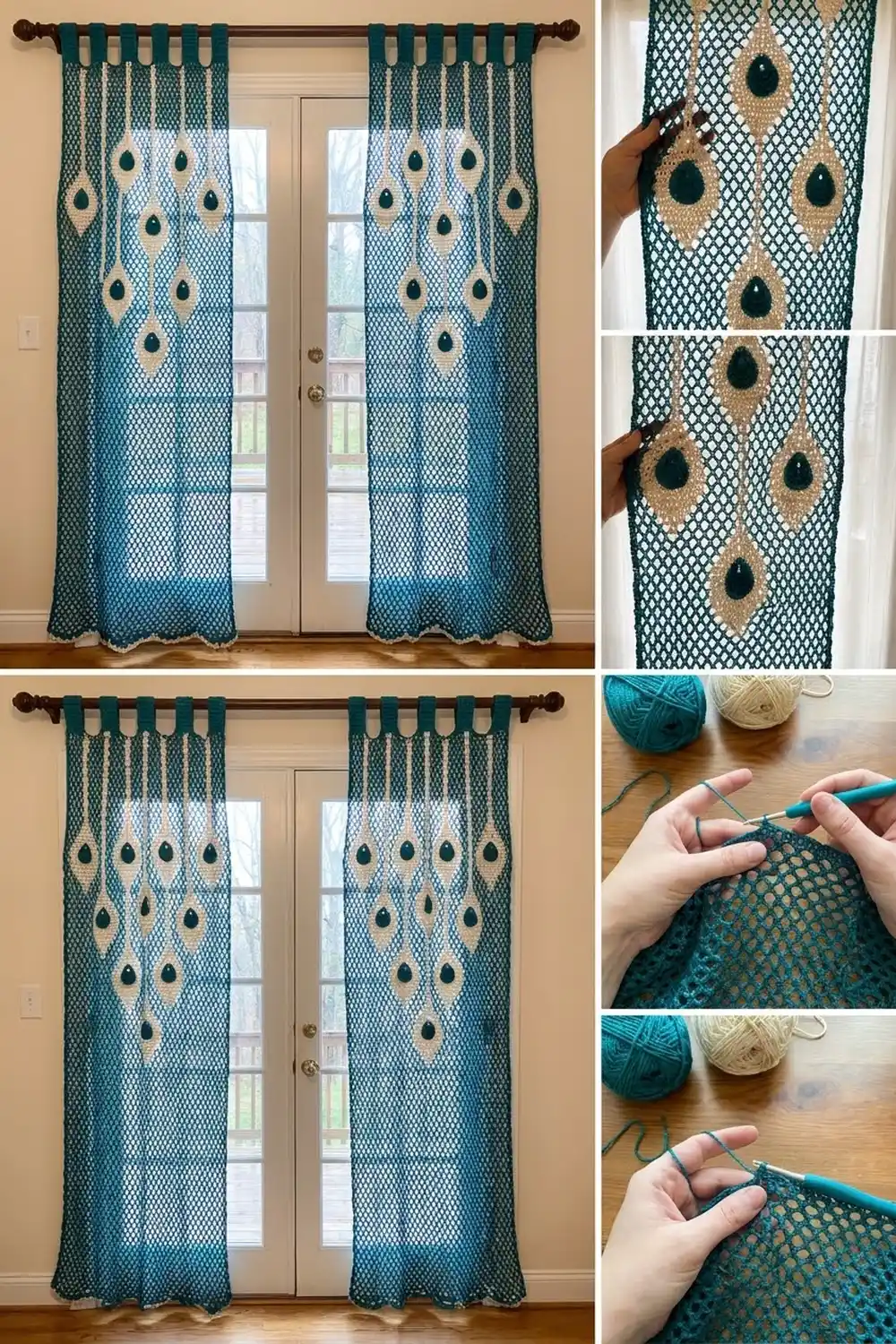
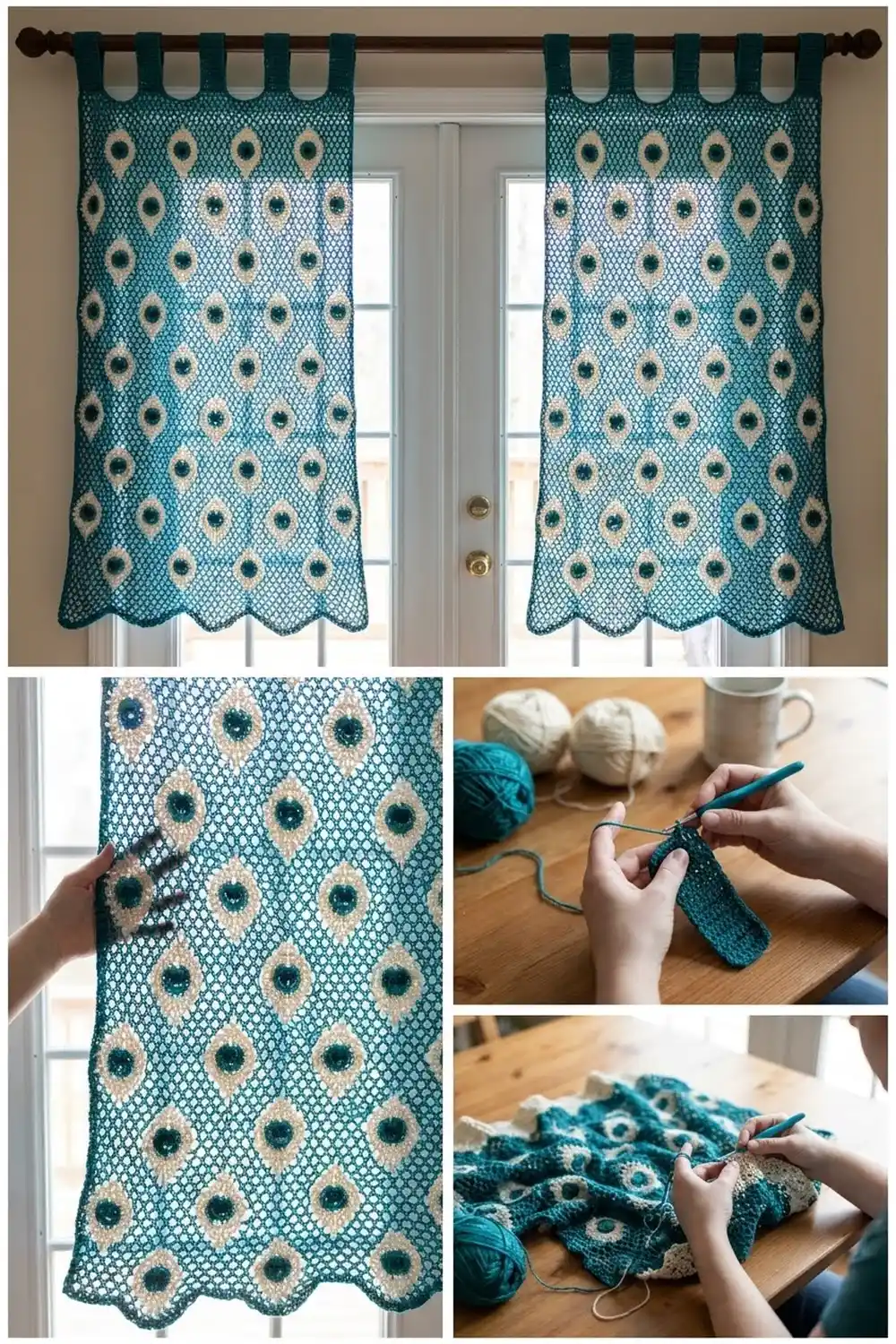
The Peacock Plume panels are long filet-lace curtains in deep peacock teal and natural cream. The teal forms an open mesh lattice. Staggered cream feathers float on that lattice, and each one has a solid teal teardrop eye. Hung in a sunny doorway, the mesh filters the light and the feathers stand out clearly.
The style is vintage filet crochet with a modern two-color palette. Every shape is built from simple blocks and spaces, so the pattern only uses chains and double crochet. The color changes are worked intarsia-style with small bobbins. This pattern uses US crochet terms throughout.
Each finished panel measures 31 in (78.7 cm) wide by 89.75 in (228.0 cm) long, not counting the tabs. The tabs add 3 in (7.6 cm), so the total hanging length is 92.75 in (235.6 cm). The pattern makes one panel. Make two for a pair.
Construction is straightforward. You work the panel flat in rows from the bottom up: a teal mesh band, 7 vertical repeats of the staggered feather lattice, then a teal mesh band at the top. Next you add a two-round single crochet border all the way around, followed by a scalloped bottom row. Last, you work five tabs up from the top edge, fold them, and sew them down.
Finished Size and Construction
- Finished size (one panel): 31 in × 89.75 in (78.7 cm × 228.0 cm), plus 3 in (7.6 cm) tabs
- Skill level: Intermediate (filet reading, intarsia color changes)
- Terminology: US crochet terms
- Yarn weight: DK (light worsted, #3) cotton
- Hook: US G-6 (4 mm)
- Number of pieces: 2 separate identical panels (a pair). They are not joined to each other.
- Layout per panel: 3 feather columns across, 7 feather repeats up, half-drop stagger
- Piece size before border: 30 in × 88 in (76.2 cm × 223.5 cm)
- Border depth: 0.5 in (1.3 cm) on the top and sides; 1.25 in (3.2 cm) on the bottom, scallops included
Materials
Use a smooth mercerized or matte cotton DK. Cotton holds the filet shapes crisply and doesn’t stretch out much while it hangs. Avoid fuzzy yarns, because the halo blurs the mesh.
Quantities for the pair (two panels), using 50 g / 120 m balls:
- Color T – Peacock Teal: 650 g, 1,560 m (13 balls)
- Color C – Natural Cream: 350 g, 840 m (7 balls)
These quantities include a margin of about 15% for swatching, bobbins, and weaving in ends. One panel uses about 640 m of teal and 360 m of cream.
Tools:
- 4 mm (G-6) crochet hook
- 8–10 yarn bobbins or small butterflies
- Tapestry needle
- Locking stitch markers
- Tape measure
- Blocking mats or a clean carpet with a sheet, and rust-proof pins
- Spray bottle
Abbreviations (US Terms)
- ch – chain
- sc – single crochet
- dc – double crochet
- sk – skip
- sl st – slip stitch
- st(s) – stitch(es)
- sp – space
- RS / WS – right side / wrong side
- T / C / E – teal mesh unit / cream block unit / teal eye block unit
Special stitches: filet units. After the edge dc, each row is made of 60 units of 2 sts each. A unit is one filler stitch followed by one dc.
- Space: ch 1, sk next st, dc in next st.
- Block: dc in next st (or ch-sp), dc in next st.
Every row has 1 edge dc + 60 units × 2 sts = 121 sts.
Color change: work the last yarn over of the dc that ends the previous unit in the new color. Keep the yarn not in use on the WS and give every color section its own bobbin. Don’t carry yarn across the back of open mesh.
Gauge and Checkpoints
Gauge: 10 filet units (20 sts) = 5 in (12.7 cm) wide, and 8 rows = 4 in (10.2 cm) tall, measured after blocking. That’s 4 sts and 2 rows per inch (2.5 cm).
Swatch first with ch 28 and 12 rows of mesh (12 units). Block it the same way you’ll block the panel. A small gauge difference grows over 88 in (223.5 cm) of height and throws off the whole fit, so don’t skip this step.
Checkpoints:
- After Row 4: 30 in (76.2 cm) wide, 2 in (5.1 cm) tall.
- After Row 28 (the first full feather repeat in Columns A and C): 14 in (35.6 cm) tall.
- After Row 172: 86 in (218.4 cm) tall.
- After Row 176: 88 in (223.5 cm) tall.
If your fabric is too big, go down a hook size, to 3.75 mm. If it’s too small, go up to 4.5 mm. If only your height is off, adjust how tall you make your dc rather than changing the hook, so the width stays correct.
Panel Pattern
Bottom Band
With T, ch 124.
Row 1 (RS): Dc in the 6th ch from hook. The skipped chs count as the edge dc, a ch-1 and a skipped ch. Ch 1, sk 1 ch, dc in next ch; repeat from * across. Turn. (121 sts: 60 spaces)
Rows 2–4: Ch 3 (counts as edge dc). Work 60 spaces across, with the last dc in the 3rd ch of the turning ch. Turn. (121 sts)
The Feather Block (20 units wide, 24 rows tall)
The panel has 3 columns of 20 units each. On RS rows they are Column A (units 1–20), Column B (units 21–40) and Column C (units 41–60). On WS rows you meet them in the order C, B, A. Each feather row is symmetrical, so it reads the same in both directions.
Use this sequence. T = teal space, C = cream block, E = teal block.
- Block Row 1: 8T, 4C, 8T
- Block Row 2: 6T, 8C, 6T
- Block Row 3: 4T, 4C, 4E, 4C, 4T
- Block Row 4: 3T, 4C, 6E, 4C, 3T
- Block Row 5: 2T, 5C, 6E, 5C, 2T
- Block Row 6: 2T, 6C, 4E, 6C, 2T
- Block Rows 7–8: 2T, 7C, 2E, 7C, 2T
- Block Rows 9–10: 3T, 14C, 3T
- Block Row 11: 4T, 12C, 4T
- Block Row 12: 5T, 10C, 5T
- Block Row 13: 6T, 8C, 6T
- Block Row 14: 7T, 6C, 7T
- Block Row 15: 8T, 4C, 8T
- Block Row 16: 9T, 2C, 9T
- Block Rows 17–24: 20T
Every block row adds up to 20 units. The feather shape is 4 units wide at the base and grows to 16 units in Block Rows 5–8. It then narrows to a 2-unit point. The teal E blocks form a teardrop eye: 4 units wide, then 6, 6, 4, 2 and 2, so its rounded base sits low and its tip points up. Block Rows 17–24 are open teal mesh, which becomes the lattice between feathers.
Body (Rows 5–172)
Each row: ch 3 (edge dc, always T), then work the 3 columns, then turn. Every row = 121 sts.
- Columns A and C: on panel row r, work Block Row ((r − 5) mod 24) + 1. So panel Row 5 = Block Row 1, Row 28 = Block Row 24, and Row 29 starts Block Row 1 again.
- Column B (half-drop): start 12 rows ahead. Panel Row 5 = Block Row 13, Row 16 = Block Row 24, Row 17 = Block Row 1, and so on.
Put a stitch marker at the column boundaries (after units 20 and 40). Note the current block row for A/C and for B on a sticky note, and update it every row.
When teal spaces in neighboring columns meet, keep working with one teal bobbin. In the busiest eye rows you will have up to 5 teal and 4 cream bobbins active.
Work Rows 5–172 (168 rows, 7 full repeats).
Top Band
Rows 173–176: With T only, ch 3, work 60 spaces, turn. (121 sts each row)
Don’t fasten off. Continue straight into the border.
Make Both Panels
Make 2 identical panels. Per panel: about 640 m T and 360 m C. For the pair: 650 g T and 350 g C including the margin.
Feather placement per panel:
- Columns A and C: 7 full feathers starting on Rows 5, 29, 53, 77, 101, 125 and 149.
- Column B: a feather tip on Rows 5–8, then 7 feathers starting on Rows 17, 41, 65, 89, 113, 137 and 161. The last one is cut off after its Block Row 12 by the top band.
TOP BAND (Rows 173–176, teal mesh)
 Col A   Col B   Col C
   .      F7*      .      from Row 161
   F7      .      F7      from Row 149
  ...     ...     ...
   .      F1       .      from Row 17
   F1     tip     F1      from Row 5
BOTTOM BAND (Rows 1–4, teal mesh)
The panels hang separately and are not joined, so there is no joining step.
Border
Border gauge: sc at 4 sts per inch (2.5 cm), the same as the filet width. Along the sides, 2 sc in each dc row-end gives 4 sc per inch, because there are 2 rows per inch. That’s why the edges lie flat without ruffling or cupping.
Corner rule: 3 sc go into each corner stitch, and the middle sc is the corner. Each side’s count below includes both of its corner sc, so each corner is shared by two sides. To get the round total, add the four sides and subtract 4.
Rnd 1 (T, RS): Ch 1. Across the top: 3 sc in the first st, sc in each of the next 119 sts, 3 sc in the last st. Down the side: 2 sc in each of the 176 row-ends (352 sc). Across the bottom, working into the foundation ch loops: 3 sc in the first, sc in the next 119, 3 sc in the last. Up the second side: 352 sc. Sl st to the first sc.
- Top: 123 sts | Side: 356 | Bottom: 123 | Side: 356
- Total: 123 + 356 + 123 + 356 − 4 = 954 sc (check: 12 corner-group sc + 238 + 704 = 954)
Rnd 2: Ch 1, sc in each sc around, with 3 sc in each corner sc. Sl st to join.
- Top: 125 | Sides: 358 each | Bottom: 125
- Total: 962 sc (954 + 8)
Fasten off. With the RS facing, join T in the bottom corner sc where the scallop row will begin.
Scallop Row (bottom edge only): Ch 1, sc in the corner sc. Sk 1, 5 dc in next st, sk 1, sc in next st; repeat from * across. You end with an sc in the far corner sc.
- 1 + (4 × 31) = 125 sts used, which makes 31 scallops.
Fasten off. Each scallop is about 1 in (2.5 cm) wide and adds 0.75 in (1.9 cm) of depth.
Tab Top
The top edge has 125 sts after Rnd 2. You’ll work 5 tabs of 9 sts with 4 gaps of 20 sts: 45 + 80 = 125.
Mark the tab positions at sts 1–9, 30–38, 59–67, 88–96 and 117–125.
For each tab: with the RS facing, join T in the first marked st. Ch 1 and sc in the 9 marked sts. Then work 23 more rows: ch 1, turn, sc in each of the 9 sc. That’s 24 rows, 6 in (15.2 cm) long and 2.25 in (5.7 cm) wide. Fasten off with a 12 in (30.5 cm) tail.
Fold the tab to the WS and whipstitch the last row to the base of the Border Rnd 1 stitches. This makes a 3 in (7.6 cm) loop.
Final Blocking
- Weave in all ends along same-color blocks only, so they don’t show through the mesh.
- Soak the panel in lukewarm water for 15 minutes. Squeeze gently; don’t wring.
- Roll it in towels to remove excess water.
- Lay it flat on mats or a sheet-covered carpet.
- Pin the sides straight to 31 in (78.7 cm) wide and the length to 89.75 in (228.0 cm).
- Pin out each scallop point along the bottom.
- Smooth every feather, nudging the eye blocks into a clean teardrop.
- Let it dry completely, usually 24–48 hours, before unpinning.
Final Quality-Control Checklist
- Every row has 121 sts. Count across any three rows.
- Feathers in Column B sit exactly halfway between those in Columns A and C.
- Every eye is solid teal with no cream flecks at the color changes.
- No yarn is carried across open spaces on the WS.
- Border Rnd 2 has 125 sts on the top and bottom and 358 sts on each side.
- There are 31 even scallops.
- The 5 tabs are evenly spaced 5 in (12.7 cm) apart, each loop 3 in (7.6 cm).
- Both panels match within 0.5 in (1.3 cm) in width and length.
Troubleshooting
- The panel narrows as you go: you’re skipping the turning-ch dc. Always finish each row in the 3rd ch of the turning ch.
- Feathers lean to one side: you’re reading the columns in the RS order on WS rows. Recount from the edge every row.
- Cream peeks into teal blocks: switch colors on the final yarn over of the previous dc, not after it.
- Bobbins are tangled: turn clockwise on RS rows and counterclockwise on WS rows to unwind.
- The sides ruffle: you’re working more than 2 sc per row-end. Rip back and recount.
- The sides pull in: your dc rows are taller than gauge. Block the panel to length first; if the edges still draw in, rework Border Rnd 1 with 3 sc in every second row-end along the tight section.
- The tabs twist: sew the folded edge straight across the full 9 sts.
Care
Hand-wash in cool water with mild detergent and dry flat. To keep the length stable, don’t tumble-dry or hang the panel while it’s wet.
Final Notes
Everything in this pattern traces back to one gauge: 4 sts and 2 rows per inch (2.5 cm).
- Width: 60 units make 30 in (76.2 cm). A 0.5 in (1.3 cm) border on each side brings it to 31 in (78.7 cm).
- Length: 176 rows make 88 in (223.5 cm). The border adds 0.5 in (1.3 cm) at the top and 1.25 in (3.2 cm) at the bottom, for 89.75 in (228.0 cm).
- Tabs: 3 in (7.6 cm) loops give a total hanging length of 92.75 in (235.6 cm).
Check your swatch, count your 121 sts, keep track of the half-drop, and the feathers will line up.
Happy crocheting!