

This hanging holder stores three spare rolls in a column of small crocheted baskets. Each basket has a band of lavender puff-stitch flowers sitting on green spike-stitch leaves, all set against a calm sage background. A lavender crab-stitch rim finishes the top, and two sage straps link the baskets to a wooden ring that hangs from any hook.
The palette is sage, lavender and leaf green, so the holder looks soft and cottage-style in a bathroom without looking busy. The flowers are made with plain tapestry-style color changes and puff stitches, so there are no appliqués to sew on.
This pattern uses US crochet terms. Each basket measures about 5½ in (14.0 cm) across and 4 in (10.2 cm) tall. Hanging from the top of the ring, the finished holder measures about 23¾ in (60.3 cm).
For each basket, you crochet a flat circle in joined rounds, turn up the sides with a back-loop round, add the flower band and finish with a lavender rim. Then you crochet two long straps, stitch them to opposite sides of all three baskets, and fold the strap tops over the ring.
Finished Size and Construction
- Finished size: about 23¾ in (60.3 cm) hanging length, including the ring
- Basket size: 5½ in (14.0 cm) diameter × 4 in (10.2 cm) tall
- Skill level: Intermediate (color carrying, puff stitch, spike stitch)
- Terminology: US
- Yarn weight: Worsted (#4), cotton or cotton blend
- Hook: US H-8 (5.0 mm)
- Number of pieces: 5 (3 baskets and 2 straps)
- Layout: 3 baskets in one vertical column with 1½ in (3.8 cm) gaps between them
- Basket size before border: 3½ in (8.9 cm) tall, measured through Round 23
- Border (rim) depth: 2 rounds, ½ in (1.3 cm)
Materials
Yarn: Use a worsted-weight cotton or cotton blend. Cotton holds its shape, stands up to bathroom humidity and makes the puffs crisp. Avoid fluffy acrylic, because it blurs the flower outlines.
- Sage (MC): 150 g / 270 m
- Lavender (CC1): 60 g / 108 m
- Leaf Green (CC2): 25 g / 45 m
These quantities include a margin of about 15–20% for swatching and color carrying.
Tools:
- US H-8 (5.0 mm) crochet hook
- One 2¾ in (7.0 cm) wooden ring
- Tapestry needle
- 6–8 locking stitch markers
- Measuring tape
- Rust-proof pins and a blocking surface
- One standard toilet roll, to use as a blocking form
Abbreviations (US Terms)
- ch: chain
- sl st: slip stitch
- sc: single crochet
- inc: 2 sc in the same stitch
- BLO: back loop only
- st(s): stitch(es)
- rep: repeat
- RS: right side
Special stitches:
- Puff: Using Lavender, (yo, insert hook in st, pull up a loop to ½ in [1.3 cm]) 3 times, then yo and draw through all 7 loops on the hook. Do not chain to close. The puff counts as 1 stitch.
- Leaf (spike sc): Using Leaf Green, skip the next st of the current round. Insert the hook from the front into the matching st 2 rounds below, pull up a long loop to the height of the current round, then yo and draw through both loops. The leaf counts as 1 stitch.
- Crab st (reverse sc): Work sc from left to right, inserting the hook into the next st to the right.
Color carrying: On the flower rounds and leaf rounds, lay the unused color along the tops of the stitches and work over it. Change color on the last yo of the stitch before the color change.
Gauge and Checkpoints
Gauge: 14 sc × 16 rounds = 4 in (10.2 cm) in sc worked with the 5.0 mm hook.
Test one basket before you make the rest. These checkpoints confirm your gauge on the actual piece:
- After Round 5 (30 sts): The base measures 2¾ in (7.0 cm) across.
- After Round 10 (60 sts): The base measures 5½ in (14.0 cm) across and lies flat.
- After Round 23: The sides measure 3½ in (8.9 cm) from the table to the top edge.
- After Round 25: The basket is 4 in (10.2 cm) tall, and a roll drops in easily but does not rattle.
Too big? Go down half a hook size, to 4.5 mm. Too small, or the roll is snug? Go up to 5.5 mm. Change the hook, not the stitch counts, because the 6-stitch flower repeat depends on exactly 60 stitches.
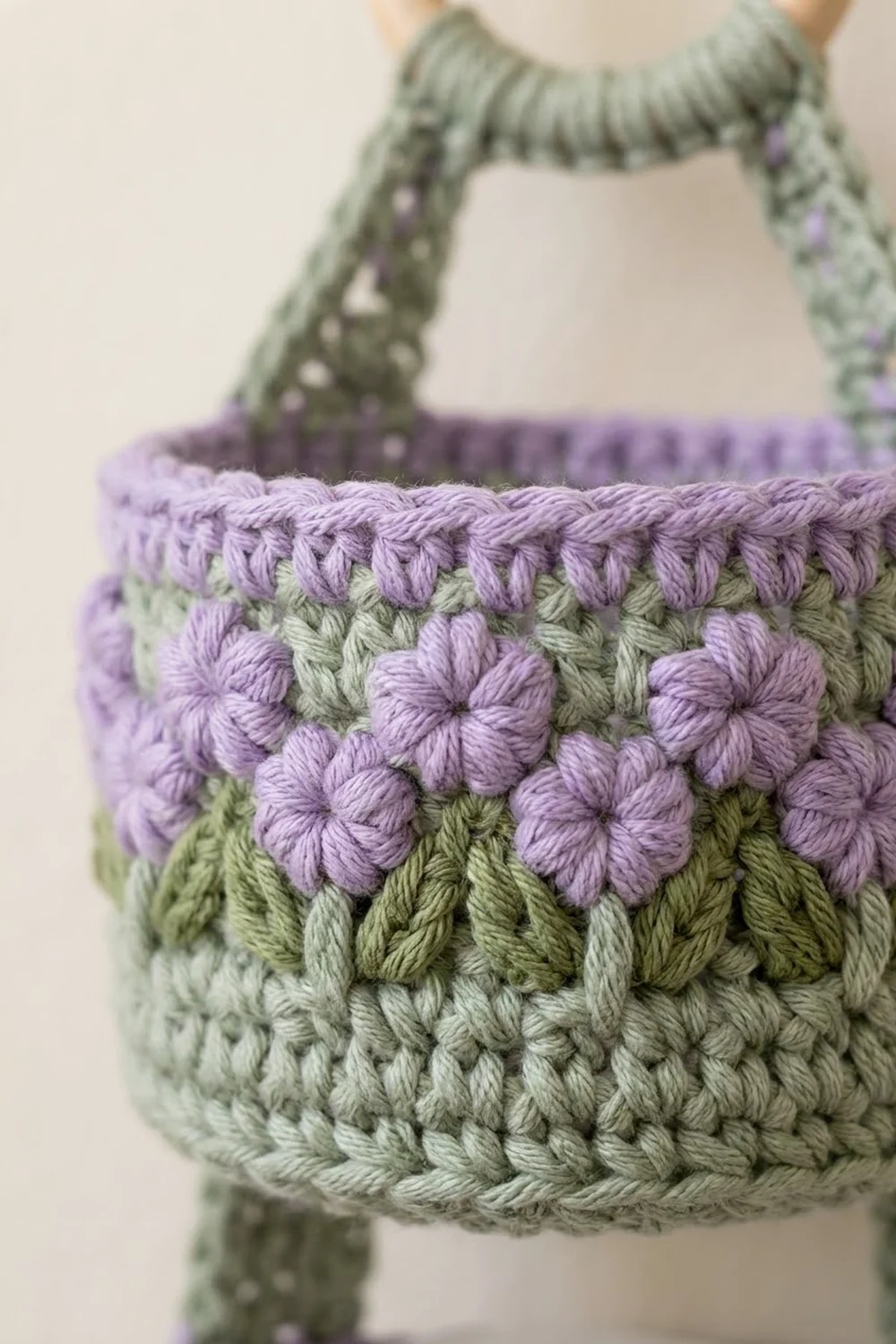
Basket (Make 3)
Every round is joined with a sl st to the first sc and begins with ch 1, which does not count as a stitch. Joining keeps the seam in a straight line, so the straps line up later. Place a marker in the first st of every round.
Base
With Sage:
Round 1: Make a magic ring, then work 6 sc into the ring. Join. (6 sts)
Round 2: Inc in each st around. Join. (12 sts)
Round 3: Sc 1, inc; rep from * 6 times. Join. (18 sts)*
Round 4: Sc 2, inc; rep from * 6 times. Join. (24 sts)*
Round 5: Sc 3, inc; rep from * 6 times. Join. (30 sts)*
Round 6: Sc 4, inc; rep from * 6 times. Join. (36 sts)*
Round 7: Sc 5, inc; rep from * 6 times. Join. (42 sts)*
Round 8: Sc 6, inc; rep from * 6 times. Join. (48 sts)*
Round 9: Sc 7, inc; rep from * 6 times. Join. (54 sts)*
Round 10: Sc 8, inc; rep from * 6 times. Join. (60 sts)*
Check that the base measures 5½ in (14.0 cm) across.
Sides
Round 11 (turning round): Sc in the BLO of each st around. Join. (60 sts) The unworked front loops form a crisp ridge, and the sides start to rise.
Rounds 12–15: Sc in each st around. Join. (60 sts per round)
Flower Band
Each round of the band uses a 6-stitch repeat worked 10 times. The flower is centered on position 4 of every repeat. Carry the unused color as you go.
Round 16 (leaves): With Sage, carrying Leaf Green: Sc 2, leaf, sc 1, leaf, sc 1; rep from * 10 times. Join. (60 sts: 40 sc + 20 leaves)* Each leaf spikes into Round 14. The two leaves in each repeat sit at positions 3 and 5 and lean toward the flower stem at position 4.
Round 17: With Sage, sc in each st around. Join. (60 sts) Drop Leaf Green and pick up Lavender to carry.
Round 18 (bottom petal): Sc 3 with Sage, puff with Lavender, sc 2 with Sage; rep from * 10 times. Join. (60 sts: 50 sc + 10 puffs)*
Round 19 (side petals): Sc 2 with Sage, puff, sc 1 with Sage, puff, sc 1 with Sage; rep from * 10 times. Join. (60 sts: 40 sc + 20 puffs)* The sage sc at position 4 becomes the flower’s center.
Round 20 (top petal): Sc 3 with Sage, puff, sc 2 with Sage; rep from * 10 times. Join. (60 sts: 50 sc + 10 puffs)* Each flower now has four puffs in a diamond shape.
Cut Lavender, leaving a 4 in (10.2 cm) tail.
Rounds 21–23: With Sage, sc in each st around. Join. (60 sts per round) Fasten off Sage.
The basket should now be 3½ in (8.9 cm) tall. This is the size before the border.
Make All Pieces
Baskets (make 3): Each basket uses about 40 g of Sage, 15 g of Lavender and 6 g of Leaf Green.
Straps (make 2): With Sage, ch 6.
- Row 1: Sc in the 2nd ch from the hook and in each ch across. (5 sts)
- Rows 2–92: Ch 1, turn, sc in each st across. (5 sts per row)
Fasten off and leave a 40 in (101.6 cm) tail for sewing. Each strap measures 1.4 in (3.6 cm) wide × 23 in (58.4 cm) long. Each strap uses about 12 g of Sage.
Layout grid (front view):
        ( RING )
       /        \
   Strap A    Strap B     rows 61–92 (top + fold)
   [ BASKET 1 (top) ]     strap rows 45–60
   |  gap 1½ in     |     strap rows 39–44
   [ BASKET 2       ]     strap rows 23–38
   |  gap 1½ in     |     strap rows 17–22
   [ BASKET 3 (bot) ]     strap rows 1–16
Joining
Strap placement: On every basket, number the stitches of Round 23 from the joining seam, with the seam as st 1. The gaps between flowers fall at positions 6, 1 and 2 of each repeat. Center Strap A over st 7 and Strap B over st 37, which is directly opposite. Neither strap covers any petals at these positions. Mark both spots.
Stitch-to-stitch logic: The strap rows and the basket rounds share the same 16-per-4-in gauge, so one strap row lines up with one basket round. Each basket overlaps the strap for 16 rows, from Round 10 (the base edge) through Round 25 (the rim).
- Strap rows 1–16 go on Basket 3 (bottom).
- Rows 17–22 leave a 1½ in (3.8 cm) gap.
- Rows 23–38 go on Basket 2.
- Rows 39–44 leave a second 1½ in (3.8 cm) gap.
- Rows 45–60 go on Basket 1 (top).
- Rows 61–84 form a 6 in (15.2 cm) free length above Basket 1.
- Rows 85–92 make a 2 in (5.1 cm) fold over the ring.
Method: Add the rim to all three baskets first (see Border). Then pin each strap in place with its row 1 at the base edge of Basket 3. Using the tail and a tapestry needle, whipstitch both long edges of the strap to the basket. Work one whipstitch per strap row into the matching round. Run the needle along the back of the strap to travel across each gap.
Tension: Keep each stitch snug but not tight. The strap should lie flat without puckering the basket wall. Hang the piece every few inches to check that the baskets sit level.
Ring: Pass rows 85–92 of each strap through the wooden ring from front to back. Fold the end down so row 92 meets row 84 on the back, then whipstitch it in place. Weave in the ends.
Size checkpoint: From the base of Basket 3 to the fold at the ring, the straps should measure 21 in (53.3 cm). The three baskets plus the two gaps take up 15 in (38.1 cm).
Border (Top Rim)
Border gauge: The rim uses the main gauge of 14 sts = 4 in (10.2 cm), so the circumference stays at about 17 in (43.2 cm).
Work the rim on each basket after Round 23 and before you attach the straps.
Round 24: Join Lavender with a sl st at the seam. Ch 1, sc in each st around. Join. (60 sts: 30 on the front half + 30 on the back half, measured between the strap marks)
Round 25: Ch 1, work crab st in each st around. Join. (60 sts: 30 front + 30 back) Fasten off and weave in the ends.
Why the math works: Round 24 matches Round 23 one stitch to one stitch, so it neither cinches nor flares. Crab stitch also works one per stitch, which gives a rolled, corded edge at the same circumference. The two strap marks split the 60 stitches into equal halves of 30, so both straps sit exactly opposite each other on all three baskets.
Final Blocking
- Weave in all the ends along the stitches of matching color.
- Lightly mist each basket with water until damp, not soaked.
- Slide a toilet roll into each basket so it holds the cylinder shape.
- Press the base flat and pinch the BLO ridge from Round 11 into a sharp edge.
- Shape each puff with your fingertips so the four petals sit evenly around the center.
- Pin the straps flat on a towel. Hang the holder from the ring and let it dry completely, which takes about 24 hours.
Final Quality-Control Checklist
- Each basket has exactly 60 stitches in every round from Round 10 to Round 25.
- Each basket has 10 flowers, and each flower has 4 puffs and 2 leaves.
- Every basket measures 5½ in (14.0 cm) across and 4 in (10.2 cm) tall.
- The straps sit at st 7 and st 37 on every basket and cover no petals.
- Both gaps measure 1½ in (3.8 cm).
- The baskets hang level, and the ring is centered.
- No carried strands show through on the RS.
Troubleshooting
- The base curls up: Your tension is tight. Go up half a hook size for Rounds 1–10.
- The base ruffles: Check your increase counts. Round n should total 6n stitches.
- The sides flare out: You skipped the BLO in Round 11. Rip back and rework it.
- The puffs sink in: Pull each loop up to a full ½ in (1.3 cm) and keep the carried strand loose behind the puff.
- The leaves pucker the fabric: Pull the spike loop all the way up to the height of the current round.
- The baskets tilt: The strap rows are off by one. Re-pin each basket using the row numbers above.
- The rim flares: Work the crab stitch tighter or use a hook half a size smaller.
Care
Hand wash in cool water with mild soap, press out the water in a towel and dry flat over a roll. Do not tumble dry, because heat can shrink the baskets.

Final Notes
The measurement chain is simple. A 60-stitch base measures 5½ in (14.0 cm) across. Fifteen side rounds plus the base bring each basket to 4 in (10.2 cm). Sixteen strap rows match each basket, with 6-row gaps of 1½ in (3.8 cm) between baskets, and a 92-row strap that is 23 in (58.4 cm) long folds over a 2¾ in (7.0 cm) ring. If you hit each checkpoint, the finished holder will hang straight at about 23¾ in (60.3 cm).
Happy crocheting!