

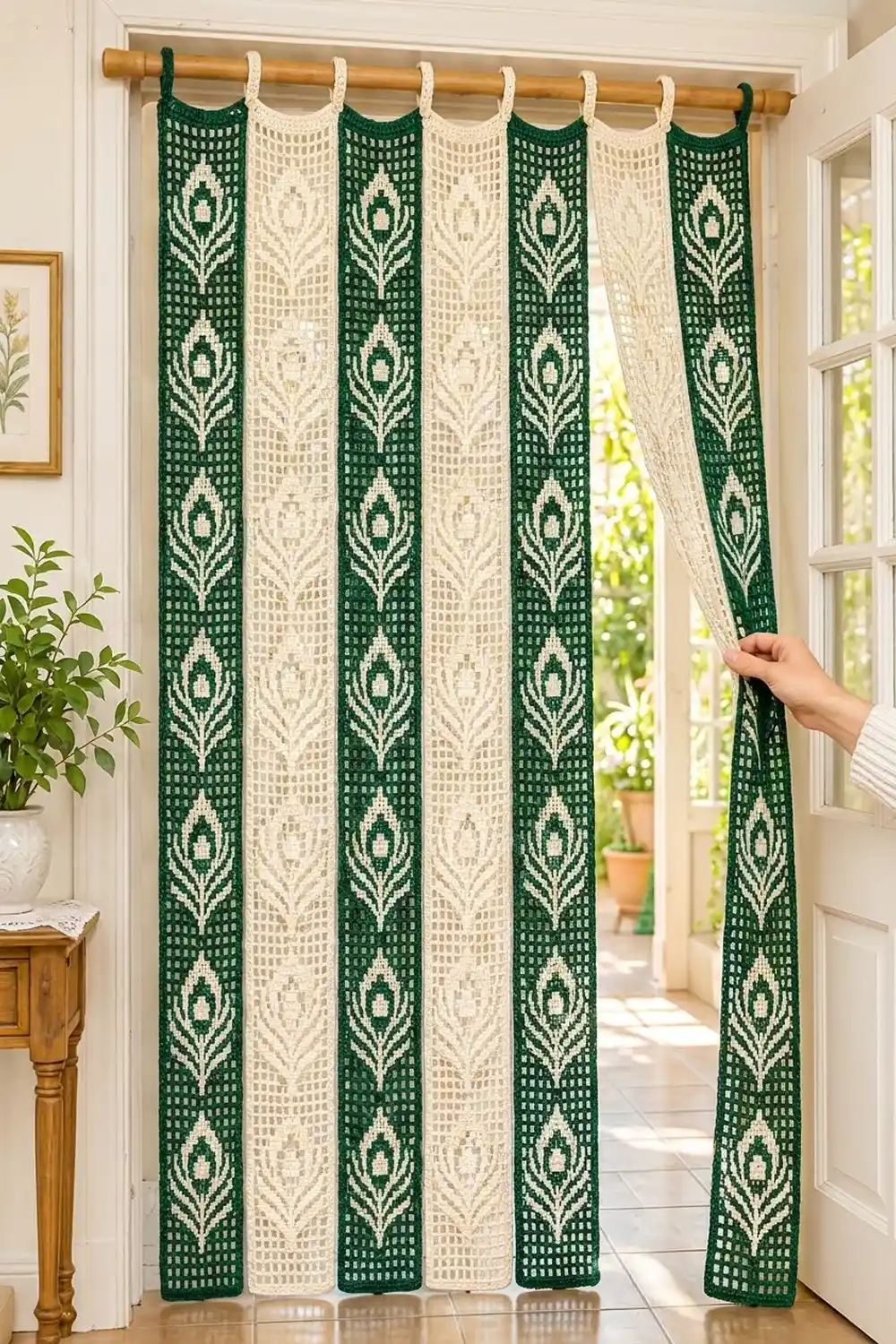
The Peacock Plume Strip Curtain is a set of seven long, narrow filet crochet strips that hang side by side from a curtain rod. Each strip shows a column of stylized peacock feathers repeated seven times from top to bottom. Each feather has a round “eye” on top, fanned barbs below it and a short stem.
The colors alternate. Four strips are deep emerald green mesh with the feathers filled in creamy ivory. Three strips are ivory mesh with tonal ivory feathers worked as solid filet blocks. From across the room they look like bold stripes. Up close they look like delicate lace.
This pattern uses US crochet terms. Each finished strip measures 6 in (15.2 cm) wide by 70.5 in (179.1 cm) long. Two hanging loops add 1.5 in (3.8 cm), for a total drop of 72 in (182.9 cm). Seven strips hung edge to edge cover about 42 in (106.7 cm).
Each strip is worked flat in rows of filet mesh, 11 squares wide and 140 rows long. On the ivory strips, you crochet the feathers as dc blocks as you go. The green strips are plain open mesh, and you darn the ivory feathers in afterward with a tapestry needle. Each strip is finished with a two-round sc border and two sturdy loops. The strips are not joined to each other, so each one hangs on its own.
Finished Size and Construction
- Finished strip size: 6 in x 70.5 in (15.2 cm x 179.1 cm), plus 1.5 in (3.8 cm) loops
- Skill level: Intermediate
- Terminology: US
- Yarn weight: DK (#3) cotton
- Hook: 4.0 mm (G-6)
- Number of pieces: 7 separate strips (4 green, 3 ivory)
- Layout: 7 strips in one row on a rod, alternating green and ivory, not joined
- Strip size before border: 5.5 in x 70 in (14.0 cm x 177.8 cm), 11 squares x 140 rows
- Border depth: 0.25 in (0.6 cm) per side, 2 rounds of sc
Materials
Choose a smooth mercerized or combed DK cotton with about 125 m per 50 g. Cotton keeps the square mesh crisp and hangs straight. Avoid fuzzy or stretchy yarns, because they blur the grid and let long strips grow.
- Green: 700 m (about 280 g) for 4 strips, their borders and loops
- Ivory: 1000 m (about 400 g) for 3 strips, plus all the darning on the green strips
These amounts include a margin of about 10% for swatching and tails. Buy each color from a single dye lot.
Tools
- 4.0 mm (G-6) crochet hook
- Blunt tapestry needle
- Stitch markers
- Tape measure
- Rust-proof pins and a long blocking surface
- Curtain rod up to 1 in (2.5 cm) in diameter
Abbreviations (US Terms)
- ch – chain
- sl st – slip stitch
- sc – single crochet
- dc – double crochet
- sk – skip
- sp – space
- st(s) – stitch(es)
- RS / WS – right side / wrong side
Special stitches
- Open square (O): ch 2, sk 2 sts (or the next ch-2 sp), dc in next dc.
- Block (X): 2 dc in the next ch-2 sp (or 1 dc in each of the next 2 sts), dc in next dc.
- Post: the dc between squares. Every row has 12 posts and 11 squares.
Gauge and Checkpoints
Gauge: 4 squares and 4 rows = 2 in (5.1 cm) in filet mesh, after blocking. Each square is 0.5 in (1.3 cm) each way.
Test swatch: Ch 29. Work Row 1 as written below to get 8 open squares, then work 7 more open rows. Block the swatch. It should measure 4 in x 4 in (10.2 cm x 10.2 cm).
- Too big: use a hook 0.5 mm smaller.
- Too small: use a hook 0.5 mm larger.
- Right width but too tall: pull up a shorter loop on each dc.
Make one complete strip first and check it before you start the rest.
Checkpoints for each strip
- Width at Row 1: 5.5 in (14.0 cm)
- After Row 20: 10 in (25.4 cm) long
- After Row 70: 35 in (88.9 cm) long
- After Row 140: 70 in (177.8 cm) long
- After border: 6 in x 70.5 in (15.2 cm x 179.1 cm)
Measure each strip lying flat, without stretching it.
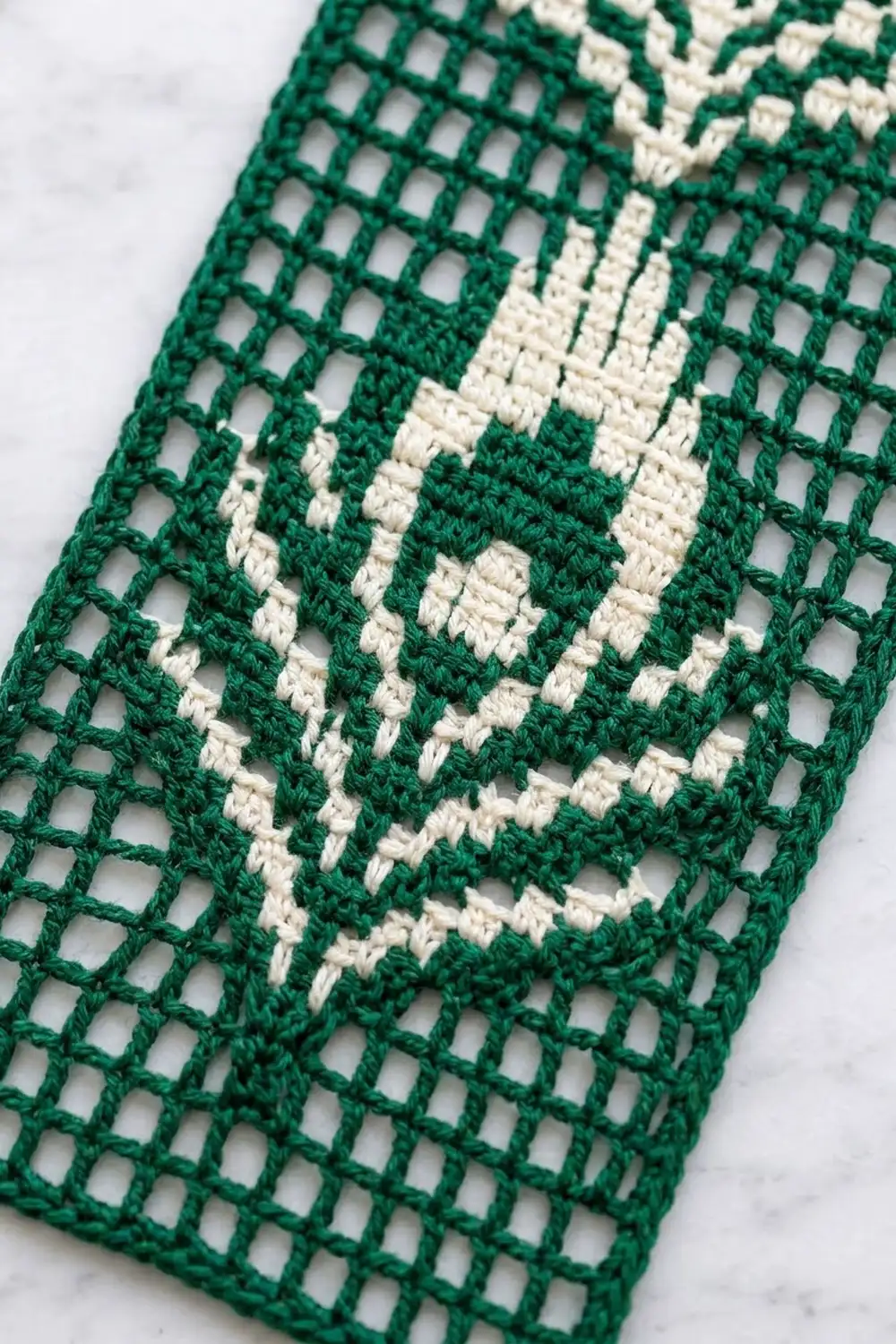
Feather Grid
Read the grid from Row 1 at the bottom upward. Each line shows the 11 squares from left to right: O = open square, X = block. The design is symmetrical, so it reads the same on RS and WS rows.
Row 20: OOOOOXOOOOO
Row 19: OOOXXXXXOOO
Row 18: OOXXOOOXXOO
Row 17: OOXOOXOOXOO
Row 16: OOXOXXXOXOO
Row 15: OOXOOXOOXOO
Row 14: OOXXOOOXXOO
Row 13: OOOXXXXXOOO
Row 12: OOOOXXXOOOO
Row 11: OOOXOXOXOOO
Row 10: OOXOXXXOXOO
Row 9:  OXOXOXOXOXO
Row 8:  OOXOXXXOXOO
Row 7:  OXOXOXOXOXO
Row 6:  OOXOOXOOXOO
Row 5:  OXOOOXOOOXO
Row 4:  OOOOOXOOOOO
Row 3:  OOOOOXOOOOO
Row 2:  OOOOOOOOOOO
Row 1:  OOOOOOOOOOO
Rows 3–4 form the stem and Rows 5–12 the fanned barbs. Rows 13–19 form the eye, with its ring and solid center, and Row 20 is the tip. One repeat has 64 blocks, and you work it 7 times per strip.
Ivory Strip (Make 3)
Use ivory throughout.
Foundation: Ch 38.
Row 1 (RS): Dc in 8th ch from hook (first open square made), *ch 2, sk 2 ch, dc in next ch; repeat from * 9 more times. Turn. (11 open squares: 12 posts, 11 ch-2 sps, 34 sts)
Row 2: Ch 5 (counts as dc and ch 2), sk first ch-2 sp, dc in next dc, *ch 2, dc in next dc; repeat from * across, working the last dc in the 3rd ch of the turning ch. Turn. (11 open squares, 34 sts)
Rows 3–20: Follow the Feather Grid.
- If a row starts with an open square, ch 5 as in Row 2.
- If a row starts with a block, ch 3 (counts as dc), 2 dc in the first sp, dc in next dc.
- Work each following square as O or X, as shown on the grid.
- End every row with a dc in the 3rd ch of the turning ch-5 (or in the top of the ch-3).
Every row has 12 posts and 11 squares, always 34 sts. A block replaces ch 2 with 2 dc, so the stitch count never changes.
Rows 21–140: Repeat the 20 grid rows 6 more times, for 7 repeats in total. Do not fasten off. Check: 140 rows, 70 in (177.8 cm).
Green Strip (Make 4)
Use green throughout.
Foundation: Ch 38.
Row 1: Work as Row 1 of the Ivory Strip. (11 open squares, 34 sts)
Rows 2–140: Work as Row 2 of the Ivory Strip, so every square is open. Do not fasten off. Check: 140 rows, 70 in (177.8 cm).
You darn the feathers in after the border and blocking, once the mesh is square and stable.
Border (All Strips)
Work the border in the strip’s own color, continuing from the last st of Row 140.
Border gauge: 6 sc = 1 in (2.5 cm) along all edges. This matches the filet itself: 34 sts across 5.5 in (14.0 cm), and 3 sc per 0.5 in (1.3 cm) row-end on the long sides.
Round 1: Ch 1, 3 sc in the last dc of Row 140 (corner). Working down the long side, work 3 sc around each row-end post or turning ch (420 sc). Working across the bottom loops of the foundation ch, work 3 sc in the first ch, sc in each of the next 32 ch, then 3 sc in the last ch. Working up the second long side, work 420 sc. Across the top, work 3 sc in the first st, then sc in each of the next 32 sts. Sl st to the first sc.
- Top and bottom: 34 sts worked 1 per existing st + 2 extra sc at each corner.
- Each long side: 140 row-ends x 3 sc = 420 sc.
- Total: 34 + 34 + 420 + 420 + (4 corners x 2 extra) = 916 sc.
- Per side, counting both corner centers: top and bottom 36 sc, long sides 424 sc.
Round 2: Ch 1, sc in each sc around, working 3 sc in each corner center. Sl st to first sc.
- Total: 916 worked 1 per st + 8 extra = 924 sc.
- Per side, counting both corner centers: top and bottom 38 sc, long sides 426 sc.
Why the math works: At 6 sc per inch, 34 sc span the 5.5 in (14.0 cm) width and 420 sc span the 70 in (177.8 cm) length. The border therefore lies flat, without ruffling or cupping. The two rounds add 0.25 in (0.6 cm) per side, giving 6 in x 70.5 in (15.2 cm x 179.1 cm).
Hanging Loops: Number the 38 top-side sts of Round 2, from the right corner center (st 1) to the left corner center (st 38).
- Right loop: Sl st along the top to st 3. Ch 16, sl st in st 7. Turn, work 22 sc over the ch-16, sl st in st 3. Fasten off.
- Left loop: Join yarn with a sl st in st 32. Ch 16, sl st in st 36. Turn, work 22 sc over the ch-16, sl st in st 32. Fasten off.
Each loop spans 5 sts, about 0.8 in (2.0 cm), and stands 1.5 in (3.8 cm) tall. The two loops sit in mirrored positions (sts 3 and 36, sts 7 and 32). Weave in all ends.
Darning the Green Strips
Block the green strips (see Final Blocking) before you darn them.
- Cut ivory into 36 in (91.4 cm) lengths and thread one onto the tapestry needle.
- Lay the strip RS up, with the bottom edge toward you. Start at Row 3, square 6 (the stem).
- Leave a 3 in (7.6 cm) tail to bury later.
- Fill each X square with 5 horizontal passes. Take the yarn around the left post, across the square and around the right post, then back again. Stack each pass just above the last one.
- Where X squares sit side by side, carry each pass across the whole run. Wrap only the outer posts, and weave over and under the inner posts.
- To reach the next X square, travel only through squares you have already filled. Never cross an open square.
- Follow the Feather Grid exactly: 64 squares per repeat, 448 per strip.
- Bury all ends inside darned squares.
Each square takes about 8 in (20.3 cm) of yarn. The passes should touch without pulling the posts inward. After each repeat, check that the mesh still measures 5.5 in (14.0 cm) across.
Make All Pieces
- Green: 4 strips, darned with ivory feathers
- Ivory: 3 strips, with block feathers
Layout across the rod, left to right:
| G | I | G | I | G | I | G |
With the strips touching, the curtain is 42 in (106.7 cm) wide. For a wider opening, leave up to 0.5 in (1.3 cm) between strips, for a total of 45 in (114.3 cm).
Hanging (No Joining)
The strips are not sewn or crocheted together. Each one hangs from its own two loops, so the curtain parts easily when you walk through.
- Slide the strips onto the rod in layout order, with the RS facing the room.
- Every strip has the same 140 rows, so the feather eyes line up across the curtain as long as your gauge matches.
- Size check: each strip should hang 72 in (182.9 cm) from the top of its loops. If a strip is more than 0.5 in (1.3 cm) off, re-block it.
Final Blocking
- Soak each strip in cool water with a little mild soap for 15 minutes.
- Press out the water in a towel. Do not wring.
- Lay the strip flat on a long blocking surface, working in sections if needed.
- Pin the corners to 6 in x 70.5 in (15.2 cm x 179.1 cm).
- Pin both long sides every 4 in (10.2 cm), keeping the edges straight.
- Nudge each square to 0.5 in (1.3 cm), with the posts vertical.
- Let the strip dry completely, then unpin it.
- For green strips, do the darning after this blocking. Then mist lightly and re-pin to set the darning.
Final Quality-Control Checklist
- Every row has 11 squares and 34 sts.
- Each strip has 140 rows and 7 complete feather repeats.
- The blocks and darned squares match the Feather Grid.
- Round 1 has 916 sc, and Round 2 has 924 sc.
- The corners are square and the long edges are straight.
- The loops sit on sts 3–7 and 32–36 and are the same height.
- All ends are woven in securely.
- All 7 strips measure 6 in x 70.5 in (15.2 cm x 179.1 cm).
Troubleshooting
- Squares are tall and narrow: use a hook 0.5 mm smaller, or pull up shorter loops.
- Strip slants: you may be missing the last post. Count 12 posts in every row.
- Feather is off-center: recount from the left edge. Square 6 is the center column.
- Border ruffles: you have too many sc per row-end. Recount to 420 per side.
- Border pulls in: you have too few sc, or your tension is tight. Use a larger hook for the border.
- Darned squares bulge: use 4 passes instead of 5, pulled just snug.
- Strips hang unevenly: re-block the long strip with less vertical stretch.
Care
Hand wash the strips in cool water, press out the water in a towel and dry them flat. Don’t tumble dry them or hang them while wet, or they may stretch.
Final Notes
The whole curtain follows one chain of measurements. Each square is 0.5 in (1.3 cm), so 11 squares make 5.5 in (14.0 cm). Each 20-row repeat is 10 in (25.4 cm), so 7 repeats make 140 rows and 70 in (177.8 cm). The border adds 0.25 in (0.6 cm) per side, for 6 in x 70.5 in (15.2 cm x 179.1 cm). The loops bring each strip to 72 in (182.9 cm), and seven strips span 42 in (106.7 cm). Match the gauge and count 34 sts in every row, and the feathers will line up across the doorway.
Happy crocheting!