

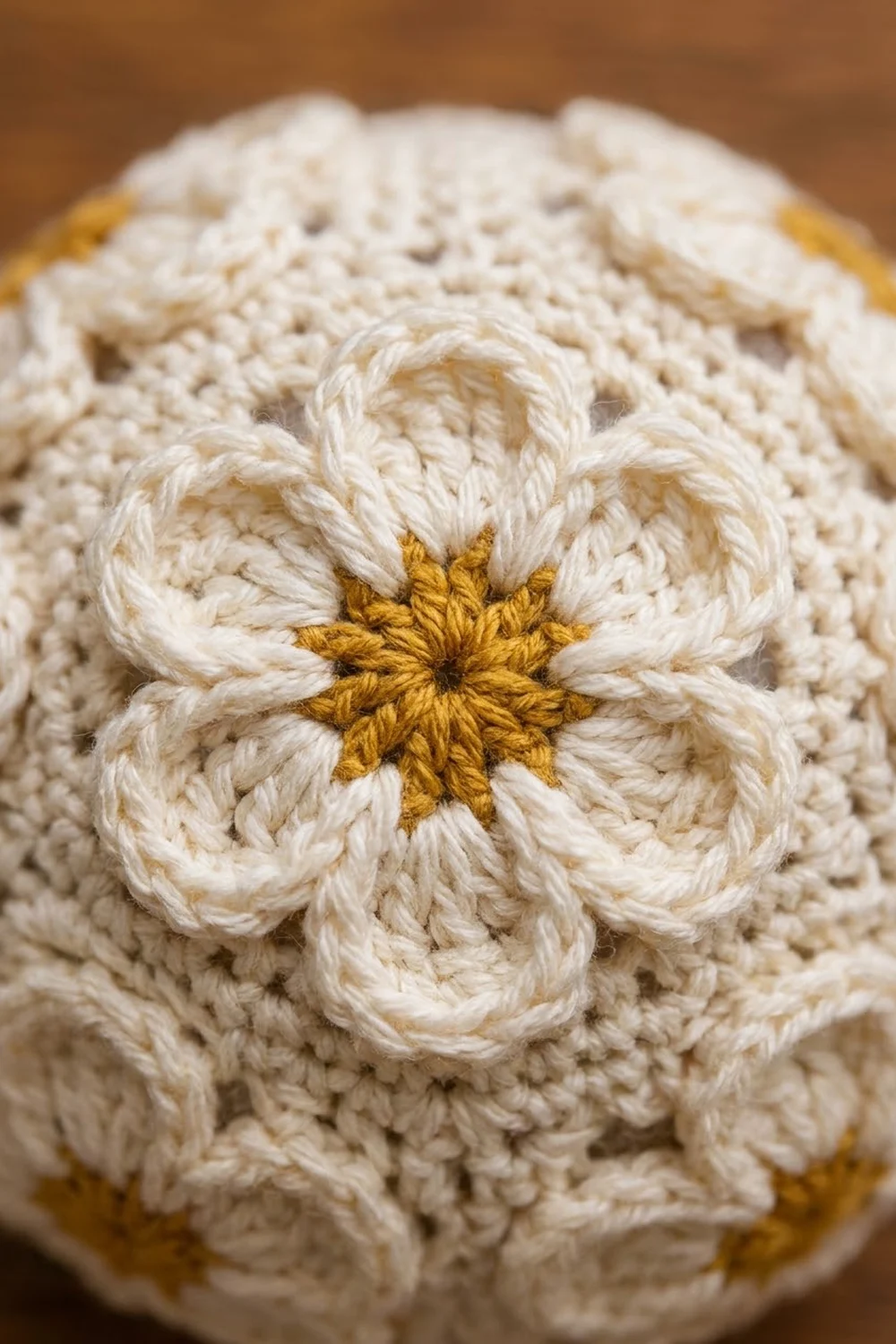
The Daisy Bauble is a small, round Christmas ornament covered in raised cream flowers. Each flower has a warm mustard-gold center and eight rounded petals with a neat outlined edge. Between the flowers, a dense cream base fabric holds the shape firmly.
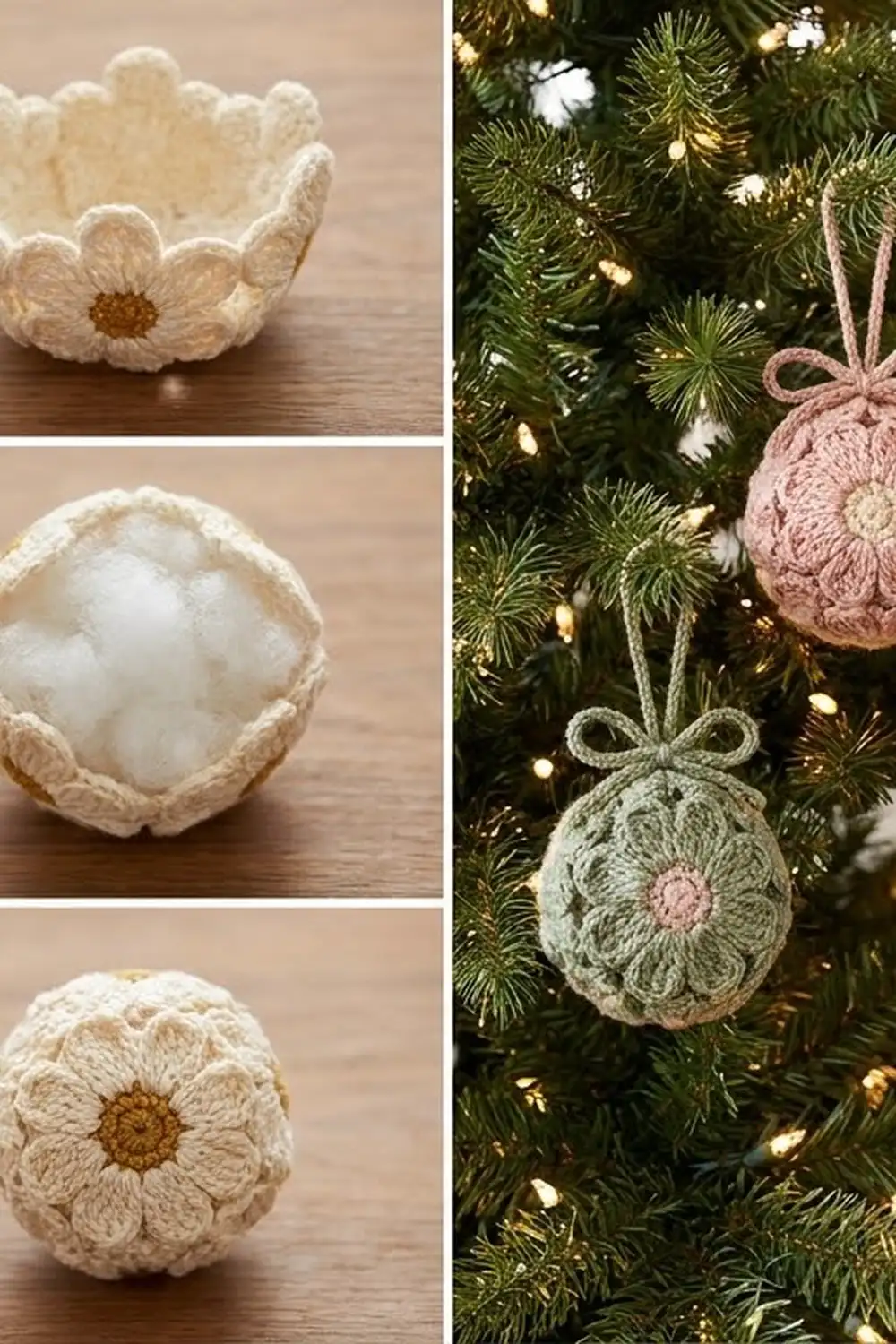
The original is cream with gold centers, so it looks soft and wintry on a green tree. It also works well in other colorways: blush pink with plum centers, sage green with cream flowers, or pale blue with cream flowers.
This pattern uses US crochet terms. The finished ball measures 3.5 in (8.9 cm) across and 11 in (27.9 cm) around. With the hanging loop, the ornament is about 6.3 in (16.0 cm) tall.
You will make one ball shell in continuous single crochet rounds, stuff it, and close the top. Next, you make 12 flowers and sew them on: one at each pole and two staggered rings of five. A chain-cord hanging loop and a small bow finish the ornament.
Finished Size and Construction
- Finished size: 3.5 in (8.9 cm) diameter, 11 in (27.9 cm) circumference
- Height with loop: about 6.3 in (16.0 cm)
- Skill level: Easy-intermediate
- Terminology: US
- Yarn weight: Sport (#2)
- Hook: 2.75 mm (US C-2)
- Number of pieces: 1 ball shell + 12 flower appliqués + 1 hanging loop + 1 bow cord
- Layout: 1 top flower, upper ring of 5, lower ring of 5, 1 bottom flower
- Flower size: 1.75 in (4.4 cm) across
- Size before finishing: 3.5 in (8.9 cm) stuffed ball
- Loop depth: 2.8 in (7.1 cm) above the ball
Materials
Use a smooth sport-weight cotton or cotton blend for crisp petals. A light wool blend gives a softer, fuzzier look. Use the same yarn for every part so the flowers sit evenly on the shell.
- Cream (main color): 35 g, about 115 m
- Mustard gold (flower centers): 5 g, about 15 m
- Polyester fiberfill: about 15 g
Tools:
- 2.75 mm (US C-2) crochet hook
- Tapestry needle
- 10 stitch markers
- Rust-proof pins
- Scissors
The yarn amounts include about 10% extra for gauge swatching, sewing tails, and the cord pieces.
Abbreviations (US Terms)
- ch – chain
- sl st – slip stitch
- sc – single crochet
- hdc – half double crochet
- dc – double crochet
- inc – 2 sc in the same stitch
- dec – invisible decrease (see below)
- MR – magic ring
- sp – space
- st(s) – stitch(es)
- rep – repeat
Invisible decrease (dec): Insert the hook in the front loop of the next st, then in the front loop of the following st (3 loops on hook). Yarn over and pull through 2 loops, then yarn over and pull through the last 2 loops. This counts as 1 sc and leaves no gaps for stuffing to show through.
Gauge and Checkpoints
Shell gauge: 24 sc x 24 rounds = 4 in (10.2 cm) in continuous single crochet rounds. That means 6 sts and 6 rounds per inch.
Flower gauge: One finished flower = 1.75 in (4.4 cm) across, blocked flat.
Make one flower first. It’s quick and it checks your tension on the taller stitches.
Checkpoints:
- Flower after Rnd 2: 0.75 in (1.9 cm) across
- Flower after Rnd 3: 1 in (2.5 cm) across
- Flower after Rnd 5: 1.75 in (4.4 cm) across
- Shell after Rnd 6 (36 sts): 6 in (15.2 cm) around
- Shell after Rnd 11 (66 sts): 11 in (27.9 cm) around
- Stuffed ball: 3.5 in (8.9 cm) across
If your flower is too big, go down a hook size (2.5 mm). If it is too small, go up to 3 mm. Your flowers must not be larger than 1.75 in (4.4 cm), or the five-flower rings will crowd and overlap. If the shell is off, change hooks for the shell only, because the flowers are sized separately.
Ball Shell
Work in continuous rounds without joining. Place a marker in the first stitch of each round and move it up as you go. Use cream throughout.
Rnd 1: In a MR, work 6 sc. (6 sts)
Rnd 2: Inc in each st around. (12 sts)
Rnd 3: (Sc 1, inc) 6 times. (18 sts)
Rnd 4: (Sc 2, inc) 6 times. (24 sts)
Rnd 5: (Sc 3, inc) 6 times. (30 sts)
Rnd 6: (Sc 4, inc) 6 times. (36 sts)
Checkpoint: the circumference is 6 in (15.2 cm).
Rnd 7: (Sc 5, inc) 6 times. (42 sts)
Rnd 8: (Sc 6, inc) 6 times. (48 sts)
Rnd 9: (Sc 7, inc) 6 times. (54 sts)
Rnd 10: (Sc 8, inc) 6 times. (60 sts)
Rnd 11: (Sc 9, inc) 6 times. (66 sts)
Checkpoint: the circumference is 11 in (27.9 cm). This is the ball’s equator size.
Rnds 12–22: Sc in each st around. (66 sts in each round, 11 rounds)
On Rnd 12, place 5 markers for the lower flower ring in sts 1, 14, 27, 40, and 53. On Rnd 22, place 5 markers for the upper ring in sts 7, 20, 33, 46, and 60. The gaps are 13, 13, 13, 13, 14 sts and 13, 13, 13, 14, 13 sts, so the two rings are offset by half a step.
Rnd 23: (Sc 9, dec) 6 times. (60 sts)
Rnd 24: (Sc 8, dec) 6 times. (54 sts)
Rnd 25: (Sc 7, dec) 6 times. (48 sts)
Rnd 26: (Sc 6, dec) 6 times. (42 sts)
Rnd 27: (Sc 5, dec) 6 times. (36 sts)
Rnd 28: (Sc 4, dec) 6 times. (30 sts)
Stuff firmly now through the opening, which is about 1.6 in (4.1 cm) wide. Shape the ball with your hands as you stuff so it ends up round, not egg-shaped.
Rnd 29: (Sc 3, dec) 6 times. (24 sts)
Continue with the top shaping in the closing section below.
Flowers (Make 12)
Rnd 1: With mustard, work 8 sc in a MR. Pull the ring almost closed, leaving a tiny hole. Sl st to first sc. (8 sts)
Rnd 2: Ch 1, 2 sc in each st around. Sl st to first sc. Fasten off mustard. (16 sts)
Rnd 3: Join cream with a sc in any st. Ch 3, skip next st. *Sc in next st, ch 3, skip next st; rep from * 6 more times. Sl st to first sc. (8 sc and 8 ch-3 sps)
Each sc sits between two petals, and each ch-3 sp becomes the base of one petal.
Rnd 4: Sl st into the first ch-3 sp. In each ch-3 sp work (sc, hdc, 3 dc, hdc, sc). Sl st to first sc. (8 petals of 7 sts each, 56 sts)
Rnd 5 (outline): Sl st loosely in each st around, through both loops. (56 sl sts)
This round makes the crisp rim around each petal. Keep it loose so the petals curve gently and don’t cup too much. Fasten off, leaving a 12 in (30.5 cm) cream tail for sewing. Weave in the mustard tail on the back.
Check that each flower is 1.75 in (4.4 cm) across. Steam lightly so all 12 flowers match.
Make All Pieces
Quantities per color:
- Cream: 1 ball shell, the petal rounds (Rnds 3–5) of all 12 flowers, 1 hanging loop, 1 bow cord
- Mustard: 12 flower centers (Rnds 1–2)
Layout (seen from the side, with the rings wrapping around the ball):
              [T]                    top pole, over closed Rnd 32
   [U1]  [U2]  [U3]  [U4]  [U5]      Rnd 22, sts 7, 20, 33, 46, 60
[L1]  [L2]  [L3]  [L4]  [L5]         Rnd 12, sts 1, 14, 27, 40, 53
              [B]                    bottom pole, over Rnd 1 ring
The ring flowers sit 13 or 14 sts apart, about 2.2 in (5.6 cm) center to center at the equator. Because the rings are offset by half a step, each flower lines up with the gap between two flowers in the other ring. This gives 12 flowers an even, close fit on the ball.
Joining: Sewing the Flowers On
Sew on the bottom flower and the ten ring flowers now. Sew the top flower after you attach the hanging loop.
Method: Pin a flower so its mustard center sits over its marker. With the cream tail, work a running stitch through the back of the Rnd 3 sc stitches and into the shell. Then go around the base of each petal.
Stitch-to-stitch logic: Each of the 8 sc in Rnd 3 gets one anchor stitch into the shell, so each flower has 8 anchor points. Between anchors, take one small stitch under the base of each petal at the ch-3 sp. That makes 16 tacking points in total. Don’t sew through Rnds 4–5, so the petal tips stay free and slightly lifted.
Tension advice: Pull each stitch just snug. If you pull too hard, the shell dimples and the ball looks lumpy. Each flower should lie flat with no puckers at the center.
Size checkpoint: With all 11 flowers on, the ball should still measure 11 in (27.9 cm) around at the equator. The flowers add only about 0.1 in (0.3 cm) of height. Gaps between neighboring flowers should be about 0.2 in (0.5 cm), with cream base fabric showing.
Border: Closing Rounds, Hanging Loop, and Bow
On this round piece, the “border” is the top closure and the cord finish. Divide the ball into 6 wedges, one for each increase or decrease repeat.
Cord gauge: With 2 strands of cream held together, 5 ch = 1 in (2.5 cm).
Rnd 30: (Sc 2, dec) 6 times. (18 sts, 3 per wedge)
Rnd 31: (Sc 1, dec) 6 times. (12 sts, 2 per wedge)
Top up the stuffing through the small opening.
Rnd 32: Dec 6 times. (6 sts, 1 per wedge)
Fasten off, leaving a 6 in (15.2 cm) tail. Thread the tail through the front loops of all 6 sts and pull closed. Don’t weave it in yet.
Why the math works: Every round from Rnd 23 on removes exactly 1 st per wedge, or 6 sts per round. This mirrors Rnds 2–11, which each added 1 st per wedge. Rnd 32 ends with 1 st per wedge, so the 6 sts close evenly at the pole with no point or pucker.
Hanging loop: With 2 strands of cream, ch 28. The cord is 5.6 in (14.2 cm) long. Fasten off, leaving 6 in (15.2 cm) tails. Fold the cord in half and push both ends through the closed top ring into the ball. Tie them to the closing tail inside the ball and knot securely. The loop stands 2.8 in (7.1 cm) above the ball. Hide the tails in the stuffing.
Top flower: Slide the top flower down over the loop so the loop comes up through its center hole. Sew it on with 8 anchor points, as you did for the others.
Bow: With 2 strands of cream, ch 40. The cord is 8 in (20.3 cm) long. Fasten off. Wrap it once around the base of the loop, just above the top flower. Tie it in a bow about 2 in (5.1 cm) wide and trim the ends to about 0.25 in (0.6 cm) past the knot. If you like, add a dot of fabric glue to the knot.
Final Blocking
- Lightly mist the ornament with cool water. Don’t soak it, because wet stuffing dries slowly.
- Roll the ball between your palms to even out the shape.
- With a fingertip, gently ease each petal so it curves outward evenly.
- Hold a steam iron 1 in (2.5 cm) above the flowers and steam lightly. Don’t let the iron touch the yarn.
- Shape the bow loops and straighten the hanging loop.
- Let it dry fully, resting on a small cup so it keeps its round shape.
Final Quality-Control Checklist
- Ball measures 3.5 in (8.9 cm) across and 11 in (27.9 cm) around
- Stuffing is firm and even, with no flat spots
- Top and bottom poles are closed cleanly
- 12 flowers, each 1.75 in (4.4 cm) across
- Every flower has 8 petals with a visible sl st rim
- Rings are offset by half a step, with even gaps
- Petal tips are free and lifted, not sewn down
- Loop stands 2.8 in (7.1 cm) and is knotted securely inside
- Bow is centered above the top flower
- All tails are woven in and hidden
Troubleshooting
Ball is egg-shaped: You may have stuffed unevenly or worked extra even rounds. Reshape the ball with your hands, and count to make sure Rnds 12–22 are exactly 11 rounds.
Stuffing shows through: Your tension is too loose. Go down a hook size, and use the invisible decrease every time.
Petals ruffle: Rnd 5 is too tight or your dc are too tall. Loosen the sl sts, or use a smaller hook for the flowers only.
Flowers overlap: The flowers are bigger than 1.75 in (4.4 cm). Remake them with a smaller hook.
Rings don’t line up: Recount the markers. The lower ring is on Rnd 12 and the upper ring is on Rnd 22, counting from the first marked stitch.
Loop pulls out: The knot inside is too small. Tie the ends around a scrap of yarn to make a bigger anchor.
Care
Spot clean with a damp cloth and mild soap, then air dry. Store in tissue paper so the petals and bow keep their shape.
Final Notes
The measurement chain is simple. A gauge of 6 sts per inch gives an 11 in (27.9 cm) equator, which makes a 3.5 in (8.9 cm) ball. Twelve 1.75 in (4.4 cm) flowers fit that ball neatly in a 1 + 5 + 5 + 1 layout. The 2.8 in (7.1 cm) loop brings the ornament to about 6.3 in (16.0 cm) tall. Check your first flower and your Rnd 11 count, and everything after that will fall into place.
Happy crocheting!