

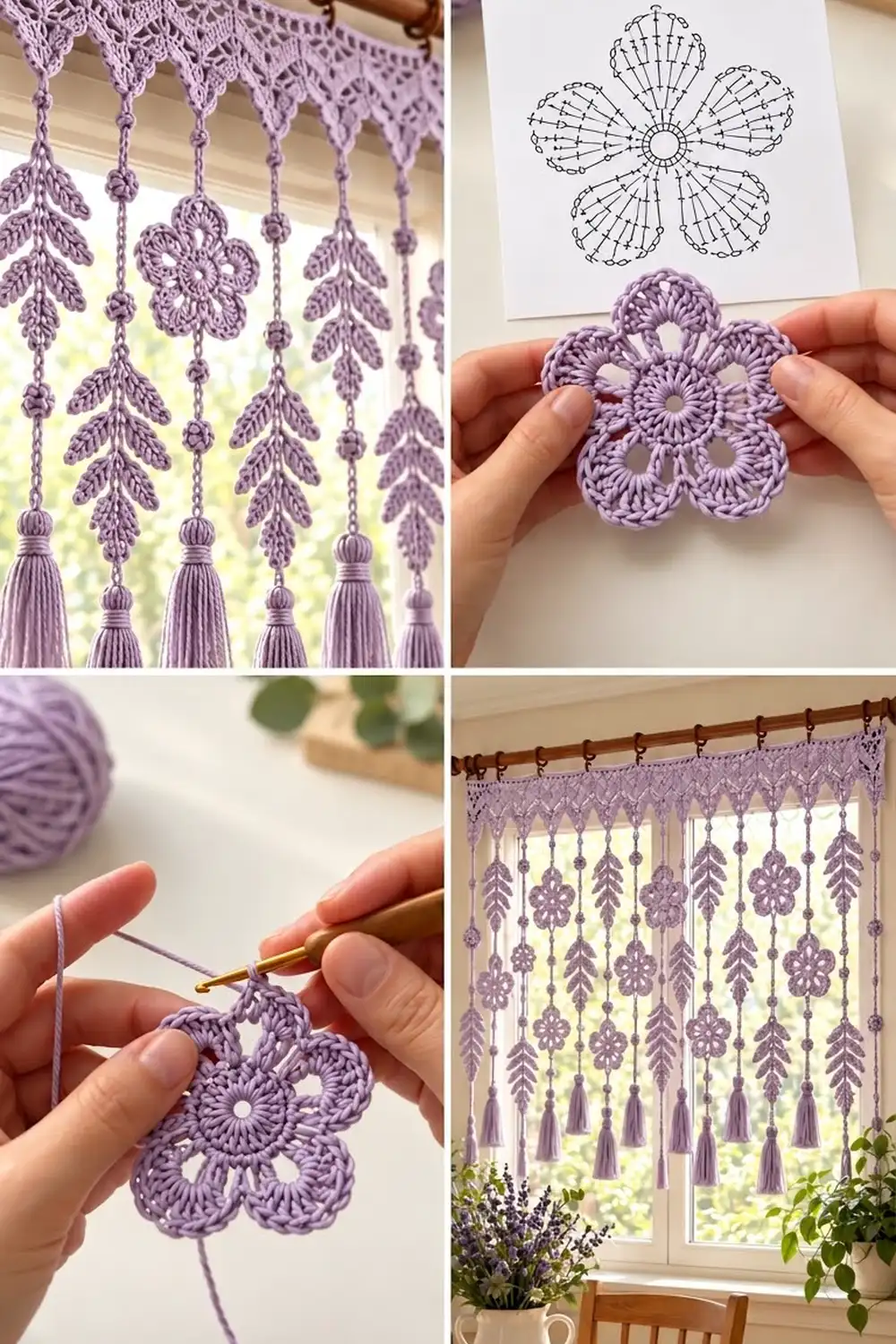
This valance hangs from a curtain rod on clip rings. It has a lacy header with pointed edges, and 12 long strands hang from the points. Each strand carries either fern sprigs or open-petal flowers, plus small bobble beads and a full tassel at the bottom. The whole piece uses one soft lilac cotton, so the texture does the decorating.
The style is light and romantic, and the open lace lets daylight through. All instructions use US crochet terms.
The finished valance is 36 in (91.4 cm) wide and 26.5 in (67.3 cm) long, measured from the top edge to the tassel tips.
First you crochet a five-row header band. Then you work one triangular point at a time. Each point ends in a single stitch, and its strand is chained straight down from that stitch. You work the leaf sprigs and bobbles into the strand as you go. The flowers are made first and joined in as you chain past them. Last, you add the tassels and a picot border along the top edge.
Finished Size and Construction
- Finished size: 36 in (91.4 cm) wide x 26.5 in (67.3 cm) long
- Skill level: Intermediate
- Terminology: US crochet terms
- Yarn weight: DK / light (#3) cotton
- Hook: 3.5 mm (E-4)
- Number of pieces: 1 main piece (header with 12 points and 12 strands), 12 flower motifs, 12 tassels
- Layout: 12 points in one row, each with 1 strand. Leaf strands (A) and flower strands (B) alternate.
- Piece sizes:
- Point: 3 in (7.6 cm) wide x 2.8 in (7.1 cm) deep
- Flower: 3.5 in (8.9 cm) across
- Strand: 18 in (45.7 cm)
- Tassel: 3.5 in (8.9 cm), including the ring
- Header before border: 36 in (91.4 cm) x 4.5 in (11.4 cm), from the top edge to the point tips
- Border depth: 0.5 in (1.3 cm), top edge only
Materials
Yarn: Choose a smooth mercerized or combed DK cotton with about 115 m per 50 g. Cotton gives crisp leaves, blocks cleanly and stretches very little on the rod.
- Lilac: 300 g (approx. 690 m)
- Header and points: 90 g (approx. 207 m)
- 12 strands with leaves and bobbles: 85 g (approx. 196 m)
- 12 flowers: 35 g (approx. 81 m)
- 12 tassels: 90 g (approx. 207 m)
These amounts include about a 15% margin for swatching and differences in tension.
Tools:
- 3.5 mm (E-4) crochet hook
- Tapestry needle
- At least 12 locking stitch markers
- Stiff card cut to 3.5 in (8.9 cm), for the tassels
- Scissors and a measuring tape
- Blocking mats, rust-proof pins and a spray bottle
- 13 curtain clip rings and a rod
Abbreviations (US Terms)
- ch: chain
- sl st: slip stitch
- sc: single crochet
- hdc: half double crochet
- dc: double crochet
- sk: skip
- sp: space
- st(s): stitch(es)
- RS / WS: right side / wrong side
- dc2tog: (yo, insert in next st, pull up a loop, yo, pull through 2) twice, then yo and pull through all 3 loops
- dc3tog: work like dc2tog over 3 sts, then yo and pull through all 4 loops
Special stitches:
- Bobble node: Ch 3. In the 3rd ch from the hook, (yo, insert, pull up a loop, yo, pull through 2) 5 times. Yo and pull through all 6 loops, then sl st in the same ch. The bobble folds into a small bead centered on the strand, about 0.4 in (1.0 cm) long.
- Leaf: Ch 8. Starting in the 2nd ch from the hook, work sc, hdc, dc, dc, hdc, sc, sl st. That’s 7 sts over 7 ch, and you finish at the base of the leaf. Each leaf is about 1.25 in (3.2 cm) long.
- Picot: Ch 3, then sl st in the last sc made.
Gauge and Checkpoints
- Dc: 20 sts and 10 rows = 4 in (10.2 cm). One dc row = 0.4 in (1.0 cm).
- Sc: 20 sts = 4 in (10.2 cm). One sc row = 0.25 in (0.6 cm).
- Chain: 5 ch = 1 in (2.5 cm), unstretched.
Make one flower first. It’s the quickest way to check gauge. After Round 1 it should measure 1.25 in (3.2 cm) across. After Round 3 it should measure 3.5 in (8.9 cm) from one petal tip to the opposite petal edge.
Checkpoints:
- Foundation chain: 36 in (91.4 cm), relaxed
- Header band after Row 5: 36 in x 1.7 in (91.4 cm x 4.3 cm)
- Each point: 3 in (7.6 cm) wide at the base, 2.8 in (7.1 cm) deep
- Each strand: 18 in (45.7 cm) from the point tip to the tassel ring, hanging freely
If your work comes out too big, go down 0.5 mm. If it’s too small, go up 0.5 mm. Chain tension matters most in this project. Check it on its own: ch 25, and the chain should measure 5 in (12.7 cm).
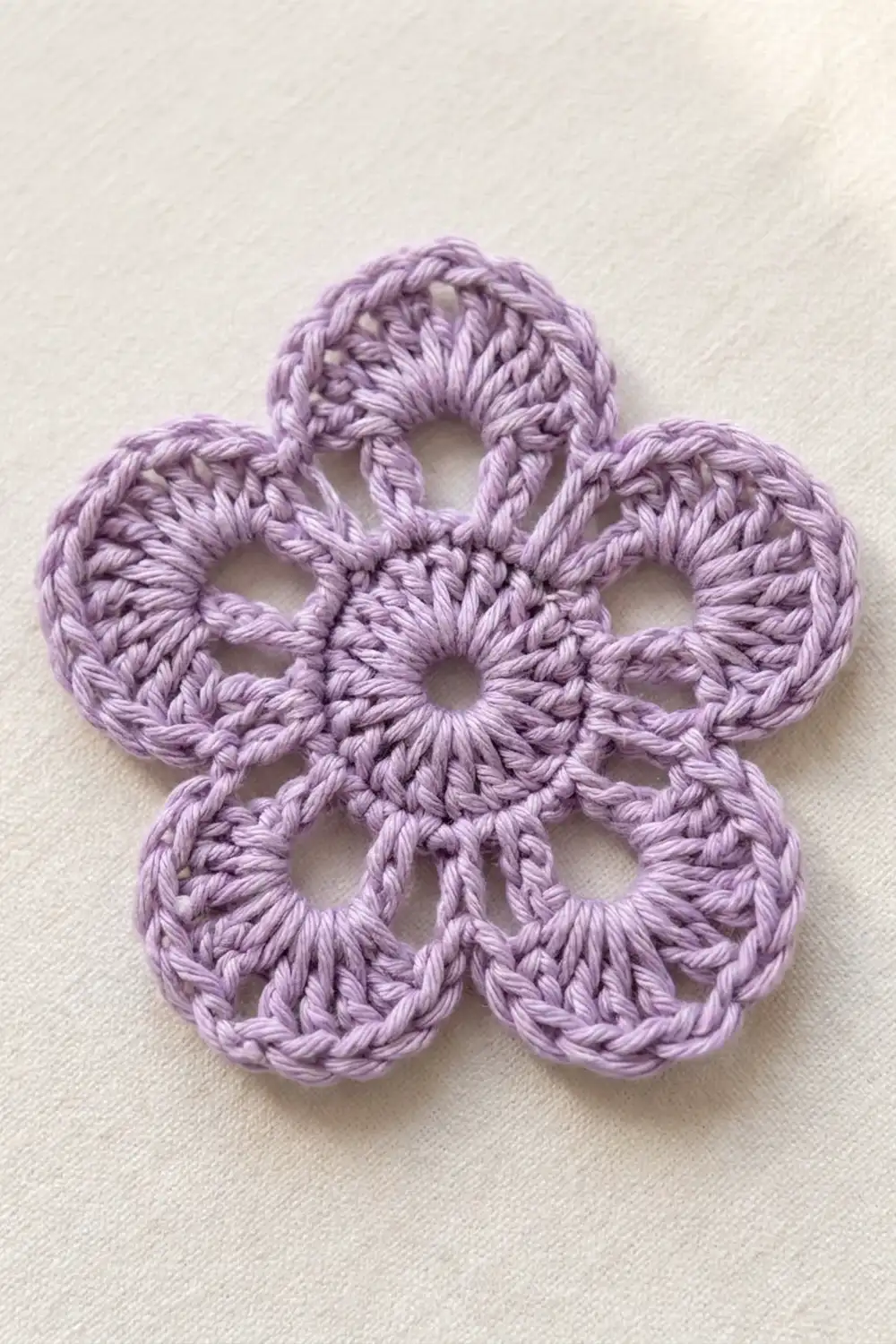
Flower Motif (make 12)
Make a magic ring.
Round 1: Ch 3 (counts as dc), 14 dc in the ring, sl st to the top of the ch-3. Pull the ring almost closed, leaving a small hole in the center. (15 dc)
Round 2: Ch 1, sc in the same st, ch 7, sk 2 sts. Sc in the next st, ch 7, sk 2 sts; repeat from * 3 more times. Sl st to the first sc. (5 sc, 5 ch-7 loops)
Round 3: In each ch-7 loop, work (sc, hdc, 12 dc, hdc, sc), then sl st in the next sc of Round 2. (16 sts per petal, 80 sts total, plus 5 sl sts between petals)
Each ch-7 loop spans 2 skipped sts, which leaves an open window inside every petal. The solid ring from Round 1 stays visible in the center. Fasten off and weave in the ends.
Stitch reference: In each petal, sts 8 and 9 are the 6th and 7th dc and form the petal tip. The sl sts between the petals are the “gaps.”
Main Piece: Header Band
Foundation: Ch 181.
Row 1 (RS): Sc in the 2nd ch from the hook and in each ch across. Turn. (180 sc)
Row 2: Ch 3 (counts as dc), dc in each st across. Turn. (180 dc)
Row 3 (mesh): Ch 4 (counts as dc + ch 1), sk the next st. Dc in the next st, ch 1, sk the next st; repeat from * 87 more times, for 88 repeats in total. Dc in each of the last 2 sts. Turn. (91 dc + 89 ch-1 sps = 180 sts)
Row 4: Ch 3 (counts as dc), dc in each dc and each ch-1 sp across. Turn. (180 dc)
Row 5: Ch 1, sc in each st across. Fasten off. (180 sc)
Checkpoint: the band should measure 36 in x 1.7 in (91.4 cm x 4.3 cm). Place a marker every 15 sts to divide Row 5 into 12 sections of 15 sts.
Points and Strands
Work Section 1 and its strand, then fasten off. Repeat for Sections 2–12. The ch-2 at the start of each point row does not count as a st.
Point (on each 15-st section)
PR1 (RS): Join yarn in the 1st st of the section. Ch 2, dc2tog, dc in the next 11 sts, dc2tog. Turn. (13 sts)
PR2: Ch 2, dc2tog, dc in the next st, (ch 1, sk 1, dc in the next st) 4 times, dc2tog. Turn. (11 sts)
PR3: Ch 2, dc2tog, dc in the next 7 sts (working into both dc and ch-sps), dc2tog. Turn. (9 sts)
PR4: Ch 2, dc2tog, dc in the next st, (ch 1, sk 1, dc in the next st) twice, dc2tog. Turn. (7 sts)
PR5: Ch 2, dc2tog, dc in the next 3 sts, dc2tog. Turn. (5 sts)
PR6: Ch 2, dc2tog, dc in the next st, dc2tog. Turn. (3 sts)
PR7: Ch 2, dc3tog. (1 st, the point tip)
Every row loses exactly 2 sts, so the triangle closes to a clean tip in 7 rows and is 2.8 in (7.1 cm) deep. Don’t fasten off. The strand starts from this tip.
Strand A: Leaf Strand (Sections 1, 3, 5, 7, 9, 11)
Fern sprig: Ch 3 (spine), leaf, leaf, sl st in the last spine ch. Repeat from * 6 more times. (7 nodes, 14 leaves, 21 spine ch, 4.2 in / 10.7 cm)
- Ch 10 (2 in / 5.1 cm), then work a bobble node.
- Ch 10 (2 in / 5.1 cm), then work a fern sprig (4.2 in / 10.7 cm).
- Ch 5, bobble node, ch 5, bobble node, ch 5 (3.8 in / 9.7 cm).
- Work a fern sprig (4.2 in / 10.7 cm).
- Ch 7 (1.4 in / 3.6 cm).
- Tassel ring: ch 6, sl st in the 6th ch from the hook. Fasten off.
Total: 2.4 + 6.2 + 3.8 + 4.2 + 1.4 = 18 in (45.7 cm).
Spread each pair of leaves apart, one to each side, so the sprig opens to about 2.75 in (7.0 cm) wide.
Strand B: Flower Strand (Sections 2, 4, 6, 8, 10, 12)
Flower join: Hold a flower with the RS facing you. Sl st into a gap between two petals. Ch 12 behind the flower, then sl st into st 8 of the opposite petal. This adds 2.4 in (6.1 cm) to the strand, and the back chain stays hidden behind the solid center.
- Ch 10, bobble node, ch 10 (4.4 in / 11.2 cm).
- Join Flower 1 (2.4 in / 6.1 cm).
- Ch 5, bobble node, ch 5, bobble node, ch 5 (3.8 in / 9.7 cm).
- Join Flower 2 (2.4 in / 6.1 cm).
- Ch 10, bobble node, ch 13 (5 in / 12.7 cm).
- Make a tassel ring as for Strand A. Fasten off.
Total: 4.4 + 2.4 + 3.8 + 2.4 + 5 = 18 in (45.7 cm).
Make All Pieces
- Main piece: 1 header with 12 points, 6 Strand A and 6 Strand B
- Flowers: 12 (2 for each Strand B)
- Tassels: 12 (1 for each strand)
- Bobble nodes: 18 on the A strands (3 each) + 24 on the B strands (4 each) = 42
Layout (front view, points numbered left to right):
| 1 | 2 | 3 | 4 | 5 | 6 | 7 | 8 | 9 | 10 | 11 | 12 |
| A | B | A | B | A | B | A | B | A | B  | A  | B  |
Joining
The flowers are joined as you go, as described under Strand B. Each flower is anchored at the gap sl st at the top and at petal st 8 at the bottom, so it hangs with one petal pointing down.
Tassels: Wrap yarn 30 times around the 3.5 in (8.9 cm) card. Slide a 10 in (25.4 cm) tie under the top loops, thread it through the tassel ring and knot it firmly. Remove the card. Wrap a separate strand 8 times around the bundle, 0.75 in (1.9 cm) below the top, to shape a rounded head. Tie it off and bury the ends inside the tassel. Cut the bottom loops and trim to 3 in (7.6 cm). Including the ring, each tassel hangs 3.5 in (8.9 cm).
Tension: Keep each flower’s back chain snug but not tight. If it’s too tight, the flower cups. If it’s too loose, the flower tips forward.
Size checkpoint: Hang the piece from its top edge. Every strand should measure 18 in (45.7 cm) from the point tip to the ring, within 0.5 in (1.3 cm).
Border
Work the border along the top edge only, into the free loops of the foundation chain. The border gauge matches the body: 5 sc = 1 in (2.5 cm). Leave the side edges as they are.
Border Row 1 (top edge): With the RS facing you, join yarn in the first foundation ch. Ch 1, sc in each foundation ch across. Turn. (180 sc)
Border Row 2: Ch 1, sc in each of the next 3 sc, picot; repeat from * 59 more times. Fasten off. (180 sc + 60 picots)
Why the math works: The top edge has 180 sts, which is exactly 60 groups of 3, so the last picot lands on the last st. Each 15-st section holds 5 of those groups, so 5 picots sit centered above every point. Because the border uses one st per st, it adds 0.5 in (1.3 cm) of depth and no width.
Clip the 13 rings onto the section boundaries, about every 15 sts (3 in / 7.6 cm), with one ring at each end.
Final Blocking
- Weave in all remaining ends.
- Soak the curtain in cool water, then gently press the water out without wringing.
- Lay the header flat on the mats and pin the top edge straight to 36 in (91.4 cm).
- Pin each point tip 5 in (12.7 cm) below the top of the picot border.
- Lay each strand out straight. Pin the leaves open in pairs and pin the flower petals round.
- Let the piece dry completely. Comb the tassels straight and trim them evenly to 3 in (7.6 cm).
Final Quality-Control Checklist
- The header is 36 in (91.4 cm) wide with 12 even points.
- Each point ends in a single st with no gaps.
- Leaf strands and flower strands alternate, 6 of each.
- Each sprig has 7 nodes and 14 leaves.
- All 12 flowers have 5 open petals and hang with one petal down.
- All 42 bobbles are round and centered.
- Strands are 18 in (45.7 cm) and tassels are 3 in (7.6 cm).
- 60 picots line the top edge.
- The total length is 26.5 in (67.3 cm).
Troubleshooting
- Header ruffles: The foundation chain is too loose, or Row 3 has extra sts. Recount to 180.
- Points lean sideways: Check that you worked a dc2tog at both ends of every row.
- Strands are different lengths: Your chain tension changed. Measure every 10 ch as you work.
- Leaves curl: Pin them flat when blocking, or use a hook 0.5 mm larger for the leaves only.
- Petals have no window: You didn’t skip 2 sts in Round 2.
- Strands twist: Hang the curtain overnight with a light weight on each tassel.
Care
Hand wash in cool water with mild soap. Roll it in a towel to remove water, then dry it flat and pinned to shape. Don’t tumble dry.
Final Notes
The measurements build on each other. The 36 in (91.4 cm) header band holds 12 points, each 3 in (7.6 cm) wide. Each 2.8 in (7.1 cm) point leads into an 18 in (45.7 cm) strand, and a 3.5 in (8.9 cm) tassel finishes each strand. A 0.5 in (1.3 cm) border sits on top of the header. If each of those measurements is right, you get a 36 x 26.5 in (91.4 x 67.3 cm) lilac valance that hangs straight.
Happy crocheting!