

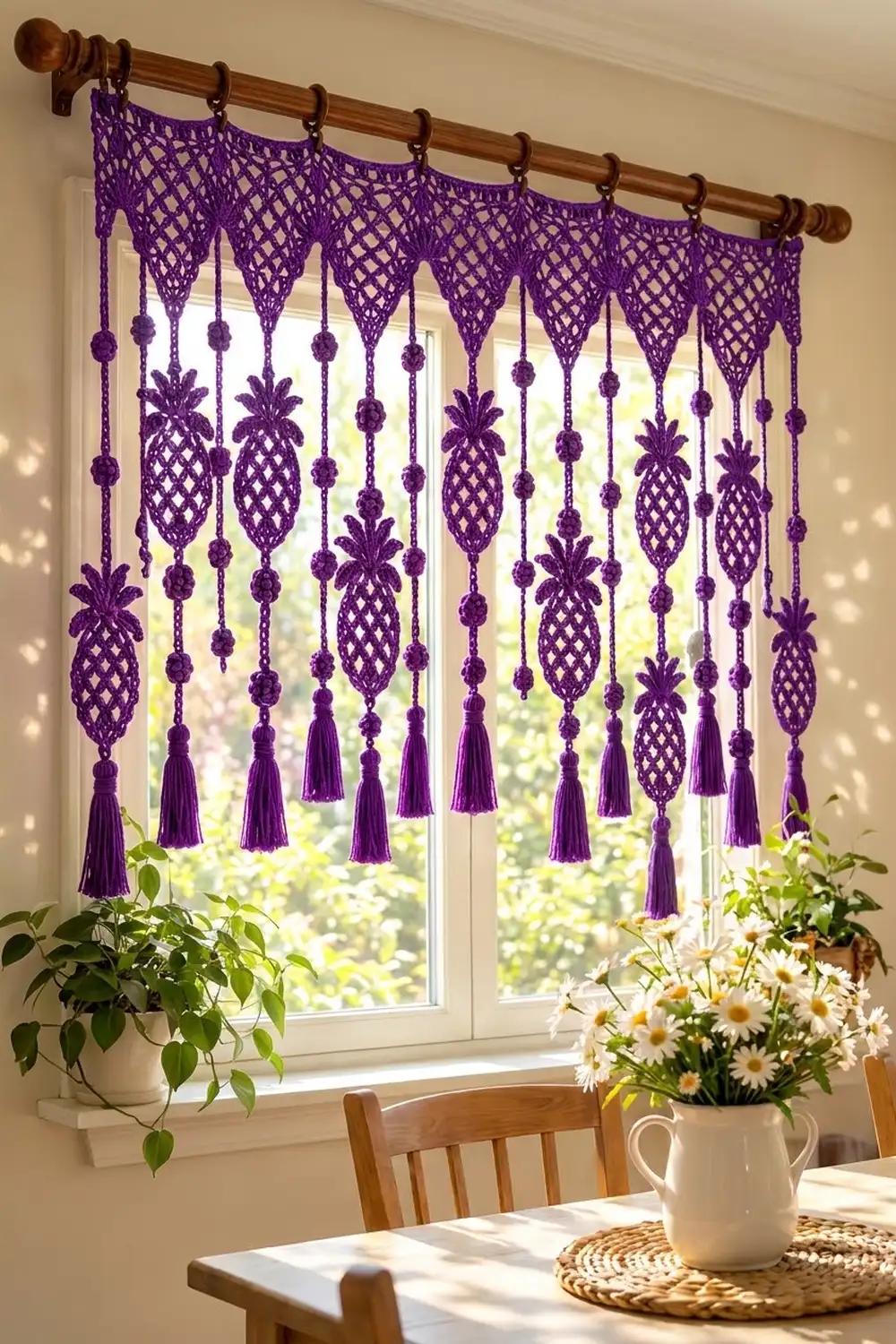
This lace curtain brings an old favorite, the crochet pineapple, into a bright, modern window. A row of mesh triangles forms a scalloped valance. Below it hang chain strands with round bobbles, openwork pineapples and full tassels. With light behind it, the diamond mesh glows and casts soft patterned shadows.
The whole piece is worked in one saturated violet. A single color keeps the busy lace calm and lets the shapes stand out: triangles, ovals, leaves and balls. The style sits somewhere between vintage pineapple lace and boho macramé.
The pattern uses US crochet terms. The finished curtain measures 44 in (111.8 cm) wide. It hangs 24.25–25.75 in (61.6–65.4 cm) from the top of the header to the tassel ends, with the tassels intentionally staggered.
Construction is modular. You make eight mesh triangles and eight pineapple motifs, whipstitch the triangles together at their top corners and work a header band across all of them. Then you crochet fifteen strands directly onto the valance and add tassels.
Finished Size and Construction
- Finished size: 44 in (111.8 cm) wide × 25.75 in (65.4 cm) at the longest strand
- Skill level: Intermediate
- Terminology: US crochet terms
- Yarn weight: Sport (#2) mercerized cotton
- Hook: 3.0 mm
- Number of pieces: 8 triangles, 8 pineapples, 15 strands, 15 tassels
- Layout: 8 triangles in one row, with 15 strands below
- Triangle size: 5.5 in (14.0 cm) across the top × 4.25 in (10.8 cm) deep
- Pineapple size: 3.25 in (8.3 cm) wide × 6 in (15.2 cm) tall, including the crown
- Size before border: 44 in (111.8 cm) wide across the joined triangle tops
- Border (header band) depth: 1 in (2.5 cm)
Materials
Yarn: Use a smooth, tightly plied mercerized cotton in sport weight. Cotton gives crisp stitch definition, holds the mesh open and hangs without stretching. Avoid acrylic, which tends to droop in long strands.
- Violet: 250 g, about 775 m (based on roughly 155 m per 50 g)
Tools:
– 3.0 mm crochet hook
– Yarn needle
– Scissors
– Stiff card, 3.5 in (8.9 cm) tall, for tassels
– Rustproof pins and a blocking mat
– Spray bottle
– Tape measure
– 9 clip curtain rings
The project uses about 220 g. The quantities above include a margin for gauge differences and tassel trimming.
Abbreviations (US Terms)
- ch – chain
- sl st – slip stitch
- sc – single crochet
- hdc – half double crochet
- dc – double crochet
- tr – treble crochet
- sp – space
- st(s) – stitch(es)
- sk – skip
- RS – right side
- cb – chain bobble (see below)
Chain bobble (cb): Ch 3. Then repeat 5 times, all in the 3rd ch from the hook: [yo, insert hook, yo, pull up a loop, yo, draw through 2 loops]. Yo and draw through all 6 loops on the hook, then ch 1 to lock. Each cb makes a round ball about 0.5 in (1.3 cm) tall on the strand.
Mesh rows: A “loop” is one ch-5 sp.
– Increase row: Ch 5, turn, sc in first ch-5 sp, [ch 5, sc in next ch-5 sp] across, ch 5, sc in same sp as last sc. You end with 1 loop more than the previous row.
– Even row: Ch 5, turn, sc in first ch-5 sp, [ch 5, sc in next ch-5 sp] across. The loop count stays the same.
– Decrease row: Ch 5, turn, sk first ch-5 sp, sc in next ch-5 sp, [ch 5, sc in next ch-5 sp] across. You end with 1 loop fewer.
Gauge and Checkpoints
- Mesh: 5 loops = 2.5 in (6.4 cm) wide; 5 mesh rows = 2 in (5.1 cm) tall
- Single crochet: 24 sc and 20 rows = 4 in (10.2 cm)
- Chain: 5 ch = 1 in (2.5 cm), worked slightly loose
Make one triangle and one pineapple first. They are your gauge swatches.
Checkpoints:
– Triangle after Row 5: 3 in (7.6 cm) wide × 2 in (5.1 cm) tall
– Triangle after Row 10: 5.5 in (14.0 cm) wide × 4 in (10.2 cm) tall
– Triangle after the edging round: top edge 5.5 in (14.0 cm), depth 4.25 in (10.8 cm)
– Pineapple after Row 9: 2.5 in (6.4 cm) wide × 3.6 in (9.1 cm) tall
– Pineapple body after Rnd 2: 3.25 in (8.3 cm) × 4.5 in (11.4 cm)
If a piece is too big, go down 0.25 mm in hook size, or tighten your chains so each ch-5 loop sits flatter. If it is too small, go up 0.25 mm. Every 0.25 in (0.6 cm) of error on a triangle top adds up to 2 in (5.1 cm) across the curtain, so fix gauge before you make all the pieces.
Mesh Triangle (make 8)
The triangle is worked from the bottom point up to the wide top edge. Mesh is reversible, so whichever side faces you during the edging round becomes the RS.
Row 1: Ch 6, sc in 6th ch from hook (1 loop), ch 5, sc in same ch. (2 loops)
Row 2: Increase row. (3 loops)
Row 3: Increase row. (4 loops)
Row 4: Increase row. (5 loops)
Row 5: Increase row. (6 loops)
Rows 6–10: Work an increase row 5 times. Each row’s total is the row number plus 1, so Row 10 has 11 loops. (Row 6: 7, Row 7: 8, Row 8: 9, Row 9: 10, Row 10: 11 loops)
Edging Round: Ch 1, turn. This conversion round turns loops into a solid outline.
– Work 3 sc in each of the 11 top loops: 33 sts (sts 1–33). The first and last of these 33 sts are the top corner sts.
– Work 30 sc evenly spaced down the side, about 3 sc per row (sts 34–63).
– Work 3 sc around the Row 1 base ch at the point (sts 64–66, with st 65 at the center).
– Work 30 sc evenly spaced up the other side (sts 67–96).
– Join with sl st to the first sc.
Total: 96 sts = 33 top + 30 side + 3 point + 30 side. Fasten off and weave in the ends.
The sides use 3 sc per row because the diagonal edge is longer than one row height. Each side is about 4.85 in (12.3 cm) long, so 30 sc matches the 6-sc-per-inch gauge.
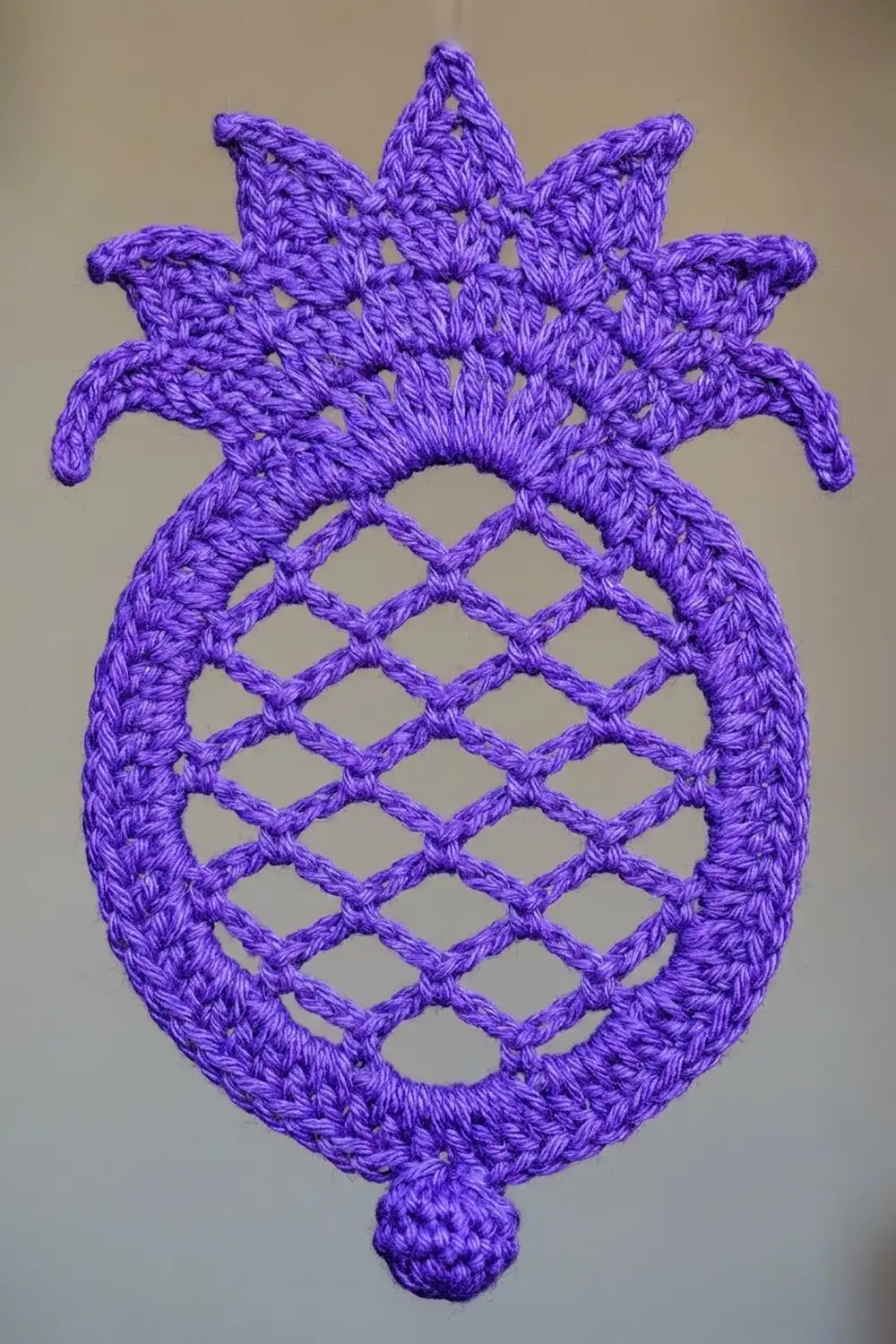
Pineapple Motif (make 8)
The body is worked from the bottom tip up, outlined in 2 rounds, then crowned with leaves.
Row 1: Ch 6, sc in 6th ch from hook, ch 5, sc in same ch. (2 loops)
Row 2: Increase row. (3 loops)
Row 3: Increase row. (4 loops)
Row 4: Increase row. (5 loops)
Rows 5–7: Work an even row 3 times. (5 loops in each row)
Row 8: Decrease row. (4 loops)
Row 9: Decrease row. (3 loops)
These rows make the oval: they widen quickly, hold straight through the middle and narrow toward the crown.
Rnd 1 (conversion): Ch 1, turn.
– Work 3 sc in each of the 3 top loops: 9 sts (sts 1–9).
– Work 18 sc evenly down the side, about 2 per row (sts 10–27).
– Work 3 sc around the base ch at the tip (sts 28–30, with st 29 at the center).
– Work 18 sc evenly up the other side (sts 31–48).
– Join.
Total: 48 sts = 9 + 18 + 3 + 18.
Rnd 2: Ch 1, sc in each st around, join. (48 sts)
This second round makes the thick corded outline. Slightly fewer sc per row than the triangle uses pulls the oval taut so it doesn’t ruffle.
Crown: The leaves are worked into sts 1–9 of Rnd 2, which sit along the top edge.
Sl st in st 1. Then work one leaf in each of sts 2–8. Each leaf ends with a sl st into the same st it started from.
- Leaf A (short): Ch 8. Working back down the chain from the 2nd ch from hook: sl st, sc, hdc, dc in next 2 ch, sc, sl st. (7 sts)
- Leaf B (medium): Ch 10. Working back from the 2nd ch from hook: sl st, sc, hdc, dc in next 3 ch, hdc, sc, sl st. (9 sts)
- Leaf C (long): Ch 12. Working back from the 2nd ch from hook: sl st, sc, hdc, dc in next 2 ch, tr, dc in next 2 ch, hdc, sc, sl st. (11 sts)
Work the leaves in this order: st 2 = A, st 3 = B, st 4 = B, st 5 = C, st 6 = B, st 7 = B, st 8 = A. Then sl st in st 9 and fasten off.
Seven leaves crowded into seven neighboring sts fan out on their own. The short outer A leaves droop outward. The center leaf C adds about 1.5 in (3.8 cm) of height, which brings the full motif to 6 in (15.2 cm).
Make All Pieces
- Triangles: 8 (96 edging sts each)
- Pineapples: 8 (48 sts in Rnd 2 each)
- Tassels: 15
- Strands: 4 Strand A, 4 Strand B and 7 Strand J, all worked later directly onto the curtain
Number the triangles T1–T8 from left to right as the curtain will hang. The strand layout below is read left to right:
HEADER BAND (264 sts across)
[ T1 ][ T2 ][ T3 ][ T4 ][ T5 ][ T6 ][ T7 ][ T8 ]
  A   J  B   J  A   J  B   J  A   J  B   J  A   J  B
A = high pineapple on a triangle point. B = low pineapple on a triangle point. J = bobble-only strand at a junction between triangles.
Joining
Method: Whipstitch the triangles together with a yarn needle, working stitch to stitch.
Lay T1–T8 flat in order with the RS up and the top edges in a straight line. Match the top 3 sts of the right side of each triangle (sts 94–96) to the top 3 sts of the left side of the next triangle (sts 34–36). Pair them in reverse order: st 96 to st 34, st 95 to st 35 and st 94 to st 36.
Whipstitch each pair through both loops, 2 passes per pair. You’ll make 7 short seams. Below each seam the triangle sides separate and form the V-notch.
Tension: Pull each pass snug but not tight. The top corners must stay level with each other so the header row runs straight.
Size checkpoint: The joined tops should measure 44 in (111.8 cm). That is 8 triangles × 5.5 in (14.0 cm).
Border (Header Band)
Border gauge: 24 sc = 4 in (10.2 cm). The header is worked along the long top edge only. Each short end is just the edge of the rows.
Row 1 (RS): Join yarn in st 1 of T8, the top corner at the far right. Sc in sts 1–33 of T8, then continue straight into sts 1–33 of T7, and keep going across T6 to T1. (264 sc)
Row 2: Ch 1, turn, sc in each st across. (264 sc)
Row 3: Ch 3 (counts as dc), turn, dc in each st across. (264 sts)
Row 4: Ch 1, turn, sc in each st across. (264 sc)
Fasten off.
Per-side counts:
– Long top edge: 264 sts in every row.
– Each short end: 4 row-ends, about 1 in (2.5 cm) deep. Leave them unworked or neaten them with 5 sl sts.
Why the math works: 8 triangles × 33 top sts = 264. Each triangle’s 33 already includes its own corner sts. The seam sts (34–36 and 94–96) sit on the sides below the top row, so no stitches are added at the seams. At 6 sc per inch, 264 ÷ 6 = 44 in (111.8 cm), which matches the joined width exactly. The header depth is 3 sc rows at 0.2 in (0.5 cm) each plus 1 dc row at 0.4 in (1.0 cm), for 1 in (2.5 cm).
Strands
Work all strands from the valance down. Chain gauge is 5 ch = 1 in (2.5 cm).
Strand A (high pineapple, on T1, T3, T5 and T7):
1. Join with sl st in st 65 (the point) of the triangle.
2. Ch 10, cb, ch 10, then sl st into the tip of a pineapple’s center leaf C. That’s 4.5 in (11.4 cm) above the pineapple. Fasten off.
3. Join yarn in st 29 of the pineapple’s Rnd 2 (the bottom tip).
4. Cb, ch 10, cb, ch 10. That’s 5 in (12.7 cm) below the pineapple.
5. Leave an 8 in (20.3 cm) tail.
Strand A total: 15.5 in (39.4 cm), or 19 in (48.3 cm) with the tassel.
Strand B (low pineapple, on T2, T4, T6 and T8):
1. Join in st 65 of the triangle.
2. Ch 10, then [cb, ch 10] 3 times. That’s 9.5 in (24.1 cm) above the pineapple.
3. Sl st into the tip of leaf C and fasten off.
4. Join in st 29 of the pineapple.
5. Cb, ch 5. That’s 1.5 in (3.8 cm) below the pineapple.
6. Leave an 8 in (20.3 cm) tail.
Strand B total: 17 in (43.2 cm), or 20.5 in (52.1 cm) with the tassel.
Strand J (bobbles only, 7 strands):
1. Insert hook through st 93 of the left triangle and st 37 of the right triangle together, at the bottom of a seam, and join with sl st.
2. [Ch 10, cb] 6 times, then ch 10.
3. Leave an 8 in (20.3 cm) tail.
Strand J total: 17 in (43.2 cm), or 20.5 in (52.1 cm) with the tassel.
Tassels (make 15)
- Wrap yarn 30 times around the 3.5 in (8.9 cm) card.
- Slide an 8 in (20.3 cm) strand under the wraps at the top and tie tightly.
- Cut the wraps open at the bottom.
- Wrap the neck 6 times, 0.5 in (1.3 cm) below the top, and tie it off.
- Trim the ends level at 3.5 in (8.9 cm).
- Thread the strand tail through the top of the tassel, knot it and bury the end inside the tassel skirt.
Final Blocking
- Weave in all the ends before blocking.
- Mist the triangles and header band until they are damp, not soaked.
- Pin the header straight at 44 in (111.8 cm) wide, placing a pin every 2 in (5.1 cm).
- Pin each triangle point 4.25 in (10.8 cm) below the header’s bottom edge, and open the mesh so the diamonds are even.
- Pin each pineapple to 3.25 in × 6 in (8.3 × 15.2 cm). Fan the leaves and curl the two A leaves slightly outward.
- Mist the tassels and smooth them straight with your fingers.
- Let everything dry fully, at least 12 hours, before you unpin.
- Hang the curtain from the clip rings. Space 9 rings evenly, about 5.5 in (14.0 cm) apart, with one at each end.
Final Quality-Control Checklist
- Each triangle has 96 edging sts, with 33 along the top.
- Each pineapple has 48 sts in Rnd 2 and 7 leaves in the order A-B-B-C-B-B-A.
- 7 seams, each joining exactly 3 st pairs.
- 264 sts in every header row.
- The header measures 44 in (111.8 cm) and is 1 in (2.5 cm) deep.
- 15 strands following the A-J-B-J pattern.
- Strand lengths: A 15.5 in (39.4 cm); B and J 17 in (43.2 cm).
- All 15 tassels trimmed to 3.5 in (8.9 cm).
- All ends woven in and knots hidden.
Troubleshooting
- Mesh triangle leans to one side: You probably missed the ear loop (“ch 5, sc in same sp”) at the end of an increase row. Count the loops in each row.
- Pineapple edge ruffles: You have too many sc per row on the sides. Keep exactly 18 sc per side.
- Pineapple edge puckers: Your sc are too tight. Go up a hook size for Rnd 1 only.
- Header wider than the joined triangles: Your sc gauge is loose. Redo the header with a smaller hook. The count stays at 264.
- Strands twist: Block them damp with a light weight, such as a clothespin, on each tassel.
- Bobbles look flat: Make sure all 5 partial dc go into the same ch and that you lock each bobble with ch 1.
- Crown leaves flop forward: Starch the crown lightly while blocking.
Care
Hand wash in cool water with mild soap, roll the curtain in a towel to remove water, then lay it flat or pin it to dry. Don’t wring or tumble dry it, because the long strands can tangle and stretch.
Final Notes
Everything rests on the measurement chain:
– A 5-loop gauge of 2.5 in (6.4 cm) gives triangles with a 5.5 in (14.0 cm) top edge.
– Eight triangles make a 44 in (111.8 cm) joined row.
– That row carries the 264-st header band, 1 in (2.5 cm) deep.
– Below it hang 3.25 in × 6 in (8.3 × 15.2 cm) pineapples on strands up to 25.75 in (65.4 cm) long.
Check gauge on the first triangle and pineapple, keep your counts, and the curtain will hang straight and even.
Happy crocheting!