

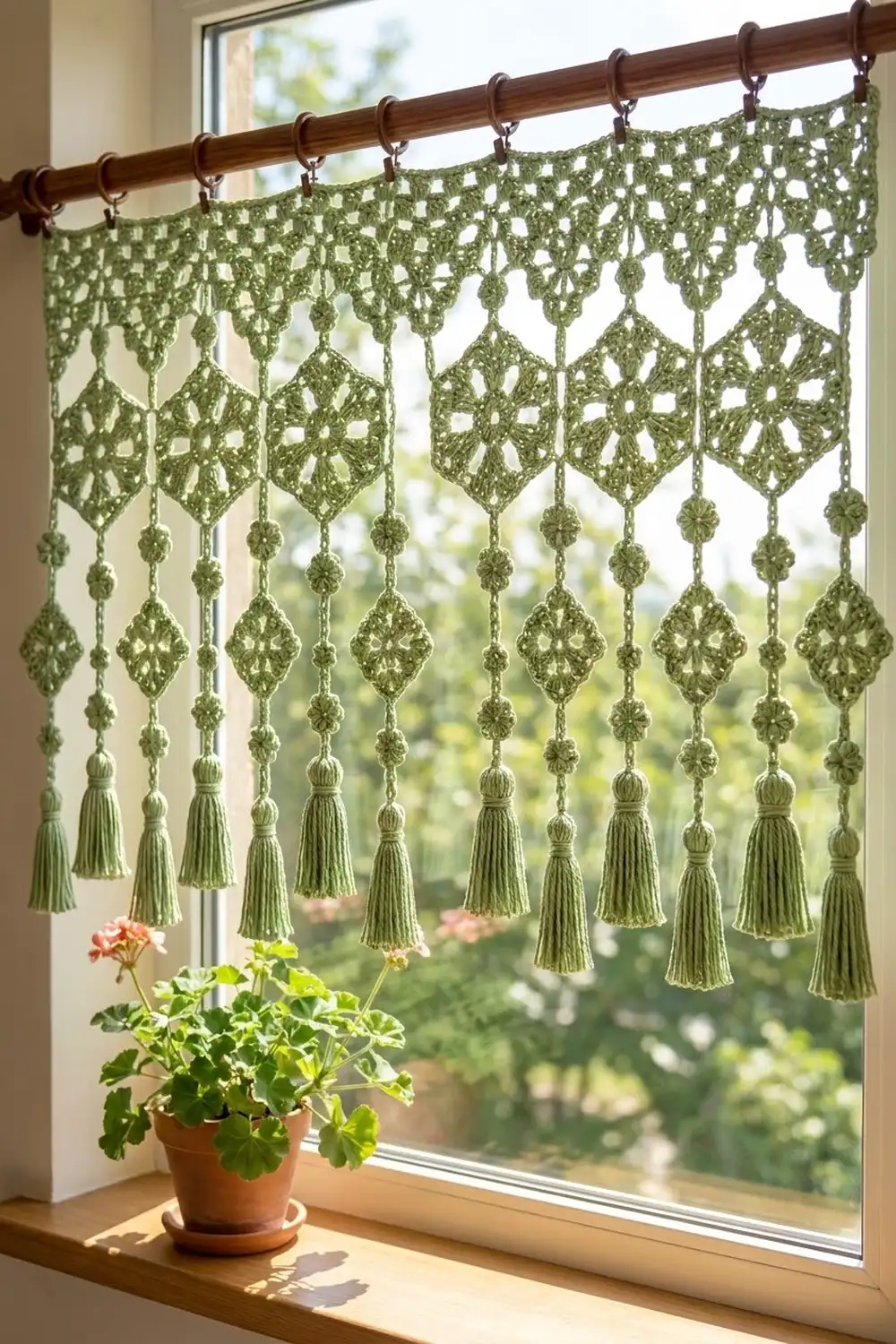
The Sage Garden Valance is a light, airy window topper made in one soft shade of sage green. A row of seven lacy hexagons sits under a granny-mesh header. Fifteen chain strands hang below, each with tiny flowers and a small granny diamond sewn on, and each ends in a full tassel.
The style is cottage-meets-boho. It is open enough to let daylight through and firm enough to hang straight from clip rings on a wooden rod. Because it uses only one color, the texture does all the work, so even tension matters more than usual.
This pattern uses US crochet terms. The finished valance is 35 in (88.9 cm) wide and about 22 in (55.9 cm) deep from the top edge to the tips of the longest tassels.
Here is the order of work: make seven hexagons and join them side by side in one row. Then work the straight header band across the top. Finally, attach the hanging strands, motifs and tassels along the bottom.
Finished Size and Construction
- Finished size: 35 in (88.9 cm) wide x 22 in (55.9 cm) deep
- Skill level: Intermediate
- Terminology: US crochet terms
- Yarn weight: DK (weight 3) cotton or cotton blend
- Hook: 4 mm (US G-6)
- Number of pieces: 7 hexagons, 45 small flowers, 15 diamonds, 15 tassels
- Layout: 1 row of 7 hexagons, points up and down, joined along their vertical sides
- Piece size: each hexagon is 5 in (12.7 cm) flat side to flat side, 5.8 in (14.7 cm) point to point, and 2.9 in (7.4 cm) per side
- Size before border: joined row is 35 in (88.9 cm) wide x 5.8 in (14.7 cm) tall
- Border depth: the header is 3.2 in (8.1 cm) above the hexagon peaks and 4.6 in (11.7 cm) above the valleys; the fringe hangs 13 in (33.0 cm) below the hexagon points
Materials
Choose a smooth DK cotton, either mercerized or matte. Cotton holds the lace open, resists stretching in a sunny window and makes crisp tassels. Avoid fuzzy or very stretchy yarn, because the strands will lengthen over time.
- Sage Green: about 300 g / 660 m (722 yd)
Rough breakdown: hexagons 56 g, header 55 g, flowers 45 g, diamonds 45 g, strand chains 10 g, tassels 26 g. These quantities include a margin of about 20 percent for swatching and tension differences.
Tools:
- 4 mm (US G-6) crochet hook
- Tapestry needle
- Stitch markers
- Scissors
- Stiff card 3 in (7.6 cm) wide, for tassels
- Rustproof pins and a blocking mat
- Spray bottle
- 8 clip-on curtain rings and a curtain rod
Abbreviations (US Terms)
- ch – chain
- sl st – slip stitch
- sc – single crochet
- hdc – half double crochet
- dc – double crochet
- tr – treble crochet
- dtr – double treble crochet (yo 3 times, insert hook, [yo, pull through 2] 4 times)
- sp(s) – space(s)
- sk – skip
- st(s) – stitch(es)
- RS / WS – right side / wrong side
Special stitches:
- dc3tog (cluster, cl): [yo, insert in next st, pull up loop, yo, pull through 2] 3 times, yo, pull through all 4 loops. Counts as 1 st.
- dtr2tog: [yo 3 times, insert in next st, pull up loop, (yo, pull through 2) 3 times] 2 times, yo, pull through all 3 loops. Counts as 1 st.
- Petal: (sl st, ch 2, 2 dc, ch 2, sl st) all in the same st.
Gauge and Checkpoints
Make one hexagon before anything else and block it. Measure gauge on this test piece.
- Main gauge: 15 sc per hexagon side = 2.9 in (7.4 cm), corner sc included
- Chain gauge: 5 ch = 1 in (2.5 cm)
Hexagon checkpoints (measured flat side to flat side):
- After Round 1: 1.5 in (3.8 cm)
- After Round 3: 3 in (7.6 cm)
- After Round 4: 3.8 in (9.7 cm)
- After Round 5: 4.5 in (11.4 cm)
- After Round 6: 5 in (12.7 cm)
If your hexagon is larger than 5 in (12.7 cm), go down to a 3.75 mm hook. If it is smaller, go up to a 4.5 mm hook. An error of 1/4 in (0.6 cm) per hexagon adds up to 1.75 in (4.4 cm) across the valance, so fix it now.
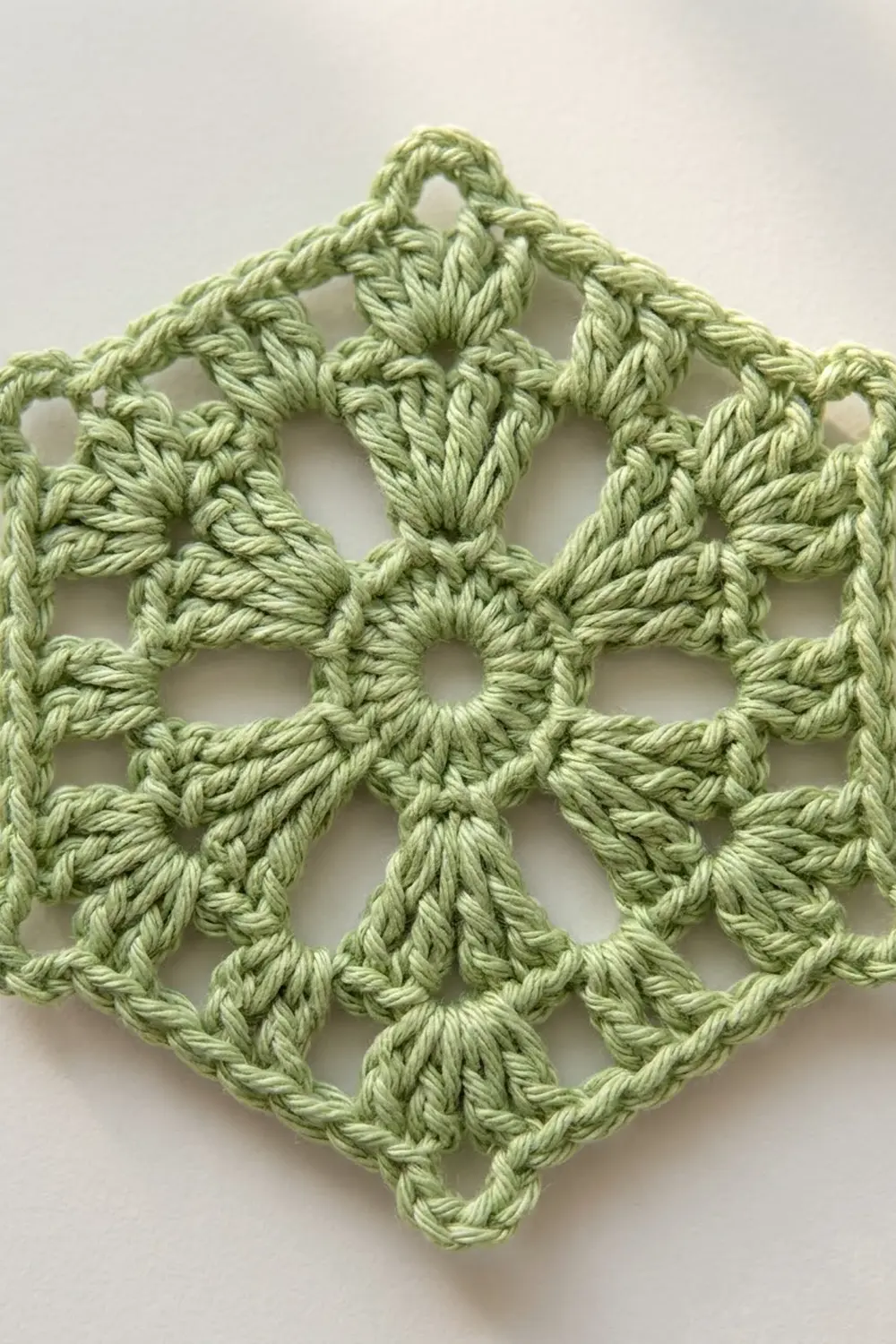
Hexagon (make 7)
Ch 6, sl st in first ch to form a ring.
Round 1: Ch 3 (counts as dc), 17 dc in ring, sl st in top of beginning ch-3. (18 dc)
Round 2: Ch 3 (counts as dc), dc in next 2 sts, ch 2, *dc in next 3 sts, ch 2; rep from * 4 more times, sl st in top of beginning ch-3. (18 dc in 6 groups of 3, 6 ch-2 sps)
Round 3: Ch 3 (counts as dc), dc in same st, dc in next st, 2 dc in next st, ch 3, sk ch-2 sp, *2 dc in next st, dc in next st, 2 dc in next st, ch 3, sk ch-2 sp; rep from * 4 more times, sl st in top of beginning ch-3. (30 dc in 6 solid petals of 5, 6 ch-3 sps)
Round 4: Sl st in next 4 sts and into the next ch-3 sp. Ch 3 (counts as dc), (2 dc, ch 2, 3 dc) in same sp, *ch 1, sk next dc, dc3tog over next 3 dc, ch 1, sk next dc, (3 dc, ch 2, 3 dc) in next ch-3 sp; rep from * 4 more times, ch 1, sk next dc, dc3tog over next 3 dc, ch 1, sk last dc, sl st in top of beginning ch-3. (36 dc, 6 cl, 12 ch-1 sps, 6 ch-2 corner sps)
The shells become the six corners. Each cluster closes the tip of a petal at the middle of a side.
Round 5: Sl st in next 2 dc and into the ch-2 corner sp. Ch 3 (counts as dc), (dc, ch 2, 2 dc) in same sp, *dc in next 3 dc, dc in ch-1 sp, dc in cl, dc in ch-1 sp, dc in next 3 dc, (2 dc, ch 2, 2 dc) in next corner sp; rep from * 4 more times, dc in next 3 dc, dc in ch-1 sp, dc in cl, dc in ch-1 sp, dc in next 3 dc, sl st in top of beginning ch-3. (78 dc: 13 per side, corner dc included; 6 ch-2 corner sps)
Round 6: Ch 1, *(sc, ch 2, sc) in corner sp, sc in next 13 dc; rep from * 5 more times, sl st in first sc. Fasten off. (90 sc: 15 per side including the 2 corner sc; 6 ch-2 corner sps)
Weave in ends and block each hexagon to 5 in (12.7 cm) flat to flat.
Small Flower (make 45)
Make a magic ring.
Round 1: Ch 1, 6 sc in ring, sl st in first sc. Pull ring closed. (6 sc)
Round 2: Work a petal in each sc around, so the last sl st of the final petal lands in the first sc. (6 petals)
Fasten off and leave a 6 in (15.2 cm) tail for sewing. Each flower is about 1.25 in (3.2 cm) across.
Diamond (make 15)
Make a magic ring.
Round 1: Ch 3 (counts as dc), 2 dc in ring, ch 2, *3 dc in ring, ch 2; rep from * 2 more times, sl st in top of beginning ch-3. (12 dc, 4 ch-2 sps)
Round 2: Sl st in next 2 dc and into the ch-2 sp. Ch 3 (counts as dc), (2 dc, ch 2, 3 dc) in same sp, ch 1, *(3 dc, ch 2, 3 dc) in next ch-2 sp, ch 1; rep from * 2 more times, sl st in top of beginning ch-3. (24 dc, 4 ch-2 corner sps, 4 ch-1 sps)
Round 3: Ch 1, *(sc, ch 2, sc) in corner sp, sc in next 3 dc, sc in ch-1 sp, sc in next 3 dc; rep from * 3 more times, sl st in first sc. (36 sc: 9 per side including the 2 corner sc)
Fasten off and leave an 8 in (20.3 cm) tail. Each diamond is 2.25 in (5.7 cm) per side and 3.2 in (8.1 cm) from corner to opposite corner. It hangs on point.
Tassel (make 15)
- Wrap yarn 20 times around the 3 in (7.6 cm) card.
- Slide a 10 in (25.4 cm) tie strand under the wraps at the top and knot it tightly.
- Cut the loops at the bottom.
- Wrap a separate strand tightly 5 times around the bundle, 0.5 in (1.3 cm) below the top, to form the rounded head. Knot it and bury the ends inside the tassel.
- Trim to an even 3 in (7.6 cm).
Make All Pieces
All pieces are Sage Green:
- 7 hexagons
- 45 flowers
- 15 diamonds
- 15 tassels
Layout grid (front view, points up):
[H1] [H2] [H3] [H4] [H5] [H6] [H7]
The layout is one row of seven hexagons. Each hexagon joins its neighbor along a vertical side, which gives 6 seams.
Joining
Use a slip stitch seam worked through back loops only, so the outline ridge sits neatly on the front.
Place two hexagons RS together with their vertical sides lined up. Insert the hook through both upper corner ch-2 sps and sl st. Then sl st through the back loops of each matching pair of sc, 1 st to 1 st, for 15 sl sts (corner sc included). Finish with a sl st through both lower corner ch-2 sps. Fasten off.
Both sides have exactly 15 sc, so the seam matches stitch for stitch with no easing or skipping.
Keep the sl sts as loose as the sc underneath. A tight seam puckers the lace and shortens the width. If your seams pull, go up one hook size for joining only.
Checkpoint: The joined row should be 35 in (88.9 cm) wide (7 x 5 in / 12.7 cm) and 5.8 in (14.7 cm) tall at each hexagon. If it ripples, block it lightly before starting the header.
Border: Header Band and Hanging Strands
Header Band
The top of the joined row is a zigzag of peaks and valleys, and each valley is 1.4 in (3.6 cm) deep. Rows 1 and 2 use stitches of graded heights to fill the valleys. The granny rows above them then build a straight band.
Header gauge: 197 sts across 35 in (88.9 cm), about 5.6 sts per inch (2.5 cm).
Where 197 comes from:
- Each top slant has 15 sc. The 13 middle sc are worked 1 to 1.
- At each peak, skip the 2 corner sc and work 1 st into the peak ch-2 sp.
- At each of the 6 seams, the 2 corner sc that meet there become 1 dtr2tog.
- At each outer end, work 1 st into the corner ch-2 sp.
So 7 hexagons x (13 + 1 + 13) = 189, plus 6 seam sts, plus 2 end sts = 197. The single dtr2tog is the only stitch at each seam.
Row 1 (RS): Join yarn in the outer upper corner ch-2 sp of H1. Ch 5 (counts as dtr), sk corner sc. For the rising slant, work dtr in next st, tr in next 3 sts, dc in next 3 sts, hdc in next 3 sts, sc in next 3 sts. Sk corner sc, sc in peak ch-2 sp, sk corner sc. For the falling slant, work sc in next 3 sts, hdc in next 3 sts, dc in next 3 sts, tr in next 3 sts, dtr in next st. At the seam, skip the joined ch-2 sps and dtr2tog over the corner sc of this hexagon and the first corner sc of the next hexagon. Rep from * across. On the last hexagon, stop at *, then sk corner sc and dtr in the outer corner ch-2 sp. (197 sts)
Row 2 (WS): Ch 5 (counts as dtr), turn. Work 1 st in each st across, matching the heights of Row 1: dtr over each dtr and dtr2tog, tr over tr, dc over dc, hdc over hdc and sc over sc. End with dtr in top of turning ch. (197 sts) The top edge is now level.
Row 3: Ch 3 (counts as dc), turn, sk next st, *3 dc in next st, sk next 3 sts; rep from * 47 more times, 3 dc in next st, sk next st, dc in last st. (49 groups; 149 dc)
Row 4: Ch 3 (counts as dc), turn, dc in first st, 3 dc in each of the 48 sps between groups, 2 dc in top of turning ch. (148 dc)
Row 5: Ch 3 (counts as dc), turn, 3 dc in each of the 49 sps between groups, dc in top of turning ch. (149 dc)
Rows 6–7: Repeat Rows 4 and 5. (148 dc, then 149 dc)
Row 8: Ch 1, turn, sc in each dc, plus 1 sc in each of the 48 sps between groups. (149 + 48 = 197 sc) Fasten off.
Why the math works: Row 3 uses 1 + 1 + (48 x 4) + 1 + 1 + 1 = 197 sts, so the granny rows sit exactly over Row 2. Row 8 returns to 197 sts, the same count as Rows 1 and 2. That keeps the top edge the same width as the hexagon row, so it won’t flare or pull in.
Checkpoint: The header is 3.2 in (8.1 cm) deep above the peaks, and the width is still 35 in (88.9 cm). Clip the 8 rings to Row 8, one at each end and one above each seam, 5 in (12.7 cm) apart.
Hanging Strands
There are 15 strands, each ch 50, or 10 in (25.4 cm) long:
- Strand A (7): one at each bottom point ch-2 sp.
- Strand B (8): one at each of the 6 bottom seams (through both joined ch-2 sps) and one at each of the 2 outer lower corner ch-2 sps.
Strand B starts 1.4 in (3.6 cm) higher than Strand A, so its tassels hang higher. This creates the staggered fringe.
For each strand, join yarn with a sl st in the ch-2 sp, ch 50, and fasten off with a 10 in (25.4 cm) tail. Thread the tail through the top of a tassel and knot it securely at the end of the chain.
Motif placement (count chains from the top):
- Strand A: flower centered at ch 8, flower at ch 18, diamond centered at ch 30, flower at ch 44.
- Strand B: flower at ch 8, diamond centered at ch 22, flower at ch 35, flower at ch 45.
Lay each motif over the chain with the RS facing out. Use the motif’s tail to sew its top and bottom petal tips (or the top and bottom diamond corners) to the chain, so the chain runs straight behind the motif.
Final Blocking
- Lay the valance face down on a blocking mat.
- Pin the top edge straight to 35 in (88.9 cm).
- Pin each hexagon to 5 in (12.7 cm) flat to flat and 5.8 in (14.7 cm) point to point. Use pins to open the clusters and shells.
- Mist evenly until damp but not soaked.
- Lay each strand straight and pin the motifs flat, with the diamonds on point.
- Mist the tassels and straighten them with your fingers.
- Let everything dry completely, then unpin.
Final Quality-Control Checklist
- Each hexagon has 15 sc per side and 6 clean ch-2 corners.
- All 6 seams lie flat without puckering.
- The header top is level, with no dips over the seams.
- Rows 1, 2 and 8 each have 197 sts.
- Width is 35 in (88.9 cm) at both the top edge and the hexagon row.
- There are 15 strands of 50 ch, with the motifs sewn on in the correct order.
- Tassels are trimmed evenly to 3 in (7.6 cm).
- All ends are woven in and can’t be seen from the front.
Troubleshooting
- Header dips over the seams: The dtr2tog is too short. Pull up taller loops, or add one extra yarn over to each half on Row 1 only.
- Header bumps at the peaks: The peak sc is too loose. Work it tightly, or use a sl st there on Row 2.
- Hexagon cups: Round 3 or Round 5 is too tight. Go up a hook size for those rounds.
- Hexagon ruffles: Your tension is loose. Go down a hook size, especially for Round 6.
- Granny rows lean: Make sure each turning chain counts as the first dc and that the last st goes into it.
- Strands twist: While blocking, clip a light weight to each tassel.
- Tassels look thin: Add 5 more wraps.
Care
Hand wash in cool water with mild soap, roll in a towel to remove water, and lay flat to dry. Pin the strands straight again while damp.
Final Notes
The whole valance depends on one chain of measurements. Fifteen sc per side gives a 5 in (12.7 cm) hexagon, and seven hexagons give 35 in (88.9 cm). The header keeps that width with 197 sts and rises 3.2 in (8.1 cm) above the peaks. Fifty chains make 10 in (25.4 cm) strands, and 3 in (7.6 cm) tassels bring the total depth to 22 in (55.9 cm). If your first hexagon measures correctly, the rest will follow.
Happy crocheting!