

This curtain is a soft wall of lacy fans. Sixty-one small ginkgo-style fan motifs hang on eleven strands from a tabbed header band. Each fan is linked to the one above it by a short chain stem with a round bead. Light passes through the open ribs, so the whole piece glows in a sunny window.
Everything is worked in one color, a pale butter yellow in mercerized cotton. The look is light, airy and suits a cottage kitchen. Each fan has seven radiating ribs of double crochet, open chain gaps between them, and six rounded scallops along the bottom edge.
The pattern uses US crochet terms. The finished curtain measures 35 in (88.9 cm) wide. It is about 37.75 in (95.9 cm) long from the top of the header band to the lowest fan, not counting the rod tabs.
Construction is simple. You make each fan with its stem and bead attached, then sew the stems together into strands. A header band worked in rows holds the strands together, and its tab loops slide straight onto a curtain rod.
Finished Size and Construction
- Finished size: 35 in (88.9 cm) wide x 37.75 in (95.9 cm) long, plus rod tabs
- Skill level: Intermediate (easy stitches, many repeats)
- Terminology: US crochet terms
- Yarn weight: DK / light worsted (#3), mercerized cotton
- Hook: 3.5 mm (E-4)
- Number of pieces: 61 fans (56 regular-stem, 5 long-stem) plus 1 header band
- Layout: 11 strands: 6 strands of 6 fans and 5 strands of 5 fans, alternating
- Piece size: one fan is 5 in (12.7 cm) wide x 3 in (7.6 cm) tall; one stem is about 3 in (7.6 cm) long
- Size before header: the strands span 35 in (88.9 cm) wide; the longest strand is 36 in (91.4 cm)
- Header depth: 1.75 in (4.4 cm), plus chain tabs
Materials
Choose a smooth, mercerized DK cotton. It shows the stitches clearly, keeps the scallops crisp, and does not stretch much when the strands hang. Avoid fuzzy or very stretchy yarns, because the strands will grow over time.
- Butter Yellow: about 200 g, roughly 500 yd (457 m)
These quantities include a margin of about 25 percent. One fan with its stem and bead uses about 2.5 g, so 61 fans use about 155 g. The header uses about 15 g.
Tools
- 3.5 mm (E-4) crochet hook
- Tapestry needle
- Scissors
- Stitch markers (at least 11)
- Measuring tape
- Blocking mat and rust-proof pins
- Spray bottle
- Curtain rod up to 0.75 in (1.9 cm) thick
Abbreviations (US Terms)
- ch – chain
- sl st – slip stitch
- sc – single crochet
- dc – double crochet
- sp – space
- st(s) – stitch(es)
- tch – turning chain
- RS – right side
- [ ] – repeat the steps in brackets the stated number of times
Special stitch – Bead: Ch 4, sl st in 4th ch from hook to form a small ring, ch 1, work 10 sc in the ring, sl st in first sc. The bead measures about 0.75 in (1.9 cm) across.
Gauge and Checkpoints
Gauge: 20 sts and 10 dc rows = 4 in (10.2 cm). In this pattern, 5 chains also measure about 1 in (2.5 cm).
Make one complete test fan before anything else. It works as a true gauge swatch and becomes part of the curtain if it measures correctly.
Checkpoints for one fan:
- After Row 5: about 4.25 in (10.8 cm) across in a straight line, and 2.25 in (5.7 cm) from the top of the ring to the Row 5 edge.
- After Row 6: 5 in (12.7 cm) wide and 2.75 in (7.0 cm) tall.
- After the edging: 5 in (12.7 cm) wide and 3 in (7.6 cm) tall.
- Regular stem, unstretched: about 3 in (7.6 cm) from the starting tail to the ring.
If your fan is too big, go down 0.25 mm in hook size. If it is too small, go up 0.25 mm. Change the hook rather than the stitch counts, because the header math depends on the fan width and the strand spacing.
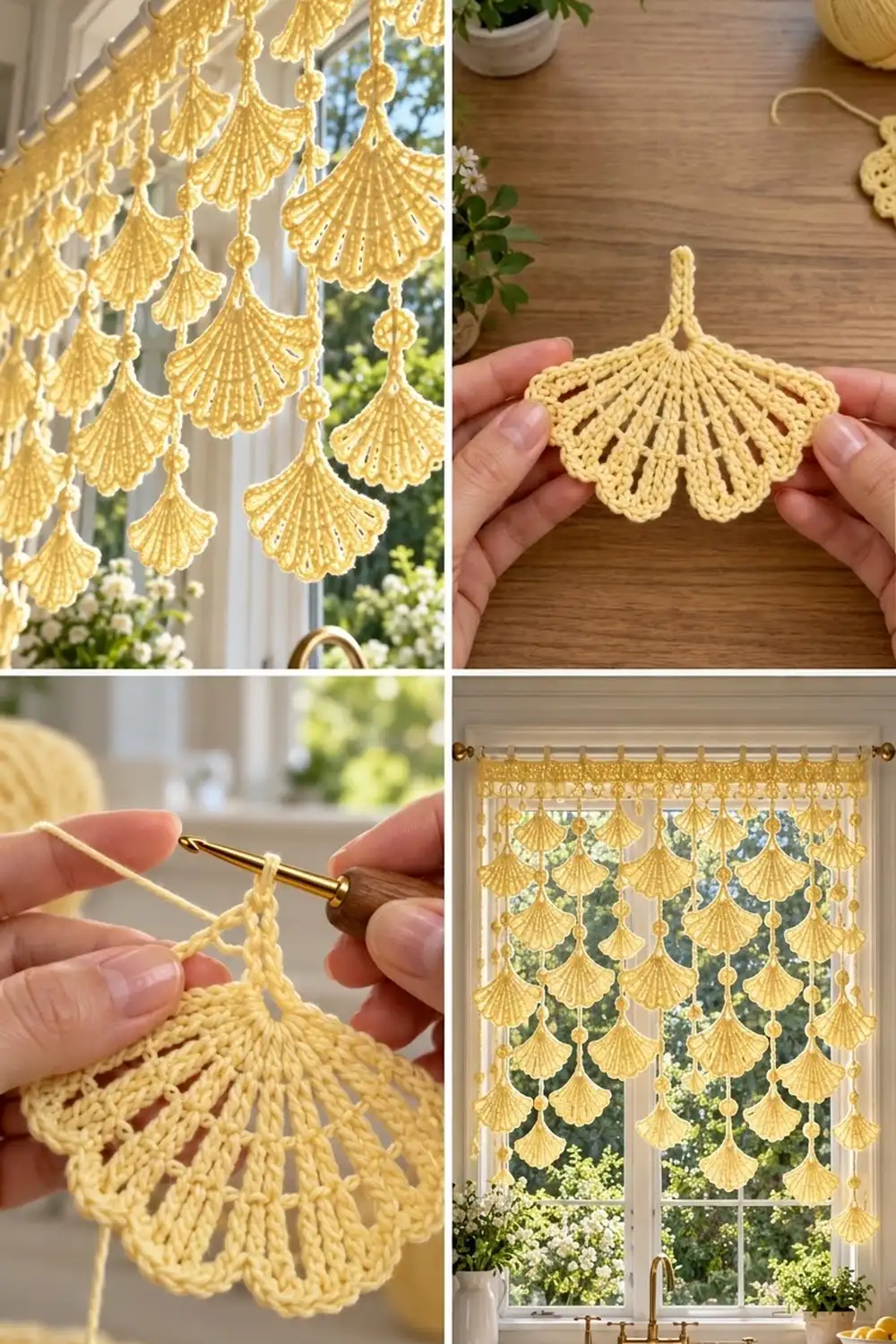
Fan Motif
Each fan starts at the top of the stem, adds the bead, and then forms the fan ring. The fan is worked in rows that widen from the ring toward the scalloped edge.
Regular-Stem Fan (make 56)
Stem: Leaving an 8 in (20.3 cm) tail, ch 6. Make a Bead. Ch 10, sl st in the 4th ch from hook to form the fan ring. You now have 6 stem chains between the bead and the ring.
Row 1 (RS): Ch 3 (counts as dc), 6 dc in ring, turn. (7 dc)
These 7 dc become the 7 ribs. They fill the lower half of the ring, and the stem rises from the top.
Row 2: Ch 4 (counts as dc and ch 1), [dc in next dc, ch 1] 5 times, dc in top of tch, turn. (7 dc, 6 ch-1 sps)
Row 3: Ch 3 (counts as dc), dc in same st, [ch 1, 2 dc in next dc] 6 times, working the last 2 dc in the 3rd ch of the tch, turn. (14 dc, 6 ch-1 sps)
Each rib is now 2 dc wide.
Row 4: Ch 3 (counts as dc), dc in next dc, [ch 2, dc in each of next 2 dc] 6 times, working the last dc in top of tch, turn. (14 dc, 6 ch-2 sps)
Row 5: Ch 3 (counts as dc), dc in next dc, [ch 3, dc in each of next 2 dc] 6 times, working the last dc in top of tch, turn. (14 dc, 6 ch-3 sps; 32 sts in total)
The open gaps now widen evenly toward the edge, which gives the fan its ginkgo shape.
Row 6 (scallops): Ch 1, sc in each of first 2 dc, [7 dc in next ch-3 sp, sc in each of next 2 dc] 6 times. Do not turn. (14 sc and 42 dc = 56 sts; 6 scallops)
The sc pairs sit on top of the ribs and pull the edge in, while each 7-dc shell rounds out into a lobe. The 4th sc pair is the bottom center of the fan, and the next stem joins there.
Edging: Ch 1 and rotate to work along the side. Work 2 sc around each row-end post of Rows 5, 4, 3, 2 and 1 (10 sc). Work 3 sc in the free top of the ring, around the base of the stem. Work 2 sc around each row-end post of Rows 1 through 5 down the other side (10 sc). Sl st in the first sc of Row 6. (23 edging sc) Fasten off and weave in this end only. Keep the 8 in (20.3 cm) starting tail for joining.
Long-Stem Fan (make 5)
Work exactly as the Regular-Stem Fan, but start with ch 21 instead of ch 6 before the Bead. The extra 15 chains add 3 in (7.6 cm). This drops these strands by half a unit and staggers the fans.
Make All Pieces
All pieces are Butter Yellow.
- Regular-stem fans: 56
- Long-stem fans: 5
- Header band: 1
Strand types:
- Strand A (make 6): 6 regular-stem fans. Length 36 in (91.4 cm).
- Strand B (make 5): 1 long-stem fan on top, then 4 regular-stem fans. Length: 3 in (7.6 cm) of extra stem plus 5 units of 6 in (15.2 cm), for 33 in (83.8 cm) in total.
One unit is one stem of 3 in (7.6 cm) plus one fan of 3 in (7.6 cm), so 6 in (15.2 cm).
Layout (left to right, front view):
Strand:   1   2   3   4   5   6   7   8   9   10  11
Type:     A   B   A   B   A   B   A   B   A   B   A
Fans:     6   5   6   5   6   5   6   5   6   5   6
Header:   13  28  43  58  73  88  103 118 133 148 163
The “Header” row gives the sc in header Row 7 where each strand attaches. Strands sit 3 in (7.6 cm) apart. Strand B fans hang 3 in (7.6 cm) lower, so the fans form a checkerboard: every A fan sits beside a B stem, and every B fan sits beside an A stem.
Joining
Method: Sew each stem end to the bottom center of the fan above it, building each strand from the top down.
Stitch-to-stitch logic: Thread the 8 in (20.3 cm) starting tail of the lower fan. Pass it through the gap between the two sc of the upper fan’s 4th sc pair (the center of Row 6). Pass back through the last chain of the stem, then repeat once more. Knot securely and weave the tail up into the stem chain. Each stem joins at a single point, so no stitches are added.
Strand A: Join fan 2 to fan 1, fan 3 to fan 2, and so on down to fan 6. Leave the stem of fan 1 free for the header.
Strand B: The long-stem fan is fan 1. Join 4 regular-stem fans below it in the same way.
Tension advice: Pull the joining tail just snug. A loose join lets the fan twist sideways, and a tight join puckers the center scallops. Each joined fan should hang straight with its ribs spread evenly.
Size checkpoint: Hang each finished strand from its top stem. Strand A should measure 36 in (91.4 cm) and Strand B 33 in (83.8 cm). If a strand is more than 1 in (2.5 cm) off, check the stem chains for tension changes before going on.
Header Band
The header band is the border of this curtain. It sets the width, carries the rod tabs, and fixes the spacing of all 11 strands.
Header gauge: 20 sc = 4 in (10.2 cm), so 5 sts = 1 in (2.5 cm).
Row 1: Ch 176, sc in 2nd ch from hook and in each ch across, turn. (175 sc) Checkpoint: 35 in (88.9 cm).
Row 2: Ch 3 (counts as dc), dc in each st across, turn. (175 dc)
Row 3: Ch 4 (counts as dc and ch 1), skip next st, dc in next st, [ch 1, skip next st, dc in next st] 86 times, turn. (88 dc and 87 ch-1 sps = 175 sts)
Row 4: Ch 3 (counts as dc), [dc in next ch-1 sp, dc in next dc] 87 times, turn. (175 dc)
Row 5: Ch 1, sc in each st across, turn. (175 sc)
Row 6 (rod tabs): Ch 1, sc in each of first 5 sts, [sc in each of next 5 sts, ch 15, skip next 5 sts, sc in each of next 5 sts] 11 times, sc in each of last 5 sts. Fasten off. (120 sc and 11 ch-15 tabs)
Row 7 (bottom edge): With RS facing, join yarn in the first free loop of the foundation chain. Ch 1, sc in each of the 175 free loops. Fasten off. (175 sc)
Attaching strands: Place a marker in sc 13, 28, 43, 58, 73, 88, 103, 118, 133, 148 and 163 of Row 7. Sew the free stem of fan 1 of each strand to its marked sc, using the same stitch-to-stitch join as above. Follow the layout: Strand A goes at the odd positions and Strand B at the even positions.
Why the math works: 175 sts = 5 edge sts + (11 strands x 15 sts) + 5 edge sts. Each strand gets its own 15-st block, which is exactly 3 in (7.6 cm), the strand spacing. Each strand attaches at the 8th st of its block, so 7 sts sit on each side and the strand is centered. The 5 skipped sts under each tab are sts 6 to 10 of that block. Every tab therefore sits directly above its strand and carries the strand’s weight straight to the rod. Sc 88 is the exact center of 175, so the middle strand hangs on the curtain’s center line. The outer strands sit 12 sts from each edge, which keeps the layout symmetrical.
Row 6 check: 5 + (11 x 10 sc) + 5 = 120 sc, and 120 sc + (11 x 5 skipped sts) = 175. Every Row 5 stitch is accounted for.
Final Blocking
- Block the fans before joining if you can. Otherwise, block the finished curtain in sections.
- Soak the fans in cool water for 10 minutes, or spray them until damp. Press out the water in a towel; do not wring.
- Pin each fan to 5 in (12.7 cm) wide and 3 in (7.6 cm) tall. Put one pin in each scallop tip and one at the ring.
- Open the ch-3 gaps with your fingers so the ribs spread out evenly.
- Pin the header band flat to 35 in (88.9 cm) x 1.75 in (4.4 cm). Leave the tabs unpinned.
- Let everything dry completely.
- Hang the curtain on the rod for a day. Gravity will settle the stems and straighten the strands.
Final Quality-Control Checklist
- 61 fans in total: 56 regular-stem and 5 long-stem.
- Every fan has 7 ribs, 6 scallops and 23 edging sc.
- Every fan measures 5 in (12.7 cm) x 3 in (7.6 cm).
- Every bead is closed, round and about 0.75 in (1.9 cm) across.
- Strand A has 6 fans and measures 36 in (91.4 cm).
- Strand B has 5 fans and measures 33 in (83.8 cm).
- Header Rows 1 to 5 and Row 7 each have 175 sts.
- The header has 11 tabs, each centered above a strand.
- All joins are knotted and all ends are woven in.
- All fans face the same side out.
Troubleshooting
The fan cups instead of lying flat. Your chain spaces are too tight. Chain a little more loosely or go up a hook size.
The fan ruffles. The chains are too loose or the scallops are too full. Tighten the chains, or use 6 dc per scallop on every fan.
The fan twists on the strand. Make sure the stem is sewn to the exact center sc pair, not to one side.
The strands are different lengths. Count the stem chains, because one missed chain changes the drop. Measure again after blocking.
The header ripples. Row 1 is too tight compared with the dc rows. Rework Row 1 with a hook one size larger.
The tabs are too small for the rod. Rework Row 6 with ch 18 instead of ch 15.
Care
Hand wash in cool water with mild soap, press out the water in a towel, and dry flat. Re-pin the fans if they lose their shape.
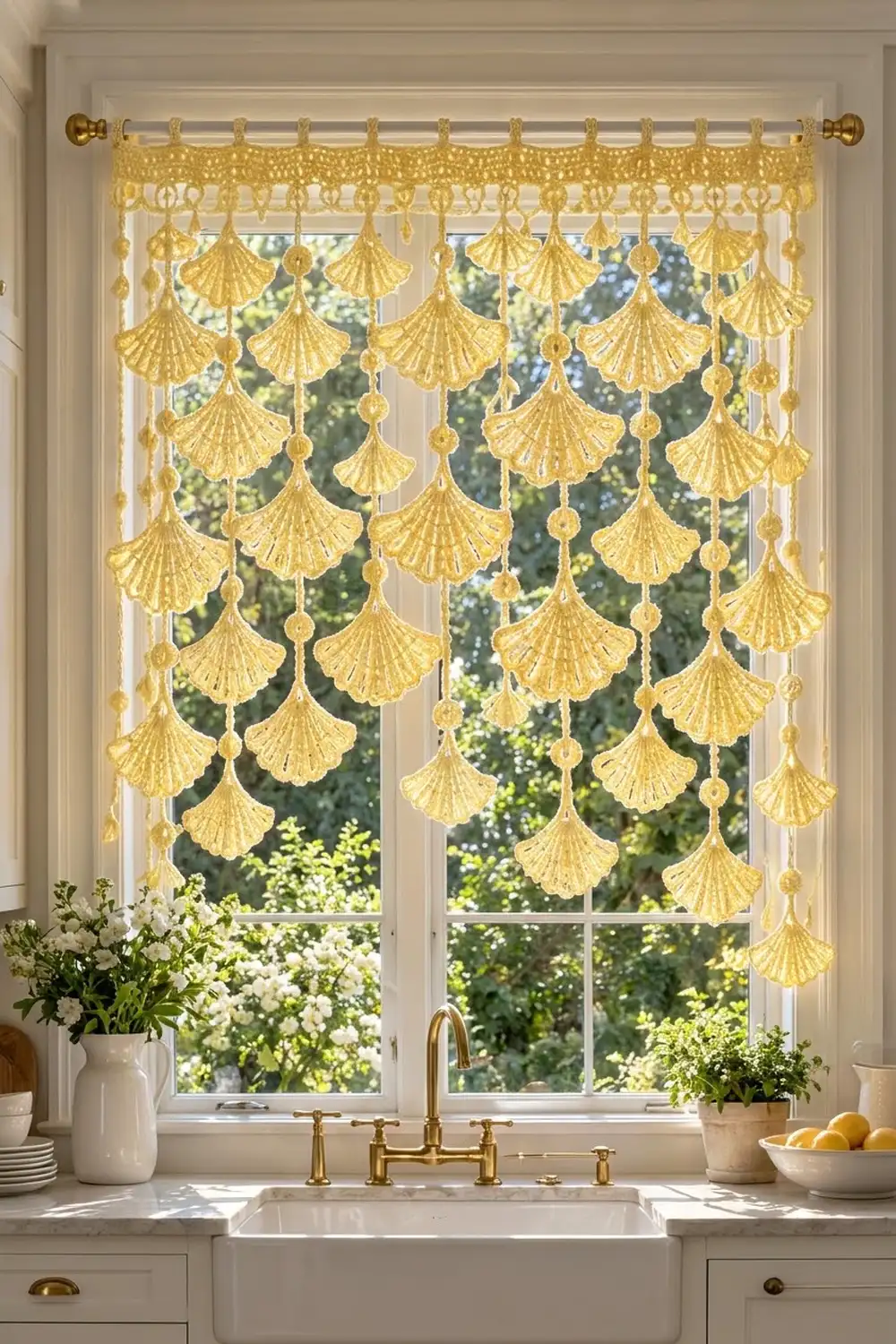
Final Notes
The whole curtain depends on one chain of measurements. A gauge of 20 sts = 4 in (10.2 cm) gives a fan of 5 in (12.7 cm) x 3 in (7.6 cm). A 3 in (7.6 cm) stem plus a 3 in (7.6 cm) fan makes a 6 in (15.2 cm) unit. Six units make Strand A 36 in (91.4 cm) long. One extra 3 in (7.6 cm) of stem plus five units make Strand B 33 in (83.8 cm) long. The 175-st header measures 35 in (88.9 cm), with one 15-st block of 3 in (7.6 cm) for each strand. Check each measurement as you go, and the curtain will hang straight and even.
Happy crocheting!