

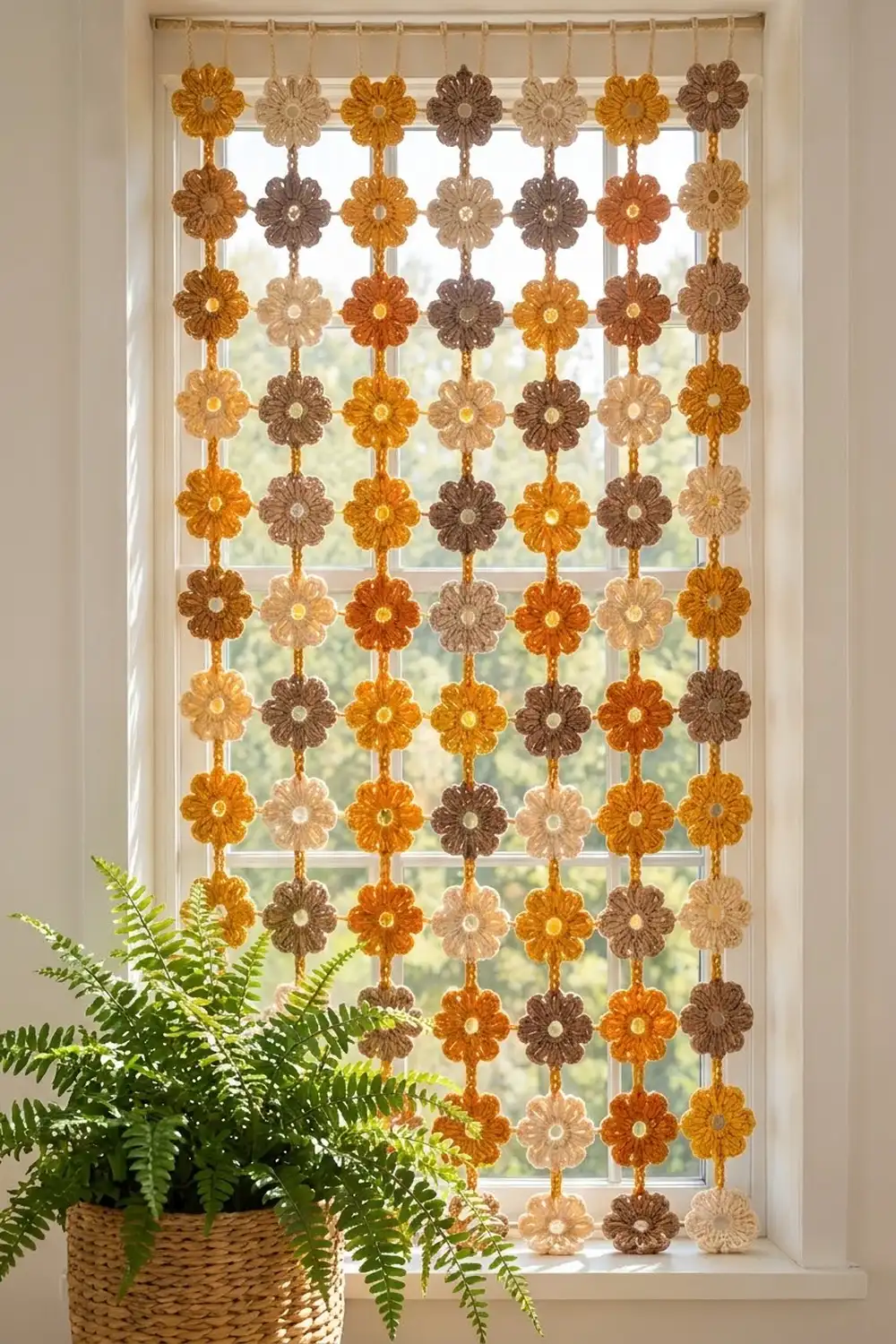
This hanging curtain is made from 84 small eight-petal flowers in four warm, earthy shades: mustard gold, burnt orange, cream and taupe brown. The flowers hang in seven vertical strands joined by short, firm mustard cords. Light and garden views show through every gap.
Each flower has an open center ring, a dense ring of double crochet around it, and eight rounded petals made from fans of tall stitches. The look is relaxed, sunny and a little retro. Use it as a window panel, a doorway divider or a backdrop for a reading corner.
This pattern uses US crochet terms. The finished curtain is about 29 in (73.7 cm) wide and 60.75 in (154.3 cm) long, including the hanging loops. Each flower is 3.5 in (8.9 cm) across.
The construction is simple and repetitive. You work each flower in three rounds and join the flowers into strands with slip-stitched chain connectors. Then you add a chain hanging loop to the top of each strand. Nothing is sewn. The only finishing is weaving in ends and a light blocking.
Finished Size and Construction
- Finished size: about 29 in (73.7 cm) wide x 60.75 in (154.3 cm) long
- Skill level: Easy / advanced beginner
- Terminology: US crochet terms
- Yarn weight: Worsted weight (medium #4) cotton
- Hook: 4.5 mm (US 7)
- Number of pieces: 84 flowers, 77 connectors, 7 hanging loops
- Layout: 7 strands (columns) x 12 flowers (rows)
- Piece size: each flower is 3.5 in (8.9 cm) from petal tip to opposite petal tip
- Size before border: each strand is 58.5 in (148.6 cm) long without its hanging loop
- Border depth: the hanging loop adds 2.25 in (5.7 cm) at the top
Materials
Choose a smooth mercerized or combed cotton in worsted weight. Cotton holds the petal shape, stretches very little when hanging and resists fuzzing in sunlight. Avoid very soft acrylic, because long strands slowly get longer under their own weight.
The amounts below assume a yarn of about 95 m per 50 g (roughly 1.9 m per gram). One flower uses about 4.5 g (8.6 m).
- Mustard gold (Color A): 160 g / 304 m (21 flowers plus all connectors and hanging loops)
- Burnt orange (Color B): 120 g / 228 m (21 flowers)
- Cream (Color C): 120 g / 228 m (21 flowers)
- Taupe brown (Color D): 120 g / 228 m (21 flowers)
All quantities include a margin of roughly 20 percent for gauge swatches, tails and small differences in tension.
Tools:
- 4.5 mm (US 7) crochet hook
- Tapestry needle
- Scissors
- Stitch marker
- Rigid ruler or tape measure
- Rust-proof pins and a blocking mat
- Spray bottle
- Curtain rod or tension rod at least 32 in (81.3 cm) long
Abbreviations (US Terms)
- ch: chain
- sl st: slip stitch
- sc: single crochet
- hdc: half double crochet
- dc: double crochet
- tr: treble crochet
- sp: space
- st(s): stitch(es)
- rep: repeat
Special stitch – Petal: In the indicated ch-5 sp, work (sc, hdc, 2 dc, 3 tr, 2 dc, hdc, sc). One petal has 11 sts. The center tr is the petal tip, and you use it for every join. It is the 2nd of the 3 tr and the 6th st of the petal.
Gauge and Checkpoints
Make one complete flower before you buy all your yarn or start production. Measure it flat, without stretching.
- Chain gauge: 4 ch = 1 in (2.5 cm), measured relaxed.
- After Round 1: 2 in (5.1 cm) across, with a center hole of about 0.75 in (1.9 cm).
- After Round 2: 3 in (7.6 cm) across the chain loops.
- After Round 3: 3.5 in (8.9 cm) from one petal tip to the opposite tip.
If your flower is larger than 3.75 in (9.5 cm), go down to a 4 mm hook. If it is smaller than 3.25 in (8.3 cm), go up to a 5 mm hook. Check carefully: a difference of 0.25 in (0.6 cm) per flower adds up to 3 in (7.6 cm) over a 12-flower strand.
Also check your chain gauge. Chain 12 and measure it. It should be 3 in (7.6 cm). The connectors and hanging loops depend on this number.
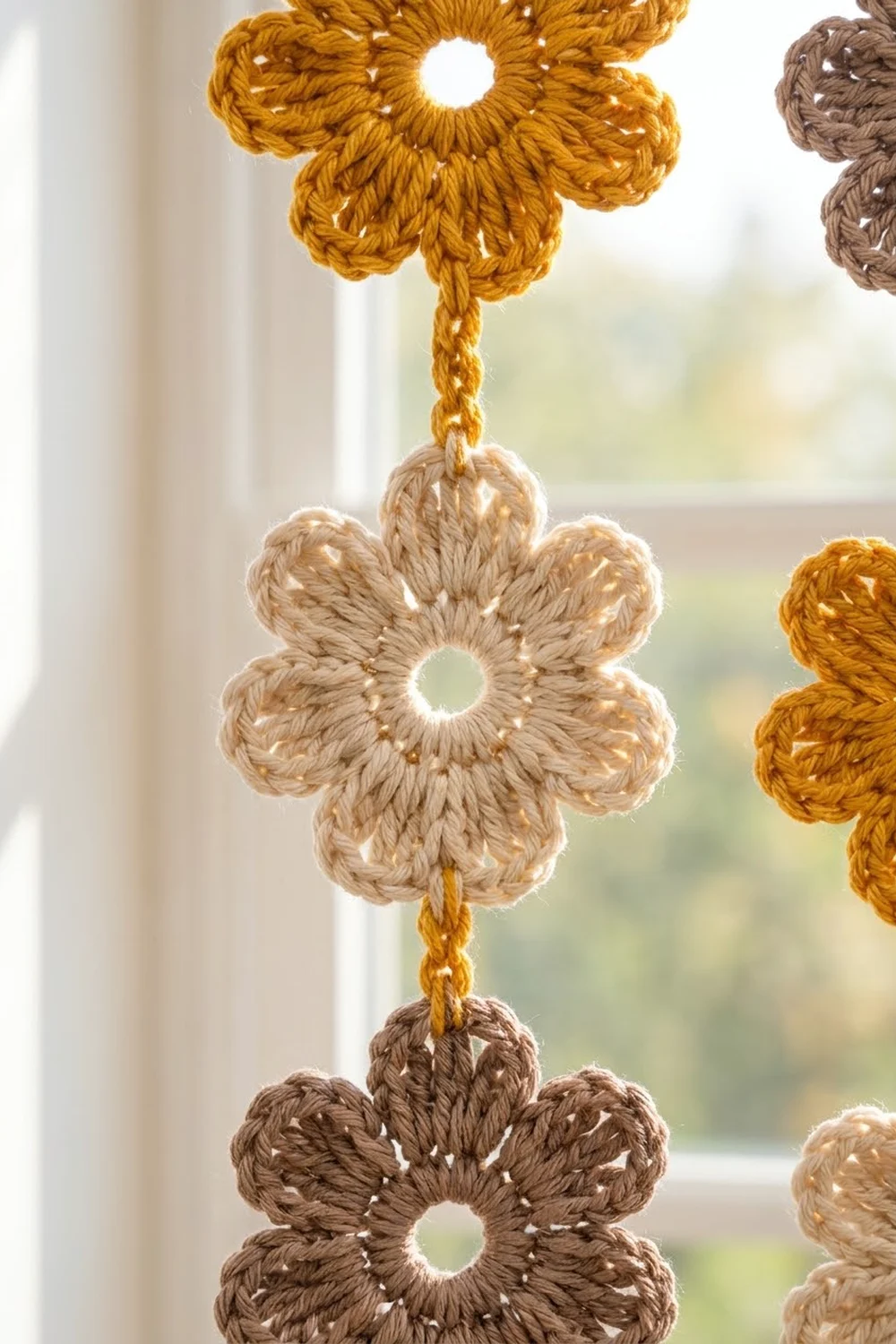
Flower Pattern (make 84)
Leave a 6 in (15.2 cm) starting tail on every flower.
Ring: Ch 8, sl st in first ch to form a ring.
Round 1: Ch 3 (counts as dc), 23 dc in ring. Sl st in top of beginning ch-3. (24 dc)
Pull the starting tail gently to firm up the ring, but keep the center open. The hole should stay about 0.75 in (1.9 cm) wide. Work the dc snugly so they sit side by side without ruffling.
Round 2: Ch 1, sc in same st as join. Ch 5, skip 2 dc, sc in next dc. Rep from * 6 more times. Ch 5, skip 2 dc, sl st in first sc. (8 sc and 8 ch-5 sps)*
Check: 1 sc + 7 x (2 skipped + 1 sc) + 2 skipped = 24 sts used. Every dc of Round 1 is accounted for.
Round 3: Sl st in first ch-5 sp. Work 1 Petal in this ch-5 sp, then sl st in next sc. Move to the next ch-5 sp and rep from * 7 more times. Place the final sl st in the first sc of Round 2. (8 petals = 88 petal sts, plus 8 sl sts between petals)*
Fasten off, leaving a 6 in (15.2 cm) tail. Weave in both tails on the back, following the dc of Round 1 so they stay hidden. Do not let a tail cross the center hole.
Each petal comes out as a rounded fan, with short stitches at the sides and three tr at the top. The sl st into each sc pulls the petal bases together and makes the clear notches between petals.
Production tip: Work in batches of one color at a time. Once you know the rhythm, a flower takes about 10 minutes. Spot-check one flower in every five against the 3.5 in (8.9 cm) gauge so your tension doesn’t drift.
Make All Pieces
Make 21 flowers in each color:
- Color A (mustard gold): 21 flowers
- Color B (burnt orange): 21 flowers
- Color C (cream): 21 flowers
- Color D (taupe brown): 21 flowers
Total: 84 flowers.
Use the layout grid below. Columns are numbered 1 to 7 from left to right, and rows are numbered 1 to 12 from top to bottom.
        Col: 1  2  3  4  5  6  7
Row  1:      A  B  C  D  A  B  C
Row  2:      D  A  B  C  D  A  B
Row  3:      C  D  A  B  C  D  A
Row  4:      B  C  D  A  B  C  D
Row  5:      A  B  C  D  A  B  C
Row  6:      D  A  B  C  D  A  B
Row  7:      C  D  A  B  C  D  A
Row  8:      B  C  D  A  B  C  D
Row  9:      A  B  C  D  A  B  C
Row 10:      D  A  B  C  D  A  B
Row 11:      C  D  A  B  C  D  A
Row 12:      B  C  D  A  B  C  D
Each block of 4 rows uses 7 flowers of each color. The block repeats 3 times, which gives 21 flowers per color. No two flowers of the same color touch side by side or top to bottom.
Sort the flowers into seven piles, one per column, and stack each pile in row order before you join.
Joining
The flowers are joined into vertical strands with mustard connectors. Each connector is a short chain slip-stitched back on itself. This makes a firm double cord that will not stretch.
Orientation: Lay each flower with one petal pointing straight up. That petal’s tip is the top tip. The petal directly opposite it, 4 petals away, is the bottom tip. Because there are 8 petals, the top and bottom tips are always exactly opposite each other.
Connector (make 11 per strand, 77 total):
- With Color A, make a slip knot and sl st into the bottom tip (center tr) of the upper flower, inserting the hook from front to back.
- Ch 6.
- Sl st into the top tip (center tr) of the lower flower, from front to back.
- Sl st in each of the 6 ch, working back up toward the upper flower. (6 ch + 6 sl st)
- Sl st into the same bottom tip to finish. Fasten off, then weave one tail into the upper petal and one into the lower petal.
Stitch logic: Every connector attaches to exactly one stitch on each flower, always the center tr. This keeps every flower hanging straight and centered on the cord.
Tension: Work the ch at your normal gauge, then make the sl sts loosely so the cord doesn’t pucker. Each connector should measure 1.5 in (3.8 cm) from petal tip to petal tip. If yours are shorter, loosen the sl sts. Do not add chains, or the strands will no longer match.
Size checkpoint: One strand = 12 flowers x 3.5 in (8.9 cm) + 11 connectors x 1.5 in (3.8 cm) = 42 in (106.7 cm) + 16.5 in (41.9 cm) = 58.5 in (148.6 cm). Measure each strand flat when it is done. All seven should be within 0.5 in (1.3 cm) of each other.
Border (Top Hanging Edge)
A flower curtain does not need a traditional border. Instead, you finish the top edge with one hanging loop per strand. The loops act as the border and set the final length.
Border gauge: the same chain gauge as the connectors, 4 ch = 1 in (2.5 cm).
Hanging loop (make 7, one per strand):
- With Color A, sl st into the top tip (center tr) of the Row 1 flower.
- Ch 18.
- Sl st into the same center tr to close the loop. (18 ch)
- Work 1 more sl st into the same st to lock it. Fasten off and weave in.
Count per side: The top edge has 7 loops (one per column) x 18 ch = 126 ch in total. The side and bottom edges get no extra stitches. Their edges are the flowers’ own petals.
Why the math works: 18 ch at 4 ch per inch makes a 4.5 in (11.4 cm) loop. Folded over the rod, it hangs 2.25 in (5.7 cm) deep. The strand length of 58.5 in (148.6 cm) + 2.25 in (5.7 cm) = 60.75 in (154.3 cm) total.
Width: Space the loops so the strand centers are 4.25 in (10.8 cm) apart. Each flower is 3.5 in (8.9 cm) wide, which leaves a 0.75 in (1.9 cm) gap between columns. Width = 6 spaces x 4.25 in (10.8 cm) + 3.5 in (8.9 cm) = 25.5 in (64.8 cm) + 3.5 in (8.9 cm) = 29 in (73.7 cm).
Final Blocking
- Lay all seven strands face up in column order on a blocking mat or clean towel.
- Spray each flower lightly until it is damp, not soaked.
- Use your fingertip to shape each center into a round 0.75 in (1.9 cm) hole.
- Pin each petal tip outward so every flower measures 3.5 in (8.9 cm) across.
- Straighten each connector so it lies flat at 1.5 in (3.8 cm), without stretching it.
- Check that each strand is 58.5 in (148.6 cm) from the top flower’s tip to the bottom flower’s tip.
- Let everything dry completely, for at least 12 hours.
- Unpin, slide the hanging loops onto the rod and space them 4.25 in (10.8 cm) apart.
Final Quality-Control Checklist
- 84 flowers, 21 in each color, placed as in the grid
- Every flower has 8 petals and 88 petal sts
- Center holes are open and round, about 0.75 in (1.9 cm)
- Each flower measures 3.5 in (8.9 cm) across
- Every connector is joined to a center tr at the top and bottom
- Each connector is 1.5 in (3.8 cm) long
- Each strand is 58.5 in (148.6 cm) before the hanging loop
- All 7 hanging loops are 18 ch and lock-stitched
- No loose tails on the front or across the center holes
- Columns hang straight, with no twisting
Troubleshooting
Round 1 ruffles. You have too many dc, or the ring is too tight. Recount to 24 and loosen the ring slightly.
Petals look flat or pointed. Check that you worked 3 tr in the middle of each petal, not 3 dc. The tr give the petal its rounded top.
Flowers hang tilted. The connector is joined to the wrong stitch. Remove it and rejoin at the exact center tr of the top and bottom petals.
Strands are different lengths. Measure each connector. Redo any connector that is more than 0.25 in (0.6 cm) longer or shorter than 1.5 in (3.8 cm).
Strands twist. Block again, flat, and let the strands dry fully. A slightly firmer cotton also helps.
Center hole closed up. The starting tail was pulled too hard. Loosen it with the tip of your hook and reblock.
Care
Hand wash in cool water with a mild detergent, roll in a towel and dry flat, reblocking as needed. Keep it out of the dryer, because heat can shrink cotton and change the strand lengths.
Final Notes
The whole curtain depends on one chain of measurements. Round 1 is 2 in (5.1 cm), Round 2 is 3 in (7.6 cm) and the finished flower is 3.5 in (8.9 cm). Twelve flowers and eleven 1.5 in (3.8 cm) connectors make a 58.5 in (148.6 cm) strand. An 18-ch loop adds 2.25 in (5.7 cm), for 60.75 in (154.3 cm) in total. Seven strands spaced 4.25 in (10.8 cm) apart give 29 in (73.7 cm) of width.
Check your first flower, keep your connectors even, and the rest will follow. Happy crocheting!