

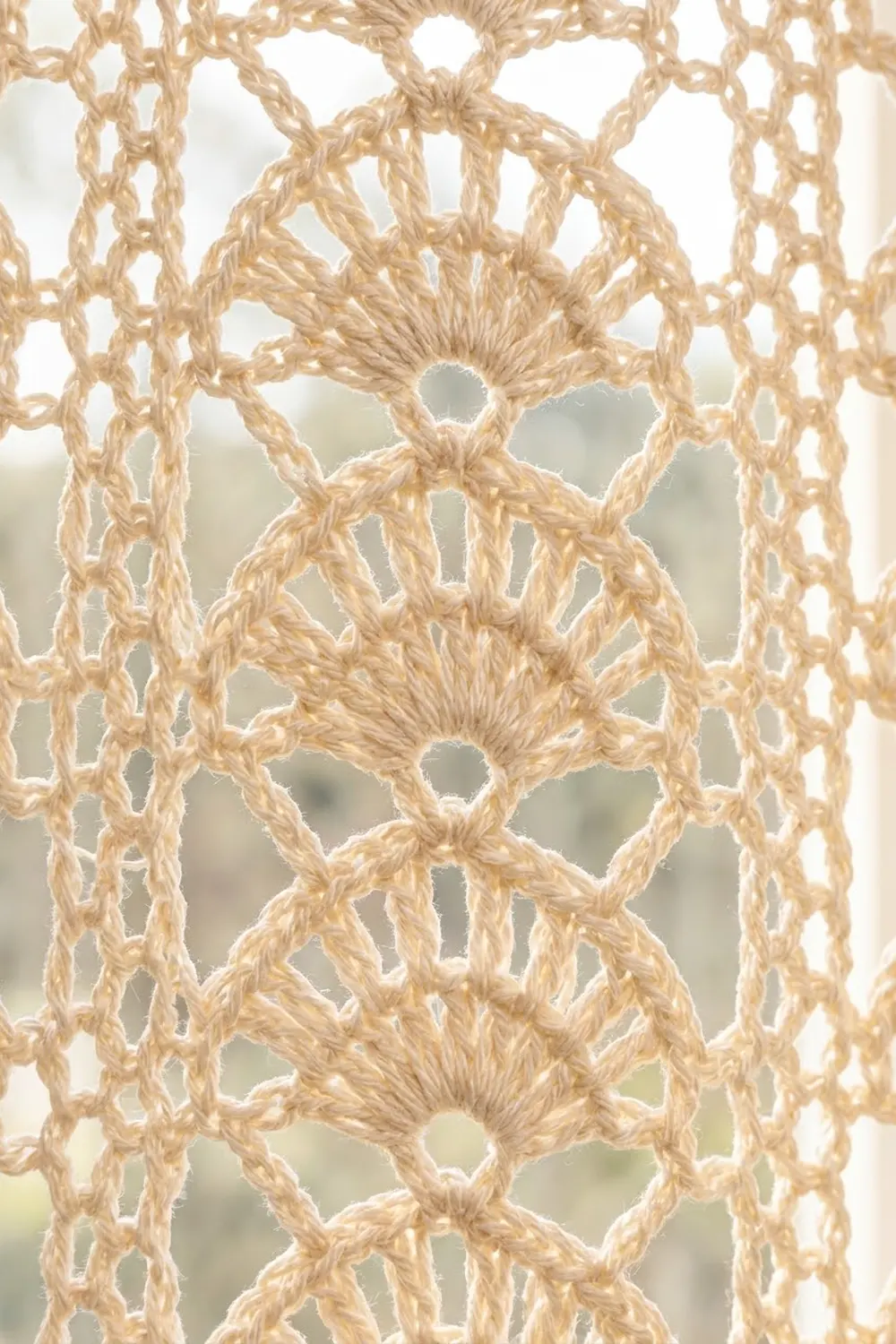
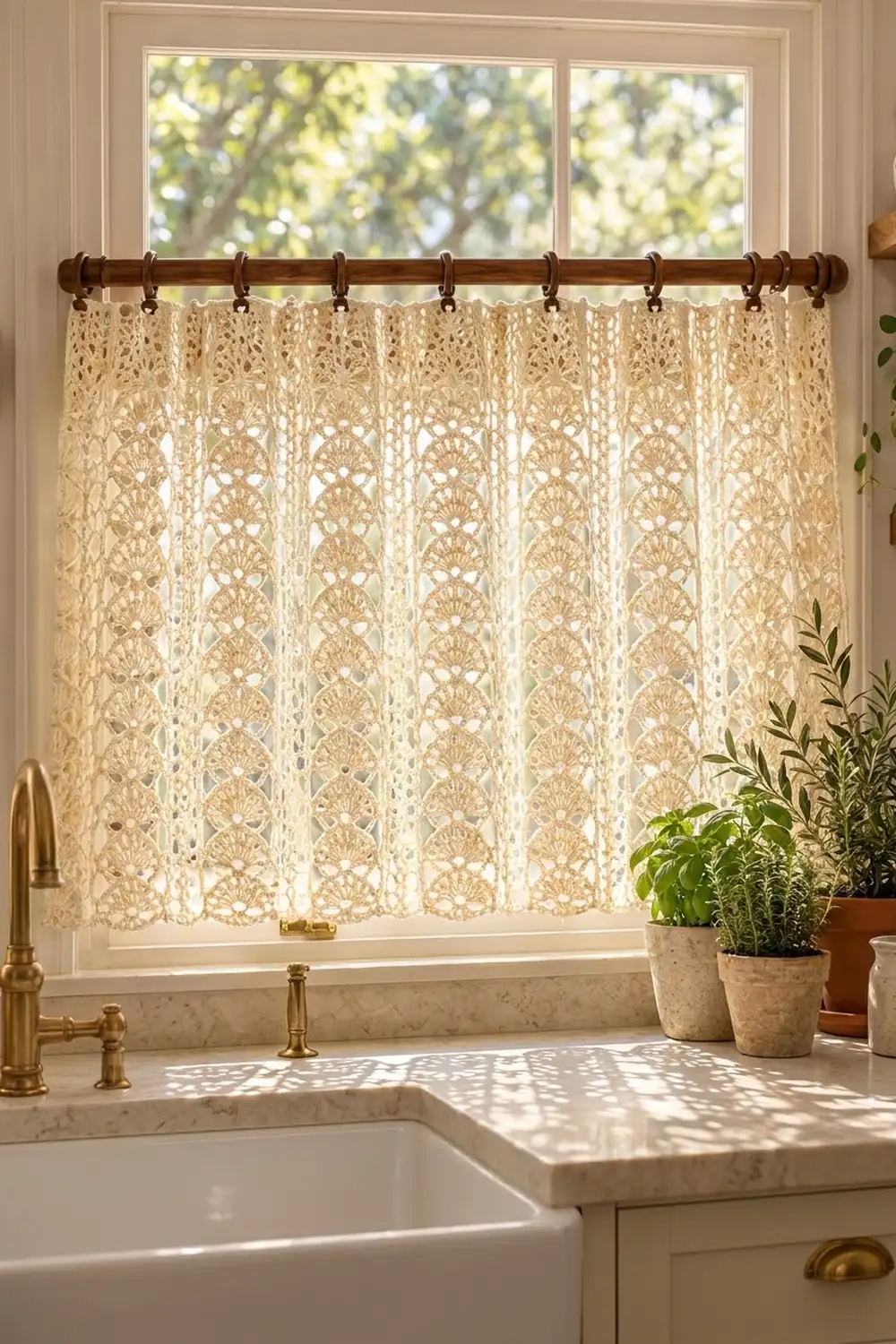
The Seashell Ladder Cafe Curtain is a single lace panel made for the lower half of a kitchen or bathroom window. Columns of stacked fans climb from hem to rod, and a narrow, solid ladder of double crochet frames each column. When light comes through, the fans look like little seashells and the ladders look like soft cords.
The sample uses one solid color, a warm cream cotton. One neutral keeps the attention on the lace and suits farmhouse, cottage, and coastal rooms. In bright sun the open fans throw a soft, lacy shadow onto the countertop below. The curtain hangs from a wooden rod with ring clips, so you don’t need to sew a rod pocket.
This pattern uses US crochet terms. After blocking, the curtain measures 32 in wide x 23.5 in tall (81.3 cm x 59.7 cm). That includes a 0.75 in (1.9 cm) border.
You work the panel flat, in rows, from the bottom up. A double crochet foundation row sets the width. A three-row fan repeat builds the columns. A shaped top row fills in the last fans to make a straight edge. Three rounds of single crochet finish all four sides.
Finished Size and Construction
- Finished size: 32 in x 23.5 in (81.3 cm x 59.7 cm)
- Skill level: Intermediate (simple lace repeat that needs careful counting)
- Terminology: US crochet terms
- Yarn weight: DK (#3) cotton
- Hook: 4.0 mm (G-6)
- Number of pieces: 1 (one curtain panel)
- Layout: 12 fan columns separated by 13 ladder columns, 14 fans tall
- Piece size: 30.5 in x 22 in (77.5 cm x 55.9 cm) before border
- Size before border: 30.5 in x 22 in (77.5 cm x 55.9 cm)
- Border depth: 0.75 in (1.9 cm) on every side
Materials
Choose a smooth mercerized or combed cotton in DK weight. Cotton holds the fan shape, blocks crisply, and stands up to washing near a sink. Avoid fuzzy or brushed yarns, which blur the ladders and fill in the lace.
- Cream (main and only color): about 300 g / 690 m (about six 50 g balls of 115 m each)
These amounts include about a 10 percent margin for the gauge swatch and small differences in tension. If your yarn has a different length per ball, buy by total meters, not by number of balls.
Tools
– 4.0 mm (G-6) crochet hook
– Tapestry needle
– Stitch markers (at least 26)
– Measuring tape
– Rust-proof blocking pins, plus blocking mats or a large towel
– Spray bottle
– 13 curtain ring clips and a cafe rod
Abbreviations (US Terms)
- ch – chain
- sk – skip
- sl st – slip stitch
- sp(s) – space(s)
- st(s) – stitch(es)
- sc – single crochet
- hdc – half double crochet
- dc – double crochet
- tr – treble crochet
- RS / WS – right side / wrong side
Special stitch
– V-st (V-stitch): (dc, ch 2, dc) in the same stitch.
Note: The ch 3 at the start of every row counts as the first dc. Work the last dc of each row into the top of the turning ch 3 from the row below.
Gauge and Checkpoints
Basic gauge: 22 dc and 10 rows = 5 in (12.7 cm) in plain dc, after blocking. That works out to 4.4 sts and 2 rows per inch.
Pattern gauge: One repeat (one fan column plus one ladder, 11 sts) = 2.5 in (6.4 cm) wide. One fan (3 rows) = 1.5 in (3.8 cm) tall.
Make a test swatch first. Ch 26. Work Row 0 (24 dc). Then work Rows 1–9, which gives 2 fan columns that are 3 fans tall. Finish with the Top Row worked as Row 43. Fasten off, wet the swatch, pin it out, and let it dry. It should measure about 5.5 in x 5.5 in (14.0 cm x 14.0 cm).
Checkpoints for the curtain:
– After Row 0: 134 sts, 30.5 in (77.5 cm) wide
– After Row 12 (4 fans, 13 rows): 6.5 in (16.5 cm) tall
– After Row 42 (14 fans, 43 rows): 21.5 in (54.6 cm) tall
– After Row 43 (44 rows): 22 in (55.9 cm) tall
– After the border: 32 in x 23.5 in (81.3 cm x 59.7 cm)
If your swatch is too big, go down one hook size to 3.75 mm. If it’s too small, go up one size to 4.5 mm. Change hooks instead of changing how you hold the yarn. Lace stretches when you block it, so always measure the blocked swatch, not the fresh one.
Pattern: The Curtain Panel
The panel is one piece. The width is 12 fan repeats of 11 sts, plus 2 sts for the last ladder: 12 x 11 + 2 = 134 sts.
Foundation: Ch 136.
Row 0 (WS): Dc in 4th ch from hook (the 3 skipped ch count as a dc) and in each ch across. Turn. (134 dc)
To mark the 13 ladders, place markers in sts 1–2, 12–13, 23–24, and so on, every 11 sts, ending at sts 133–134. This makes Row 1 much easier to place.
Row 1 (RS, V row): Ch 3, dc in next dc (first ladder). Ch 4, sk 4 sts, V-st in next st, ch 4, sk 4 sts, dc in each of next 2 sts (ladder). Repeat from * 11 more times. Turn. (13 ladders of 2 dc, 12 V-sts, 24 ch-4 sps)*
Each repeat uses 9 sts for the fan base plus 2 for the ladder. Since 2 + (12 x 11) = 134, the row ends exactly in the top of the ch 3.
Row 2 (WS, fan row): Ch 3, dc in next dc. Ch 3, sk ch-4 sp, 9 dc in ch-2 sp of V-st, ch 3, sk ch-4 sp, dc in each of next 2 dc. Repeat from * 11 more times. Turn. (12 fans of 9 dc, 13 ladders of 2 dc)*
Packing 9 dc into one space makes them spread into a fan. The ch-3 loops on each side keep the fan apart from the ladders and open small lace holes at its base.
Row 3 (RS, fan top): Ch 3, dc in next dc. Ch 2, dc in first dc of fan, (ch 1, dc in next dc) 8 times, ch 2, dc in each of next 2 dc. Repeat from * 11 more times. Turn. (12 fans of 9 dc with 8 ch-1 sps each, 13 ladders)*
The ch-1 sps spread the 9 dc into a half circle with spokes. This finishes one seashell fan.
Row 4 (WS, V row): Ch 3, dc in next dc. Ch 4, sk ch-2 sp and first 4 dc of fan (with their ch-1 sps), V-st in center (5th) dc, ch 4, sk last 4 dc and ch-2 sp, dc in each of next 2 dc. Repeat from * 11 more times. Turn. (13 ladders, 12 V-sts, 24 ch-4 sps)*
The new V-st grows straight up from the center of the fan below, so the fans stack neatly in their columns.
Rows 5–40: Repeat Rows 2–4 twelve more times, ending with a V row.
Rows 41–42: Repeat Rows 2–3 once more. (14 fans in each of the 12 columns)
From Row 5 on, the fan rows land on the other side of the work than they did in Rows 2–4. Both sides of this lace look almost the same, and the stitch counts don’t change. Just keep checking that every V-st sits on a fan center.
Row 43 (RS, Top Row): Ch 3, dc in next dc. Tr in ch-2 sp, dc in 1st dc of fan, hdc in 3rd dc, sc in 4th, 5th, and 6th dc, hdc in 7th dc, dc in 9th dc, tr in ch-2 sp, dc in each of next 2 dc. Repeat from * 11 more times. Do not turn. (134 sts)*
Each fan top now holds 9 sts: tr, dc, hdc, 3 sc, hdc, dc, tr. The tall stitches fill the low corners next to the ladders, and the short stitches sit on the rounded top of the fan, so the edge comes out straight. Count: 2 + 12 x (9 + 2) = 134.
Check the width (30.5 in / 77.5 cm) and height (22 in / 55.9 cm) before you start the border.
Border
Border gauge: Single crochet worked along the panel matches the body at 4.4 sts per inch. Each sc round adds about 0.25 in (0.6 cm) on each side, so three rounds add 0.75 in (1.9 cm).
Corner rule: Work each corner as 3 sc in one stitch. The middle sc is the corner st. The per-side counts below run from corner st to corner st and include both corner sts.
Round 1 (RS): Turn the panel to work down the side. Ch 1. Work 2 sc in the row-end of each of Rows 42 down to 1 (84 sc). Work 3 sc in the corner st of Row 0. Working into the free loops of the foundation chain, sc in each of the next 132 sts, then 3 sc in the last st (corner). Work up the other side with 2 sc in each row-end of Rows 1–42 (84 sc). Work 3 sc in the first st of Row 43 (corner), sc in each of the next 132 sts, then 3 sc in the last st (corner). Sl st to first sc. Do not turn.
This is a conversion round. Stitches worked 1 per stitch or 2 per row-end: 134 + 134 + 84 + 84 = 436. Extra stitches: 2 at each of 4 corners = 8. Total: 436 + 8 = 444 sc.
Per side, top and bottom have 136 sts each, and the left and right sides have 88 sts each. Check: 2 x 136 + 2 x 88 – 4 shared corner sts = 444.
Round 2: Ch 1, sc in each sc around, working 3 sc in each corner st. Sl st to first sc. (452 sc: 444 + 8) Per side: top and bottom 138, sides 90. Check: 2 x 138 + 2 x 90 – 4 = 452.
Round 3: Ch 1, sc in each sc around, working 3 sc in each corner st. Sl st to first sc. Fasten off. (460 sc: 452 + 8) Per side: top and bottom 140, sides 92. Check: 2 x 140 + 2 x 92 – 4 = 460.
Why the math works: Along the top and bottom, the border uses one sc per body stitch. Body and border share the same gauge of 4.4 sts per inch, so those edges keep their 30.5 in (77.5 cm) width. On the sides, 2 sc per dc row gives 4 sc per inch, a little less than the 4.4 gauge. That slight easing keeps the long side edges taut, so they hang straight instead of rippling. Adding 0.75 in (1.9 cm) to every side gives 30.5 + 1.5 = 32 in (81.3 cm) wide and 22 + 1.5 = 23.5 in (59.7 cm) tall.
Final Blocking
- Weave in all ends along the ladders or the border, never across an open fan.
- Soak the curtain for 15 minutes in cool water with a little gentle soap.
- Press out the water gently and roll the curtain in a towel. Don’t wring it.
- Lay it flat on mats or a towel and shape it to 32 in x 23.5 in (81.3 cm x 59.7 cm).
- Pin the four corners first, then pin the top and bottom edges every 2 in (5.1 cm).
- Run a measuring tape along each ladder and nudge it straight. Pin the ladders if needed.
- Open each fan with your fingers so the spokes spread evenly.
- Mist any areas that have started to dry, then leave the curtain until it is completely dry.
- Attach a ring clip at the top of each of the 13 ladders, about 2.5 in (6.4 cm) apart.
Final Quality-Control Checklist
- 12 fan columns and 13 ladders across the width
- 14 fans stacked in every column
- Each fan has 9 dc and 8 ch-1 spokes
- Every V-st sits directly above a fan center
- The top edge is straight, with no dips above the fans
- Border Round 3 has 460 sc: 140 on each long edge and 92 on each short edge
- Corners are square and lie flat
- Blocked size is 32 in x 23.5 in (81.3 cm x 59.7 cm)
- All ends are woven in and hidden from both sides
Troubleshooting
The ladders lean or zigzag. You may be skipping the wrong number of sts or working into a ch-sp. Each ladder dc goes into a dc of the ladder below.
The fans look crowded or cupped. Your chains are too tight. Loosen the ch-3 and ch-4 loops, or use a hook one size larger for the chains only.
The fans flare or ruffle. Your 9-dc groups are too loose. Snug up the dc or try a 3.75 mm hook.
A V-st is off center. Count the fan dc again. Skip exactly 4 dc so the V-st lands in the 5th.
The stitch count drifts. Count the ladders, not the stitches. There should always be 13.
The top edge dips. Make sure each tr goes into the ch-2 sp, not into the first dc.
The border ripples. Your sc are too loose, so redo it with a smaller hook. If the border pulls in instead, add 1 extra sc every 10 row-ends.
The curtain is too short for your window. Add fans in sets of 3 rows. Each fan adds 1.5 in (3.8 cm), and each extra sc round adds 0.5 in (1.3 cm) to the total height.
Care
Hand wash in cool water, or machine wash on a delicate cycle in a mesh bag. Reshape while damp and dry flat. A light steam will freshen it between washes.
Final Notes
The whole curtain rests on a simple chain of measurements. One 11-st repeat equals 2.5 in (6.4 cm), and 12 repeats plus a ladder give 134 sts, or 30.5 in (77.5 cm) wide. One fan equals 1.5 in (3.8 cm), and 14 fans plus the foundation and top rows make 44 rows, or 22 in (55.9 cm) tall. Three border rounds add 0.75 in (1.9 cm) per side, for a finished size of 32 in x 23.5 in (81.3 cm x 59.7 cm). Check your swatch and each checkpoint along the way, and the panel will fit your rod.
Happy crocheting!