

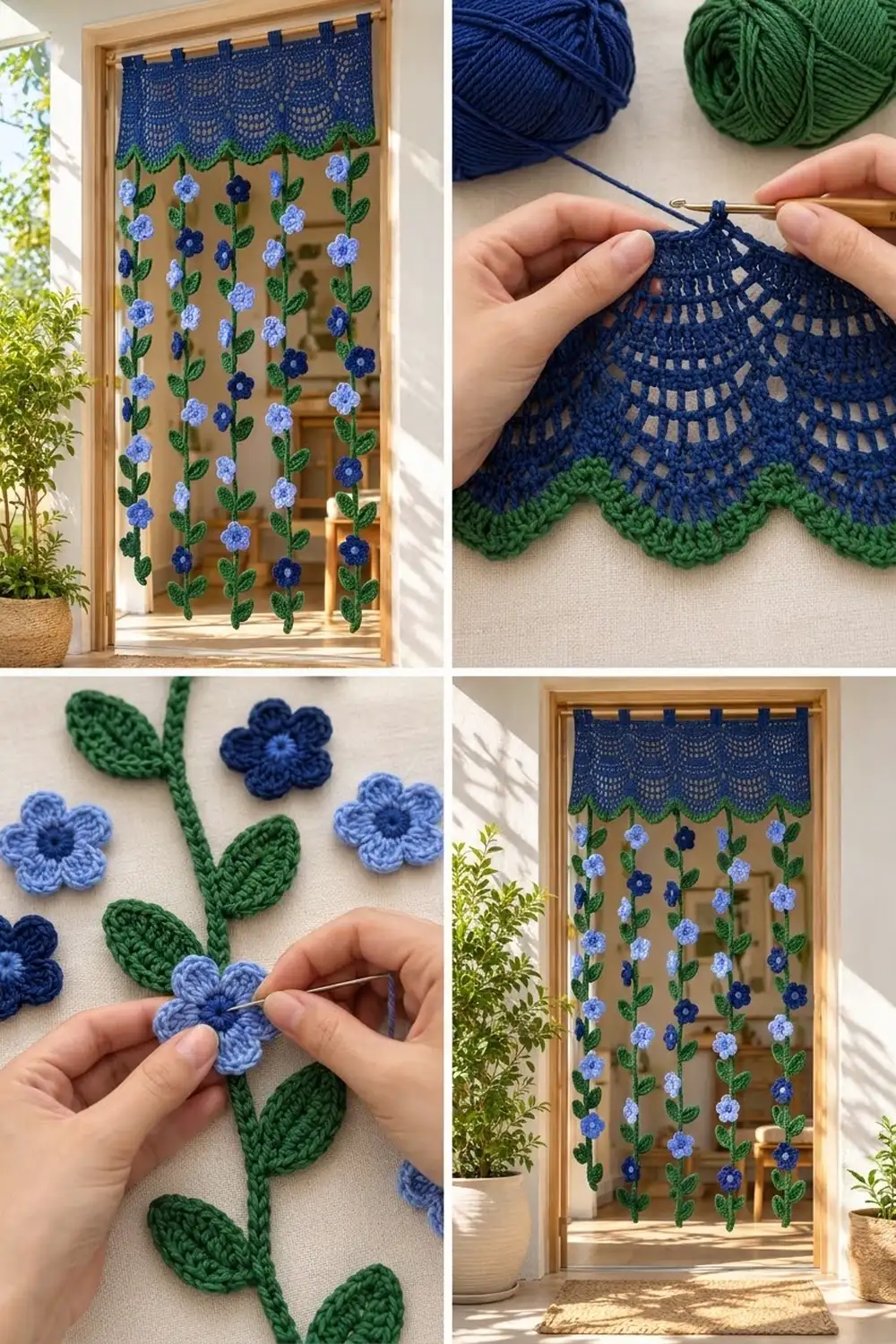
The Bluebell Trellis Door Curtain has a lacy navy valance across the top with five leafy green vines hanging from it. Small blue flowers are scattered down every vine. When it hangs in a sunny doorway, it looks like a little garden climbing a trellis.
The palette uses three colors. Deep navy is for the valance, tabs, and some of the flowers. Leaf green is for the scalloped edge, the stems, and the leaves. Soft periwinkle is for the lighter flowers. Each flower has a center in the other blue, so the vines look varied but still belong together.
The pattern uses US crochet terms. The valance is 30¼ in (76.8 cm) wide and 8 in (20.3 cm) deep, including the green scalloped border. The vines hang 48 in (121.9 cm) below it. That gives a total drop of 56 in (142.2 cm) from the top of the valance body to the vine tips.
You work the valance flat in rows from the top down: first a mesh band, then six lace fans, then a two-row green border that shapes the scallops. Tabs are worked into the foundation chain. The vines are chained directly from the scallop valleys, and the leaves are made as you go. Last, you make 50 flowers and sew them onto the vines.
Finished Size and Construction
- Finished size: 30¼ in (76.8 cm) wide × 56 in (142.2 cm) drop, not including the tab loops
- Skill level: Intermediate
- Terminology: US crochet terms
- Yarn weight: Worsted (#4) cotton
- Hook: 4.5 mm (US 7)
- Number of pieces: 1 valance with tabs and vines attached, plus 50 flower appliqués
- Layout: 6 lace fans across, with 5 vines hanging from the 5 valleys between scallops
- Fan repeat width: 5 in (12.7 cm)
- Valance size before border: 30¼ in × 7 in (76.8 × 17.8 cm)
- Border depth: 1 in (2.5 cm) at the scallop centers
- Flower size: 2 in (5.1 cm) across
- Leaf size: 2 in × 1 in (5.1 × 2.5 cm)
Materials
Choose a smooth, mercerized worsted cotton. Cotton holds its shape when it hangs and won’t stretch the way acrylic can. The amounts below assume a yarn of about 155 m per 100 g (170 yd per 3.5 oz).
- Navy: 200 g (310 m)
- Green: 200 g (310 m)
- Periwinkle: 100 g (155 m)
All amounts include about 20% extra for swatching and tails.
Tools:
- 4.5 mm (US 7) crochet hook
- Tapestry needle
- At least 5 stitch markers
- Rust-proof pins and a blocking mat
- Spray bottle and measuring tape
- Curtain rod up to ¾ in (1.9 cm) in diameter
Abbreviations (US Terms)
- ch – chain
- sl st – slip stitch
- sc – single crochet
- hdc – half double crochet
- dc – double crochet
- sp – space
- st(s) – stitch(es)
- RS / WS – right side / wrong side
- rep – repeat
Special stitch – Fan: Work 7 dc in the same stitch. In later rows, each fan opens into a spaced arch.
Gauge and Checkpoints
- Valance dc gauge: 16 dc and 8 rows = 4 in (10.2 cm)
- Tab sc gauge: 16 sc and 18 rows = 4 in (10.2 cm)
- Stem gauge: 4 ch = 1 in (2.5 cm), measured after the slip-stitch return
Make a test piece before you start. Crochet a dc swatch 20 sts wide and 8 rows tall. It should measure 5 in × 4 in (12.7 × 10.2 cm). Then make one flower and check that it is 2 in (5.1 cm) across.
Checkpoints:
- After Row 1, the valance is 30¼ in (76.8 cm) wide.
- After Row 7, at the end of the mesh band, it is 3½ in (8.9 cm) tall.
- After Row 12, it is 7 in (17.8 cm) tall.
- After the border, it is 8 in (20.3 cm) tall at the scallop centers.
If your work is too big, use a hook 0.5 mm smaller. If it is too small, use a hook 0.5 mm larger. The width can be off by up to ½ in (1.3 cm).
Valance
Use navy and work back and forth in rows. A turning ch-3 or ch-4 counts as a stitch.
Foundation: Ch 123.
Row 1 (RS): Dc in the 4th ch from the hook (the 3 skipped ch count as a dc) and in each ch across. Turn. (121 dc)
Row 2: Ch 4 (counts as dc + ch 1), skip the next st, dc in the next st. Ch 1, skip the next st, dc in the next st; rep from * across. Turn. (61 dc, 60 ch-1 sps)*
Rows 3–7: Ch 4 (counts as dc + ch 1), skip the first ch-1 sp, dc in the next dc. Ch 1, dc in the next dc; rep from * across. Work the last dc in the 3rd ch of the turning ch. Turn. (61 dc, 60 ch-1 sps in each row)*
Each fan repeat covers 10 mesh spaces, so there are 6 repeats across the row. Count the first dc as dc 1 and put a marker in dc 11, 21, 31, 41, and 51. These 5 markers are the repeat boundaries, and the vines will hang below them.
Row 8: Ch 1, sc in the first dc. Ch 5, skip the next 3 ch-1 sps, sc in the next dc. Ch 2, skip the next 2 ch-1 sps, work a Fan in the next dc. Ch 2, skip the next 2 ch-1 sps, sc in the next dc. Ch 5, skip the next 3 ch-1 sps, sc in the next dc (the boundary dc). Rep from * 5 more times. Turn. (7 sc, 6 fans [42 dc], 12 ch-5 sps, 12 ch-2 sps)*
Row 9: Ch 6 (counts as dc + ch 3), sc in the first ch-5 sp. Ch 3, skip the ch-2 sp, dc in the first dc of the fan, (ch 1, dc in the next dc) 6 times. Ch 3, skip the ch-2 sp, sc in the next ch-5 sp. Ch 5, sc in the next ch-5 sp. Rep from * across, ending the last rep at . Ch 3, dc in the last sc. Turn. (6 fans of 7 dc with 6 ch-1 sps each, 12 sc, 5 ch-5 arches, and a ch-3 half-arch with a dc at each edge)*
Row 10: Ch 1, sc in the first dc. Ch 3, dc in the first dc of the next fan, (ch 2, dc in the next dc) 6 times. Ch 3, sc in the next ch-5 sp. Rep from * across. On the last rep, work the final sc in the 3rd ch of the turning ch-6. Turn. (7 sc, 6 fans of 7 dc with 6 ch-2 sps each, 12 ch-3 sps)*
Row 11: Ch 1, sc in the first sc. Ch 2, dc in the first dc of the fan, (ch 2, dc in the next ch-2 sp, ch 2, dc in the next dc) 6 times. Ch 2, sc in the next sc. Rep from * across. Turn. (7 sc, 78 dc [13 per fan], 84 ch-2 sps [14 per repeat])*
Row 12: Ch 1, sc in the first sc. Skip the ch-2 sp, dc in the next dc, (dc in the next ch-2 sp, dc in the next dc) 12 times. Skip the ch-2 sp, sc in the next sc. Rep from * across. Fasten off. (157 sts: 6 fans of 25 dc + 7 sc)*
Each fan is now a solid 25-dc arc sitting over a 20-st repeat. The extra width makes the lower edge curve into scallops.
Tabs
Hold the valance with the WS facing you and the foundation chain at the top. Work into the free loops under the 121 stitches of Row 1.
The tabs go over stitches 1–7, 20–26, 39–45, 58–64, 77–83, 96–102, and 115–121. That is 7 tabs of 7 sts with 12 sts between them: 49 + 72 = 121.
Row 1: Join navy in the first stitch of a tab position. Ch 1, sc in the same st and in the next 6 sts. Turn. (7 sc)
Rows 2–14: Ch 1, sc in each sc. Turn. (7 sc)
Fasten off and leave a 10 in (25.4 cm) tail. Each tab is 1¾ in (4.4 cm) wide and about 3 in (7.6 cm) long. Fold each tab to the back and whipstitch Row 14 to the base of Row 1. This makes a loop about 1½ in (3.8 cm) tall.
Border
Use green and work along the bottom edge only. The border uses the same gauge as the valance: 16 sts = 4 in (10.2 cm).
Border Row 1 (RS): Join green in the first sc of Row 12. Ch 1, sc in the same sc. Sc in the next 12 dc, 3 sc in the next dc (the fan center), sc in the next 12 dc, skip the boundary sc. Rep from * 5 more times. On the last rep, work 1 sc in the final sc instead of skipping it. Turn. (164 sc: 27 per scallop + 2 edge sc)*
Border Row 2: Ch 1, sc in the first sc. Sc in the next 2 sc, hdc in the next 11 sc, 3 hdc in the center sc, hdc in the next 11 sc, sc in the next 2 sc. Rep from * 5 more times. Sc in the last sc. Fasten off. (176 sts: 29 per scallop + 2 edge sc)*
Why the math works: Row 12 has 157 sts. Border Row 1 skips the 5 boundary sc, so it works 1 sc into each of the other 152 sts. It also adds 2 extra sts at each of the 6 fan centers: 152 + 12 = 164. Row 2 works 1 st into each of those 164 sts and again adds 2 at each center: 164 + 12 = 176.
Skipping the boundary sc pulls the valleys in. The increases at the centers push the points out. The sc at each end of a scallop keeps the valleys low.
Vines
Make 5 green vines, chained directly from the valance. Each vine hangs from a valley, which is the gap between two scallops in Border Row 2. The valleys are 5 in (12.7 cm) apart.
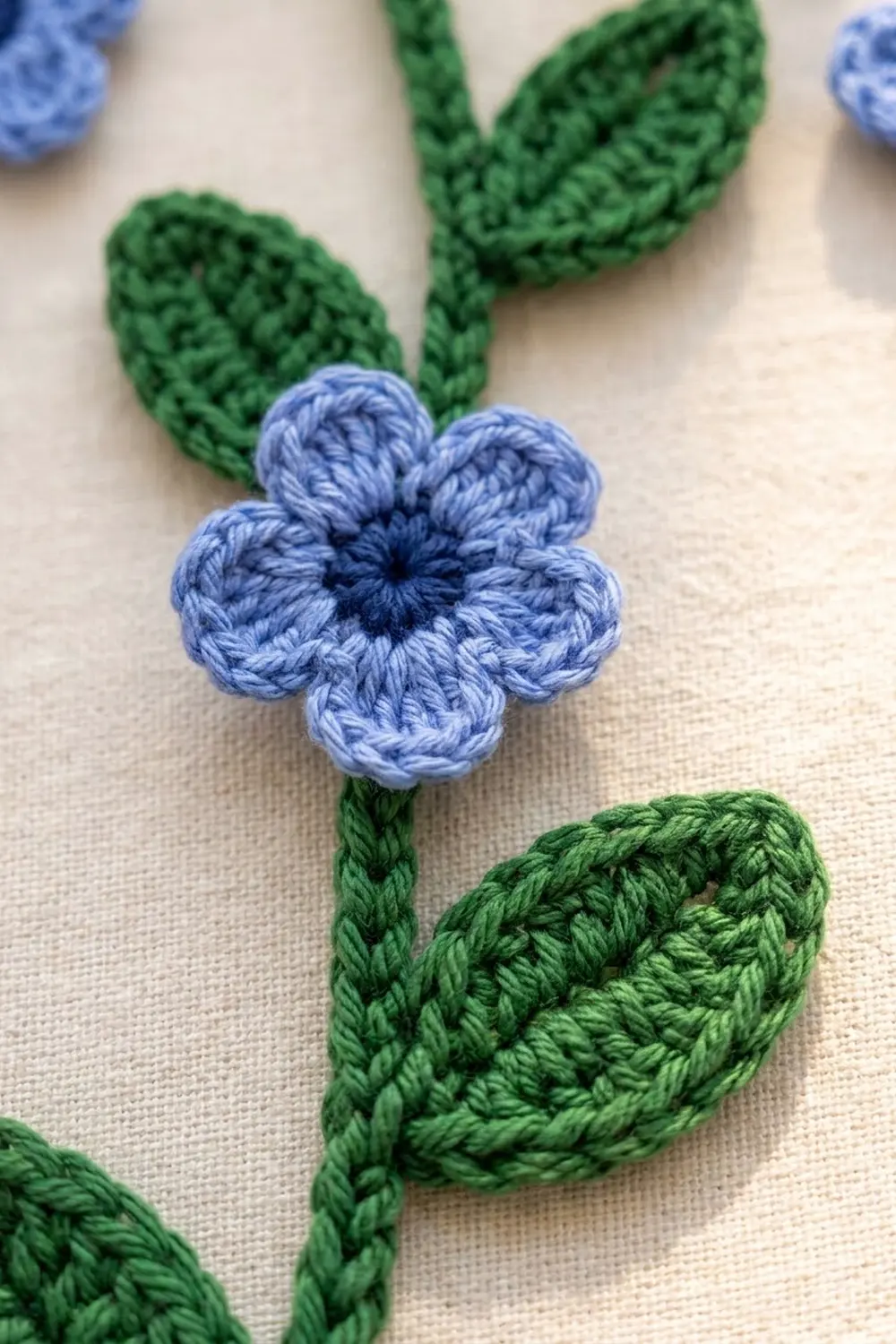
Leaf (worked off the stem):
- Ch 10.
- Sc in the 2nd ch from the hook, hdc in the next ch, dc in the next 4 ch, hdc in the next ch, sc in the next ch, then 3 sc in the last ch (this is the leaf base).
- Turn the chain and work into the other side of the same chains: sc in the next ch, hdc in the next ch, dc in the next 4 ch, hdc in the next ch, sc in the next ch. (19 sts)
- Ch 2, sl st at the tip.
- To make the vein, work 8 sl st down the center line between the two halves. Sl st in the base stitch.
Vine: With the RS facing you, join green with a sl st in a valley.
- Ch 8 for the top of the stem.
- *Work a Leaf, then ch 8. Rep from * 21 more times.
- Work 1 last Leaf. (23 leaves, 184 stem ch)
Return: Sl st in the back bump of each stem chain all the way up to the valance, passing behind each leaf base. Join with a sl st in the valley and fasten off. (184 sl st)
Before you start each new leaf, give the stem a half turn so the leaves alternate left and right. The stem is 46 in (116.8 cm) long, and the last leaf adds 2 in (5.1 cm), for a total of 48 in (121.9 cm). Make a vine in each of the 5 valleys.
Make All Pieces
Flower:
- Rnd 1 (center color): Make a magic ring and work 10 sc in it. Join and fasten off. (10 sc)
- Rnd 2 (petal color): Join in any sc, ch 1. Sc in the next sc, ch 3, skip the next sc. Rep from * 4 more times. Join. (5 sc, 5 ch-3 loops)*
- Rnd 3: Sl st into the first loop. Work (sc, hdc, 3 dc, hdc, sc) in each ch-3 loop. Join and fasten off, leaving a 12 in (30.5 cm) tail. (5 petals, 35 sts)
How many to make:
- P: 30 periwinkle flowers with navy centers
- N: 20 navy flowers with periwinkle centers
Layout: Counting from the top, the flowers sit at the base of leaves 3, 5, 7, 9, 11, 13, 15, 17, 19, and 21. That spaces them 4 in (10.2 cm) apart. Each vine has 6 P flowers and 4 N flowers. In the grid below, the vines go left to right and the positions go top to bottom.
Vine 1: P N P P N P N P P N
Vine 2: N P P N P P N P N P
Vine 3: P P N P N P P N P N
Vine 4: N P N P P N P P N P
Vine 5: P N P P N P N P P N
Joining
Use the petal-color tail and a tapestry needle to sew each flower to its vine. Center the flower over the stem at the leaf base. Whipstitch through Rnd 2 all the way around, catching the stem chain at the back.
Keep your stitches snug but not tight. If you pull too hard, the stem bunches up and the vine gets shorter. Hide the tails along the back of the stem.
Size checkpoint: After sewing, each stem should still be 46 in (116.8 cm) long. If it has shrunk by more than ½ in (1.3 cm), loosen the stitches on the last few flowers you sewed.
Final Blocking
- Wet the valance and gently press the water out in a towel.
- Pin it flat to 30¼ in × 7 in (76.8 × 17.8 cm), measured to Row 12.
- Pin each scallop point 1 in (2.5 cm) below Row 12. Pin each valley on the Row 12 line.
- Use pins to open up the fan arches and mesh squares.
- Lay the vines straight, arrange the leaves so they alternate, and press each flower flat.
- Let everything dry completely before hanging it.
Final Quality-Control Checklist
- The valance is 30¼ in (76.8 cm) wide and 8 in (20.3 cm) deep.
- There are 6 even scallops, with the 5 vines centered in the valleys.
- The 7 tabs are evenly spaced and sewn down securely.
- Each vine has 23 leaves that alternate sides.
- There are 50 flowers, 6 P and 4 N on each vine, placed as in the grid.
- All tails are woven in.
Troubleshooting
- The valance narrows at the bottom: The ch-5s in Row 8 are too tight. Loosen them.
- The scallops are flat: Check that you skipped each boundary sc in Border Row 1.
- The border ruffles: Crochet the border more tightly, or switch to a 4.0 mm hook for it.
- The vines twist: Steam them, then let them hang with a light weight for an hour.
- The leaves curl: Block them flat and pin the tips.
Care
Hand wash in cold water and lay flat to dry. Reshape the scallops and leaves while the curtain is still damp.
Final Notes
Each measurement builds on the one before it. A gauge of 16 dc per 4 in gives a 30¼ in (76.8 cm) valance. Six fans of 5 in (12.7 cm) each make six scallops. The 1 in (2.5 cm) border brings the valance to 8 in (20.3 cm) deep. Five 48 in (121.9 cm) vines hang from the five valleys. If you check each stage as you go, the curtain will hang straight and even.
Happy crocheting!