

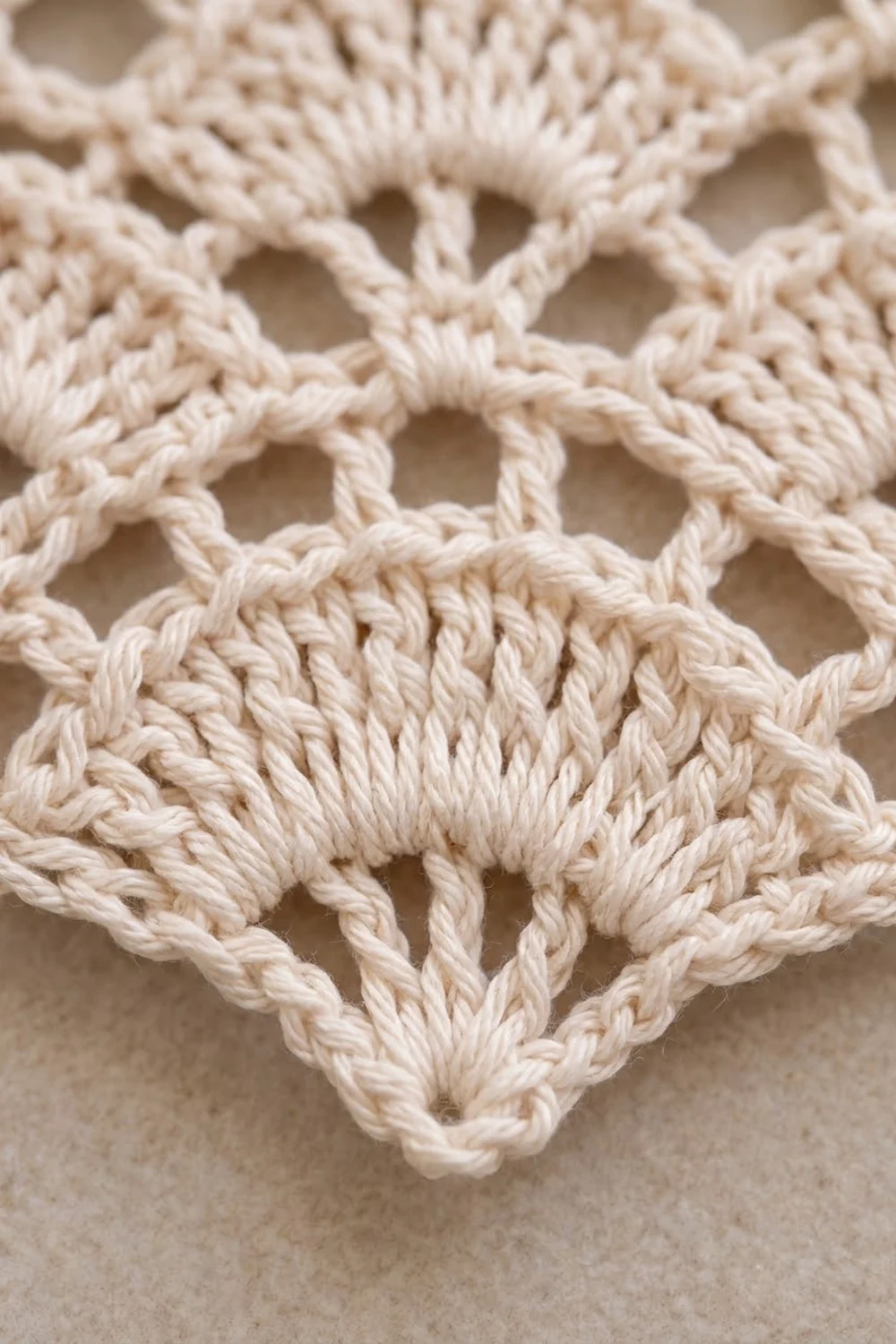
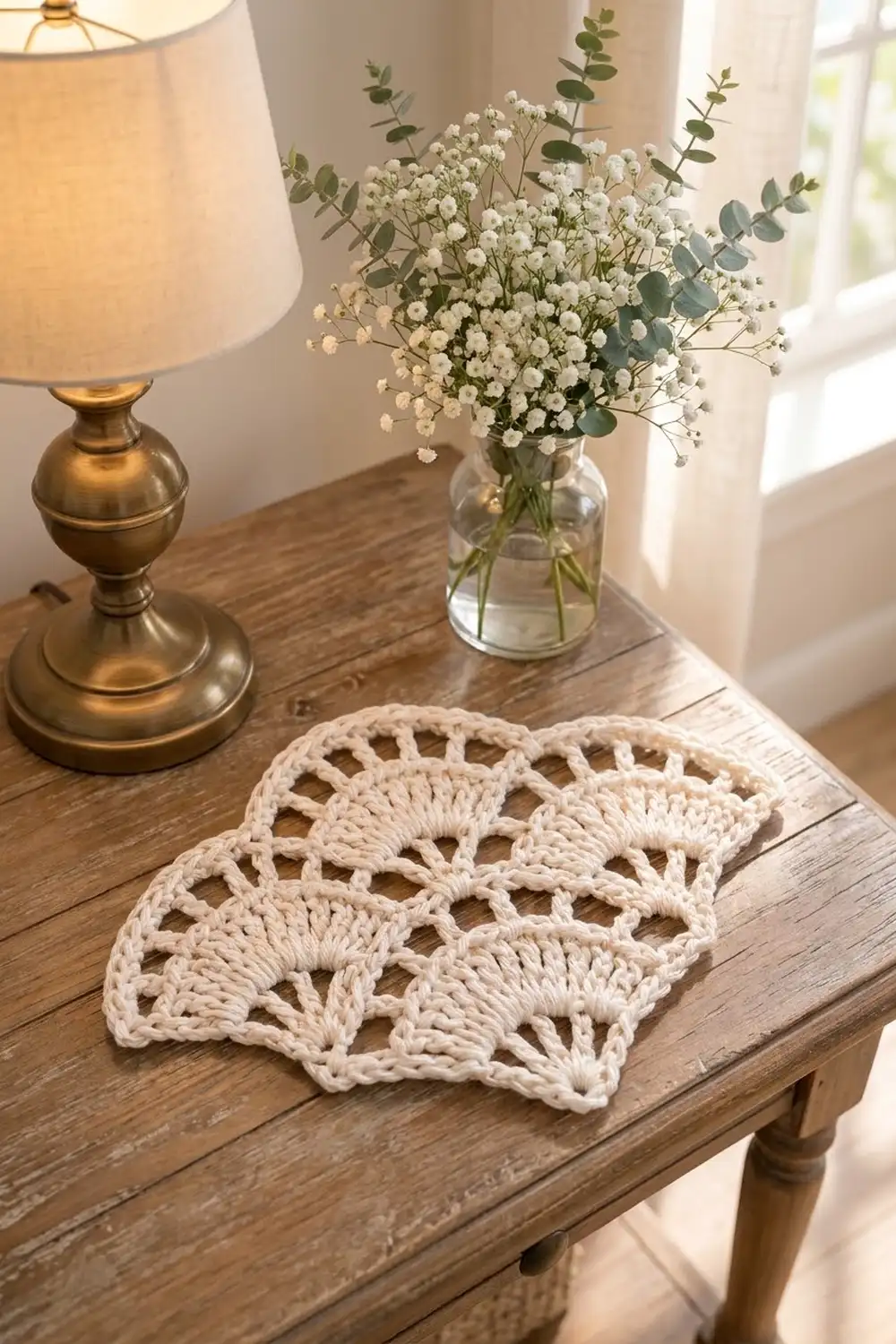
The Ivory Scallop Fan is one lace motif shaped like an upside-down fan. It starts at a small pointed tip and opens upward through three tiers of shells, then finishes with three rounded arches along the top edge. Every shell has a solid ribbed base, a ring of open spokes, and an outlined chain arch, so the piece reads as stacked fish scales.
It is worked in one color, a soft ivory cotton, which shows off the stitch texture and gives it a calm, vintage-cottage feel. Use it as a coaster-sized doily, a tray or shelf accent, a card or gift topper, or a sampler for practicing fan lace.
This pattern uses US crochet terms. The finished motif measures about 7.75 in (19.7 cm) wide across the top and 5 in (12.7 cm) tall from the tip to the highest arch.
You work the motif in turned rows from the tip upward. Each tier takes three rows (shell base, spokes, arches), and each new tier adds one more shell. That gives 1 shell, then 2, then 3. A two-round edging (single crochet, then reverse single crochet) outlines the whole shape and firms up the scallops.
Finished Size and Construction
- Finished size: 7.75 in (19.7 cm) wide x 5 in (12.7 cm) tall
- Skill level: Intermediate (easy shells, but you need to count carefully)
- Terminology: US crochet terms
- Yarn weight: Sport / light (weight 2) cotton
- Hook: 3.0 mm (US C/2 or D/3)
- Number of pieces: 1 single motif, no joining
- Layout: Inverted fan; 3 tiers of shells (1, 2, 3) stacked like scales
- Piece size before border: 7.25 in (18.4 cm) wide x 4.5 in (11.4 cm) tall
- Border depth: about 0.25 in (0.6 cm) on every edge
Materials
Yarn advice: Pick a smooth, mercerized sport-weight cotton (around 50 g = 150 to 170 m). Mercerized cotton gives crisp spokes and clean arches, and it blocks well. Fuzzy or very soft yarns blur the open spaces.
- Ivory / cream: 12 g, about 37 m (40 yd)
That quantity includes a margin of roughly 25 percent for a gauge swatch and weaving in ends.
Tools:
- 3.0 mm crochet hook
- Tapestry needle
- Scissors
- Stitch markers (2 to 3)
- Blocking mat and rust-proof pins
- Spray bottle with water
- Ruler or tape measure
Abbreviations (US Terms)
- ch chain
- sl st slip stitch
- sc single crochet
- dc double crochet
- sk skip
- sp(s) space(s)
- st(s) stitch(es)
- tch turning chain
- rev sc reverse single crochet
- sh shell
Special stitches
- Shell (sh): 7 dc in the stitch indicated. At the start of a row, ch 3 counts as the first dc, so you work only 6 more dc in that stitch.
- Reverse single crochet (rev sc): Working from left to right (right-handed), insert the hook into the next stitch to the right, yarn over, pull up a loop, yarn over, and pull through both loops. This makes a corded, rope-like edge.
Gauge and Checkpoints
Gauge is not critical for a decorative motif, but it controls the final size and the shape of the arches. Make the first tier (Rows 1 to 3) as your test piece before you commit.
- Base gauge: 6 sc = 1 in (2.5 cm) in a plain sc swatch with the 3.0 mm hook.
- After Row 2: the spoke fan measures 1.75 in (4.4 cm) across its widest point.
- After Row 3: 2.25 in (5.7 cm) wide x 1.5 in (3.8 cm) tall.
- After Row 6: 4.75 in (12.1 cm) wide x 3 in (7.6 cm) tall.
- After Row 9: 7.25 in (18.4 cm) wide x 4.5 in (11.4 cm) tall.
- After the border: 7.75 in (19.7 cm) wide x 5 in (12.7 cm) tall.
Measure flat and lightly patted into shape, not stretched.
If your piece is too big: go down to a 2.75 mm hook, or keep your chain loops snug. If it is too small: go up to a 3.25 mm hook. If the fan cups instead of lying flat, your chains are too tight. If it ruffles, they are too loose.
Pattern
Tier 1 (1 shell)
Foundation: Ch 4, sl st in the first ch to form a ring.
Row 1 (shell base): Ch 3 (counts as dc), 6 dc in ring. Turn.
(7 dc)
Row 2 (spokes): Ch 4 (counts as dc + ch 1), [dc in next dc, ch 1] 5 times, dc in top of tch. Turn.
(7 dc, 6 ch-1 sps)
Row 3 (arch): Ch 1, sc in first dc, [ch 3, sc in next dc] 6 times, placing the last sc in the 3rd ch of the tch. Turn.
(7 sc, 6 ch-3 loops)
The 4th sc of this row is the peak of the first fan. Mark it if that helps.
Tier 2 (2 shells)
Row 4 (shell base): Ch 3 (counts as dc), 6 dc in first sc (first sh made). Ch 4, sk next 2 sc, sc in next sc (the peak sc). Ch 4, sk next 2 sc, sh in last sc. Turn.
(14 dc in 2 shells, 1 sc, 2 ch-4 sps)
The new shells sit on the shoulders of the first fan, and the ch-4 links anchor to its peak. This is what staggers the scales.
Row 5 (spokes): Ch 4 (counts as dc + ch 1), [dc in next dc, ch 1] 5 times, dc in next dc (7th dc of shell). Ch 3, sc in sc, ch 3. Dc in first dc of next shell, [ch 1, dc in next dc] 6 times, working the last dc in the top of the tch. Turn.
(14 dc, 12 ch-1 sps, 1 sc, 2 ch-3 sps)
Row 6 (arches): Ch 1, sc in first dc, [ch 3, sc in next dc] 6 times. Ch 1, sc in sc, ch 1. Sc in first dc of next shell, [ch 3, sc in next dc] 6 times, placing the last sc in the 3rd ch of the tch. Turn.
(15 sc, 12 ch-3 loops, 2 ch-1 sps)
That is 7 sc per arch, plus 1 valley sc between the arches. The 4th sc of each arch is that fan’s peak, and the center sc is the valley.
Tier 3 (3 shells)
Row 7 (shell base): Ch 3 (counts as dc), 6 dc in first sc (first sh made). Ch 4, sk next 2 sc, sc in next sc (peak of first fan). Ch 4, sk next 3 sc, sh in valley sc. Ch 4, sk next 3 sc, sc in next sc (peak of second fan). Ch 4, sk next 2 sc, sh in last sc. Turn.
(21 dc in 3 shells, 2 sc, 4 ch-4 sps)
When you skip “3 sc” here, the ch-1 sp next to the valley sc is skipped as well. Shells go into the edges and the valley, and links anchor to the peaks, the same rule as Row 4.
Row 8 (spokes): Ch 4 (counts as dc + ch 1), [dc in next dc, ch 1] 5 times, dc in next dc. Ch 3, sc in sc, ch 3, dc in first dc of next shell, [ch 1, dc in next dc] 6 times. Repeat from * to * once more, working the last dc in the top of the tch. Turn.
(21 dc, 18 ch-1 sps, 2 sc, 4 ch-3 sps)
Row 9 (top arches): Ch 1, sc in first dc, [ch 3, sc in next dc] 6 times. Ch 1, sc in sc, ch 1, sc in first dc of next shell, [ch 3, sc in next dc] 6 times. Repeat from * to * once more, placing the last sc in the 3rd ch of the tch. Do not fasten off.
(23 sc, 18 ch-3 loops, 4 ch-1 sps)
That is 3 arches of 7 sc each (21) plus 2 valley sc (23 total). Check: 7.25 in (18.4 cm) wide x 4.5 in (11.4 cm) tall.
Border
Border gauge: 6 sc = 1 in (2.5 cm), the same as the base gauge. Along the arches, the rule is 1 sc in each sc and 3 sc in each ch-3 loop, which is 1 sc per chain or stitch underneath.
Definitions for counting: the top edge runs from corner sc to corner sc. Each top corner is worked as 3 sc in one stitch: 1 sc counts toward the top edge, and the 2 extra sc are corner stitches counted separately. The sides count row-end stitches only, and the tip is counted on its own.
Round 1 (sc): Ch 1, turn. The side now facing you is the right side.
- Top edge, first arch: 3 sc in first sc (corner), [3 sc in next ch-3 loop, sc in next sc] 6 times.
- First valley: sk ch-1 sp, sl st in valley sc, sk ch-1 sp.
- Center arch: sc in next sc, [3 sc in next ch-3 loop, sc in next sc] 6 times.
- Second valley: sk ch-1 sp, sl st in valley sc, sk ch-1 sp.
- Last arch: sc in next sc, [3 sc in next ch-3 loop, sc in next sc] 5 times, 3 sc in last ch-3 loop, 3 sc in last sc (corner).
- First side: Working down the row ends from Row 8 to Row 1, work 2 sc in each dc-height row end (Rows 8, 7, 5, 4, 2, 1) and 1 sc in each sc row end (Rows 6 and 3).
(14 sc) - Tip: 3 sc in the foundation ring, working around the base of the Row 1 stitches.
- Second side: Work up the row ends from Row 1 to Row 8 the same way.
(14 sc) - Join with sl st to the first sc.
Round 1 counts:
- Top edge: 75 sc (25 per arch x 3) + 2 valley sl sts = 77 sts
- Corners: 2 extra sc x 2 = 4 sc
- Each side: 14 sc
- Tip: 3 sc
- Total: 77 + 4 + 14 + 14 + 3 = 112 sts
Round 2 (rev sc): Ch 1, do not turn. Rev sc in each st around, including the valley sl sts. Join with sl st to the first st. Fasten off.
Round 2 counts: 81 along the top including corners (77 + 4), 14 on each side, 3 at the tip. Total: 112 rev sc.
Why the math works: Each Row 9 arch is 7 sc plus 6 loops of 3 ch, or 25 stitch widths. Working 25 sc into it (7 + 18) gives one border stitch per base stitch, so the arches neither cup nor ruffle. The valley sl sts hold the dips down, keeping the three scallops separate. On the sides, 2 sc per dc-height row and 1 sc per sc row matches row height, so the slanted edges stay straight. The 3-sc corners and tip turn each point without pulling. Round 2 adds no stitches, so the count stays at 112 and the edge gains a cord without extra width.
Final Blocking
- Weave in all ends along the solid shell bases. Don’t trim yet.
- Soak in cool water for 10 minutes, then press out the water in a towel without wringing.
- Lay it right side up on the blocking mat.
- Pin the tip, then the two top corners, to 7.75 in (19.7 cm) across and 5 in (12.7 cm) tall.
- Pin the peak of each top arch, with the center arch slightly higher than the outer two.
- Pin both valleys down so they form clear dips.
- Open each spoke fan with your fingertips so the spaces are even.
- Let it dry completely (6 to 8 hours), then unpin and trim the ends.
Final Quality-Control Checklist
- [ ] 3 tiers of shells: 1, then 2, then 3
- [ ] Each shell has 7 dc at the base, 7 spokes, and an arch of 6 ch-3 loops
- [ ] Tier 2 and tier 3 links anchor exactly at the fan peaks
- [ ] Row 9: 23 sc, 18 ch-3 loops, 4 ch-1 sps
- [ ] Border Rounds 1 and 2: 112 sts each
- [ ] Three distinct top arches with two defined valleys
- [ ] Straight side edges, no rippling
- [ ] Blocked size 7.75 in (19.7 cm) x 5 in (12.7 cm)
- [ ] All ends secure and invisible from the right side
Troubleshooting
The fan cups. The chains are too tight. Loosen the ch-3 loops or go up a hook size for the arch rows only.
The arches ruffle. The loops are too loose. Make each loop exactly 3 ch with even tension.
The shells miss the peaks. You miscounted the skips in Row 4 or Row 7. Mark each peak sc (the 4th sc of every arch) before the next shell row.
The sides pucker in the border. Check that you used 2 sc per dc-height row end, not 1.
The tip looks loose. Pull the foundation tail snug to close the ring before weaving it in.
The shell count is off. Each base row needs 7 dc per shell. Remember that the starting ch 3 counts as the first dc.
Care
Hand wash in cool water with mild soap, roll in a towel, and dry flat, reshaping as needed. Cotton tolerates a warm iron through a press cloth.
Final Notes
The measurement chain is simple. At a gauge of 6 sc per 1 in (2.5 cm), the first tier is 2.25 in (5.7 cm) wide. Two tiers reach 4.75 in (12.1 cm), and three tiers reach 7.25 in (18.4 cm) x 4.5 in (11.4 cm). The 0.25 in (0.6 cm) border then brings the motif to 7.75 in (19.7 cm) x 5 in (12.7 cm). If each checkpoint matches, the arches block out evenly and the scales line up.
Happy crocheting!