

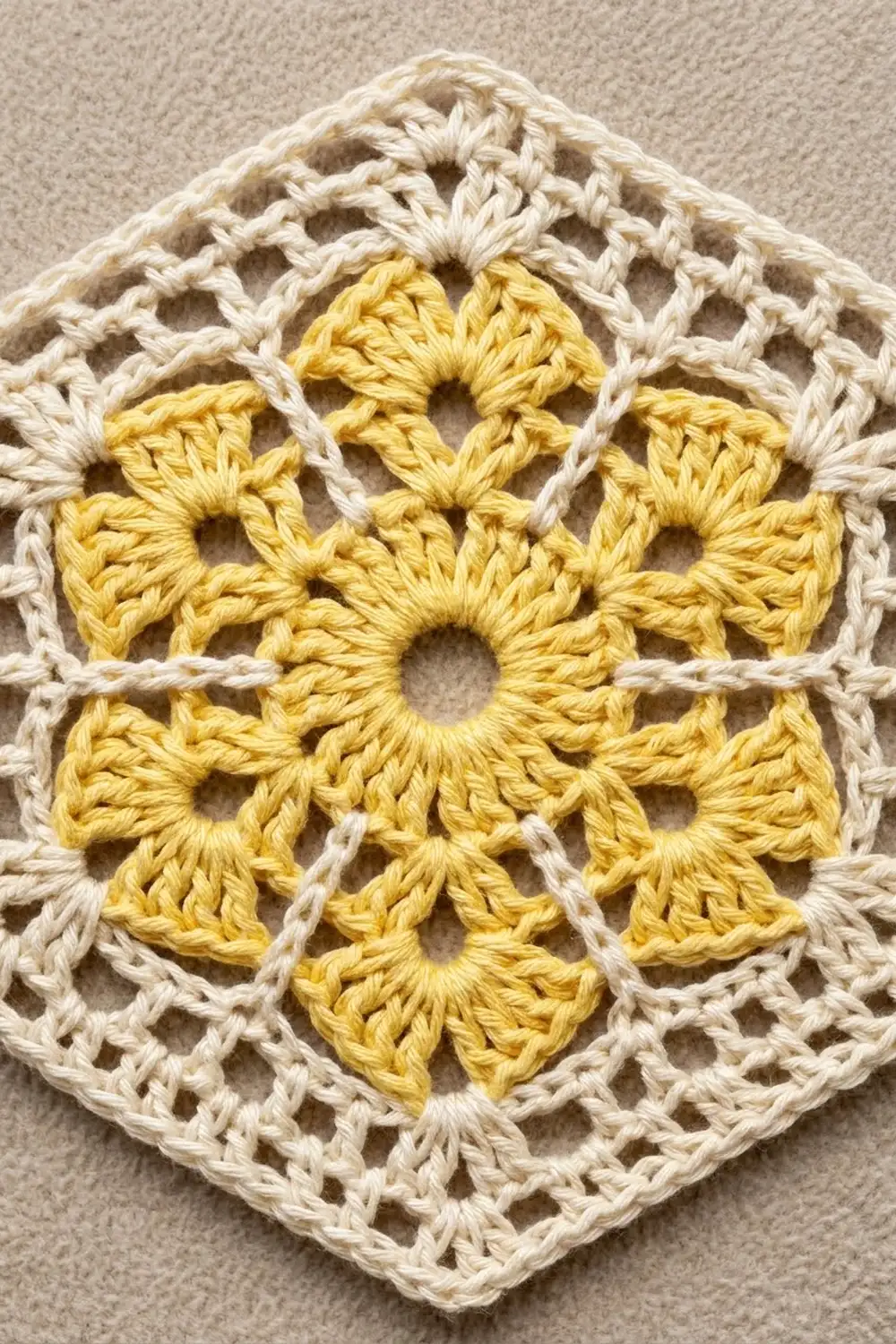
The Buttercup Lace Hexagon is a single flat hexagon motif with a soft yellow flower in the center and a crisp cream lace frame around it. Six fan-shaped petals spread out from a small open ring. Each petal has a teardrop-shaped eyelet at its base, which gives the flower an airy, vintage look.
The colors are soft and warm: butter yellow for the center ring and petals, and cream for the loops, petal outlines and hexagon frame. The style falls between a classic thread doily and modern cottage décor, and the ribbed treble petals catch the light well.
This pattern uses US crochet terms. After blocking, the motif measures 6.5 in (16.5 cm) from flat side to flat side and 7.5 in (19.1 cm) from corner to corner.
You work in the round with the right side always facing. The order is a yellow center ring, a round of cream chain loops, yellow petals worked over those loops, a cream outline round, a cream round that turns the flower into a hexagon, and a two-round cream lace border. That’s seven rounds in total, all in one piece, with no sewing.
Finished Size and Construction
- Finished size: 6.5 in (16.5 cm) flat side to flat side; 7.5 in (19.1 cm) corner to corner
- Skill level: Intermediate
- Terminology: US crochet terms
- Yarn weight: DK (weight 3) mercerized cotton
- Hook: 3.5 mm (E-4)
- Number of pieces: 1 (single motif)
- Layout: one hexagon, 6 sides, 6 corners
- Piece size: each side 3.75 in (9.5 cm) long after the border
- Size before border (after Round 5): 5.5 in (14.0 cm) flat to flat; each side 3.2 in (8.1 cm)
- Border depth: 0.5 in (1.3 cm) on each side (Rounds 6–7)
Materials
Use a smooth DK-weight mercerized cotton or cotton blend. Mercerized cotton gives the petals clear stitch definition and keeps the eyelets open. A yarn with about 123 yd (113 m) per 50 g is ideal.
- Color A – Butter Yellow: 8 g, about 18 m (19.7 yd)
- Color B – Cream: 12 g, about 27 m (29.5 yd)
Both amounts include about 25% extra for your gauge test, joining tails and small differences in tension.
Tools:
- 3.5 mm (E-4) crochet hook
- Tapestry needle
- Scissors
- Stitch markers (2–3)
- Ruler or tape measure
- Blocking mat, rust-proof pins and a spray bottle
Abbreviations (US Terms)
- ch – chain
- sl st – slip stitch
- sc – single crochet
- hdc – half double crochet
- dc – double crochet
- tr – treble crochet (yarn over twice, insert hook, pull up a loop, [yarn over, pull through 2 loops] 3 times)
- sp – space
- st(s) – stitch(es)
- rep – repeat
- MR – magic ring
Special stitch – Petal Fan: worked entirely into one ch-12 loop: sc, hdc, 3 dc, 5 tr, 3 dc, hdc, sc. That’s 15 sts per petal. Working over the loop covers the chain and leaves its center open as the teardrop eyelet.
Gauge and Checkpoints
Gauge matters more for a motif than for a garment, because the hexagon has to lie flat and stay even on all sides. Make a test motif through at least Round 5 and measure it before you continue.
- After Round 1: the yellow ring measures 1.25 in (3.2 cm) across.
- After Round 3: the flower measures 4.5 in (11.4 cm) from one petal tip to the opposite petal tip.
- After Round 5: the hexagon measures 5.5 in (14.0 cm) flat to flat.
- After Round 7: the finished hexagon measures 6.5 in (16.5 cm) flat to flat, within 0.25 in (0.6 cm) before blocking.
- Border gauge: 5 sc = 1 in (2.5 cm) along the Round 7 edge.
If your motif is too big: go down a hook size to 3.25 mm, and check that your trebles aren’t loose and loopy.
If your motif is too small: go up to 3.75 mm. If only the petals are cupping, loosen your trebles instead of changing hooks.
Pattern
Round 1 – Center Ring (Color A)
With A, make a MR. Ch 3 (counts as dc), then work 17 dc into the ring. Pull the ring closed, leaving a small open center about 0.25 in (0.6 cm) wide. Join with a sl st to the top of the beginning ch-3.
Stitch count: 18 dc.
Fasten off A, leaving a 6 in (15.2 cm) tail.
Round 2 – Petal Loops (Color B)
Join B with a standing sc in any dc.
Ch 12, sc in next dc, sc in next dc, sc in next dc; rep from * 4 more times. Then ch 12, sc in next dc, sc in next dc, and join with a sl st to the first sc. The first sc of the round is the third sc of the last repeat.
Each repeat uses 3 dc from Round 1. Each ch-12 loop is anchored between two neighboring sc, so it hangs as a teardrop.
Stitch count: 18 sc and 6 ch-12 loops.
Fasten off B.
Round 3 – Petals (Color A)
Between two loops there are three sc. Call them sc 1 (just before a loop), sc 2 (just after a loop) and sc 3 (the divider in the middle).
Join A with a sl st in any divider sc. Ch 1, then sc in the same st.
Skip sc 1, work a Petal Fan into the next ch-12 loop (sc, hdc, 3 dc, 5 tr, 3 dc, hdc, sc), skip sc 2, sc in the next divider sc; rep from * 5 more times, leaving off the last sc on the final repeat. Join with a sl st to the first sc.
As you work, push the stitches along the loop so the 15 sts spread evenly from one end of the loop to the other. The cream chain disappears inside the petal, and the center of the loop stays open as a teardrop eyelet.
Stitch count: 96 sts (6 petals × 15 sts = 90, plus 6 divider sc).
For the next round, number each petal’s sts from 1 to 15. St 8 is the center tr. Fasten off A.
Checkpoint: 4.5 in (11.4 cm) from tip to tip.
Round 4 – Petal Outline and Spokes (Color B)
Join B with a standing sc in st 4 (the first dc) of any petal. Sc in the next 8 sts (sts 5–12), for 9 sc across the top of the petal.
Ch 1, skip sts 13–15, tr in the divider sc, ch 1, skip sts 1–3 of the next petal, sc in sts 4–12 (9 sc); rep from * 4 more times. Ch 1, skip sts 13–15, tr in the last divider sc, ch 1, and join with a sl st to the first sc.
The tr in each divider sc forms the short cream spoke between two petals.
Stitch count: 66 (54 sc + 6 tr + 12 ch-1 sps).
Don’t fasten off.
Round 5 – Hexagon Shaping (Color B)
Sl st in the next 4 sc. You’re now in the 5th sc of the petal, which is the petal’s center. This sc becomes the first corner.
Ch 3 (counts as dc), dc, ch 2, 2 dc in the same sc. This is the first corner.
Dc in next 2 sc, tr in next 2 sc, tr in ch-1 sp, tr in tr, tr in ch-1 sp, tr in next 2 sc, dc in next 2 sc, (2 dc, ch 2, 2 dc) in next sc (the petal center); rep from * 4 more times. Dc in next 2 sc, tr in next 2 sc, tr in ch-1 sp, tr in tr, tr in ch-1 sp, tr in next 2 sc, dc in next 2 sc, and join with a sl st to the top of the beginning ch-3.
The 11 sts between corners are taller in the middle, where the spoke dips in, and shorter near the petal tips. This fills the curve and straightens each side.
Per side: 15 sts (2 corner dc + 11 sts + 2 corner dc), counted between two corner ch-2 sps.
Stitch count: 90 sts and 6 corner ch-2 sps.
Checkpoint: 5.5 in (14.0 cm) flat to flat; each side 3.2 in (8.1 cm).
Border
The border is two cream rounds: an open mesh round that makes the lacy frame, then a solid sc round that firms up the edge.
Border gauge: 5 sc = 1 in (2.5 cm). The border adds 0.5 in (1.3 cm) to each side.
Round 6 – Lace Mesh
Sl st in the next dc, then into the corner ch-2 sp. Ch 3 (counts as dc), ch 3, dc in the same sp. This is the first corner.
Dc in next st, [ch 1, skip next st, dc in next st] 7 times, (dc, ch 3, dc) in next corner ch-2 sp; rep from * 4 more times. Dc in next st, [ch 1, skip next st, dc in next st] 7 times, and join with a sl st to the top of the beginning ch-3.
On each side you work into sts 1, 3, 5, 7, 9, 11, 13 and 15 of the 15-st side. That gives 8 dc with 7 ch-1 sps between them.
Per side: 17 (1 corner dc + 8 dc + 7 ch-1 sps + 1 corner dc), counted between two corner ch-3 sps.
Stitch count: 60 dc, 42 ch-1 sps and 6 corner ch-3 sps.
Round 7 – Edging
Sl st into the corner ch-3 sp. Ch 1, then (sc, ch 2, sc) in the same sp.
Sc in each dc and each ch-1 sp across the side (17 sc), (sc, ch 2, sc) in next corner ch-3 sp; rep from * 4 more times. Sc in each dc and ch-1 sp across the last side (17 sc), and join with a sl st to the first sc.
Per side: 19 sc (1 corner sc + 17 sc + 1 corner sc), counted between two corner ch-2 sps.
Stitch count: 114 sc and 6 corner ch-2 sps.
Fasten off and weave in all ends.
Why the Border Math Works
Each side grows by exactly 2 per round: 15 in Round 5, 17 in Round 6 and 19 in Round 7. The 2 new stitches are the corner stitches, one at each end. Nothing is added in the middle of a side, so the edge doesn’t ruffle.
At 5 sc per inch, 19 sc measure 3.8 in (9.7 cm). That matches the target side of 3.75 in (9.5 cm) within normal blocking tolerance. A hexagon’s sides get only slightly longer as it grows, so 2 extra stitches per side plus the corner chain spaces keep the corners at 120° and the motif flat.
Final Blocking
- Weave in each tail along stitches of its own color: yellow tails inside the petals, cream tails along the border.
- Soak the motif in cool water for 10 minutes, then press the water out in a towel. Don’t wring it.
- Lay it right side up on the blocking mat.
- Pin the 6 corners first, placing them on a 7.5 in (19.1 cm) circle so opposite corners line up.
- Measure flat to flat across all three pairs of sides. Each should be 6.5 in (16.5 cm).
- Pin the middle of each side straight, then add pins in between as needed.
- Gently open each teardrop eyelet and the center ring with a fingertip, and spread the petals evenly.
- Let it dry completely, usually 6–12 hours, before unpinning.
Final Quality-Control Checklist
- The center ring has 18 dc and a small open hole.
- There are six petals, each with 15 sts and an open teardrop eyelet at its base.
- There are six cream spokes, one between each pair of petals.
- Round 5 has 15 sts per side, Round 6 has 17 and Round 7 has 19 sc.
- All six corners have a ch-2 sp in Round 7.
- The motif measures 6.5 in (16.5 cm) flat to flat and 7.5 in (19.1 cm) corner to corner.
- The motif lies flat with no cupping or ruffling.
- All tails are hidden and secure.
Troubleshooting
Petals cup forward. The trebles are too tight for the loop. Pull up each loop of the tr a little longer, or go up 0.25 mm for Round 3 only.
Petals ruffle. The ch-12 loops are too long for your tension. Try ch 11 in Round 2 and keep the Petal Fan the same.
Eyelets close up. You’re bunching the stitches at the base of the loop. Spread them along the whole loop, and open the eyelets when you block.
Sides curve inward. Your trebles in Round 5 are too short. Check that the middle 7 sts of each side are true tr.
Corners pucker. Make sure each corner has the full ch-2 or ch-3. A skipped chain is the usual cause.
Round 6 count is off. Recount Round 5. Each side needs exactly 15 sts so the [ch 1, skip 1, dc] repeat ends on st 15.
Care
Hand wash in cool water with mild soap, then reshape while damp and dry flat. Don’t tumble dry, because it can pull the petals and corners out of shape.
Final Notes
The measurements build in a simple chain. Round 1 makes a 1.25 in (3.2 cm) ring. Round 3 opens into a 4.5 in (11.4 cm) flower. Round 5 turns it into a 5.5 in (14.0 cm) hexagon with 15 sts per side. The two-round border adds 2 sts per side each round and 0.5 in (1.3 cm) of depth, finishing at 19 sc per side and 6.5 in (16.5 cm) flat to flat.
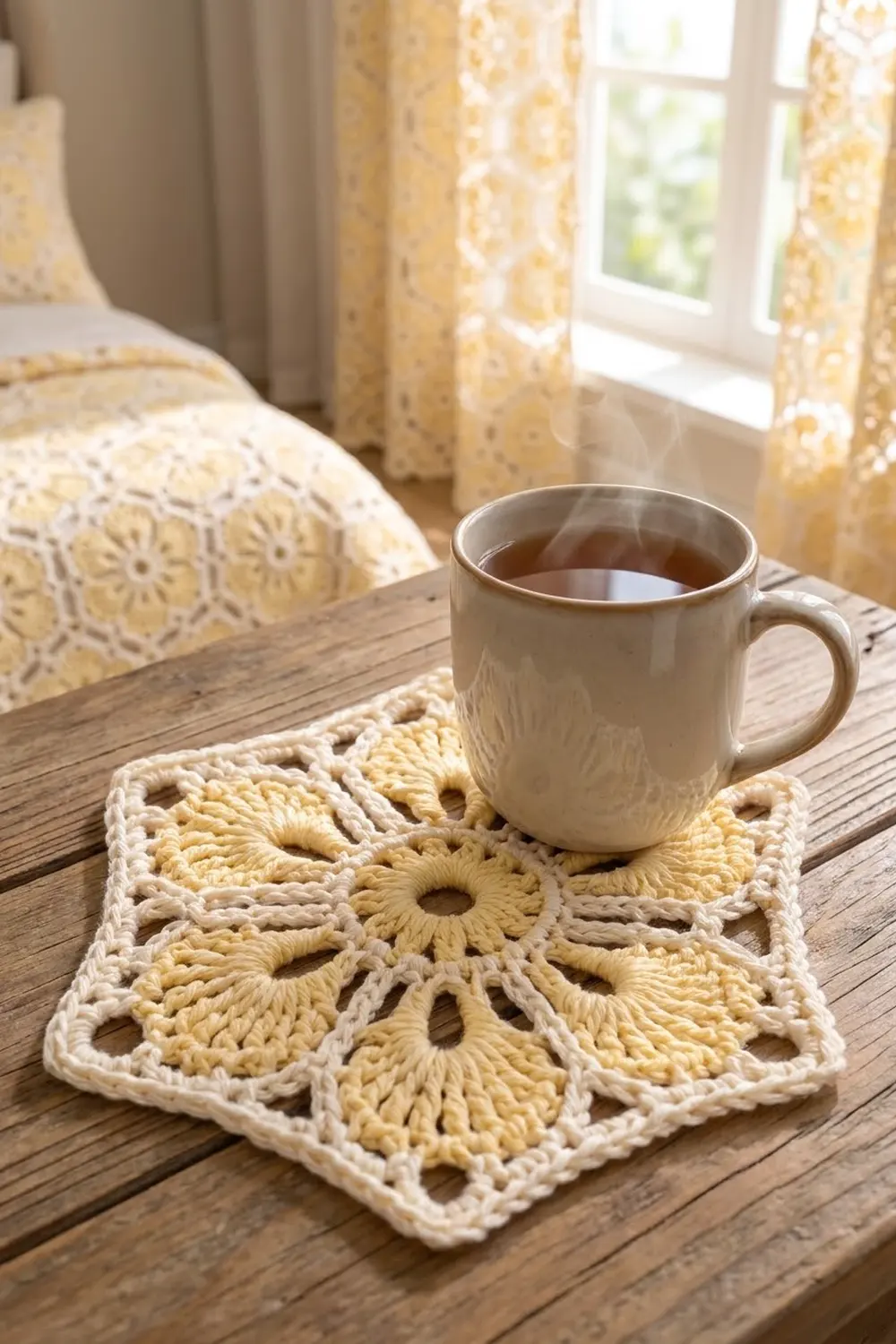
If your test motif hits those checkpoints, every motif you make after it will match. Use one as a coaster or small doily, or keep a stack on hand for your own lace projects.
Happy crocheting!