

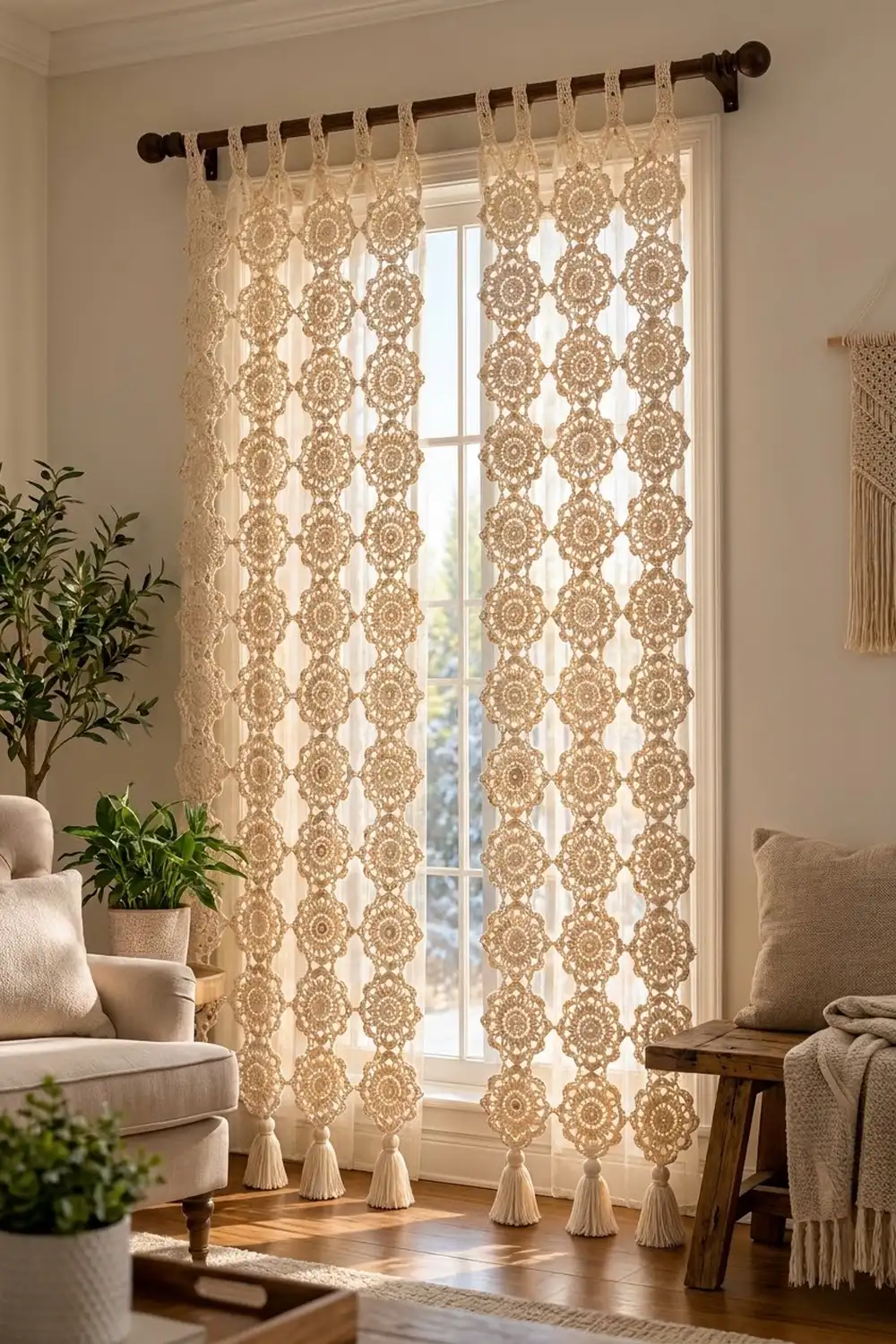
This curtain is made from round lace motifs with a swirled center. They are linked one under another into long vertical strands, and each strand ends in a full tassel. The strands hang side by side from a curtain rod on small crocheted loops. Light shows through the open petals, so the curtain filters a window instead of blocking it.
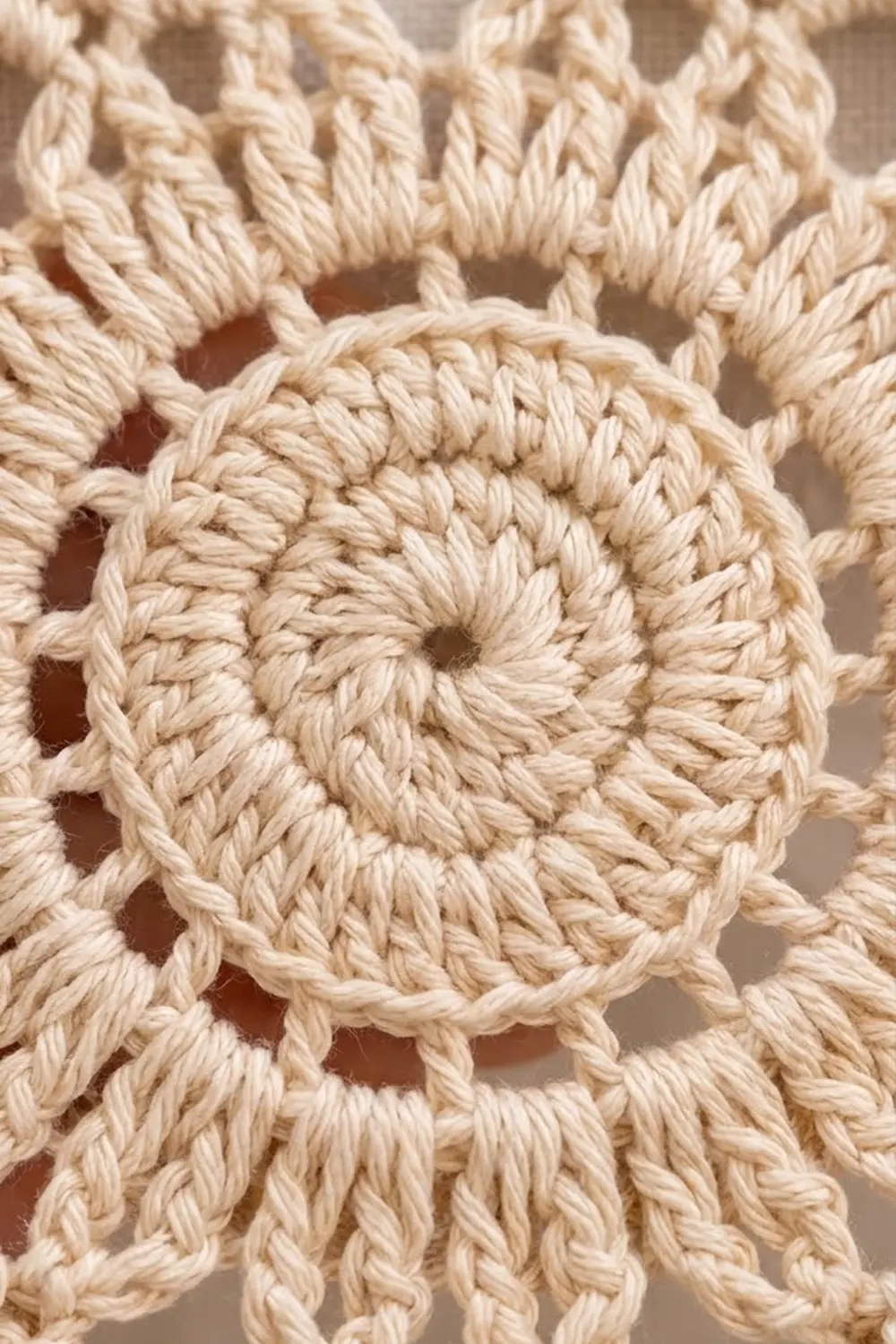
Each motif has a dense spiral center, a ring of open chain windows, and eight rounded petals. A small ring picot sits between each pair of petals. The whole curtain is one color, a soft cream or ivory cotton, which gives it a calm, vintage look that suits holiday decorating and works the rest of the year too.
This pattern uses US crochet terms. One motif measures 4 in (10.2 cm) from picot tip to picot tip. A strand of 15 motifs is 67 in (170.2 cm) long. One panel of 4 strands is about 19 in (48.3 cm) wide.
You work the center as a continuous spiral in back loops only, and that is what creates the swirl. Then you add a chain-window round, a loop round, and a petal round. Motifs are joined as you go with short link picots. To finish, you add a hanging tab at the top of each strand and a tassel at the bottom.
Finished Size and Construction
- Motif size: 4 in (10.2 cm) across, picot tip to picot tip
- Center size (Rounds 1–4): 2.75 in (7.0 cm) diameter
- Strand length: 67 in (170.2 cm), not counting tab and tassel
- Strand length with tab and tassel: about 73 in (185.4 cm)
- Panel width: about 19 in (48.3 cm) with 4 strands and 1 in (2.5 cm) gaps
- Skill level: Intermediate
- Terminology: US
- Yarn weight: DK / light (3), mercerized cotton
- Hook: 3.5 mm (E-4)
- Number of pieces: 60 motifs per panel (4 strands of 15). The photo shows a pair of panels, so 120 motifs for a full window.
- Layout: 4 separate vertical strands per panel. Motifs are joined top to bottom only, and strands are not joined to each other.
- Edge finish (“border”): one crocheted tab at the top of each strand, about 2 in (5.1 cm) deep once it hangs from the rod, and one 4 in (10.2 cm) tassel at the bottom
Materials
Use a smooth mercerized cotton or cotton blend in DK weight. It shows the stitch definition clearly, holds its shape when it hangs, and doesn’t stretch much under its own weight. Stay away from fuzzy or very stretchy yarns, because long strands get longer as they hang.
Yarn (one color):
– Cream/Ivory: 600 g (about 1,380 m) for two panels, based on 50 g ≈ 115 m. For one panel you need 300 g (about 690 m).
– Motifs: about 3.5 g (8 m) each
– Tassels: about 10 g (23 m) each
– Tabs: about 1.5 g (3.5 m) each
These amounts already include a margin of about 15% for gauge differences and test swatches.
Tools:
– 3.5 mm (E-4) crochet hook
– Tapestry needle
– Scissors
– Stitch markers
– A piece of stiff card 4.5 in (11.4 cm) tall, for winding tassels
– Blocking mat and rust-proof pins
– Spray bottle
– Ruler or tape measure
Abbreviations (US Terms)
- ch – chain
- sl st – slip stitch
- sc – single crochet
- hdc – half double crochet
- dc – double crochet
- BLO – back loop only
- sp(s) – space(s)
- st(s) – stitch(es)
- MR – magic ring
Special stitches:
- Ring picot (rp): Ch 5, then sl st in the 5th ch from the hook. This makes a small closed ring.
- Link picot (lp): Ch 3, sl st in the ring picot of the previous motif, ch 3, then sl st in the 1st of the first 3 ch. This makes a closed double-chain link, about 0.5 in (1.3 cm) long, that holds two motifs together.
Gauge and Checkpoints
Make one full motif and block it before you start the curtain. With 120 motifs, a small gauge difference adds up quickly.
- After Round 1: 1 in (2.5 cm) diameter
- After Round 2: 1.5 in (3.8 cm)
- After Round 3: 2.1 in (5.3 cm)
- After Round 4: 2.75 in (7.0 cm)
- After Round 5: 3.25 in (8.3 cm)
- After Round 7 (blocked): 4 in (10.2 cm), picot tip to picot tip
If your blocked motif measures more than 4.25 in (10.8 cm), go down half a hook size. If it measures less than 3.75 in (9.5 cm), go up half a size. A 0.25 in (0.6 cm) difference on each motif changes a 15-motif strand by almost 4 in (10.2 cm), so check this before you go on.
Motif Pattern
Swirl Center (Rounds 1–4, Continuous Spiral)
Do not join these rounds. Put a marker in the first stitch of each round and move it up as you go.
Round 1: MR, ch 2 (does not count as a st), work 10 dc into the ring. Pull the ring closed. (10 dc)
Round 2: Working in BLO, 2 dc in each st around. (20 dc)
Round 3: Working in BLO, dc in next st, 2 dc in next st; repeat from * 9 more times. (30 dc)
Round 4: Working in BLO, dc in next 2 sts, 2 dc in next st; repeat from * 9 more times. (40 dc)
The front loops you leave unworked make a raised line that turns around the center, and that line is the swirl. To smooth out the step at the end of the spiral, sl st in the next 2 sts (both loops). These slip stitches move the yarn into position and are not counted. Round 4 still has 40 stitches to work into.
Lace Rounds (Rounds 5–7, Joined)
Round 5 (chain-window round): Ch 3 (counts as dc), dc in next 3 sts, ch 3, skip 1 st. Dc in next 4 sts, ch 3, skip 1 st; repeat from * 6 more times. Sl st to top of the beginning ch-3.
Count: 32 dc (worked 1 per existing st) + 8 ch-3 sps (each replacing 1 skipped st) = 40 base sts used. (32 dc, 8 ch-3 sps)
Round 6 (loop round): Sl st in next 3 dc and into the next ch-3 sp. Ch 1, sc in same sp, ch 7. Sc in next ch-3 sp, ch 7; repeat from * 6 more times. Sl st to first sc.
(8 sc, 8 ch-7 loops)
Each ch-7 loop arches over one group of 4 dc. The gaps under the arches are the open windows around the center.
Round 7 (petal round): Sl st into the first ch-7 loop. Ch 1. In the loop work (2 sc, hdc, 5 dc, hdc, 2 sc), then work 1 rp; repeat from * 7 more times. Sl st to first sc and fasten off.
Count: 8 petals × 11 sts = 88 sts, plus 8 rp. (88 sts, 8 rp)
Number the picots P1 to P8 in the order you work them. P4 and P8 sit directly opposite each other. P4 is the top of the motif and P8 is the bottom.
Make All Pieces
For one panel, make 4 strands of 15 motifs each, which is 60 motifs in Cream. For a pair of panels, make 8 strands and 120 motifs. Every motif is the same, and all of them are worked in the one color.
Layout of one panel, seen from the front (M = motif, | = link picot, T = tab, ✱ = tassel):
 T     T     T     T
 M1    M1    M1    M1
 |     |     |     |
 M2    M2    M2    M2
 ...   ...   ...   ...
 M15   M15   M15   M15
 ✱     ✱     ✱     ✱
The columns are 1 in (2.5 cm) apart on the rod and are not joined to each other.
Joining (Join-As-You-Go)
Make Motif 1 of a strand exactly as written. For Motifs 2 to 15, work Rounds 1–6 as usual. In Round 7, work P1 to P3 as normal ring picots. In place of P4, work a link picot: ch 3, sl st into P8 of the motif above, ch 3, then sl st in the 1st of the first 3 ch. Then finish the round, working P5 to P8 as normal ring picots.
Stitch logic: Each motif is joined at one point only, and the link picot uses the same position as a ring picot would. That means the petal count of 88 sts stays the same, and so does the spacing between petals.
Tension: Keep the link chains at the same tension as your normal chains. If the links are tight, the strand will pucker and twist. If they’re loose, the motifs will droop when hung.
Checkpoint: Lay a finished strand flat without stretching it. 15 motifs × 4 in (10.2 cm) + 14 links × 0.5 in (1.3 cm) = 60 in + 7 in = 67 in (170.2 cm). After 5 motifs, measure 5 × 4 + 4 × 0.5 = 22 in (55.9 cm) and adjust if you are off by more than 0.5 in (1.3 cm).
Border (Top Tab and Tassel Finish)
Because each strand hangs on its own, the edge finish goes on the two ends of each strand instead of around a perimeter.
Tab gauge: 9 sc packed over a chain = 1 in (2.5 cm). 7 ch = 1 in (2.5 cm).
Tab Round 1: Join yarn in P4 of Motif 1. Ch 30, then sl st into the same P4. This makes a chain loop about 4.3 in (10.9 cm) around.
Tab Round 2: Work 40 sc over the ch-30 loop, then sl st into P4 and fasten off. (40 sc: 20 sc on each side of the folded tab)
Why the math works: 30 ch at 7 per inch is about 4.3 in (10.9 cm). 40 sc at 9 per inch is about 4.4 in (11.2 cm), which is just enough to cover the chain without making it ruffle. Folded over a 1.25 in (3.2 cm) rod, which is about 3.9 in (9.9 cm) around, the tab hangs the motif about 2 in (5.1 cm) below the top of the rod.
Tassel: Wrap the yarn 30 times around the 4.5 in (11.4 cm) card. Slip a 10 in (25.4 cm) strand under the top of the wraps and tie it tight. Cut the wraps at the bottom. Wrap a second strand 6 times around the bundle 0.75 in (1.9 cm) below the top and knot it. Trim the ends to 4 in (10.2 cm). Use the top tie to sew the tassel securely to P8 of Motif 15.
Final Blocking
- Weave in all ends first. Leave 6 in (15.2 cm) tails and weave them into the dense center or the petals, not into the links.
- Wet each strand in cool water, then press out the water in a towel. Do not wring it.
- Pin a motif to a 4 in (10.2 cm) circle. Put a pin in each ring picot and one at the tip of each petal.
- Open each ch-7 window and the center swirl lightly with your fingertips.
- Block 3–5 motifs at a time and work your way down the strand. Check the 0.5 in (1.3 cm) link gaps as you go.
- Let it dry completely. Comb out the tassels, steam them lightly, and trim them level.
Final Quality-Control Checklist
- Each motif has 10 / 20 / 30 / 40 dc in the spiral and a clear swirl ridge
- Round 5 has 32 dc and 8 windows
- Each motif has 8 even petals of 11 sts and 8 picots
- Each motif measures 4 in (10.2 cm) when blocked
- Links connect P4 to P8 so the strand hangs straight
- Each strand measures 67 in (170.2 cm), with no more than 0.5 in (1.3 cm) difference between strands
- Each tab has 40 sc and fits the rod
- Tassels are 4 in (10.2 cm) and all the same
- All ends are woven in securely
Troubleshooting
- No visible swirl: You worked through both loops. Rounds 2–4 must be worked in BLO.
- Center cups: Your dc are too tight, or you skipped increases. Check the counts of 20 / 30 / 40.
- Center ruffles: You added extra increases. Count again at the end of each round.
- Petals look uneven: Make sure each ch-7 loop has exactly 7 ch and holds 11 sts.
- Strand twists: You linked the wrong picot. The link should always go to P8, directly opposite P4.
- Strands are different lengths: Block all of them to the same length, or take out or add one motif.
- Tab is too tight for the rod: Work the tab again with ch 34 and 46 sc.
Care
Hand wash in cool water with a mild soap and lay flat to dry, then block again if needed. Hang the curtain out of strong direct sun so the cream color doesn’t yellow.
Final Notes
The measurements build on each other: a 2.75 in (7.0 cm) center grows into a 4 in (10.2 cm) motif. Fifteen motifs with 0.5 in (1.3 cm) links make a 67 in (170.2 cm) strand. With a 2 in (5.1 cm) tab and a 4 in (10.2 cm) tassel, it hangs about 73 in (185.4 cm). Four strands spaced 1 in (2.5 cm) apart make a 19 in (48.3 cm) panel. If your test motif hits its size, the rest of the curtain will measure correctly too.
Happy crocheting!