
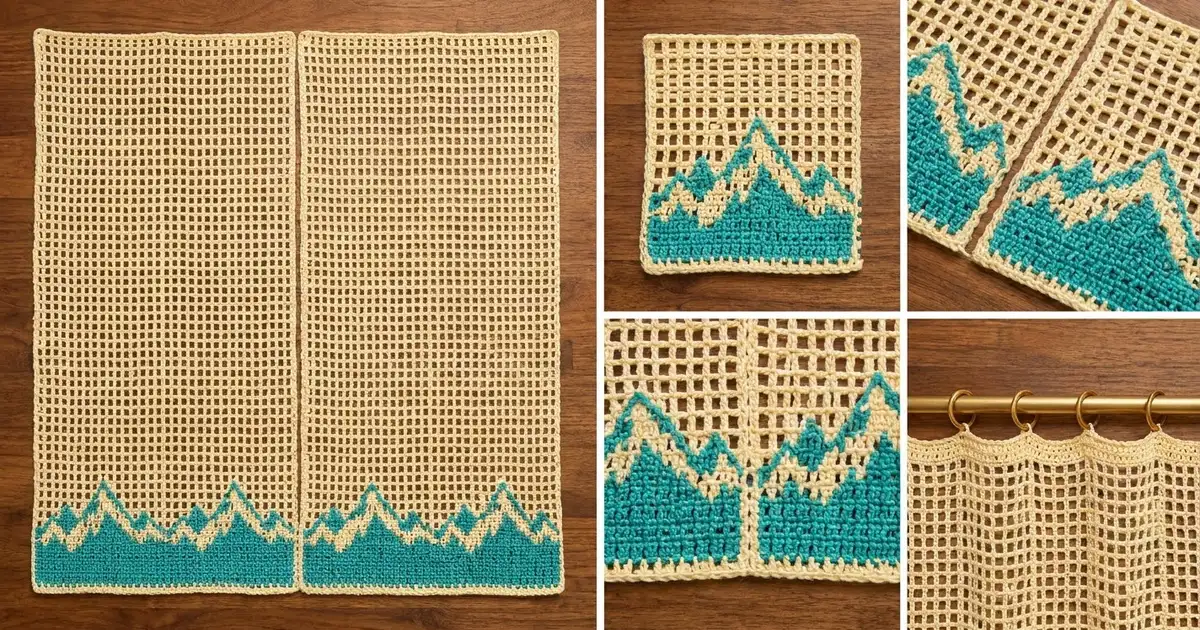
The Alpine Ridge Curtain is a light, airy filet-crochet panel. Open cream mesh fills most of the curtain and lets daylight through. Along the bottom runs a band of teal mountains, each topped with a stepped cream “snow” line and a thin teal ridge. The look is simple and graphic, and it suits bright rooms, tall windows and calm color schemes.
The panel is made in blocks. You crochet small square blocks of filet mesh, edge each one in cream single crochet, then slip-stitch them together into a grid. The bottom row uses Mountain Blocks and every other row uses Plain Mesh Blocks. A three-round border finishes the panel.
The pattern uses US crochet terms. One finished panel measures 31 in x 61 in (78.7 cm x 154.9 cm). For a pair like the one in the photo, make two panels.
In short, you’ll: crochet 5 Mountain Blocks and 45 Plain Mesh Blocks, edge each block, join them 5 wide by 10 tall, add the border, block the panel and hang it on rings.
Finished Size and Construction
- Finished size (one panel): 31 in x 61 in (78.7 cm x 154.9 cm)
- Skill level: Intermediate (filet mesh plus simple color changes)
- Terminology: US
- Yarn weight: Sport (#2) mercerized cotton
- Hook: 3.5 mm (E-4)
- Number of pieces: 50 blocks per panel (5 Mountain, 45 Plain Mesh)
- Layout: 5 blocks wide x 10 blocks tall
- Block size: 5.75 in (14.6 cm) square before edging, 6 in (15.2 cm) square after edging
- Size before border: 30 in x 60 in (76.2 cm x 152.4 cm)
- Border depth: 0.5 in (1.3 cm) on every side
Materials
Use a smooth, mercerized sport-weight cotton. Mercerized cotton holds the mesh crisply, resists sagging and shows the stepped mountain outline clearly. Avoid fuzzy or very stretchy yarns, because hanging fabric stretches lengthwise over time.
Yarn (per panel):
– Cream (main color): 500 g, about 1,500 m
– Teal (contrast color): 60 g, about 180 m
These amounts include a margin of about 10% for gauge differences and the test block. Double them for a pair of panels.
Tools:
– 3.5 mm (E-4) crochet hook
– Tapestry needle
– Stitch markers
– Scissors
– Measuring tape
– Blocking mats, rustproof pins and a spray bottle
– 11 curtain rings (clip or sew-on) for hanging
Abbreviations (US Terms)
- ch – chain
- sc – single crochet
- dc – double crochet
- sl st – slip stitch
- sp – space
- st(s) – stitch(es)
- RS / WS – right side / wrong side
Filet squares: Each row is 15 squares wide and has 46 stitches: 16 dc posts plus 30 stitches between them.
– Block (solid square): 2 more dc after the shared post, then dc in the next post (3 sts per square). Over a block, dc in each of the next 3 dc. Over a mesh, work 2 dc in the ch-2 sp and dc in the next dc.
– Mesh (open square): ch 2, skip 2 sts (or the ch-2 sp), dc in the next dc.
– Beginning a row: ch 3 counts as the first dc if the first square is a block. Ch 5 counts as dc + ch 2 if the first square is a mesh.
Color change: Work the last dc before the new color until 2 loops remain, then finish it with the new color. Each square’s closing dc is worked in that square’s color.
Gauge and Checkpoints
Gauge: 15 filet squares and 15 rows = 5.75 in (14.6 cm) in mesh. For edging and border: 23 sc = 3 in (7.6 cm).
Your first block is your gauge swatch. Make one Plain Mesh Block, edge it and pin it out lightly before you make any more.
Checkpoints:
– After Row 5: the block measures 5.75 in (14.6 cm) wide.
– After Row 15: the block measures 5.75 in x 5.75 in (14.6 cm x 14.6 cm).
– After edging: the block measures 6 in x 6 in (15.2 cm x 15.2 cm).
– After joining one row of 5 blocks: 30 in (76.2 cm) wide.
– After joining all blocks: 30 in x 60 in (76.2 cm x 152.4 cm).
– After the border: 31 in x 61 in (78.7 cm x 154.9 cm).
If your block is too big, go down a hook size (3.25 mm). If it’s too small, go up to 3.75 mm. If the width is right but the height isn’t, check your dc height: pull up the first loop a little higher for taller rows, or keep it snug for shorter rows. Every block must match, because 50 blocks multiply any error.
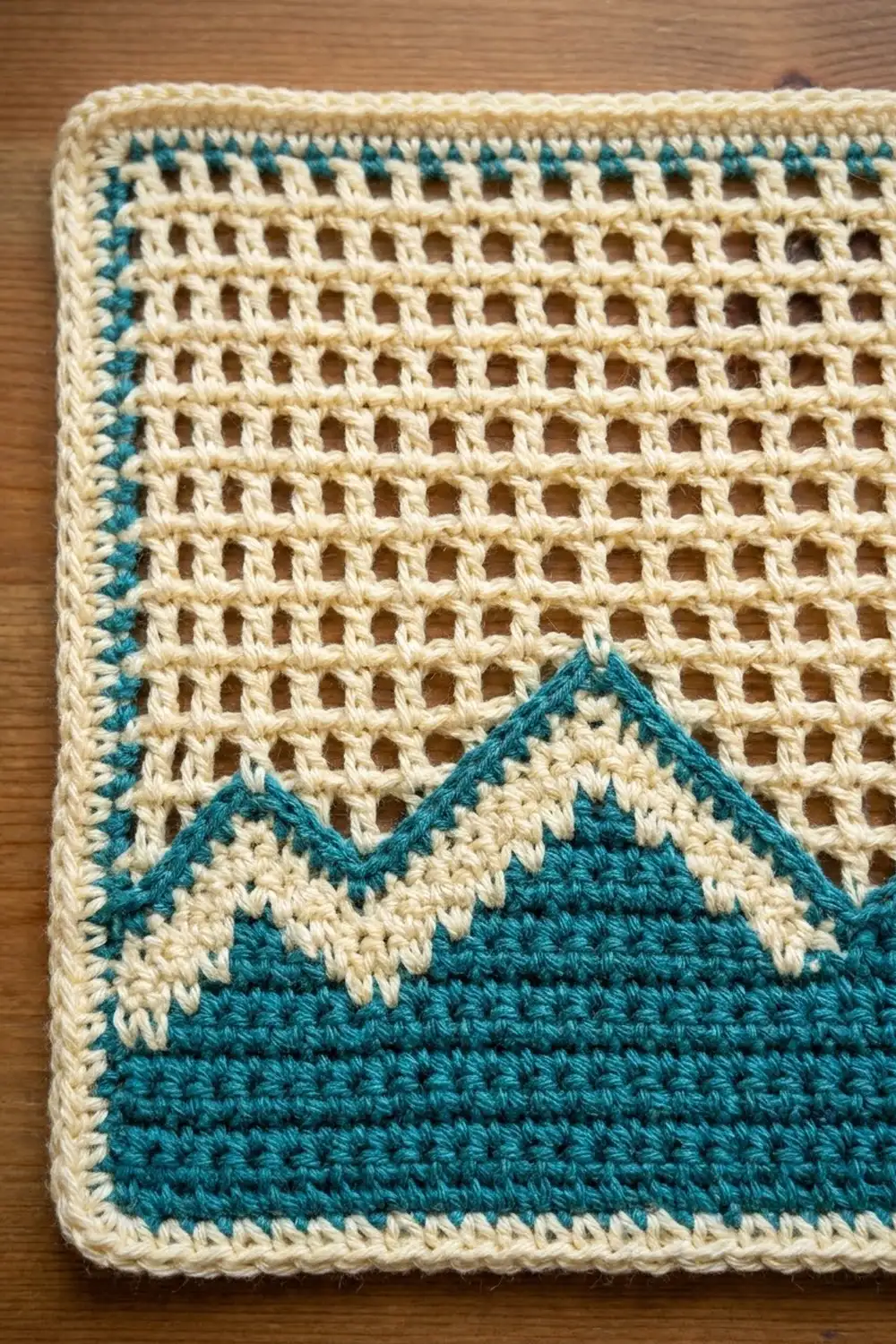
Plain Mesh Block (make 45)
With cream, ch 50.
Row 1 (RS): Dc in 8th ch from hook. Ch 2, skip 2 ch, dc in next ch. Repeat from * 13 more times. Turn. (15 mesh squares: 16 dc posts and 15 ch-2 sps = 46 sts, counting the skipped beginning ch as dc + ch 2)
Rows 2–15: Ch 5 (counts as dc + ch 2), skip ch-2 sp, dc in next dc. Ch 2, dc in next dc. Repeat from * across, working the last dc in the 3rd ch of the turning ch. Turn. (15 mesh squares, 46 sts)
Don’t fasten off. Go to Block Edging.
Mountain Block (make 5)
The chart below gives each row as 15 squares, read from square 1 to square 15: T = teal block, C = cream block, M = cream mesh. Every row is symmetrical, so you can read it the same way on RS and WS rows.
With teal, ch 48.
Row 1 (RS): Dc in 4th ch from hook and in each ch across. Turn. (46 dc = 15 teal blocks)
Rows 2–4: Ch 3 (counts as dc), dc in each st across. Turn. (46 dc, all teal)
At the end of Row 4, join cream with the last yo. From now on, carry the color you’re not using inside the solid blocks by laying it along the top of the row and working over it.
Row 5: C, T x 13, C. (46 dc)
Row 6: T, C, T, C, T, T, T, T, T, T, T, C, T, C, T. (46 dc)
Row 7: M, T, C, T, C, T, T, T, T, T, C, T, C, T, M. (42 dc + 4 ch = 46 sts)
Row 8: M, M, T, M, T, C, T, T, T, C, T, M, T, M, M. (46 sts)
Row 9: M, M, M, M, M, T, C, T, C, T, M, M, M, M, M. (46 sts)
Row 10: M x 6, T, C, T, M x 6. (46 sts)
Row 11: M x 7, T, M x 7. (46 sts)
Rows 12–15: M x 15. (46 sts)
Carrying rule: Carry teal only through solid squares. If the next teal square is separated by open mesh (as in Rows 7–11), cut teal, leaving a 4 in (10.2 cm) tail, and rejoin it where needed. Never carry a strand across a ch-2 space, because it would show in the open mesh. Cut teal after Row 11.
What the rows build: Rows 1–4 are the solid teal base. In Rows 5–11, the teal mountain mass steps up to three peaks (squares 3, 8 and 13). A single cream solid square sits directly on top of the teal in each column, forming the snow zigzag. One teal square sits on top of that cream, forming the ridge line. Above the ridge, everything is cream mesh.
Don’t fasten off cream. Go to Block Edging.
Block Edging (all 50 blocks)
Work this in cream. Make the Mountain Blocks’ edging so the teal base sits along the bottom.
Round 1 (RS): Ch 1. Along the top edge: sc in each dc and 2 sc in each ch-2 sp (or sc in each dc of a block). (46 sc) Ch 1 for the corner.
Down the side: work 3 sc around each row-end post. (15 rows x 3 = 45 sc) Ch 1 for the corner.
Along the bottom, working into the foundation chain: on a Mountain Block, sc in each base loop (46 sc). On a Plain Mesh Block, sc at the base of each dc and 2 sc in each foundation ch-2 sp (16 + 30 = 46 sc). Ch 1 for the corner.
Up the second side: 3 sc around each row-end post. (45 sc) Ch 1, sl st to the first sc.
Edging total: 46 + 45 + 46 + 45 = 182 sc, plus 4 corner ch-1 sps. The corner ch-1 sps are not included in the per-side counts. Fasten off and weave in the ends through solid stitches.
Checkpoint: 6 in x 6 in (15.2 cm x 15.2 cm). Steam or wet-block the blocks lightly before joining. Square blocks make straight seams.
Make All Pieces
Per panel:
– Mountain Blocks: 5 (teal and cream)
– Plain Mesh Blocks: 45 (cream only)
Double these numbers for a pair.
Layout (RS facing, top of curtain at the top):
Row 1:  P  P  P  P  P
Row 2:  P  P  P  P  P
Row 3:  P  P  P  P  P
Row 4:  P  P  P  P  P
Row 5:  P  P  P  P  P
Row 6:  P  P  P  P  P
Row 7:  P  P  P  P  P
Row 8:  P  P  P  P  P
Row 9:  P  P  P  P  P
Row 10: M  M  M  M  M
P = Plain Mesh Block, M = Mountain Block with the teal base at the bottom. Lay all blocks with the foundation edge facing down so the mesh lines run the same way.
Joining
Method: Slip stitch seam in cream. Hold two blocks WS together with the RS facing you, and work through both loops of both layers. This makes the slightly raised cream seam line you can see in the photo.
Step 1 – Vertical seams (make horizontal strips): Join blocks side to side into 10 strips of 5. For each seam, sl st into the matching corner ch-1 sps. Then sl st through each pair of side stitches, 45 pairs, matching stitch to stitch. Finish with a sl st through the opposite pair of corner sps. That’s 47 sl sts per seam. On the Mountain row, the snow lines meet at the seams because square 1 and square 15 match.
Step 2 – Horizontal seams (stack the strips): Join the strips top to bottom. Each block’s 46 top sc meet the 46 bottom sc of the block above, stitch to stitch. Where vertical seams meet, sl st through the joined corner sps together. Across each strip, that’s 5 x 46 = 230 sts plus the corner sps.
Tension: Keep your slip stitches as loose as the edging stitches. If you pull them tight, the seams pucker, and a curtain shows every pucker against the light. If needed, go up to a 4.0 mm hook for joining.
Checkpoint: The joined panel measures 30 in x 60 in (76.2 cm x 152.4 cm), and the seams lie flat.
Border
Border gauge: 23 sc = 3 in (7.6 cm). This matches the block edging gauge (46 sc per 6 in / 15.2 cm), so the border fits exactly without ruffling or pulling in.
Starting count (before Round 1):
– Top and bottom: 5 blocks x 46 sc = 230 sc.
– Sides: 10 blocks x 45 sc = 450 sc.
These numbers don’t include the seam points. Round 1 adds exactly 1 sc at each seam point, as shown below.
Round 1 (RS): Join cream in the top right corner ch-1 sp. Work (sc, ch 2, sc) in each outer corner ch-1 sp. Along each edge, sc in each edge sc and work 1 sc in each seam point (the joined pair of corner sps).
– Top and bottom: 230 + 4 seam sc + 2 corner sc = 236 sc each.
– Sides: 450 + 9 seam sc + 2 corner sc = 461 sc each.
– Total: 2 x 236 + 2 x 461 = 1,394 sc plus 4 corner ch-2 sps.
From here on, each side count includes the 2 corner sc on either side of its corner ch-2 sp. Sl st to the first sc.
Round 2: Ch 1. Sc in each sc around, and work (sc, ch 2, sc) in each corner ch-2 sp.
– Top and bottom: 238 sc each.
– Sides: 463 sc each.
– Total: 1,402 sc.
Round 3: Repeat Round 2.
– Top and bottom: 240 sc each.
– Sides: 465 sc each.
– Total: 1,410 sc.
Fasten off and weave in the ends.
Why the math works: Each round only adds 2 sc per side, at the corners, so the edges stay straight while the corners turn flat. The 4 and 9 seam stitches add just 0.5 in (1.3 cm) and 1.2 in (3.0 cm) of stitch length over 30 in (76.2 cm) and 60 in (152.4 cm). They fill the seam dips and don’t create ripples. Three sc rounds add 0.5 in (1.3 cm) per side, giving 31 in x 61 in (78.7 cm x 154.9 cm).
Final Blocking
- Soak the panel in cool water for 15 minutes, then gently press out the water. Don’t wring it.
- Roll it in towels to remove more water.
- Lay it flat on blocking mats, RS up.
- Pin the corners to 31 in x 61 in (78.7 cm x 154.9 cm).
- Pin along each seam line so the seams run straight and parallel.
- Pull the mesh squares gently into true squares. Check a few with a ruler.
- Make sure the Mountain row lies flat. Solid areas can pull in slightly, so pin that row to the full 30 in (76.2 cm) block width.
- Let it dry completely before you unpin it.
- Sew or clip 11 rings to the top border: one at each corner, at each of the 4 seams, and at the center of each of the 5 blocks. That’s one ring about every 3 in (7.6 cm).
Final Quality-Control Checklist
- [ ] All 50 blocks measure 6 in (15.2 cm) square.
- [ ] Each block edging has 46 / 45 / 46 / 45 sc.
- [ ] The Mountain row is at the bottom, with the teal base facing down.
- [ ] The snow lines and ridge lines meet cleanly at the seams.
- [ ] No carried strands cross any open mesh.
- [ ] The seams are flat, with no puckers.
- [ ] Border Round 3: 240 / 465 / 240 / 465 sc.
- [ ] The panel measures 31 in x 61 in (78.7 cm x 154.9 cm).
- [ ] The rings are evenly spaced and secure.
Troubleshooting
Mesh squares are tall rectangles: Your dc are too tall. Shorten the first loop you pull up, or use a smaller hook for the mesh rows only.
The Mountain Block is narrower than the plain blocks: Solid colorwork often pulls in. Keep the carried yarn relaxed along the top of the row, or go up a half hook size for Rows 1–11.
Teal shows through cream blocks: Push the carried strand to the center of the stitches, or carry it on the WS edge of the stitch.
Row count is off: Count the posts. Every row needs 16 dc posts.
The curtain grows longer after hanging: Cotton relaxes over time. Re-block it, and consider sewing a light cotton tape behind the top border.
Seams ripple: The joining stitches are too tight. Undo the seam and rework it with a larger hook.
Care
Hand wash cool or machine wash on gentle inside a mesh laundry bag, then lay flat and pin to shape to dry. Don’t tumble dry, and don’t hang it while it’s wet.
Final Notes
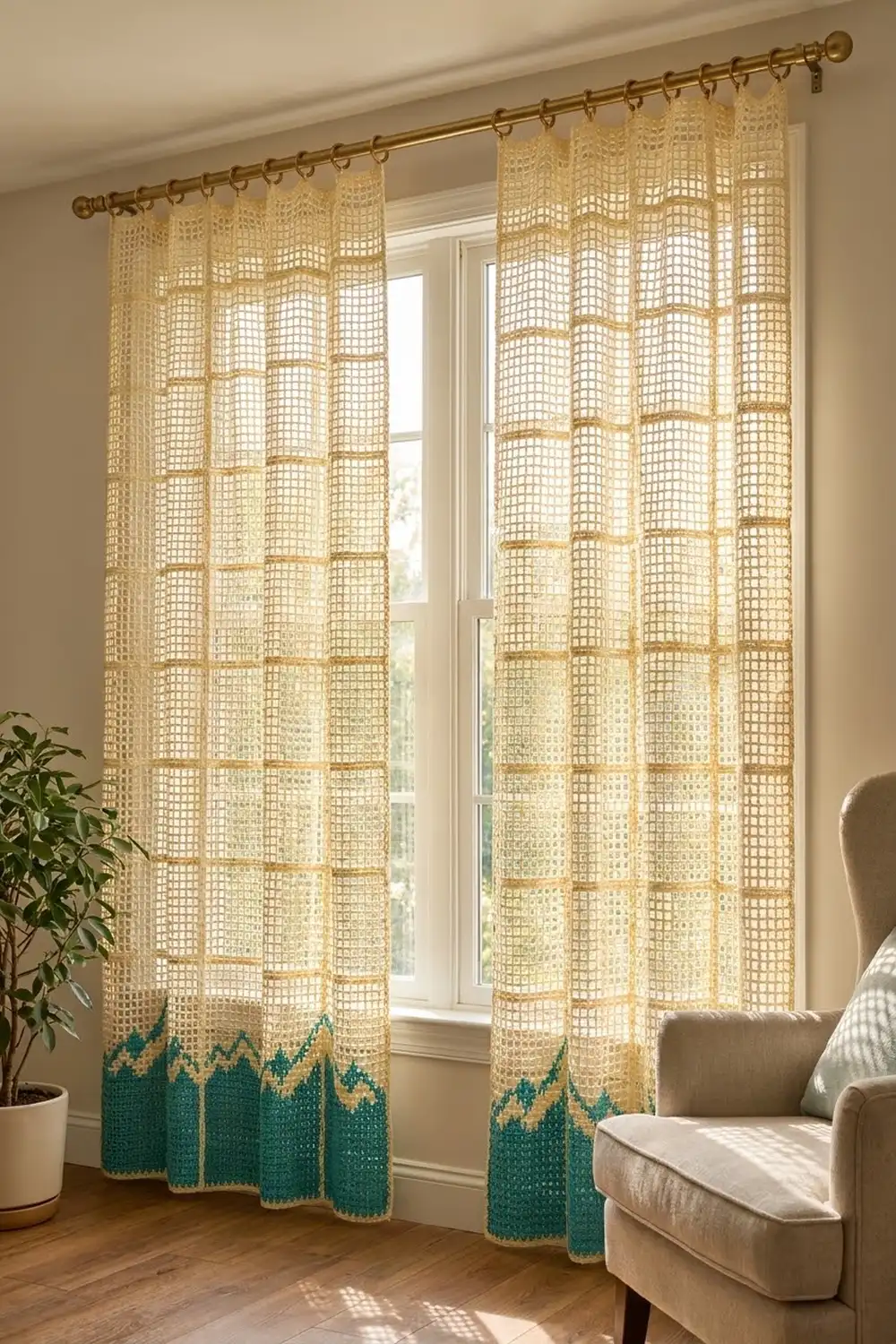
The measurement chain is what keeps this curtain straight. Each row is 15 squares (46 stitches), and 15 rows give a 5.75 in (14.6 cm) block. The edging takes it to 6 in (15.2 cm). Five blocks across make 30 in (76.2 cm), and ten blocks down make 60 in (152.4 cm). Three border rounds bring the panel to 31 in x 61 in (78.7 cm x 154.9 cm). Check each link before you move on to the next, and the light will fall through even, square mesh with a row of teal mountains along the bottom.
Happy crocheting!