

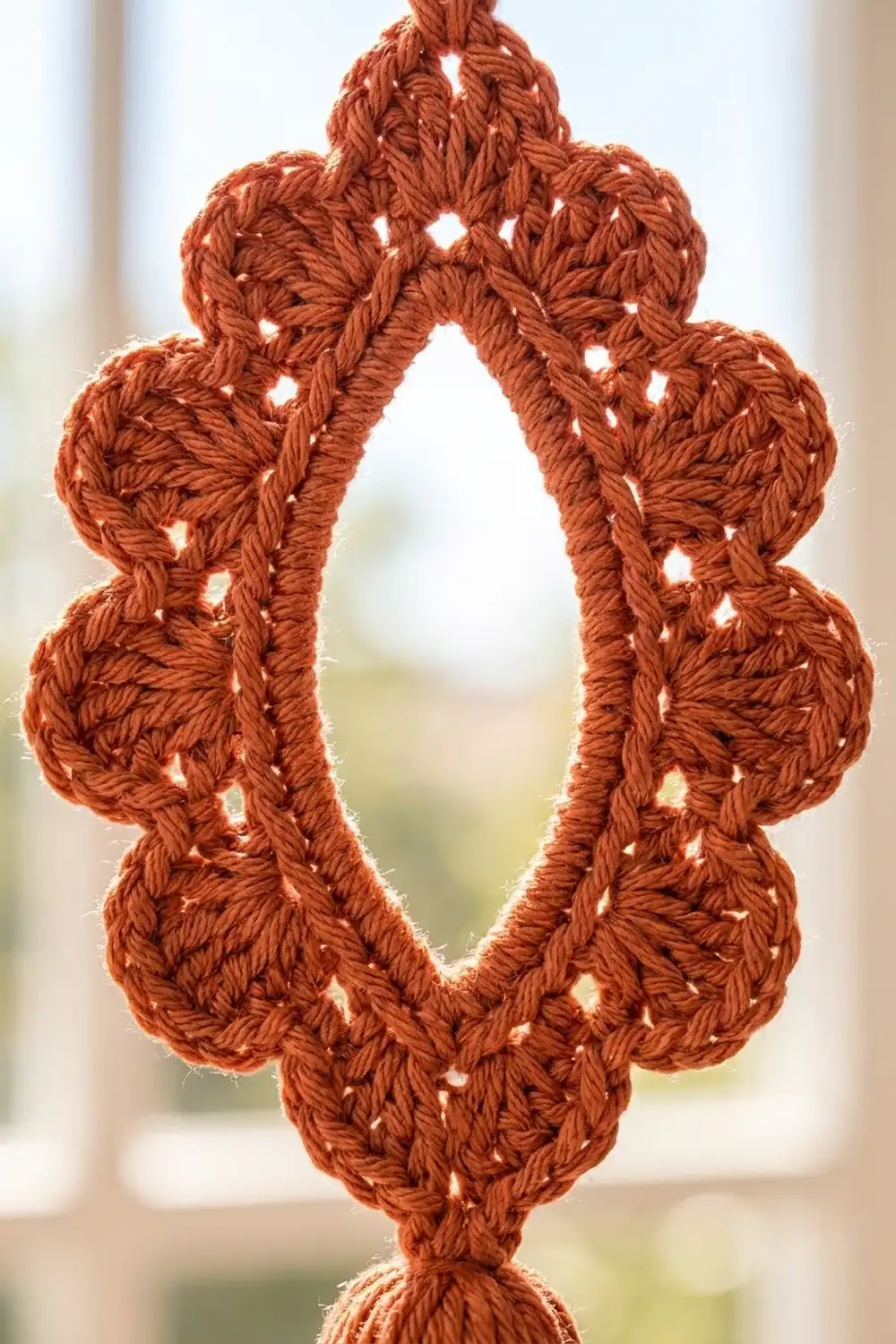
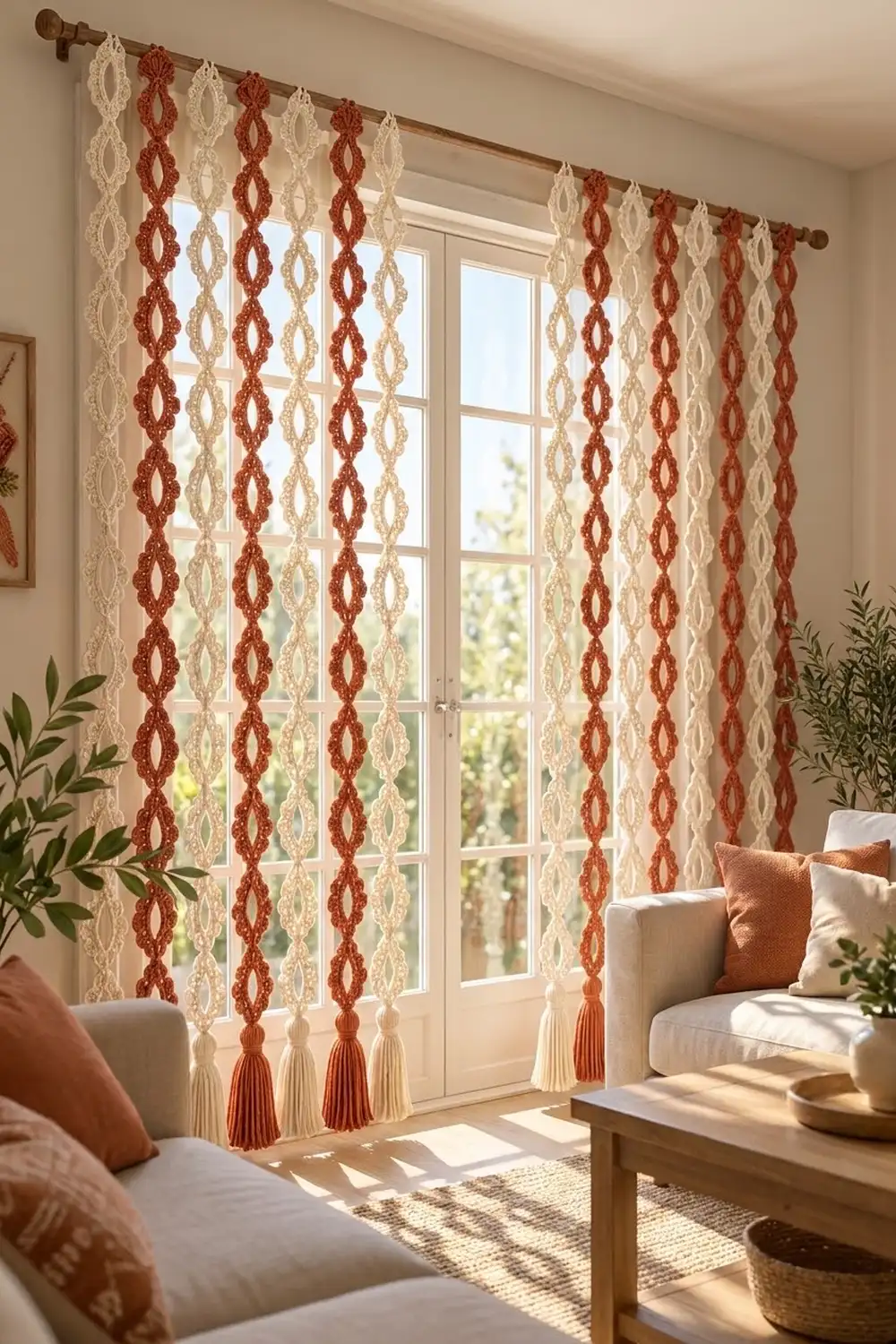
This curtain is made of hanging crochet strands. Each strand is a column of almond-shaped “eyelet” motifs edged with soft scallops and finished with a plump tassel. When the strands hang in a window, light comes through every open center, and the room gets a warm, airy boho look without losing the view.
The sample alternates cream and rust (terracotta) strands across the rod. The two warm, earthy colors suit natural wood, linen and plants. They also look good in other pairs, like sage and oat or charcoal and natural.
This pattern uses US crochet terms. The finished curtain measures about 48.5 in (123.2 cm) wide and 67 in (170.2 cm) long, measured from the top of the hanging loop to the bottom of the tassel. Each motif measures 3 in (7.6 cm) wide by 5 in (12.7 cm) tall.
Here is the construction in short. Each motif starts as a chain ring with single crochet worked into it. You shape the points on Round 2, and the scalloped edging on Round 3 acts as the motif’s border. Starting with the second motif, you join each one to the motif above it while you work its edging (join-as-you-go). Each strand holds 12 motifs, with a hanging loop at the top and a tassel at the bottom. You make 14 strands.
Finished Size and Construction
- Finished curtain: 48.5 in (123.2 cm) wide × 67 in (170.2 cm) long
- Skill level: Easy (advanced beginner)
- Terminology: US crochet terms
- Yarn weight: Worsted (#4), cotton or cotton blend
- Hook: 5.0 mm (H-8)
- Number of pieces: 168 motifs (14 strands of 12) plus 14 tassels
- Layout: 14 strands across the rod, alternating cream and rust, each strand 12 motifs long
- Finished motif size: 3 in (7.6 cm) wide × 5 in (12.7 cm) tall, tip to tip
- Motif size before border (after Round 2): 2 in (5.1 cm) × 4 in (10.2 cm)
- Border depth: 0.5 in (1.3 cm) on every side
Materials
Yarn: Use a smooth worsted-weight cotton or cotton blend, about 100 g = 190 m (208 yd). Cotton keeps the scallops crisp and hangs straight without stretching much. Avoid very fuzzy yarns, because they blur the open centers.
- Color A, Cream: 320 g (approx. 608 m / 665 yd), for 7 strands and 7 tassels
- Color B, Rust: 320 g (approx. 608 m / 665 yd), for 7 strands and 7 tassels
One strand uses about 74 m: about 60 m for 12 motifs, about 11 m for the tassel, and the rest for the hanging loop and tails. The quantities above include a margin of about 15–20% for gauge differences, swatching and tassel trimming.
Tools:
– 5.0 mm (H-8) crochet hook
– Tapestry needle
– Scissors
– Stiff card, 5 in (12.7 cm) tall, for tassels
– Optional: 14 wooden beads, 0.75 in (1.9 cm), to round out the tassel heads
– Stitch markers
– Rust-proof pins and a blocking mat
– Spray bottle
– Measuring tape
Abbreviations (US Terms)
- ch – chain
- sl st – slip stitch
- sc – single crochet
- dc – double crochet
- sk – skip
- sp – space
- st(s) – stitch(es)
- rep – repeat
Special stitches:
– Shell: 7 dc in the same stitch.
– Point picot: (sc, ch 3, sc) in the same space.
– Join picot: (sc, ch 1, sl st into the ch-3 space of the previous motif’s bottom point picot, ch 1, sc) in the same space. It replaces a point picot and has the same stitch count: 2 sc plus one loop.
Gauge and Checkpoints
Base gauge: 16 sc = 4 in (10.2 cm), so each sc is 0.25 in (0.6 cm) wide.
Make one complete motif before you commit to a whole strand. Lay it flat and check it at each stage:
- After Round 1: the ring, flattened into an oval, measures 1.5 in (3.8 cm) × 3.5 in (8.9 cm).
- After Round 2: the pointed oval measures 2 in (5.1 cm) × 4 in (10.2 cm).
- After Round 3: the motif measures 3 in (7.6 cm) × 5 in (12.7 cm) tip to tip, and the open center is about 0.75 in (1.9 cm) × 3 in (7.6 cm).
If your motif is too big, go down to a 4.5 mm hook. If it is too small, go up to a 5.5 mm hook. Over 12 motifs, a difference of 0.25 in (0.6 cm) per motif adds up to 3 in (7.6 cm) of strand length, so match the height closely.
Motif Pattern (Rounds 1–2)
Work in joined rounds with the right side facing. Don’t turn.
Foundation: Ch 22 and sl st into the first ch to form a ring. Don’t twist the chain.
Round 1: Ch 1 (doesn’t count as a st). Work 36 sc into the ring, working over the chain rather than into the individual chains. Push the stitches together so they cover the chain evenly. Join with a sl st to the first sc. (36 sc)
Flatten the ring into an oval and place a marker in the first sc (top) and another in the 19th sc (bottom). This gives you 17 sc between the markers on each side.
Round 2 (growth round, shapes the points): Ch 1. Work (sc, ch 2, sc) in the first sc (top point). Sc in each of the next 17 sts. Work (sc, ch 2, sc) in the next st (bottom point). Sc in each of the next 17 sts. Join with a sl st to the first sc.
Round 2 total: 38 sc + 2 ch-2 spaces. That is 36 sts worked one per stitch, plus 2 extra sc (one at each point).
Per-side count: each long side has 19 sc. That is 1 sc from the top point, 17 side sc, and 1 sc from the bottom point. The point sc are already included in the 19, so 19 + 19 = 38.
Checkpoint: 2 in (5.1 cm) × 4 in (10.2 cm).
Border: Scalloped Edging (Round 3)
Round 3 is the motif’s border. It turns each 19-stitch side into three fan scallops and puts a picot tip at each point.
Border gauge: one repeat of shell plus sc uses 6 stitches from Round 2 and covers 1.5 in (3.8 cm) of edge.
First motif of a strand
Round 3: Sl st into the top ch-2 space. Ch 1. Work (sc, ch 16, sc) in the same space. This is the hanging loop.
Side 1: Sc in the next sc. Then [sk 2 sts, shell in the next st, sk 2 sts, sc in the next st] 3 times.
Bottom point: Work a point picot in the bottom ch-2 space.
Side 2: Sc in the next sc. Then [sk 2 sts, shell in the next st, sk 2 sts, sc in the next st] 3 times.
Join with a sl st to the first sc. Fasten off and weave in the ends.
Motifs 2–12 of a strand
Work Round 3 the same way, with one change: at the top point, work a join picot instead of the hanging loop. The sl st goes into the ch-3 space of the bottom point picot on the motif above. Check that both motifs face right side up before you make the sl st.
Counts
- Per side: 4 sc + 3 shells (21 dc) = 25 sts
- Per point: 2 sc + 1 loop (ch-3, join loop or hanging loop)
- Round 3 total: 25 + 25 + 2 + 2 = 54 sts + 2 loops
Why the math works
Each side has 19 stitches, and 19 = (3 repeats × 6 stitches) + 1 closing sc. In stitch positions, the sc go in stitches 1, 7, 13 and 19, and the shells go in stitches 4, 10 and 16. The two scallops at the ends of each side sit next to a point and curve around it, which makes the almond silhouette. Because nothing is left over, both sides come out as mirror images.
Checkpoint: 3 in (7.6 cm) × 5 in (12.7 cm).
Make All Pieces
- Cream (A): 7 strands × 12 motifs = 84 motifs and 7 tassels
- Rust (B): 7 strands × 12 motifs = 84 motifs and 7 tassels
- Total: 168 motifs and 14 tassels
Strand layout across the rod, left to right:
Strand:  1  2  3  4  5  6  7  8  9  10 11 12 13 14
Color:   A  B  A  B  A  B  A  B  A  B  A  B  A  B
Motifs:  12 12 12 12 12 12 12 12 12 12 12 12 12 12
Strand length:
– Hanging loop: 2 in (5.1 cm)
– Motifs: 12 × 5 in = 60 in (152.4 cm)
– Tassel: 5 in (12.7 cm)
– Total: 67 in (170.2 cm)
Joining
Method: Join motifs as you go (see Round 3 above). The strands themselves aren’t joined to each other. They hang side by side.
Stitch-to-stitch logic: each join is one sl st, connecting the top point of the new motif to the bottom picot of the motif above. The tips meet with no overlap, so each motif adds exactly 5 in (12.7 cm) to the strand. The join doesn’t add any stitches: the join picot has the same 2 sc and one loop as a point picot.
Tension advice: work the ch 1 on each side of the join sl st at your normal tension. If those chains are tight, the strand puckers at every neck. If they are loose, the motifs flop forward.
Spacing on the rod: slide the strands onto the rod through their hanging loops, leaving 0.5 in (1.3 cm) gaps between strands. The ch-16 loop is about 4 in (10.2 cm) around, so it fits rods up to about 1.25 in (3.2 cm) in diameter.
Width: 14 strands × 3 in (7.6 cm) + 13 gaps × 0.5 in (1.3 cm) = 42 in + 6.5 in = 48.5 in (123.2 cm).
Size checkpoint: after every 4 motifs, hang the strand and measure it. It should be 20 in (50.8 cm) after 4 motifs, 40 in (101.6 cm) after 8, and 60 in (152.4 cm) after 12, not counting the loop and tassel.
Tassels
- Wrap yarn 40 times around the 5 in (12.7 cm) card.
- Slide a 12 in (30.5 cm) tie strand under the wraps at the top, knot it tightly, and leave the ends long.
- Cut the wraps at the bottom edge of the card.
- If you’re using a bead, set it under the tie inside the bundle and spread the strands evenly over it.
- Wrap a separate strand tightly around the bundle 1 in (2.5 cm) below the top, 8–10 times, to form the round head. Knot it and bury the ends inside the tassel.
- Use the tie ends to tie the tassel securely to the bottom picot of motif 12, then bury those ends inside the head.
- Trim the skirt straight so the tassel is 5 in (12.7 cm) long.
Final Blocking
- Lay each strand flat on the blocking mat, right side up.
- Mist it until it is evenly damp but not dripping.
- Pin each motif to 3 in (7.6 cm) × 5 in (12.7 cm). Pin the top and bottom picots first, then the widest point of the middle scallop on each side.
- Pin each open center into a smooth almond about 0.75 in (1.9 cm) × 3 in (7.6 cm).
- Shape each shell into an even fan, with all 7 dc spread out.
- Leave it to dry completely, usually 12–24 hours.
- Steam the tassels lightly, comb the strands straight, and re-trim the ends level.
- Hang the strand and check that it measures 67 in (170.2 cm).
Final Quality-Control Checklist
- [ ] Every motif has 54 sts + 2 loops on Round 3.
- [ ] Each side has 3 scallops, and they mirror the opposite side.
- [ ] Every motif measures 3 in (7.6 cm) × 5 in (12.7 cm).
- [ ] All joins are secure, and no motif is twisted.
- [ ] Each strand has 12 motifs and measures 60 in (152.4 cm) before the loop and tassel.
- [ ] The hanging loops are all the same size.
- [ ] The tassels are all 5 in (12.7 cm) with matching heads.
- [ ] The colors alternate A, B, A, B across all 14 strands.
- [ ] All ends are woven in or buried.
Troubleshooting
- The motif cups instead of lying flat: the stitches in Round 1 are too crowded. Spread the 36 sc evenly around the whole ring, or add 1 ch to the foundation ring.
- The scallops ruffle: your dc are tight compared with your sc. Go up half a hook size for Round 3 only.
- The scallops on the two sides don’t match: recount Round 2. You need exactly 19 sts per side.
- The strand twists while hanging: a motif was joined wrong side out. Undo that join and redo it with both pieces right side up.
- The strands are different lengths: block them again and pin all 14 to the same measurement, or add or remove a motif as needed.
- The tassel heads come out flat: use the optional bead, or wrap the neck more tightly.
Care
Hand-wash cold with mild soap, press out the water in a towel, and dry the strands flat, re-pinning the motifs if needed. Don’t tumble-dry, because the tassels will tangle.
Final Notes
Here is how the measurements build on each other:
- Gauge: 16 sc = 4 in (10.2 cm)
- Round 2: 2 in × 4 in (5.1 cm × 10.2 cm)
- Round 3: 3 in × 5 in (7.6 cm × 12.7 cm)
- 12 motifs per strand: 60 in (152.4 cm)
- Full strand with loop and tassel: 67 in (170.2 cm)
- 14 strands with 0.5 in (1.3 cm) gaps: 48.5 in (123.2 cm) wide
If every motif matches its checkpoint, the curtain comes out the right size. Measure early, block carefully, and enjoy the light coming through.
Happy crocheting!