

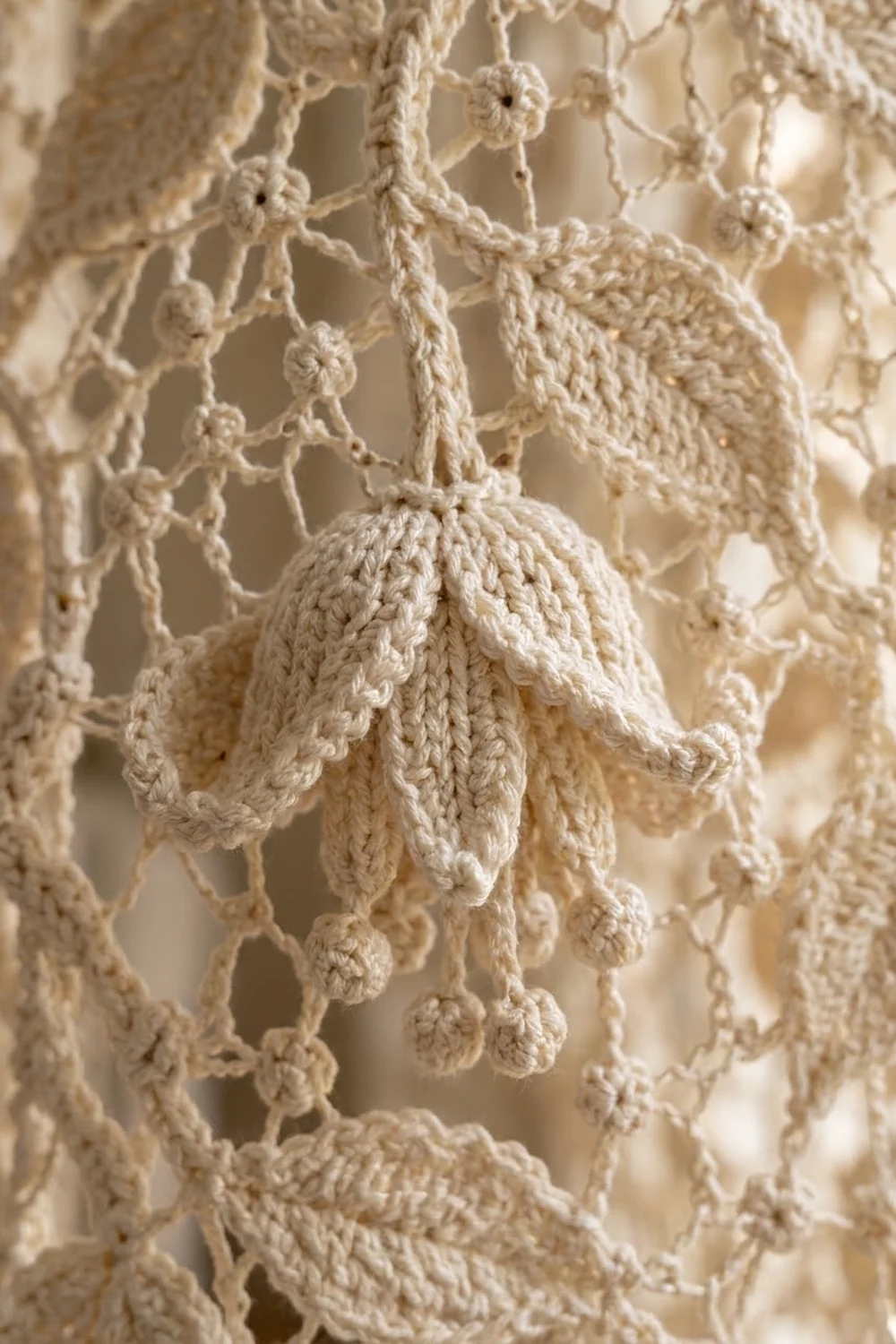
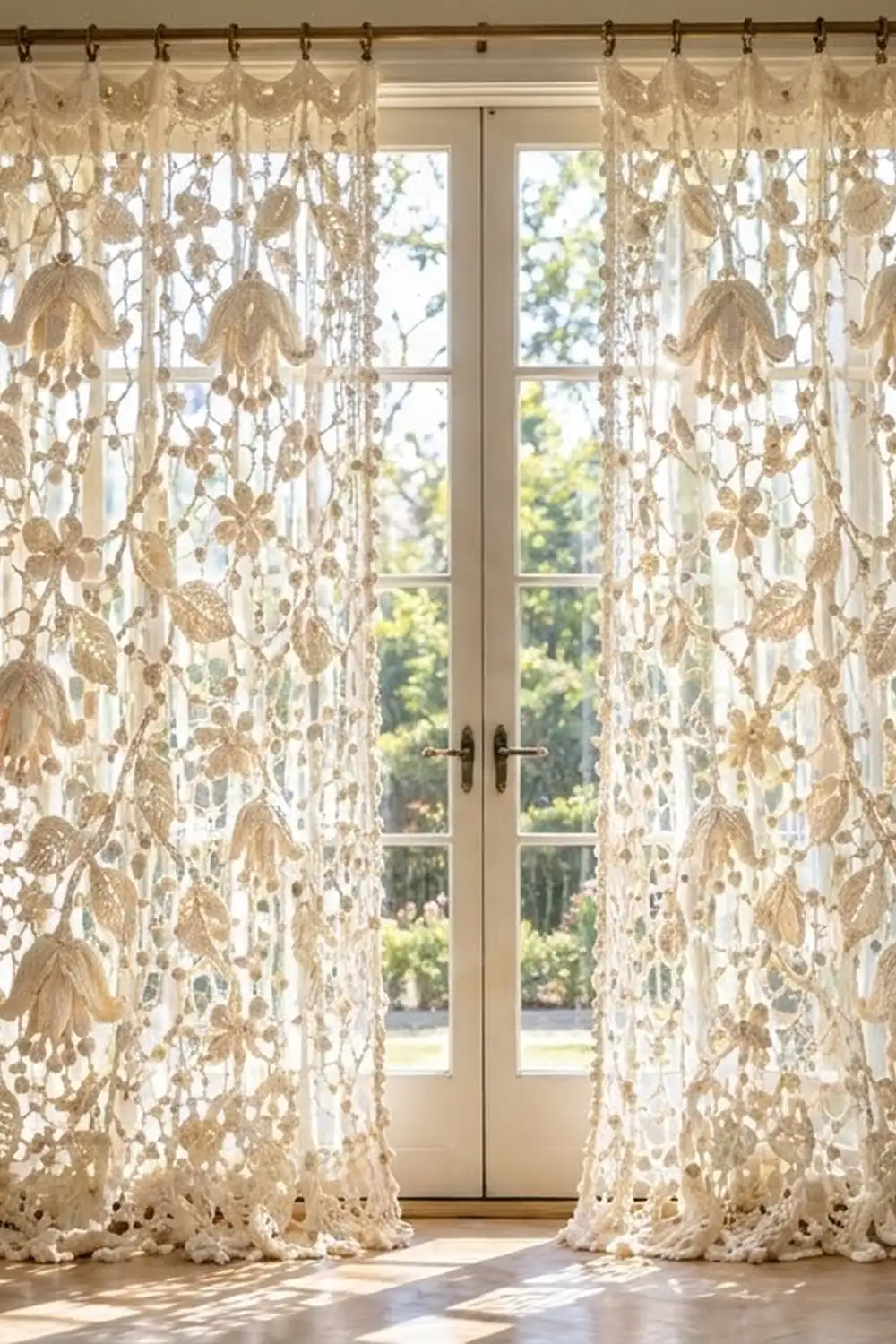
These Bellflower Lace curtain panels bring the feel of vintage Irish crochet to a sunny window. Each panel is an open cream mesh with tiny bobble nodes. Raised bellflowers with dangling bobble stamens, veined leaves on chain-cord stems, and small five-petal flowers are sewn on top.
The whole piece uses one soft cream. Light through the mesh and shadows from the raised motifs supply all the contrast. The style is romantic cottage lace, but the build is modular and fully measured.
This pattern uses US crochet terms. One finished panel measures 51 in x 83 in (129.5 cm x 210.8 cm) after blocking, and the pattern makes a matching pair.
For each panel, you crochet 60 square mesh blocks in rows and edge each one with a round of single crochet. Then you sew a bellflower, two leaves, and a stem onto each block. You join the blocks 6 wide by 10 tall, add small flowers at the seam crossings, and finish with a three-round border of dangling bobble picots.
Finished Size and Construction
- Finished panel size: 51 in x 83 in (129.5 cm x 210.8 cm); make 2 panels
- Skill level: Intermediate
- Terminology: US crochet terms
- Yarn weight: Sport (#2) mercerized cotton
- Hook: 3.25 mm (US D/3)
- Number of pieces: 60 mesh blocks per panel, plus appliqués
- Layout: 6 blocks wide x 10 blocks tall
- Block size: 8 in x 8 in (20.3 cm x 20.3 cm), edged
- Size before border: 48 in x 80 in (121.9 cm x 203.2 cm)
- Border depth: 1.5 in (3.8 cm) on all sides
Materials
Choose a smooth, mercerized sport-weight cotton. It keeps the bobbles crisp and the petals ridged, and it hangs without stretching. Avoid fuzzy blends, which blur the mesh.
- Cream: 750 g / about 2,250 m per panel; 1,500 g / about 4,500 m for the pair (based on 50 g = 150 m skeins)
These quantities include a margin of about 15%.
Tools: 3.25 mm (US D/3) hook, tapestry needle, rust-proof pins, stitch markers, blocking mats, spray bottle, tape measure, and 7 curtain clip rings per panel.
Abbreviations (US Terms)
- ch – chain
- sl st – slip stitch
- sc – single crochet
- hdc – half double crochet
- dc – double crochet
- sk – skip
- sp – space
- BLO – back loop only
- RS – right side
Special stitches:
- Bobble: [Yo, insert hook in stitch, yo and pull up a loop, yo and draw through 2 loops] 4 times in the same stitch, then yo and draw through all 5 loops. Counts as 1 stitch.
- Bobble picot (bp): Ch 4, then work a bobble in the 4th ch from the hook.
Gauge and Checkpoints
Mesh gauge: 2 mesh cells and 2 rows = 1 in (2.5 cm). One cell is (dc, ch 2), about 0.5 in (1.3 cm) square.
Make, edge, and block one complete block before starting the rest. Check it at each stage:
- After Row 4: 7.5 in (19.1 cm) wide and 2 in (5.1 cm) tall.
- After Row 15: 7.5 in x 7.5 in (19.1 cm x 19.1 cm).
- After edging: 8 in x 8 in (20.3 cm x 20.3 cm).
- Motifs: a petal is 2 in (5.1 cm) long and a leaf is 2.75 in (7.0 cm) long.
If your block is too big, go down 0.25 mm in hook size. If it is too small, go up 0.25 mm. An error of 0.25 in (0.6 cm) per block grows to 1.5 in (3.8 cm) across the panel width.
Mesh Block (Make 60 per Panel)
Foundation: Ch 50.
Row 1 (RS): Dc in the 8th ch from the hook (the skipped chs count as a dc, a ch-2, and 2 skipped chs). *Ch 2, sk 2 ch, dc in next ch; rep from * 13 more times. (16 posts, 15 ch-2 sps)
Row 2: Ch 5 (counts as dc + ch 2), turn. Dc in next dc, [ch 2, dc in next dc] 13 times, ch 2, dc in 3rd ch of beg ch-7. (16 posts, 15 sps)
Rows 3–15: Ch 5, turn. Dc in next dc, [ch 2, dc in next dc] 13 times, ch 2, dc in 3rd ch of turning ch-5. (16 posts, 15 sps)
Bobble nodes: On Rows 2, 5, 8, 11, and 14, work a bobble instead of a dc on posts 4, 7, 10, and 13 (the turning ch is post 1). The count stays at 16 posts. Push each bobble to the RS. This gives a symmetrical grid of 4 x 5 nodes.
Edging round (RS): Ch 1, do not turn. Work 3 sc in the last dc made for the corner, then:
- Top: Work 2 sc in each ch-2 sp and 1 sc in each of the 14 middle posts. Work 3 sc in the turning-ch post for the corner. (44 sc between corner centers)
- Side: Work 2 sc over the end of Row 15 and 3 sc over the end of each of Rows 14 to 1. Work 3 sc in the base of the end post for the corner. (44 sc)
- Bottom: Working in the free loops of the foundation ch, work 2 sc in each ch-2 sp and 1 sc at the base of each of the 14 middle posts. Work 3 sc at the base of the last post for the corner. (44 sc)
- Second side: Work 3 sc over the end of each of Rows 1 to 14 and 2 sc over the end of Row 15. (44 sc)
Join with a sl st to the first sc and fasten off. The round has 4 x 44 + 4 corners x 3 = 188 sc. Each side has 48 stitches, including both corner center stitches.
Bellflower Appliqué (Make 60 per Panel)
Petal (make 3 per flower): Ch 12.
Rnd 1: Sc in 2nd ch from hook, hdc in next ch, dc in next 7 ch, hdc in next ch. In the last ch, work (sc, ch 2, sc) for the tip. Then work along the free loops on the other side: hdc in next ch, dc in next 7 ch, hdc in next ch, sc in last ch. Join. (22 sts + ch-2 tip)
Rnd 2: Ch 1. Working in BLO, sc in each st around, with (sc, ch 2, sc) in the tip sp. Join. (24 sc + ch-2 tip) Fasten off, leaving a 10 in (25.4 cm) tail.
The dc stitches give the ribbed texture, and the BLO round raises a ridge around each petal.
Stamens: Join yarn at the base of one petal. *Ch the number given, bp, then sl st in each remaining ch back to the base; rep from * using ch 8, 10, 12, 10, and 8. (5 stamens; the longest hangs about 1.5 in / 3.8 cm) Fasten off.
Stem: Ch 26. Sl st in 2nd ch from hook and in each ch back. (25 sl st, about 4 in / 10.2 cm long) Leave a long tail.
Assembly: Lay two petals side by side with the tips pointing down and angled outward. Center the petal with the stamens on top so it overlaps half of each side petal. Stitch the three bases together. Steam the two outer tips so they curl outward and form the flared bell.
Leaf Appliqué (Make 120 per Panel)
Ch 15.
Rnd 1: Sc in 2nd ch from hook, hdc in next ch, dc in next 10 ch, hdc in next ch. In the last ch, work (sc, ch 2, sc) for the tip. Then work along the free loops on the other side: hdc in next ch, dc in next 10 ch, hdc in next ch, sc in last ch. Join. (26 sts + ch-2 tip)
Rnd 2: Ch 1. Sc in BLO around, with (sc, ch 2, sc) in the tip. Join. (28 sc + ch-2 tip)
Vein: Surface sl st up the center from the base, stopping 0.25 in (0.6 cm) short of the tip. Leave a tail.
Small Flower (Make 45 per Panel)
Rnd 1: Magic ring, ch 1, 5 sc in the ring. Join. (5 sc)
Rnd 2: In each sc, work (ch 2, 3 dc, ch 2, sl st). (5 petals) The flower is about 1.25 in (3.2 cm) across.
Sew Appliqués to the Blocks
Pin the stem in an S-curve from an upper corner of the block to its center. Tuck the bellflower bases under the end of the stem, then add one leaf on each side of the stem. Sew through the back of each appliqué only, and leave the stamens free.
Make All Pieces
For each panel, in cream, make 60 blocks, 60 bellflowers (180 petals), 120 leaves, and 45 small flowers. Make the same again for the second panel.
In the layout below, B is a block with a standard stem and M is a block with a mirrored stem:
Row 1:  B M B M B M
Row 2:  M B M B M B
Row 3:  B M B M B M
Row 4:  M B M B M B
Row 5:  B M B M B M
Row 6:  M B M B M B
Row 7:  B M B M B M
Row 8:  M B M B M B
Row 9:  B M B M B M
Row 10: M B M B M B
The checkerboard of stem directions creates the staggered, trailing-vine look.
Joining
Hold two blocks with RS together. Starting at a corner center stitch, sl st through both loops of both blocks across all 48 matching stitches, ending at the opposite corner center. That is one sl st per stitch pair, so no stitches are added.
Join the blocks into 10 strips of 6, then join the strips together. Match the corner centers at every crossing. Keep the sl sts as loose as the edging, and go up one hook size if the seams pucker.
Checkpoint: The joined panel measures 48 in x 80 in (121.9 cm x 203.2 cm). Each short edge has 6 x 48 = 288 stitches, and each long edge has 10 x 48 = 480 stitches.
Sew a small flower over each of the 45 interior crossings (5 x 9).
Border
Border gauge: 6 sc = 1 in (2.5 cm), matching the block edging (288 sts over 48 in).
Rnd 1 (RS): Join at an outer corner stitch. Sc in each st around, working (sc, ch 2, sc) in each of the 4 outer corner stitches. (288 sc per short side, 480 sc per long side; 1,536 sc + 4 corner ch-2 sps in total)
Rnd 2: Sl st into the corner sp. Ch 6 (counts as dc + ch 3), then dc in the same sp. *[Ch 2, sk 2 sc, dc in next sc] 96 times on a short side or 160 times on a long side. Ch 2, then work (dc, ch 3, dc) in the corner sp. Rep from * around, omitting the last corner. Join to the 3rd ch of the beg ch-6. (97 ch-2 sps per short side, 161 per long side, and 4 corner ch-3 sps)
Rnd 3: Sl st into the corner sp. Ch 1, then work (sc, bp, sc) in the corner sp. *2 sc in the next ch-2 sp, (sc, bp, sc) in the next ch-2 sp; rep from * to the last sp before the corner. Work 2 sc in that sp, then (sc, bp, sc) in the corner sp. Continue the same way around. Join and fasten off. (48 bp per short side, 80 bp per long side, plus 4 corner bp = 260 bp)
Why the math works: 288 and 480 both divide by 3, so each Rnd 2 repeat lands exactly at the corner. Each side has an odd number of spaces (97 or 161), so every side starts and ends with a plain space beside the corner bp. That spaces the bobbles evenly, about 1 in (2.5 cm) apart.
Depth check: Rnd 1 adds 0.25 in (0.6 cm), Rnd 2 adds 0.5 in (1.3 cm), and Rnd 3 adds 0.75 in (1.9 cm). That makes 1.5 in (3.8 cm) per side.
Final Blocking
- Soak the panel in cool water for 15 minutes, then press out the water without wringing.
- Roll it in towels to remove excess moisture.
- Pin it RS up to 51 in x 83 in (129.5 cm x 210.8 cm), pinning every block corner so the seams run straight.
- Open the mesh cells and fluff the bobble nodes.
- Curl the outer petal tips outward and point the leaves. Let the stamens and border bobbles hang free.
- Leave it to dry completely for 24–48 hours.
Final Quality-Control Checklist
- Each block is 8 in (20.3 cm) square, with 48 sts per side.
- The panel is 51 in x 83 in (129.5 cm x 210.8 cm).
- Seams lie flat at every crossing.
- Every bellflower has 3 petals and 5 stamens.
- Stem directions follow the checkerboard.
- The border has 260 bobble picots.
- All ends are woven into solid stitches.
Troubleshooting
- Mesh slants: Your last dc is going into the wrong turning-chain stitch. Count 16 posts in every row.
- Edging ruffles or cups: Recount to 44 sc between corners, then adjust your hook size for the edging only.
- Petals curl inward: Steam them and pin the tips outward while they dry.
- Flat bobbles: Close all 5 loops in one pull and push each bobble to the RS.
- Panels differ in length: Block both panels to 83 in (210.8 cm) together.
Care
Hand wash in cool water with a mild detergent and dry flat, reshaping the motifs. Never hang the panels wet, because the weight of the wet cotton stretches the mesh.
Final Notes
The measurements build in a simple chain. At 2 cells = 1 in (2.5 cm), 15 cells make a 7.5 in (19.1 cm) mesh, and the edging brings each block to 8 in (20.3 cm). Six blocks across give 48 in (121.9 cm), and ten blocks down give 80 in (203.2 cm). A 1.5 in (3.8 cm) border then finishes each panel at 51 in x 83 in (129.5 cm x 210.8 cm). Clip 7 rings along the top edge, one at each seam and one at each corner, and hang the pair.
Happy crocheting!