

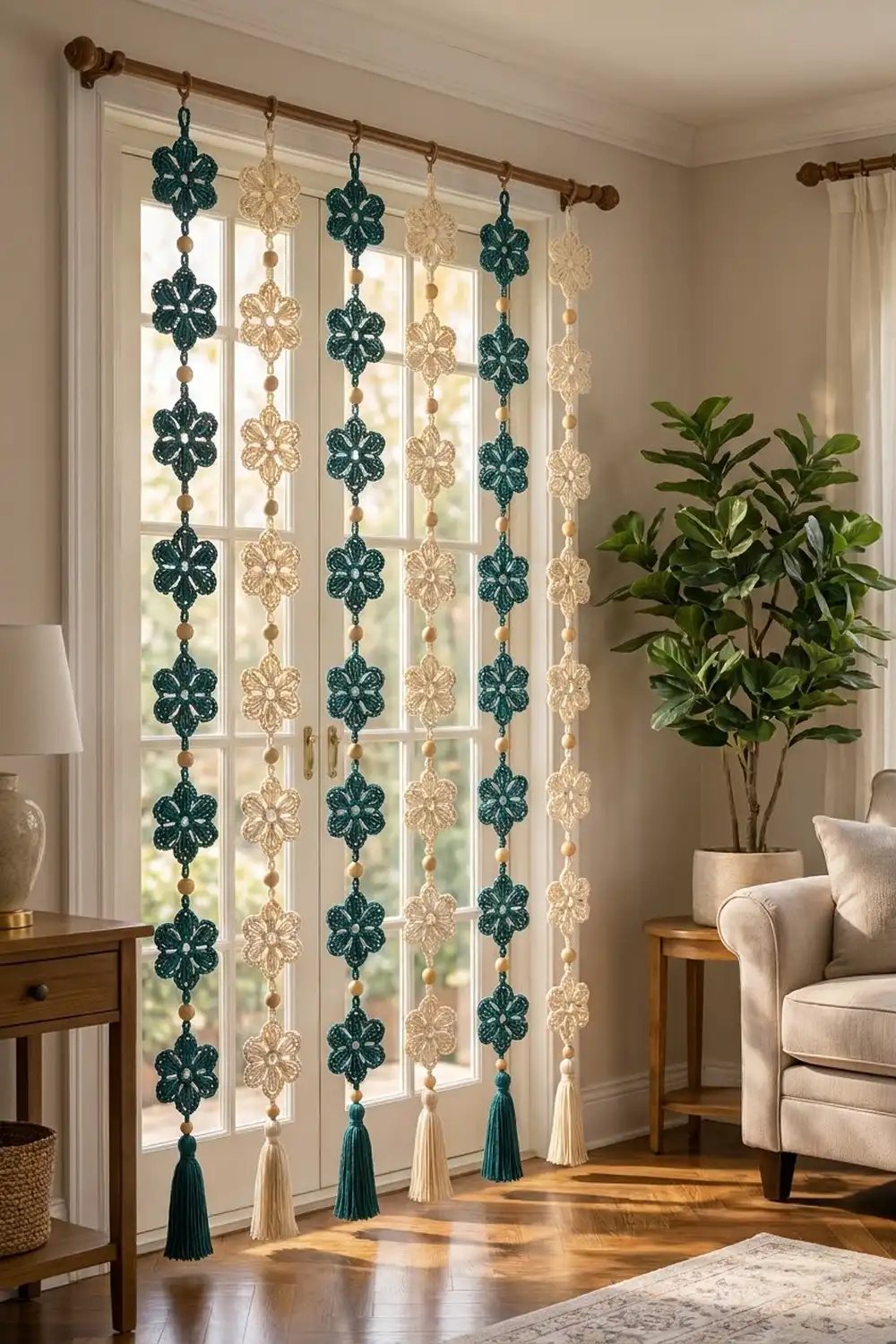
The Bloom Cascade curtain is a row of hanging flower strands that softens a doorway or window without blocking the light. Every strand is a column of open six-petal flowers. Short chain links join the flowers, each link holds a natural wooden bead, and each strand ends with a full tassel.
This version alternates deep teal and cream strands, and the light wood beads tie the two colors together. The style is boho with a clean finish. You can still see out through the strands, and they swing gently as you walk through.
The pattern uses US crochet terms. The finished curtain is 8 strands wide and covers about 46 in (116.8 cm) of rod. Each strand hangs about 73 in (185.4 cm) from the rod to the tassel tip.
To build it, you make 96 identical flower motifs and finish each one with an edging round that adds two small loops. Then you link the motifs into strands with beaded chains, add the tassels, block, and hang.
Finished Size and Construction
- Finished curtain: 8 strands across 46 in (116.8 cm); each strand 73 in (185.4 cm) long
- Skill level: Easy-intermediate
- Terminology: US
- Yarn weight: Worsted (#4) cotton or cotton blend
- Hook: 5 mm (H-8)
- Number of pieces: 96 flower motifs (48 teal, 48 cream), 96 beads, 8 tassels
- Layout: 8 strands × 12 motifs, colors alternating by strand
- Piece size: 4 in (10.2 cm) from petal tip to petal tip
- Size before edging round: 3.75 in (9.5 cm)
- Edging depth: 0.25 in (0.6 cm) added on each side
Materials
Choose a smooth, firmly twisted worsted cotton. Cotton holds the petal shapes, does not stretch much when it hangs, and shows the stitch definition. Avoid very fuzzy yarns, because they blur the open gap between each petal and its outline.
- Teal: about 450 g / 700 m (765 yd), for example nine 50 g balls of 80 m
- Cream: about 450 g / 700 m (765 yd), the same amount as teal
Each motif uses about 11 m (12 yd), or roughly 7 g. The quantities include about a 15% margin for gauge differences, swatching, and tassels.
Tools:
– 5 mm (H-8) crochet hook
– 96 round wooden beads, 12 mm, with holes of at least 4 mm
– Tapestry needle
– A firm card 5.5 in (14.0 cm) tall for the tassels
– Sharp scissors, rust-proof pins, a blocking mat, and a spray bottle
– A curtain rod up to 1 in (2.5 cm) in diameter
Abbreviations (US Terms)
- ch – chain
- sl st – slip stitch
- sc – single crochet
- tr – treble crochet (yarn over twice, insert hook, pull up a loop, [yarn over, pull through 2 loops] 3 times)
- st(s) – stitch(es)
- sp – space
- rep – repeat
Special stitch – Bead Chain (bch): Slide one pre-strung bead up against the hook. Yarn over beyond the bead and pull through the loop on the hook. The bead is now locked inside that chain.
Gauge and Checkpoints
Base gauge: 15 sc × 16 rows = 4 in (10.2 cm) with a 5 mm hook.
The motif itself is the real gauge, so make one complete flower before you start the main production run. Check it at each of these stages:
- After Round 1: the ring measures 1.25 in (3.2 cm) across.
- After Round 2: the petal fans measure 3 in (7.6 cm) from tip to opposite tip.
- After Round 3: the chain outline measures 3.75 in (9.5 cm) from tip to tip.
- After Round 4: the finished motif measures 4 in (10.2 cm) from tip to tip.
A difference of 0.25 in (0.6 cm) either way is fine.
If the motif is too big: go down to a 4.5 mm hook and check that your treble stitches are not loose at the top.
If the motif is too small: go up to a 5.5 mm hook.
Each 0.25 in (0.6 cm) of motif size changes the length of a 12-motif strand by 3 in (7.6 cm), so getting the gauge right matters.
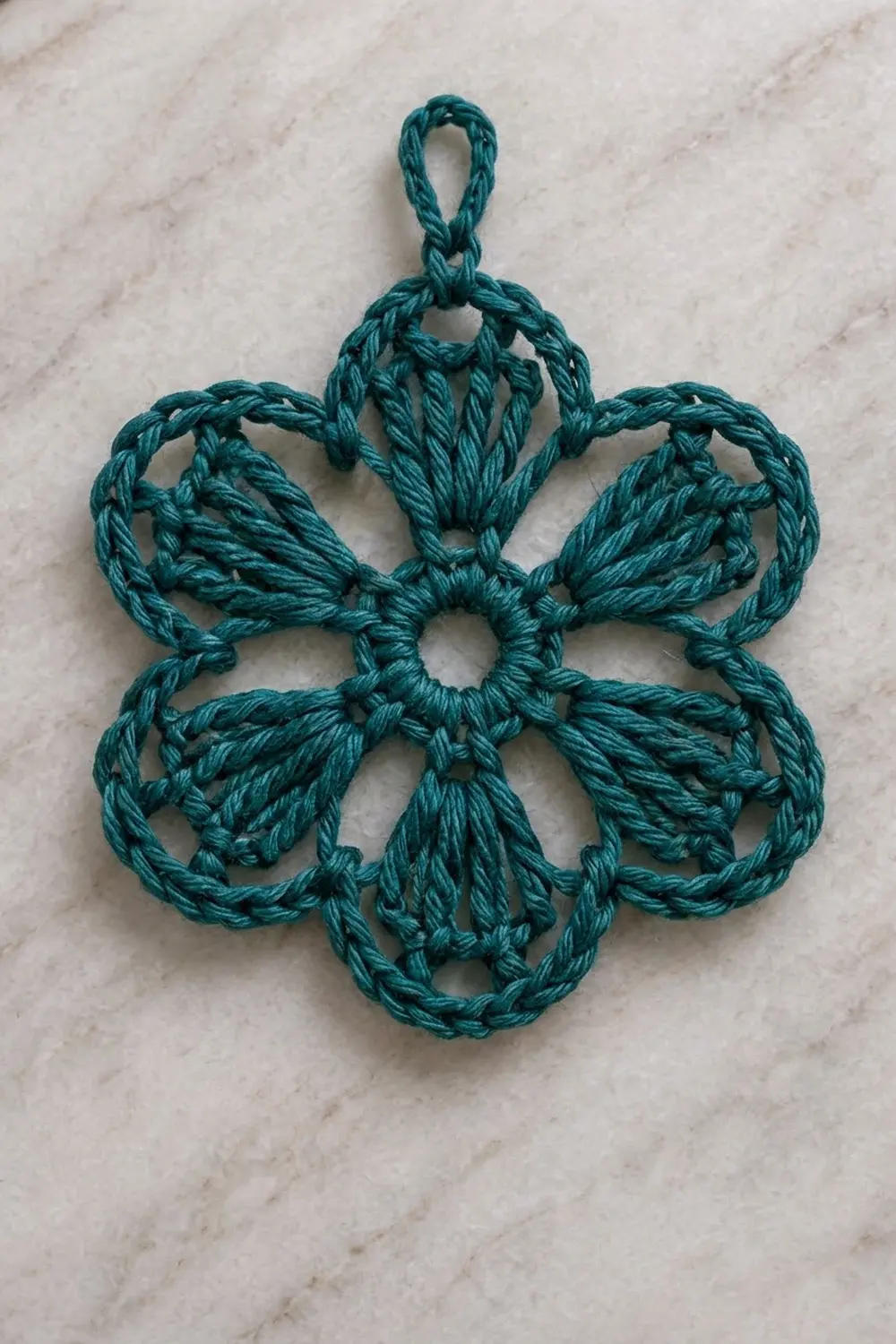
Flower Motif (Make 96)
Round 1 – Center Ring
Ch 8 and join with a sl st to the first ch to form a ring.
Ch 1 (this does not count as a stitch). Work 12 sc into the ring, then join with a sl st to the first sc.
Count: 12 sc. Pack the stitches closely so the ring looks thick and corded.
Round 2 – Petal Fans
Ch 1. Sc in the first st, then work 7 tr in the next st.
Sc in the next st, 7 tr in the next st. Rep from * 4 more times. Join with a sl st to the first sc.
Count: 48 sts (6 sc + 42 tr), forming 6 fans.
Because all 7 treble stitches share one base stitch, each fan is narrow at the center and opens wide at the tip, which gives the leaf-shaped petal. The single sc between fans keeps each petal separate.
Round 3 – Petal Outline
Ch 1. Sc in the first sc (between petals), ch 6, sc in the 4th (center) tr of the next fan, ch 6.
Sc in the next sc between petals, ch 6, sc in the center tr of the next fan, ch 6. Rep from * 4 more times. Join with a sl st to the first sc.
Count: 12 sc + 12 ch-6 sps (2 sc and 2 ch-6 sps per petal).
The ch-6 arcs are longer than the edge of the fan underneath them. That extra length makes each arc curve outward and leaves the open gap between the petal and its outline.
From here on, the sc on top of each center tr is called the tip sc. The sc between petals is called the valley sc.
Edging Round (Round 4)
Round 4 is the motif’s finishing edge. It covers the chain arcs with sc to make the thick, rope-like outline, and it adds the two linking loops.
Edging gauge: 7 sc fill one ch-6 sp so the edge lies flat. With fewer stitches the edge pulls in, and with more it ruffles.
Petal 1 points to the top of the strand, and Petal 4 points to the bottom.
Ch 1. Then work each petal as follows.
- Petal 1: Sc in the valley sc, 7 sc in the ch-6 sp, and sc in the tip sc. Make the top loop: ch 4, then sl st into the same tip sc. Work 7 sc in the next ch-6 sp.
- Petals 2 and 3: Sc in the valley sc, 7 sc in the ch-6 sp, sc in the tip sc, 7 sc in the next ch-6 sp. Rep from * once more.
- Petal 4: Sc in the valley sc, 7 sc in the ch-6 sp, and sc in the tip sc. Make the bottom loop: ch 4, then sl st into the same tip sc. Work 7 sc in the next ch-6 sp.
- Petals 5 and 6: Work the same as Petals 2 and 3.
Join with a sl st to the first sc and fasten off. Weave in the ends through the sc edge.
Count: (1 sc in each of the 12 existing sc = 12) + (7 sc in each of the 12 ch-6 sps = 84) = 96 sc, plus 2 ch-4 loops.
That works out to 16 sc per petal (1 + 7 + 1 + 7), and 16 × 6 = 96.
Why the math works: a ch-6 arc measures about 1.5 in (3.8 cm) along its inner curve. The outer edge of the finished sc is a little longer, and 7 sc at this gauge cover about 1.85 in. That small extra length lets the round curve smoothly around the petal instead of cupping it. The 0.25 in (0.6 cm) of sc height on every side brings the 3.75 in (9.5 cm) outline up to exactly 4 in (10.2 cm).
Top motif of each strand (8 motifs: 4 teal, 4 cream): for the top loop, ch 16 instead of ch 4. This makes a 2 in (5.1 cm) hanging loop that fits a rod up to 1 in (2.5 cm) in diameter.
Make All Pieces
- Teal: 48 motifs (44 standard + 4 with a long top loop)
- Cream: 48 motifs (44 standard + 4 with a long top loop)
- Tassels: 4 teal and 4 cream
- Beads: 96 (12 per strand)
Layout grid (T = teal strand, C = cream strand; each column is one strand of 12 motifs):
Strand:  1  2  3  4  5  6  7  8
Row 1:   T  C  T  C  T  C  T  C   <- long hanging loops
Row 2:   T  C  T  C  T  C  T  C
 ...     (rows 3-11 repeat)
Row 12:  T  C  T  C  T  C  T  C
Bead + tassel under each strand
Block all motifs flat before you link them (see Final Blocking). It is much easier to pin a loose flower than one that is already part of a strand.
Joining (Beaded Links)
Each strand is one top motif (with the long loop) followed by 11 standard motifs. The motifs are joined with 11 beaded links, and a 12th link at the bottom carries the tassel.
Making one link:
- Cut a 20 in (50.8 cm) length of the strand color and thread one bead onto it. A needle threader or folded dental floss helps.
- Leaving a 4 in (10.2 cm) tail, make a slip knot and sl st into the bottom loop of the upper motif.
- Ch 2, then work 1 bch, then ch 2.
- Sl st into the top loop of the lower motif and fasten off.
Stitch logic: each link joins exactly one bottom loop to exactly one top loop. No stitches are added to the motifs themselves, and the 96-sc edging stays the same on every flower.
Tension: work the link chains at your normal tension. Tight links pull the motifs out of line, and loose links let the beads droop sideways.
Weave each tail back into the edging of its own motif so the tails don’t show beside the bead.
Bottom link: after the last motif, work sl st in its bottom loop, ch 2, 1 bch, ch 2. Then ch 3 and sl st into the 3rd ch from the hook to make a tiny end ring. Fasten off.
Size checkpoints:
– From the tip of one motif to the tip of the next, the gap is 1.5 in (3.8 cm), so the pitch is 5.5 in (14.0 cm) from one motif’s top tip to the next motif’s top tip.
– Three linked motifs measure 15 in (38.1 cm).
– 12 linked motifs measure 64.5 in (163.8 cm) from the top tip to the bottom tip, not counting the hanging loop.
– The full strand is 2 in hanging loop + 64.5 in motifs and links + 1.5 in bottom link + 5 in tassel = 73 in (185.4 cm).
Tassels (Make 8)
- Wrap the yarn 30 times around the 5.5 in (14.0 cm) card.
- Slide a 10 in (25.4 cm) tie under the wraps at the top edge and knot it tightly.
- Cut through the wraps along the bottom edge.
- With an 18 in (45.7 cm) strand, wrap the neck 0.75 in (1.9 cm) below the top about 8 times. Knot it, then needle the ends down into the tassel.
- Trim the tassel evenly to 5 in (12.7 cm).
- Thread the top tie through the end ring of the bottom link, knot it securely, and hide the ends inside the tassel head.
Final Blocking
- Soak the motifs in cool water for 10 minutes, then press out the water in a towel. Don’t wring them.
- On the blocking mat, mark a 4 in (10.2 cm) circle.
- Pin each of the six petal tips to the circle, spacing them evenly at 60 degrees.
- Pin the center ring open to 1.25 in (3.2 cm).
- Gently open the gap between each fan and its outline with a fingertip.
- Lay the loops straight up and straight down, in line with Petals 1 and 4.
- Let everything dry completely, which takes 12 to 24 hours.
- After linking, hang each strand overnight so the links settle.
- Steam the tassels lightly and comb the strands straight with your fingers.
Final Quality-Control Checklist
- Every motif measures 4 in (10.2 cm) ± 0.25 in (0.6 cm).
- Every motif has 6 separate petals, with 7 tr in each fan.
- The edging has 16 sc per petal and 96 sc in total.
- The top and bottom loops sit on opposite petal tips (Petals 1 and 4).
- All tip-to-tip gaps measure 1.5 in (3.8 cm).
- Every strand has 12 motifs and 12 beads.
- All strands measure 73 in (185.4 cm) to within 1 in (2.5 cm).
- The tassels are 5 in (12.7 cm) and evenly trimmed.
- The colors alternate T, C, T, C across the rod.
- No tails show on the front.
Troubleshooting
Petals cup or curl: your tr stitches are too tight. Make looser yarn-overs or go up a hook size for Round 2.
Outline ruffles: check that you worked exactly 7 sc in each ch-6 sp, not 8.
Outline pulls the petal flat with no gap: your chains are too tight. Work Round 3 with a hook one size larger.
Strand twists when hanging: the loops are not on opposite tips. Check that the top loop is on Petal 1 and the bottom loop is on Petal 4.
Bead slides along the link: the bead was not locked. Rework that link with a proper bead chain.
Strands hang at different lengths: compare the gaps, then add or remove 1 ch on each side of the bead in the longer or shorter links.
Hanging loop too small for the rod: redo the top loop with ch 20.
Care
Take the curtain down and hand wash it cool, or machine wash it on a delicate cycle in a mesh bag. Lay the strands flat to dry, pin any motifs that have shifted back to 4 in (10.2 cm), and rehang once dry.
Final Notes
The whole curtain rests on one chain of measurements. A 1.25 in (3.2 cm) ring grows into 3 in (7.6 cm) fans, then a 3.75 in (9.5 cm) outline, then a 4 in (10.2 cm) finished flower. Each flower plus its 1.5 in (3.8 cm) gap gives a 5.5 in (14.0 cm) pitch. Twelve flowers make 64.5 in (163.8 cm), and with the hanging loop, the bottom link, and the 5 in (12.7 cm) tassel, each strand reaches 73 in (185.4 cm). Hang eight strands 6 in (15.2 cm) apart, center to center, and the curtain covers 46 in (116.8 cm). If you check the first motif carefully, the rest of the curtain will come out to these sizes.
Happy crocheting!