

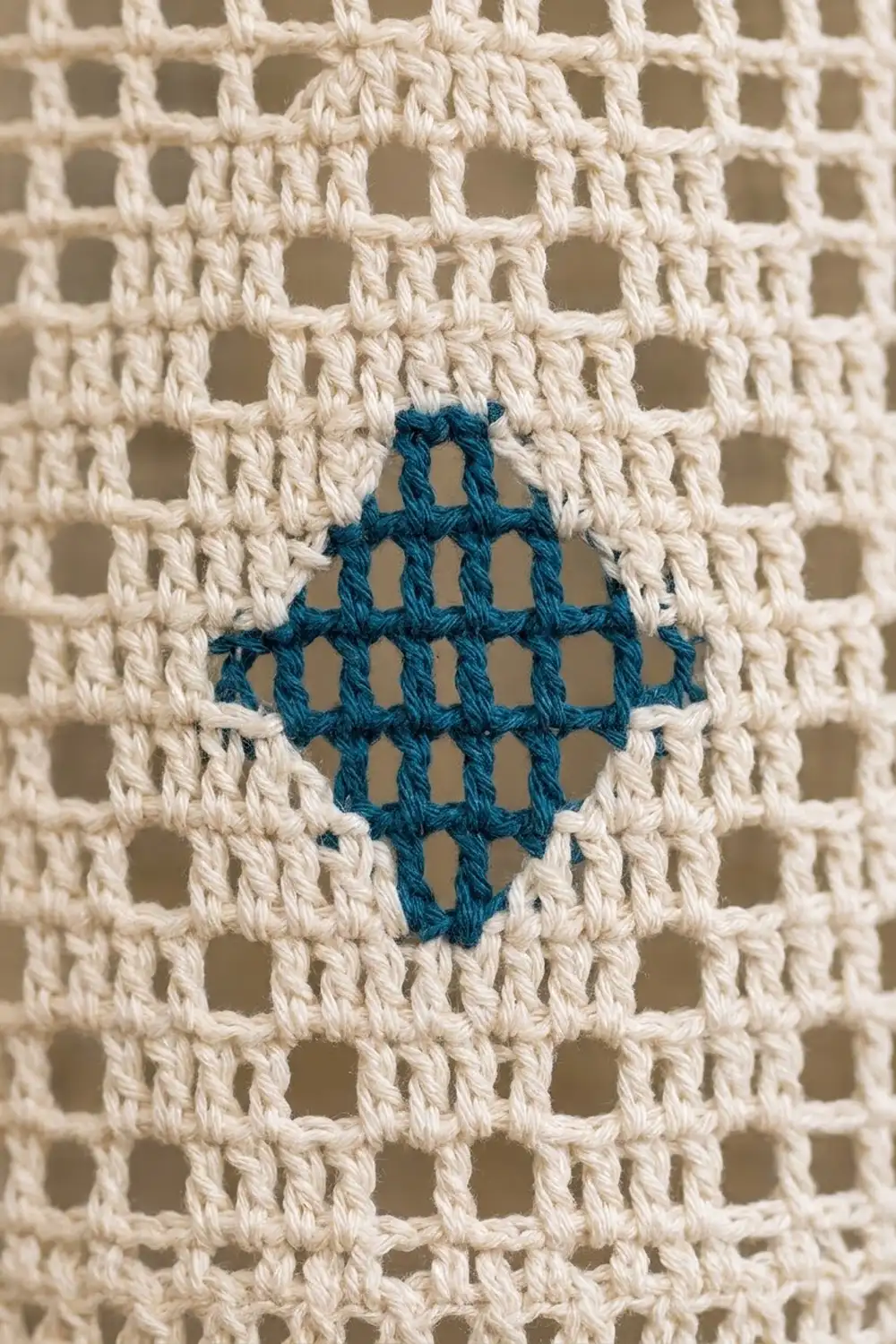
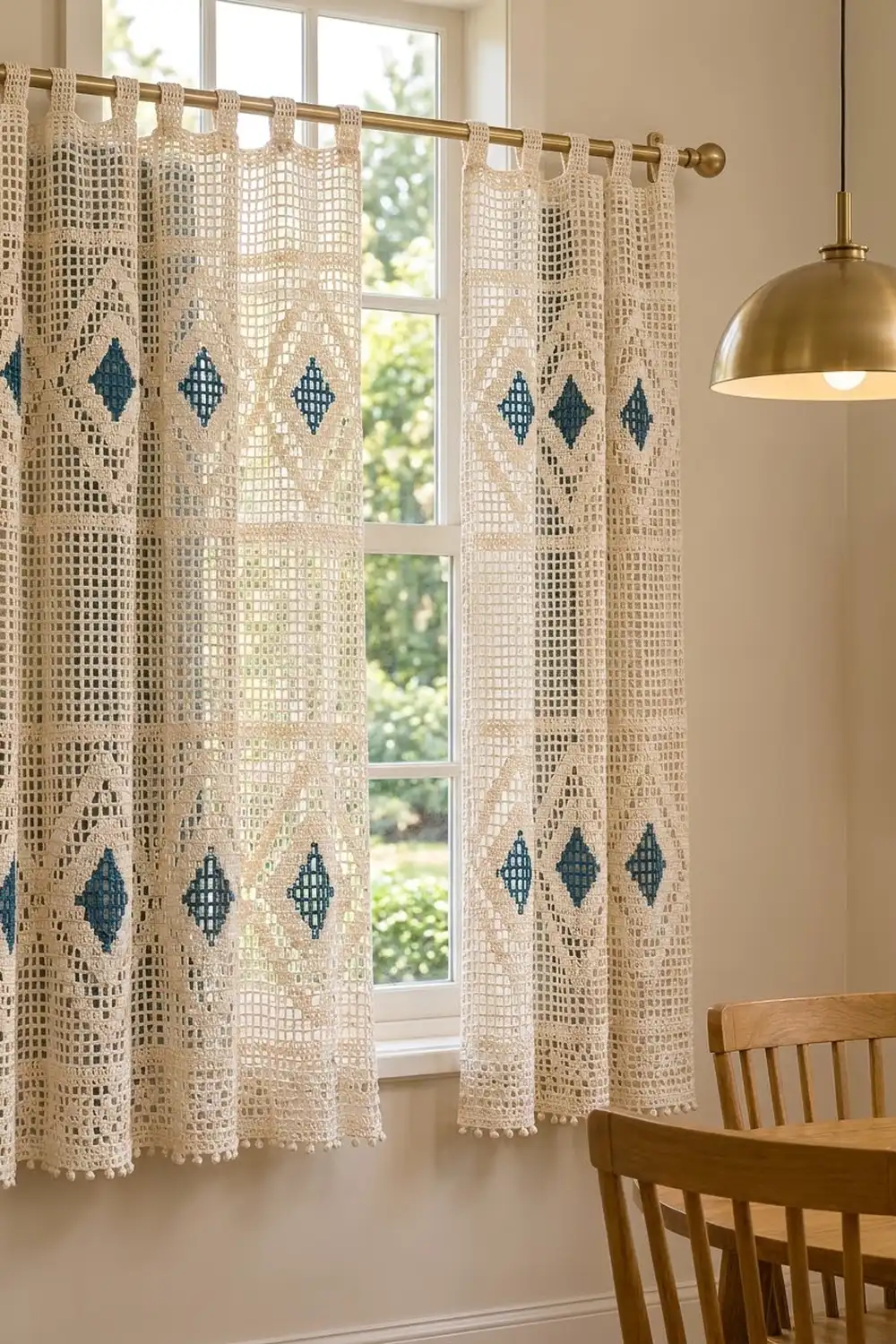
This curtain panel is worked in filet crochet: an open grid of meshes, with solid blocks that draw the design. Single-block diagonal lines form a lattice of tall cream diamonds. A small deep-blue diamond sits at the center of each one, with the cream grid still showing faintly through it. Tiny ball picots finish the bottom edge, and eight crocheted tabs hold the panel on a rod.
The colors are soft cream and deep teal-blue, in an airy cottage style that lets light through and still gives some privacy. All instructions use US crochet terms.
One panel measures 30 in (76.2 cm) wide by 48 in (121.9 cm) long before the border. After the border it is about 30.5 in (77.5 cm) by 48.5 in (123.2 cm), with 3 in (7.6 cm) tab loops on top. For a window pair, make two identical panels.
Each panel is one piece. You work it flat from the bottom up in filet rows. Then you add a single crochet border, a ball-picot edge along the bottom, and tabs worked straight off the top edge. Last, you darn the blue diamonds into meshes that were left open for them.
Finished Size and Construction
- Finished size (body): 30 in x 48 in (76.2 cm x 121.9 cm)
- Size after border: about 30.5 in x 48.5 in (77.5 cm x 123.2 cm)
- Tab loops: 3 in (7.6 cm)
- Skill level: Intermediate
- Terminology: US
- Yarn weight: DK / light (#3) cotton
- Hook: 3.5 mm (E-4)
- Number of pieces: 1 per panel (make 2 for a pair)
- Layout: 60 meshes wide x 96 rows tall; the diamond repeat is 15 meshes x 14 rows, worked 4 across x 3 up
- Piece size before border: 30 in x 48 in (76.2 cm x 121.9 cm)
- Border depth: 0.25 in (0.6 cm) on every edge, plus about 0.5 in (1.3 cm) of ball picots along the bottom
Materials
Choose a smooth, mercerized DK cotton or cotton blend. It gives crisp mesh lines and holds its shape while hanging. Avoid fuzzy or stretchy yarns, because a long panel grows under its own weight.
- Cream (main color): 300 g / about 600 m per panel (600 g / about 1,200 m for a pair)
- Deep teal-blue: 25 g / about 50 m per panel (50 g / about 100 m for a pair)
These quantities include a margin of about 15-20% for swatching and tension differences.
Tools: 3.5 mm (E-4) hook, blunt tapestry needle, at least 4 stitch markers, measuring tape, rustproof pins, a large blocking surface, and scissors.
Abbreviations (US Terms)
- ch – chain
- sc – single crochet
- dc – double crochet
- sl st – slip stitch
- sk – skip
- st(s) – stitch(es)
- sp – space
- M – mesh
- B – block
- RS / WS – right side / wrong side
Filet units: Every row starts with ch 3, which counts as the first dc (the edge post). After that come 60 units. Each unit is 3 sts wide and ends with a dc:
- Mesh (M): ch 2, sk 2 sts (or the ch-2 sp), dc in next dc.
- Block (B): dc in each of the next 2 sts (or 2 dc in the ch-2 sp), dc in next dc.
Every row has 1 + (60 x 3) = 181 sts.
Ball picot: Ch 3, then work a 3-dc bobble in the 3rd ch from hook: [yo, insert hook in ch, yo, pull up a loop, yo, draw through 2 loops] 3 times, yo, draw through all 4 loops. Ch 1 to close.
Gauge and Checkpoints
Filet gauge: 8 meshes and 8 rows = 4 in (10.2 cm). One mesh is 0.5 in (1.3 cm) wide, and one row is 0.5 in (1.3 cm) tall.
Swatch: Ch 27. Dc in the 4th ch from hook and in each ch across (25 sts, 8 B). Work 6 rows of mesh, then 1 solid row. Block the swatch lightly before you measure it.
Measure at these checkpoints as you work the panel:
- After Row 8: 30 in (76.2 cm) wide and 4 in (10.2 cm) tall.
- After Row 22: 11 in (27.9 cm) tall. One repeat is 7.5 in (19.1 cm) wide and 7 in (17.8 cm) tall.
- After Row 51: 25.5 in (64.8 cm) tall.
- After Row 96: 48 in (121.9 cm) tall.
Too big? Use a hook 0.5 mm smaller. Too small? Use a hook 0.5 mm larger. If your mesh is off by 1/8 in (0.3 cm) per 4 in, the panel width changes by about 1 in (2.5 cm). If only the height is off, keep your hook and add or remove mesh rows in Rows 52-92. Each row adds or removes 0.5 in (1.3 cm).
Panel Body
Bottom Band (Rows 1-8)
Foundation: With cream, ch 183.
Row 1 (RS): Dc in the 4th ch from hook and in each ch across. The skipped ch count as the first dc. (181 sts = 60 B)
Row 2: Ch 3 (counts as dc here and throughout), turn. Dc in each st across, ending in the top of the turning ch. (60 B)
Row 3: Ch 3, turn. Work 60 M. (61 dc + 60 ch-2 sps = 181 sts)
Row 4: Ch 3, turn. Work (1 B, 1 M) 30 times. (30 B, 30 M)
Row 5: Ch 3, turn. Work (1 B, 1 M) 30 times. Each block sits over a mesh, which makes a checkerboard. (30 B, 30 M)
Row 6: Ch 3, turn. Work 60 M.
Rows 7-8: Ch 3, turn. Work 60 B.
Checkpoint: the piece is 4 in (10.2 cm) tall.
Diamond Lattice (Rows 9-51)
Work each repeat row below 4 times across (4 x 15 = 60 units). Every row is symmetrical, so it reads the same in either direction. In the first few rows, place a marker after every 15th unit.
| Repeat row | One repeat (15 units) |
|---|---|
| 1 | 7 M, 1 B, 7 M |
| 2 | 6 M, 1 B, 1 M, 1 B, 6 M |
| 3 | 5 M, 1 B, 3 M, 1 B, 5 M |
| 4 | 4 M, 1 B, 5 M, 1 B, 4 M |
| 5 | 3 M, 1 B, 7 M, 1 B, 3 M |
| 6 | 2 M, 1 B, 9 M, 1 B, 2 M |
| 7 | 1 M, 1 B, 11 M, 1 B, 1 M |
| 8 | 1 B, 13 M, 1 B |
| 9-14 | Work repeat rows 7, 6, 5, 4, 3, 2 in that order |
Repeat row 1 has 1 B and 14 M, and every other repeat row has 2 B and 13 M. Each row still has 181 sts. On repeat row 8, the edge blocks of neighboring repeats meet and form the crossing point of the lattice.
- Rows 9-22, 23-36 and 37-50: Work repeat rows 1-14, three times.
- Row 51: Work repeat row 1 once more to close the top diamond tips.
Blue diamond meshes: Inside each diamond, leave these 13 meshes as plain cream mesh for now:
- repeat row 6: unit 8
- repeat row 7: units 7-9
- repeat row 8: units 6-10
- repeat row 9: units 7-9
- repeat row 10: unit 8
That makes 1 + 3 + 5 + 3 + 1 = 13 meshes. They fall in panel Rows 14-18, 28-32 and 42-46, giving 12 diamonds per panel.
Checkpoint: the piece is 25.5 in (64.8 cm) tall. The diamond section alone is 43 rows, or 21.5 in (54.6 cm).
Upper Field and Top Band (Rows 52-96)
Rows 52-92: Ch 3, turn. Work 60 M. (41 rows, 20.5 in / 52.1 cm)
Checkpoint after Row 92: 46 in (116.8 cm).
Rows 93-96: Ch 3, turn. Work 60 B. (181 sts per row)
This 2 in (5.1 cm) solid band anchors the tabs. Do not fasten off.
Blue Diamond Fill
Thread the tapestry needle with a 1.5 yd (1.4 m) length of blue.
- Bring the needle up from the WS at the lower left corner of the diamond’s bottom mesh.
- Pass the needle over the top ch bar and down to the WS. Come back up at the bottom bar, just right of the first strand.
- Make 5 snug vertical passes per mesh so the opening is filled.
- Carry the yarn on the WS to the next mesh, working row by row up the diamond.
- Weave the ends into the blue strands on the WS.
The cream posts and bars still show between the filled meshes, which gives the blue diamond its fine grid texture.
Border
Border gauge: 12 sc = 2 in (5.1 cm), or 6 sc per inch. That matches the filet: 3 sts per 0.5 in (1.3 cm) mesh, and 3 sc per 0.5 in (1.3 cm) dc row-end.
Rnd 1: At the end of Row 96, ch 1 and turn so the RS faces you. Work around all four edges, and ch 1 at each corner. The corner ch-1 sps are not included in the side counts below.
- Top: Sc in each st across. (181 sc) Ch 1.
- Side: Work 3 sc in each row-end. (96 x 3 = 288 sc) Ch 1.
- Bottom: Sc in each foundation ch. (181 sc) Ch 1.
- Side: Work 3 sc in each row-end. (288 sc) Ch 1.
Join with a sl st to the first sc. (938 sc + 4 corner ch-1 sps) Fasten off.
Here is why the math works. At 6 sc per inch, 181 sc is 30.2 in (76.7 cm), which matches the 30 in (76.2 cm) body with a little edge ease. The 288 side sc come to exactly 48 in (121.9 cm).
Row 2 (bottom edge only): With the RS facing, join cream in the first sc of the bottom edge. Ch 1, sc in the same sc. Then work sc in next sc, ball picot, sc in next 2 sc 60 times. (1 + (60 x 3) = 181 sc, 60 ball picots) This places one ball every 0.5 in (1.3 cm), one under each mesh column. Fasten off.
Tabs
Split the 181 top sc into 8 tabs of 13 sc and 7 gaps of 11 sc: (8 x 13) + (7 x 11) = 104 + 77 = 181. Mark the sections before you start.
Each tab: Join cream in the first sc of a tab section.
- Row 1: Ch 1, sc in the same sc and in each of the next 12 sc. (13 sc)
- Rows 2-30: Ch 1, turn, sc in each sc. (13 sc)
At 5 rows per inch, the tab is 6 in (15.2 cm) long. Fasten off and leave a 12 in (30.5 cm) tail.
Each tab is 2.2 in (5.6 cm) wide, and each gap is 1.8 in (4.6 cm). Fold each tab to the WS and whipstitch its last row to its base. This makes a 3 in (7.6 cm) loop that fits a rod up to 1.5 in (3.8 cm) in diameter.
Final Blocking
- Weave in all ends along solid blocks, never across open meshes.
- Soak the panel in cool water with gentle detergent for 15 minutes. Press the water out without wringing, then roll the panel in towels.
- Lay it RS up and pin it to 30.5 in x 48.5 in (77.5 cm x 123.2 cm).
- Use a long straightedge to line up the mesh columns so the lattice diagonals run true.
- Pin each ball picot so it points straight down.
- Let the panel dry completely, about 24 hours.
Final Quality-Control Checklist
- Every row has 181 sts, and every unit ends with a dc.
- The diamond tips line up vertically.
- All 12 blue diamonds have 13 evenly filled meshes.
- Rnd 1 counts are 181 / 288 / 181 / 288 sc.
- There are 60 evenly spaced ball picots.
- There are 8 tabs, each 13 sc wide and 30 rows long.
- The blocked size is 30.5 in x 48.5 in (77.5 cm x 123.2 cm).
- For a pair, the two panels are within 0.5 in (1.3 cm) of each other in length.
Troubleshooting
- Meshes lean: Work each mesh dc into the dc below it, not into a chain.
- Panel narrows: You are probably skipping the last dc in the turning ch. Count to 181 every few rows.
- Lattice is offset: Check your markers every 15 units.
- Blue fill puckers: The strands are too tight. Loosen them and re-block.
- Bottom edge ruffles: Redo Rnd 1 with a 3.25 mm hook.
- Panel stretches when hung: This is normal for cotton. Re-block, or work 1-2 fewer mesh rows next time.
Care
Hand wash in cool water, or machine wash on a gentle cycle in a mesh bag. Lay flat to dry and do not tumble dry.
Final Notes
One mesh is 0.5 in (1.3 cm) square. That gives 60 meshes = 30 in (76.2 cm) and 96 rows = 48 in (121.9 cm). The border adds 0.25 in (0.6 cm) on each edge, for 30.5 in x 48.5 in (77.5 cm x 123.2 cm). With the 3 in (7.6 cm) tabs and the ball picots, the panel hangs about 52 in (132.1 cm) from the top of the loops to the bottom of the picots. Confirm 4 in (10.2 cm) after Row 8 and the rest will follow.
Happy crocheting!