

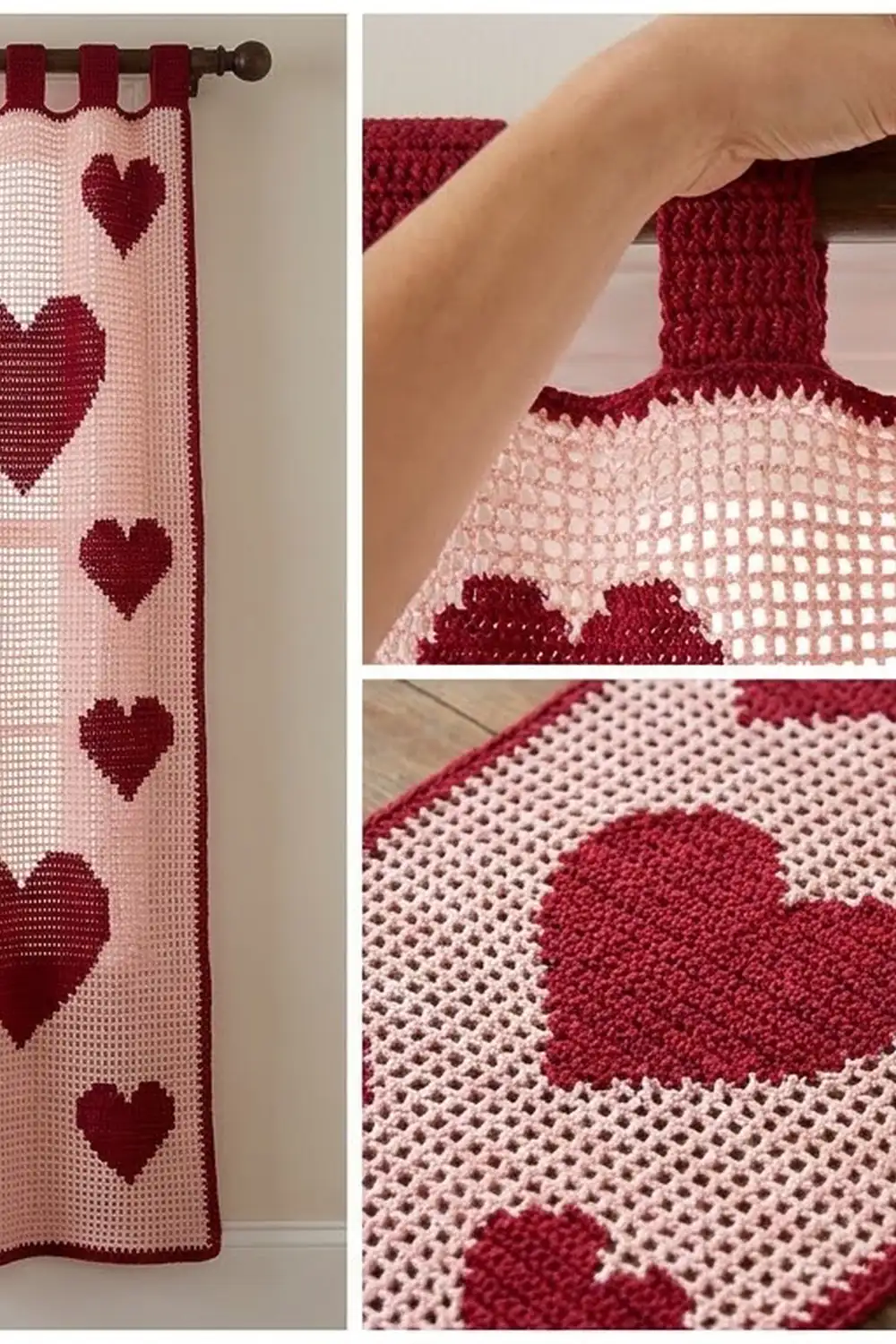
The Blush Heartline panel is a sweet, airy curtain in classic filet crochet. Large solid red hearts climb the panel in two wide columns. Narrow columns of tiny hearts and dots run between them and along both edges. The blush pink mesh lets the light through, and a deep cranberry border and tab tops frame the whole panel.
The palette is two colors: a soft blush pink for the open mesh and a rich cranberry red for the hearts, border and tabs. The style is cottage-romantic and works well for Valentine’s Day, a nursery or a cheerful kitchen window.
This pattern uses US crochet terms. The finished panel measures 22.5 in (57.2 cm) wide by 70 in (177.8 cm) long, not counting the tabs. Each tab adds a hanging loop of about 3 in (7.6 cm) above the top edge.
The panel is worked in one piece from the bottom up in filet mesh. Red blocks are added with small bobbins as you go. A three-round red border goes around all four sides, and six mesh tabs are worked straight off the top border and folded to the back. Make a second panel the same way if you want a pair.
Finished Size and Construction
- Finished size: 22.5 in × 70 in (57.2 cm × 177.8 cm), plus tabs
- Skill level: Intermediate (filet mesh, color changes, bobbins)
- Terminology: US
- Yarn weight: DK / light (#3) cotton
- Hook: 4.0 mm (G-6)
- Number of pieces: 1 (tabs are worked onto the panel)
- Layout: 5 vertical columns, 41 filet squares wide × 136 rows tall
- Panel size before border: 20.5 in × 68 in (52.1 cm × 172.7 cm)
- Border depth: 1 in (2.5 cm) on every side
Materials
Choose a smooth mercerized or combed cotton in DK weight. Cotton holds the filet squares open and crisp, and it doesn’t stretch much when it hangs. Avoid fuzzy or very soft acrylics, because they blur the hearts.
- Blush pink (MC): 400 g, about 920 m
- Cranberry red (CC): 300 g, about 690 m (hearts, border and tabs)
Quantities are for one panel and include a margin of about 10% for swatching and color changes.
Tools:
– 4.0 mm (G-6) crochet hook
– 6–8 yarn bobbins or small butterflies of CC
– Tapestry needle
– Locking stitch markers
– Tape measure
– Blocking mats or a clean sheet, rust-proof pins, spray bottle
Abbreviations (US Terms)
- ch – chain
- sc – single crochet
- dc – double crochet
- sl st – slip stitch
- sp – space
- st(s) – stitch(es)
- MC / CC – main color / contrast color
- RS / WS – right side / wrong side
Special stitches
- Open square (OS): ch 2, skip 2 sts or the ch-2 sp, dc in next dc.
- Block (B): worked in CC. Over an OS below, work 2 dc in the ch-2 sp, then dc in next dc. Over a B below, work dc in each of the next 3 sts.
- Color change: work the last dc before the change until 2 loops remain, then finish it with the new color.
Every row has 41 squares. That is 42 dc posts plus 41 two-stitch fills, so 124 sts per row.
Gauge and Checkpoints
Filet gauge: 8 squares × 8 rows = 4 in × 4 in (10.2 cm × 10.2 cm). One square is 0.5 in (1.3 cm) wide and one row is 0.5 in (1.3 cm) tall. Stitch gauge is 6 sts = 1 in (2.5 cm).
Test piece first. Chain 44 and work a swatch 13 squares wide for 12 rows, placing one large heart (repeat Rows 1–8 below, with blocks on squares 3–11 shifted to fit). It should measure 6.5 in × 6 in (16.5 cm × 15.2 cm). The swatch shows you your gauge and also lets you practice the bobbin color changes.
Checkpoints:
– After Row 4: the width is 20.5 in (52.1 cm).
– After the first full repeat (Row 16): the length is 8 in (20.3 cm).
– Each 12-row repeat adds 6 in (15.2 cm).
– After Row 136: the panel is 20.5 in × 68 in (52.1 cm × 172.7 cm).
Panel too big? Go down to a 3.75 mm hook. Too small? Go up to a 4.5 mm hook. If only the height is off, adjust your turning chain or how tall you pull up your dc, not the hook.
Panel Layout
Squares are numbered 1 to 41 across the row. The layout is symmetrical, so you can count from whichever edge you’re starting at on every row.
- Column A (edge): squares 1–5, small hearts and dots
- Column B: squares 6–18, large hearts on 8–16
- Column C (center): squares 19–23, small hearts and dots
- Column D: squares 24–36, large hearts on 26–34
- Column E (edge): squares 37–41, small hearts and dots
Squares 1 and 41 are always open, so every row starts and ends with an OS.
Panel
Foundation: With MC, ch 128.
Row 1 (RS): Dc in 8th ch from hook (counts as first OS). *Ch 2, skip 2 ch, dc in next ch; repeat from * across. Turn. You now have 41 OS (124 sts).
Rows 2–4: Ch 5 (counts as dc + ch 2), skip ch-2 sp, dc in next dc. Work OS across. Turn. Each row has 41 OS.
Heart Repeat (12 rows)
Work the 12 repeat rows 11 times in total, which makes panel Rows 5–136. Every row starts with ch 5 for the first OS. In each row, work the squares listed as blocks in CC. All other squares are OS in MC.
Bobbin method:
– Give each large heart its own CC bobbin of about 8 m, and each small heart a 1.5 m length.
– Carry MC inside the CC blocks by working over it, so one strand of MC runs the whole row.
– Leave the CC bobbins hanging on the WS between rows.
– Cut CC when a heart is finished. Use a short CC tail for each dot.
- Row 1: Blocks on 12 and 30. (2 B, 39 OS)
- Row 2: Blocks on 11–13 and 29–31. (6 B, 35 OS)
- Row 3: Blocks on 10–14 and 28–32, plus small heart tips on 3, 21 and 39. (13 B, 28 OS)
- Row 4: Blocks on 9–15 and 27–33, plus 2–4, 20–22 and 38–40. (23 B, 18 OS)
- Row 5: Blocks on 8–16 and 26–34, plus 2, 4, 20, 22, 38 and 40. (24 B, 17 OS)
- Row 6: Blocks on 8–16 and 26–34. (18 B, 23 OS)
- Row 7: Same as Row 6. (18 B, 23 OS)
- Row 8: Blocks on 9–11, 13–15, 27–29 and 31–33. These are the heart tops with a center dip. (12 B, 29 OS)
- Row 9: All OS. (41 OS)
- Row 10: Dot blocks on 3, 21 and 39. (3 B, 38 OS)
- Rows 11–12: All OS. (41 OS)
Every row has 124 sts, whatever its mix of blocks and open squares.
What the repeat produces:
– Each large heart is 9 squares wide × 8 rows tall, which is 4.5 in × 4 in (11.4 cm × 10.2 cm). It has a single-block tip at the bottom and two rounded bumps at the top.
– Each small heart is 3 × 3 squares, or 1.5 in (3.8 cm) square. The narrow columns alternate small hearts and single dots.
After repeat 11, the last 4 rows (Rows 133–136) are open mesh. This matches the 4 open rows at the bottom. Fasten off MC. Weave in all CC tails along the dc posts of their own color.
Border
Use CC throughout. Border gauge matches the panel: 6 sts = 1 in (2.5 cm), with 3 sts for each square or row-end.
Round 1 (sc): With RS facing, join CC in the top-left corner dc. Ch 1 and work 3 sc in the corner dc. Then work each edge as follows:
- Top: 2 sc in ch-2 sp, sc in next dc. Repeat across, but put 3 sc in the final corner dc instead of 1 sc. That gives 122 sc between corner groups (82 in the spaces + 40 in the inner dc).
- Sides: Work 3 sc around each row-end post, for 408 sc between corner groups (136 rows × 3). Work 3 sc in the bottom corner.
- Bottom: Work along the foundation chain the same way as the top, for 122 sc between corners.
Join with a sl st to the first sc. Total is 1,072 sts (2 × 122 + 2 × 408 + 4 corners × 3).
Round 2 (dc): Sl st into the corner center sc. Ch 3 (counts as dc) and work 2 dc in the same st. Dc in each st around, with 3 dc in each corner center sc. Join. Between corner centers there are 124 dc on the top and bottom and 410 dc on each side. Total is 1,080 sts.
Round 3 (sc): Ch 1. Sc in each st around, with 3 sc in each corner center dc. Join. Between corner centers there are 126 sc on the top and bottom and 412 sc on each side. Total is 1,088 sts. Do not fasten off if you’re going straight on to the tabs; otherwise fasten off.
Why the math works: The top edge started from 41 squares × 3 sts = 123, which became 122 between corners plus the corner. Each round adds exactly 2 sts per edge, 1 on each side of a corner center. That is 8 per round, which keeps the border flat. The sc + dc + sc rounds measure about 0.25 + 0.5 + 0.25 in (0.6 + 1.3 + 0.6 cm), so the border is 1 in (2.5 cm) deep. The finished size is 20.5 + 2 = 22.5 in (57.2 cm) by 68 + 2 = 70 in (177.8 cm).
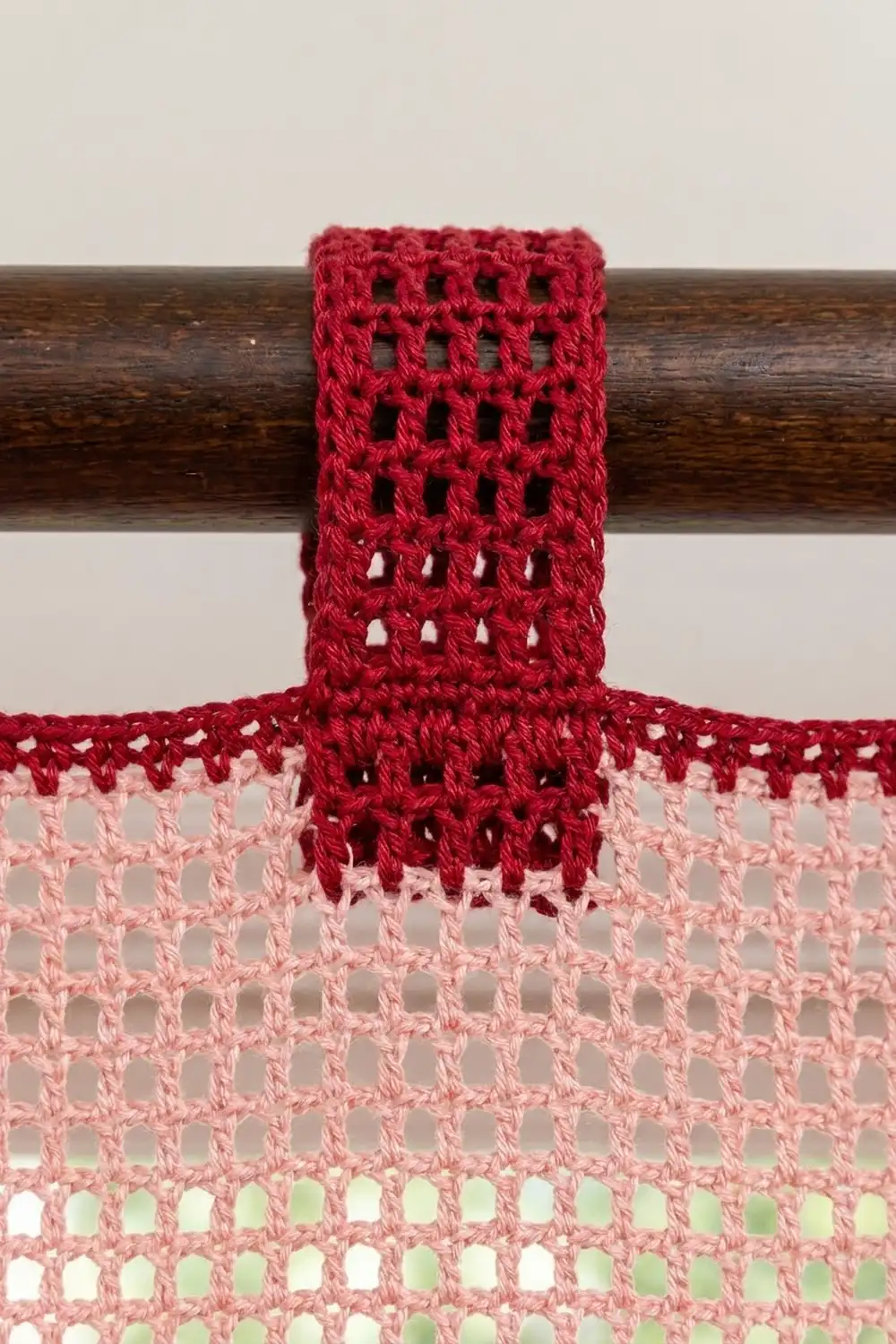
Tabs
Number the top edge sts 1 to 128 from corner center to corner center (126 + 2). The edge splits into 6 tabs of 13 sts and 5 gaps of 10 sts: 6 × 13 + 5 × 10 = 128.
- Tabs sit on sts 1–13, 24–36, 47–59, 70–82, 93–105 and 116–128.
- Mark the first and last st of each tab before you start.
For each tab, with RS facing:
– Row 1: Join CC in the first marked st. Ch 3 (counts as dc), then dc in the next 12 sts. Turn. (13 dc)
– Rows 2–11: Ch 5, skip 2, dc in next dc. Work 3 more OS. Turn. (4 OS, 13 sts)
– Row 12: Ch 3, then work 2 dc in each sp and dc in each dc. (13 dc) Fasten off, leaving a 12 in (30.5 cm) tail.
Each tab strip is 2.2 in (5.6 cm) wide and 6 in (15.2 cm) long. The gaps are about 1.7 in (4.3 cm). Fold each tab to the WS and whipstitch Row 12 to the back of border Round 2. This leaves a loop that hangs about 3 in (7.6 cm) high.
Final Blocking
- Soak the panel in cool water with a little wool or cotton wash for 15 minutes.
- Press out the water. Roll the panel in towels; don’t wring it.
- Lay it flat on mats or a sheet on the floor.
- Pin the corners to 22.5 in × 70 in (57.2 cm × 177.8 cm).
- Pin along each edge every 4 in (10.2 cm), keeping the edges straight.
- Open the mesh squares gently with your fingers so the hearts look sharp.
- Lay the tabs flat and pin each one to 2.2 in (5.6 cm) wide.
- Let it dry completely, at least 24 hours.
Final Quality-Control Checklist
- Every row has 41 squares, and the side edges are straight.
- Each large heart has 49 blocks and a centered tip.
- The small hearts and dots line up in columns A, C and E.
- No MC shows through the CC blocks.
- The border counts are 126 / 412 sts per edge on Round 3, and the corners lie flat.
- All 6 tabs are evenly spaced and sewn at the same depth.
- The blocked size is 22.5 in × 70 in (57.2 cm × 177.8 cm).
Troubleshooting
- Mesh slants to one side: Your turning chain is too loose or too tight. Ch 5 should match the height of one dc plus ch 2.
- Hearts look squashed: Your rows are short. Pull each dc up a little taller and recheck the gauge of 8 rows = 4 in (10.2 cm).
- Pink peeks through the red blocks: Hold MC snug along the top of the previous row as you work over it.
- Border ruffles: Use 2 sc per row-end on the sides instead of 3, or go down a hook size.
- Border cups: Go up a hook size for Round 2.
- Panel too long after hanging: Cotton drops a little. Block it hanging for a day, then remeasure.
Care
Hand wash cool or machine wash on a delicate cycle in a mesh bag. Reshape while damp and dry flat. If the red is new, wash it separately first so the color doesn’t bleed onto the pink.
Final Notes
Everything rests on one measurement chain: 1 square = 0.5 in (1.3 cm). From there:
- 41 squares = 20.5 in (52.1 cm) wide.
- 136 rows = 68 in (172.7 cm) long.
- A 1 in (2.5 cm) border brings the panel to 22.5 in × 70 in (57.2 cm × 177.8 cm).
- 3-inch (7.6 cm) tabs finish the top.
Check your gauge, count the 124 sts in every row, and the hearts will line up from top to bottom. Happy crocheting!