

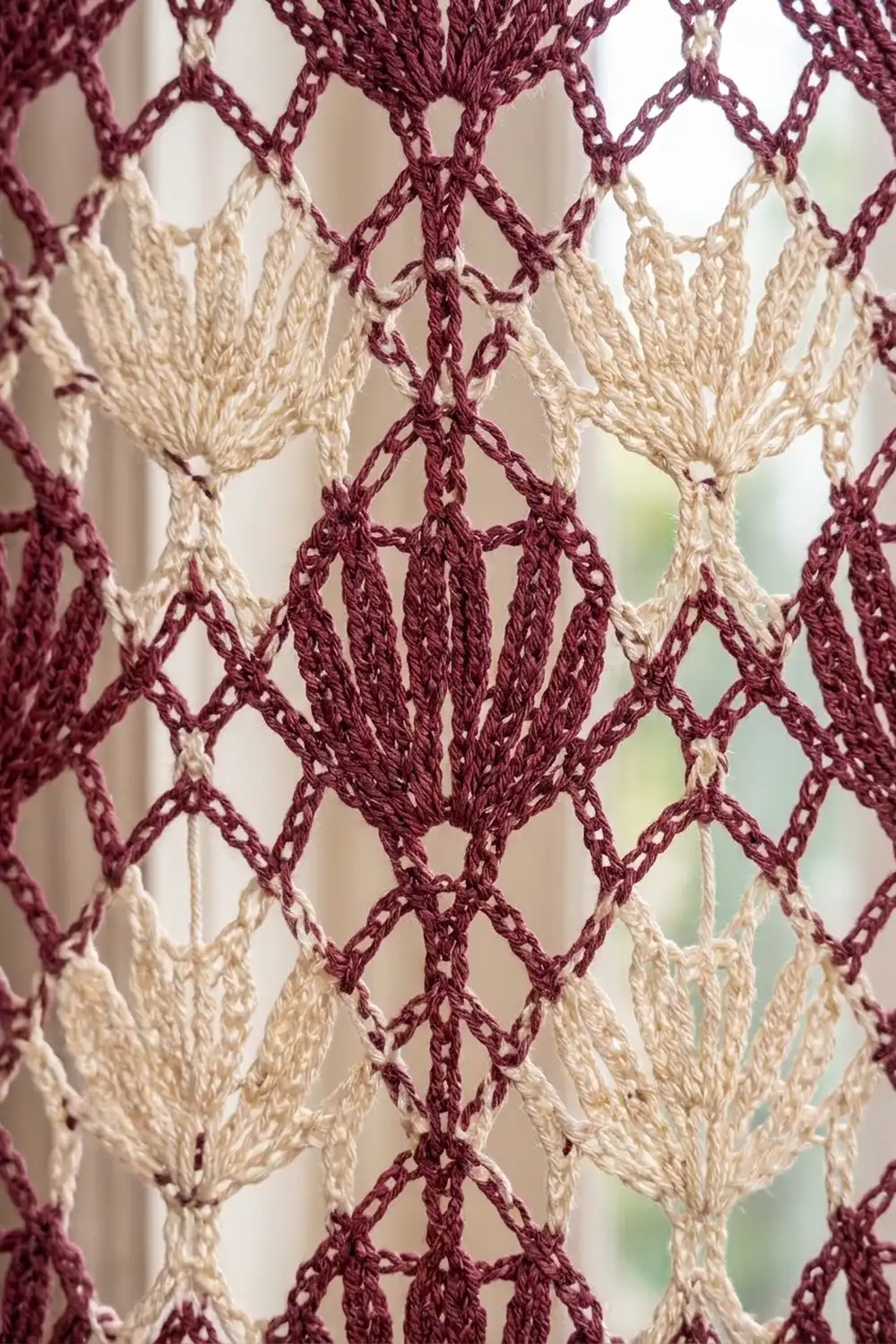
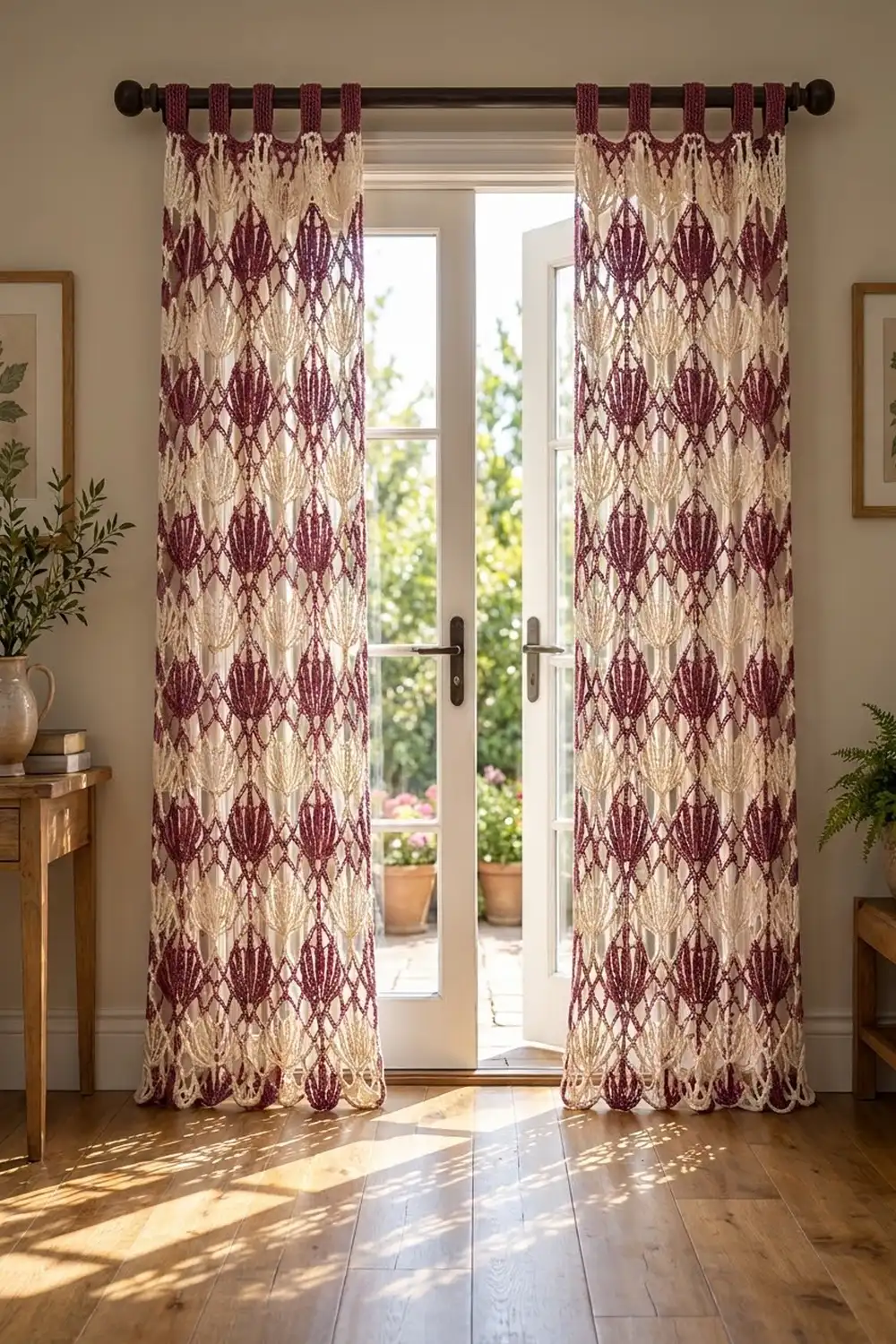
These lace curtain panels are made from an open diamond net with a ribbed fan in every diamond. The fans sit in staggered tiers that change color from deep burgundy to cream as they go up, so the panel reads as a soft checkerboard of blooms. When light comes through the window, the net looks like a lattice and the fans stand out against it.
This pattern makes a pair of two identical panels. Each one is a single piece, worked flat in rows from the bottom hem to the top. The two panels are not joined to each other. They hang side by side on one rod from seven narrow folded tabs.
All instructions use US crochet terms. Each finished panel is 36.5 in (92.7 cm) wide and 84 in (213.4 cm) long, measured from the scalloped hem to the top of the tab loops.
Here is how it’s built. You chain a foundation, work one net row, and then work 31 three-row tiers of fans. Next comes a single crochet edging round, then a solid burgundy top band with tabs, and finally a small shell scallop along the hem.
Finished Size and Construction
- Finished size (each panel): 36.5 in (92.7 cm) wide x 84 in (213.4 cm) long including tabs
- Skill level: Intermediate
- Terminology: US
- Yarn weight: DK (#3) cotton or cotton blend
- Hook: 4.0 mm (G-6)
- Number of pieces: 2 identical panels, each worked in one piece
- Layout: 2 panels hung side by side, not joined
- Piece size (lace repeat): 12 sts = 3 in (7.6 cm) wide; 1 tier = 2.5 in (6.4 cm) tall
- Size before border: 36 in (91.4 cm) x 78.5 in (199.4 cm)
- Border depth:
- Sides: 0.25 in (0.6 cm)
- Top: 1.75 in (4.4 cm), made up of the edging plus the band
- Bottom: 0.75 in (1.9 cm), made up of the edging plus the scallops
- Tabs: the tab loops stand 3 in (7.6 cm) above the band
Materials
Yarn. Choose a smooth mercerized cotton or cotton-linen blend in DK weight, about 2.3 m per gram (for example, 50 g = 115 m). Cotton holds the fan ribs crisply and resists stretching when it hangs. Avoid very soft acrylics, because long panels made with them can grow in length over time.
- Color A, Burgundy: 1,100 g (2,530 m)
- Color B, Cream: 900 g (2,070 m)
These amounts cover both panels. Each panel uses about 460 g of A and 370 g of B. The quantities include roughly a 10% margin for swatching and dye-lot safety. Buy each color from a single dye lot.
Tools
– 4.0 mm (G-6) crochet hook
– Tapestry needle
– Locking stitch markers (at least 10)
– Measuring tape
– Rust-proof pins and a flat blocking surface
– Curtain rod, up to 1.25 in (3.2 cm) in diameter
Abbreviations (US Terms)
- ch – chain
- sc – single crochet
- hdc – half double crochet
- dc – double crochet
- sk – skip
- sp(s) – space(s)
- st(s) – stitch(es)
- RS / WS – right side / wrong side
- rep – repeat
Special stitches
– Fan: 9 dc in the same stitch.
– Half fan: At the start of a row, ch 3 (counts as dc), then work 4 dc in the same st, for 5 sts. At the end of a row, work 5 dc in the last st.
– Single dc: The lone dc worked into an sc between two fans on the open-fan rows.
Gauge and Checkpoints
Test first. Ch 38 and work Row 1, then one Tier A and one Tier B, as written below. This gives 3 repeats. After a light steam, the swatch should measure 9 in (22.9 cm) wide and 6 in (15.2 cm) tall.
- Lace gauge: 12 sts (1 repeat) = 3 in (7.6 cm); 1 tier = 2.5 in (6.4 cm)
- Border gauge: 16 sc = 4 in (10.2 cm); 8 hdc rows = 3 in (7.6 cm)
If the swatch is too big, go down to a 3.75 mm hook. If it’s too small, go up to a 4.5 mm hook. Width matters most: the foundation fixes the width, while height can be adjusted by a tier.
Checkpoints (laid flat, unstretched)
– After Row 1: 36 in (91.4 cm) wide
– After Tier 2: 6 in (15.2 cm) tall
– After Tier 11: 28.5 in (72.4 cm) tall
– After Tier 21: 53.5 in (135.9 cm) tall
– After Tier 31: 78.5 in (199.4 cm) tall
Panel Pattern
The lace works over a multiple of 12 + 2 chains. Each panel uses 12 repeats.
Foundation and Net Row (Color A)
Foundation: With A, ch 146.
Row 1 (RS): Sc in 2nd ch from hook. Ch 5, sk next 5 ch, sc in next ch. Rep from * 23 more times. Turn.
(25 sc, 24 ch-5 loops.)*
Mark the RS.
Tier A (Color A): Fans Centered in Each Repeat
Row A1: Ch 1, sc in first sc. Ch 3, sk next loop, Fan in next sc, ch 3, sk next loop, sc in next sc. Rep from * 11 more times. Turn.
(12 Fans = 108 dc; 13 sc.)*
Row A2: Ch 5 (counts as dc + ch 2). [Dc in next dc, ch 1] 8 times, dc in next dc, ch 2, dc in next sc. On every rep except the last, ch 2. Rep from * 11 more times. Turn.
(121 dc, counting the turning ch: 12 open fans of 9 + 13 single dc.)*
Row A3: Ch 1, sc in first dc. Ch 5, sc in 5th (center) dc of next fan, ch 5, sc in next single dc. Rep from * 11 more times, working the final sc into the 3rd ch of the turning ch-5. Turn.
(25 sc, 24 ch-5 loops.)*
The center sc pinches each fan to a point, which closes it inside its diamond of net.
Tier B (Color B): Offset Fans with Half Fans at the Edges
Change to B on the final yarn-over of Row A3. Cut A, leaving a 6 in (15.2 cm) tail.
Row B1: Ch 3 (counts as dc), 4 dc in first sc. Ch 3, sk next loop, sc in next sc, ch 3, sk next loop, Fan in next sc. Rep from * 10 more times. Ch 3, sk next loop, sc in next sc, ch 3, sk next loop, 5 dc in last sc. Turn.
(109 dc: 2 half fans of 5 + 11 Fans of 9; 12 sc.)*
Row B2: Ch 4 (counts as dc + ch 1). [Dc in next dc, ch 1] 3 times, dc in next dc. Ch 2, dc in next sc, ch 2, [dc in next dc, ch 1] 8 times, dc in next dc. Rep from * 10 more times. Ch 2, dc in next sc, ch 2, [dc in next dc, ch 1] 4 times, working the last dc into the top of the turning ch-3. Turn.
(121 dc: 2 half fans of 5 + 11 fans of 9 + 12 single dc.)*
Row B3: Ch 1, sc in first dc. Ch 5, sc in next single dc, ch 5, sc in 5th (center) dc of next full fan. Rep from * 10 more times. Ch 5, sc in next single dc, ch 5, sc in 3rd ch of turning ch-4. Turn.
(25 sc, 24 ch-5 loops.)*
Change to A on the final yarn-over, and cut B.
Tier Sequence
Work odd-numbered tiers as Tier A in A, and even-numbered tiers as Tier B in B. Work 31 tiers in total: 16 Burgundy and 15 Cream, ending with Tier A. Fasten off.
Each tier ends on the edge opposite the one where it started, so cut and weave in the tails along the side edges. The border will cover them.
Make All Pieces
Make 2 panels exactly as written above.
- Per panel: about 460 g of A (net row, 16 tiers, border, band, tabs) and 370 g of B (15 tiers)
- Both panels: about 920 g of A and 740 g of B, before the margin
Layout (as hung, viewed from the room):
[ Panel 1 ]   [ Panel 2 ]
 7 tabs        7 tabs
 31 tiers      31 tiers
Keep the tier count and color order identical in both panels. That way the Burgundy and Cream tiers line up across the window at the same height.
Joining
The two panels are never sewn to each other. The only seams are the 7 tab folds on each panel. Sew these after you finish the Border section.
Method: Whipstitch with A, working on the WS.
Stitch-to-stitch logic: Each tab is 7 hdc wide. Fold the tab to the WS. Whipstitch the 7 sts of the last tab row to the back loops of the same 7 sts of top band Row 1. That’s one stitch to one stitch, with nothing added and nothing skipped.
Tension: Sew firmly enough that the seam doesn’t gap, but not so tight that the band puckers next to the tab.
Size checkpoint: Each folded loop stands 3 in (7.6 cm) above the band and slides easily over the rod.
Border
Border gauge: 16 sc = 4 in (10.2 cm); 8 hdc rows = 3 in (7.6 cm).
Round 1 (A, All Around)
With RS facing, join A in the top-right corner sc. Each corner is (sc, ch 2, sc) worked into the corner stitch. The side counts below are the sc between corner ch-2 spaces, and each count includes that side’s 2 corner sc.
- Top: Sc in first sc, 5 sc in each ch-5 loop, and 1 sc in each sc. That’s 24 x 5 + 25 = 145 sc.
- Left side: 4 sc in the end of Row 1. Then, in each tier, work 3 sc in the end of the fan row, 3 sc in the end of the open-fan row, and 4 sc in the end of the net row. That’s 4 + 31 x 10 = 314 sc.
- Bottom: Sc in the free loop of each foundation ch, for 145 sc.
- Right side: Work as for the left side, for 314 sc.
Sl st to the first sc and fasten off.
(918 sc + 4 corner ch-2 sps.)
Why the math works:
– Width: 145 / 4 = 36.25 in (92.1 cm), which matches the 36 in (91.4 cm) body.
– Length: 314 / 4 = 78.5 in (199.4 cm), which matches the body length exactly.
So the edging lies flat, without ruffling or drawing in.
Top Band (A, Top Edge Only)
With RS facing, join A in the first top sc.
- Row 1: Ch 2 (doesn’t count), hdc in each of the 145 sc. Turn. (145 hdc.)
- Rows 2–4: Ch 2, hdc in each hdc. Turn. (145 hdc.)
The finished band is 1.5 in (3.8 cm) deep.
Tabs
On band Row 4, mark 7 tabs of 7 sts with 6 gaps of 16 sts between them. The tabs sit on sts 1–7, 24–30, 47–53, 70–76, 93–99, 116–122, and 139–145. Check: 7 x 7 + 6 x 16 = 145.
- Each tab: Join A in the first st of a tab position. Ch 2, then hdc in each of the next 7 sts. Turn. Work 15 more rows of 7 hdc, for 16 rows in total, 6 in (15.2 cm) long. Fasten off.
- Repeat for all 7 tabs, then fold and sew each one as described in Joining.
Bottom Scallops (A, Bottom Edge Only)
With RS facing, join A in the first bottom sc.
Sc in first sc. Sk 1, 5 dc in next sc, sk 1, sc in next sc. Rep from * 35 more times. Fasten off.
(1 + 36 x 4 = 145 sts used; 36 scallops, 0.5 in (1.3 cm) deep.)*
Length check: 0.5 + 0.25 + 78.5 + 0.25 + 1.5 = 81 in (205.7 cm). Add the 3 in (7.6 cm) tab loops for 84 in (213.4 cm) in total.
Final Blocking
- Weave in all ends through stitches of the matching color.
- Soak the panel in cool water for 15 minutes, then gently press out the water. Don’t wring it.
- Roll the panel in towels to remove excess moisture.
- Lay it flat and pin it to 36.5 in (92.7 cm) wide. Check the width at the top, middle, and hem.
- Spread each fan so the ribs are evenly spaced, and pin each net loop into a crisp diamond point.
- Pin out each scallop and square up the tabs.
- Let it dry fully, or hang it damp on the rod. Confirm that it measures 84 in (213.4 cm).
- Block the second panel to the same measurements.
Final Quality-Control Checklist
- 31 tiers per panel: 16 Burgundy and 15 Cream, with Burgundy at both ends
- Every net row has 25 sc and 24 loops
- Fans alternate position from tier to tier, and no fan sits directly above another
- Round 1 counts are 145 / 314 / 145 / 314 sc
- The band has 4 rows of 145 hdc; there are 7 evenly spaced tabs of 7 sts
- The hem has 36 scallops
- Both panels measure 36.5 in (92.7 cm) x 84 in (213.4 cm)
- No tails show on the RS
Troubleshooting
- Fans cup or ruffle: Your dc are too loose compared with your chains. Tighten the fan stitches slightly.
- Net loops sag into ovals: Your chains are too long. Keep the chain tension even and block firmly.
- A row is off by one: You probably missed a turning chain. In A2 and B2, the turning chain counts as a dc.
- Half fans look short: Work the starting ch 3 snugly.
- Side edges wave: Recheck the 3 / 3 / 4 sc per tier distribution.
- Tabs twist: Sew the tab stitches to the band stitches one to one, and fold every tab in the same direction.
- Panel grows in length: Use a cotton or linen blend, and block the panel flat before you hang it.
Care
Hand wash in cool water with a mild detergent, and dry flat or hang damp on the rod. Avoid tumble drying and long periods of direct sun, which can fade the Burgundy.
Final Notes
The measurement chain is simple:
– 12 repeats at 3 in (7.6 cm) give 36 in (91.4 cm) of width.
– 1 net row plus 31 tiers at 2.5 in (6.4 cm) give 78.5 in (199.4 cm) of length.
– A border of 145 and 314 sc keeps both dimensions true.
– The band, scallops, and tabs bring each panel to 36.5 in (92.7 cm) x 84 in (213.4 cm).
Check the swatch, confirm each checkpoint, and both panels will hang as a matched pair.
Happy crocheting!