

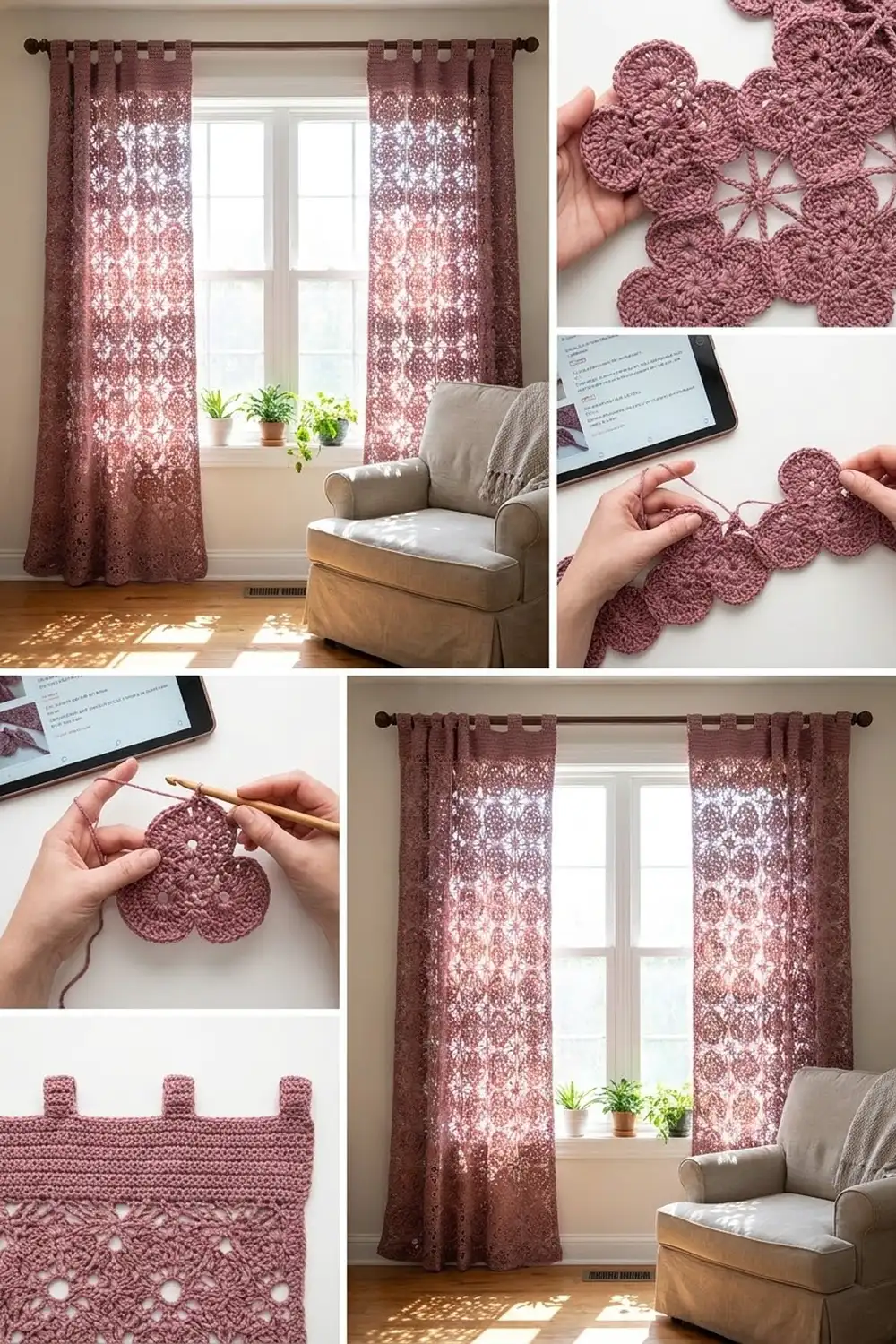
These airy curtain panels are built from one small, satisfying motif: a three-lobed trefoil. Each lobe is a padded ring with an open center, so sunlight comes through in a pattern of little clover shapes. A solid double crochet header with tab loops sits across the top, and the bottom edge is left as soft scallops.
The design uses a single dusty mauve-rose color. It works well in a boho, cottage or modern-romantic room and looks good both against daylight and against a darker wall at night.
All instructions use US crochet terms. Each finished panel measures 24 in (61.0 cm) wide by 75 in (190.5 cm) long from the top of the header band to the bottom of the lowest motifs. The tab loops add about 2 in (5.1 cm) above the band.
Here is the construction. You make each motif in two rounds and join it to its neighbors while you work the second round (join-as-you-go). Each panel is a grid of 6 motifs across and 18 rows down. When the grid is done, you work the header band straight across the top motifs and finish with six tabs.
Finished Size and Construction
- Finished panel size: 24 in × 75 in (61.0 cm × 190.5 cm), plus tabs of about 2 in (5.1 cm)
- Number of panels: 2
- Skill level: Intermediate
- Terminology: US
- Yarn weight: Worsted (#4)
- Hook: 5.0 mm (H-8)
- Number of pieces: 108 motifs per panel, 216 in total
- Layout: 6 motifs across × 18 rows down, per panel
- Single motif size: 4 in wide × 3.5 in tall (10.2 cm × 8.9 cm)
- Vertical spacing: 3.5 in (8.9 cm) motif + 0.5 in (1.3 cm) stem = 4 in (10.2 cm) per row
- Size before header: 24 in × 71.5 in (61.0 cm × 181.6 cm)
- Header (border) depth: 3.5 in (8.9 cm), plus tabs
Materials
Yarn: Choose a smooth worsted-weight cotton or cotton blend at about 200 m (219 yd) per 100 g. Cotton gives crisp ring edges and hangs straight. Avoid fuzzy or very stretchy yarns, because the open centers will blur and the panel will lengthen over time.
- Dusty Mauve: 800 g, about 1,600 m (1,750 yd) for both panels, or 400 g / 800 m (875 yd) per panel
Each motif uses about 3 g (6 m), and each header with its tabs uses about 20 g (40 m). The quantities above include a margin of roughly 10% for gauge swatches and weaving in ends.
Tools:
– 5.0 mm (H-8) crochet hook
– Tapestry needle
– 6–8 locking stitch markers
– Rust-proof pins and blocking mats
– Measuring tape
– Spray bottle
Abbreviations (US Terms)
- ch – chain
- sl st – slip stitch
- sc – single crochet
- dc – double crochet
- st(s) – stitch(es)
- RS – right side
Drop-loop join: Finish the stated sc. Take the hook out of the loop. Insert the hook from front to back through the stated stitch on the neighboring motif, catch the dropped loop and pull it through. Then continue. This join adds no stitches.
Stem: Ch 3, sl st into the stated space on the motif above, then sl st back down into each of the 3 chains. The stem stitches are never counted in the round total.
Gauge and Checkpoints
Test one motif first. Make a full motif without any joins and block it lightly before you start the panels.
- After Round 1: about 3.5 in (8.9 cm) wide and 3 in (7.6 cm) tall
- After Round 2 (finished motif): 4 in (10.2 cm) wide × 3.5 in (8.9 cm) tall. Each lobe ring is about 2 in (5.1 cm) across, with an open center of about 0.75 in (1.9 cm).
- Header gauge: 14 dc and 8 rows = 4 in (10.2 cm)
- Tab gauge: 14 sc and 16 rows = 4 in (10.2 cm)
If the motif is too big: go down one hook size. An extra 1/4 in (0.6 cm) per motif adds 1.5 in (3.8 cm) across 6 motifs and 4.5 in (11.4 cm) over 18 rows.
If the motif is too small: go up one hook size. Do not change the chain loop length, because that changes the stitch count.
The motif width matters most, because the header math depends on it.
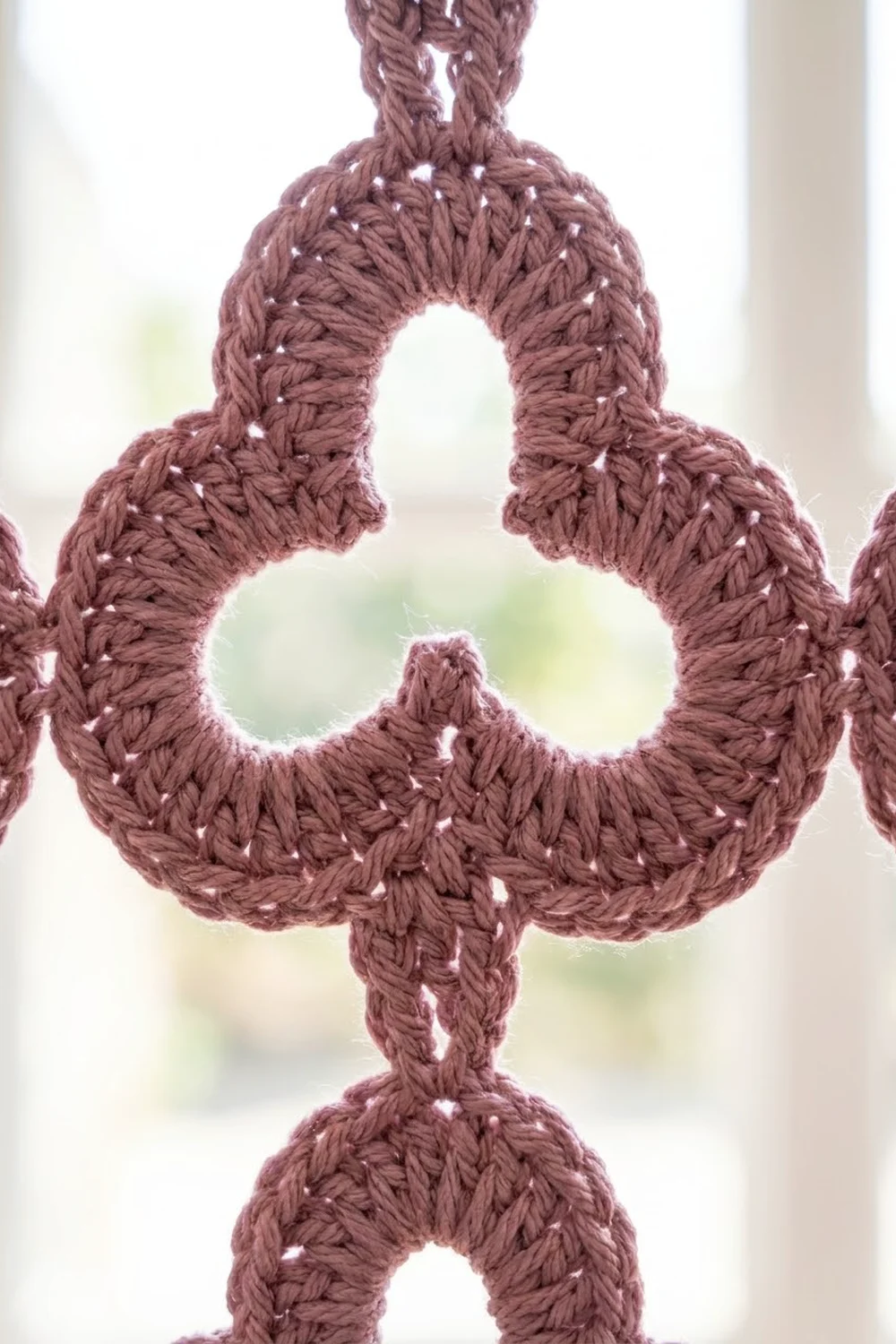
Trefoil Motif
Lobe order: Lobe A = top lobe, Lobe B = lower-left lobe, Lobe C = lower-right lobe. Work Rounds 1 and 2 counterclockwise with the RS facing you.
Foundation: Ch 12, sl st in the first ch to form Loop A. Ch 12, sl st in the same first ch to form Loop B. Ch 12, sl st in the same first ch to form Loop C. This gives three loops that share one center point.
Round 1: Ch 1. Work into Loop A: 2 sc, 18 dc, 2 sc. Sl st into the center point. Work the same 22 stitches into Loop B, sl st into the center, then into Loop C. Join with a sl st to the first sc.
Stitch count: 22 sts per lobe (4 sc + 18 dc), 66 sts total. The center sl sts are not counted.
Push the dc together evenly so each loop fills out into a full, padded ring.
Round 2: Ch 1. For each lobe, work: sc in each of the next 2 sc, (sc in each of the next 5 dc, 2 sc in the next dc) 3 times, sc in each of the next 2 sc. Join with a sl st to the first sc and fasten off.
Stitch count: 25 sc per lobe (2 + 21 + 2), 75 sc total.
Joining reference points (numbered 1–25 within each lobe):
– Lobe A, st 13: top tip. This is where the stem starts.
– Lobe B, st 9: left side point. This joins to the left neighbor.
– Lobe C, st 17: right side point. The right neighbor joins here.
– Bottom valley: the space between Lobe B st 25 and Lobe C st 1. The motif below attaches its stem here.
Place markers at these points on your test motif so you learn where they fall.
Make All Pieces
You need 216 motifs in Dusty Mauve: 108 for each panel. All joins happen during Round 2. Make Round 1 of each motif as a separate piece, then work its Round 2 into its place in the layout.
Layout per panel (H = header band, M = motif, | = side join, stems link each row to the row above):
H  H  H  H  H  H   (84 sts across)
M |M |M |M |M |M   Row 1
M |M |M |M |M |M   Row 2
...
M |M |M |M |M |M   Row 18
Number the rows from the top, and work each row from left to right.
Joining
Row 1, motif 1: Work Round 2 with no joins.
Row 1, motifs 2–6: On Round 2, when you reach Lobe B st 9, use the drop-loop join into Lobe C st 17 of the motif to the left. Do not work a stem at Lobe A st 13, because the top row joins directly to the header.
Rows 2–18, motif 1: On Round 2, after the sc in Lobe A st 13, work a stem into the bottom valley of the motif directly above. Then continue to st 14.
Rows 2–18, motifs 2–6: Work the stem at Lobe A st 13 as above. Also work the drop-loop join at Lobe B st 9 into the left neighbor’s Lobe C st 17.
Stitch logic: Each motif keeps exactly 75 sc. The joins pass through existing stitches, and the stems are extra chains that are never counted.
Tension: Keep the stem chains the same size as your Round 2 sc. Tight stems pucker the columns, and loose stems make the rows droop unevenly.
Size checkpoint: After Row 4, lay the panel flat. It should measure 24 in (61.0 cm) wide and 15.5 in (39.4 cm) tall, which is 4 motifs plus 3 stems. The full grid of 18 rows is 24 in × 71.5 in (61.0 cm × 181.6 cm).
Header Band and Tabs (Border)
Border gauge: 14 dc = 4 in (10.2 cm), so the 24 in (61.0 cm) band needs 84 sts.
Why the math works: Each motif is 4 in (10.2 cm) wide and is given 14 header sts. 6 motifs × 14 sts = 84 sts, and 84 sts ÷ 14 sts per 4 in = 24 in. Each motif’s 14 sts are split as 6 sts to the left of its top tip, the tip sc itself, and 7 sts to the right. This puts every tip under the center of its share of the band.
Row 1 (linking row): Make a slip knot. Ch 6, then sc into Lobe A st 13 of Row 1 motif 1. Ch 13, sc into Lobe A st 13 of the next motif. Repeat from * 4 more times, then ch 7.
Count: 6 + 1 + (5 × 14) + 7 = 84 sts.
Row 2: Ch 3 and turn (the ch 3 counts as the first dc). Dc in each remaining st across. 84 dc.
Rows 3–7: Ch 3 and turn (counts as first dc). Dc in each st across. 84 dc in each row.
Row 8: Ch 1 and turn. Sc in each st across. 84 sc. Do not fasten off yet.
Checkpoint: The band should be 24 in (61.0 cm) wide and 3.5 in (8.9 cm) deep.
Tab positions on Row 8: sts 1–4, 17–20, 33–36, 49–52, 65–68 and 81–84.
Check: 6 tabs × 4 sts + 5 gaps × 12 sts = 24 + 60 = 84.
Each tab: Join yarn at the first st of the tab position. Work sc in 4 sts. Then work rows of ch 1, turn, sc in 4 sts, until the tab has 20 rows: 5 in (12.7 cm) long and 1 1/8 in (2.9 cm) wide. Fasten off and leave a 12 in (30.5 cm) tail. Fold the tab to the back so its last 1 in (2.5 cm) lies flat against Rows 7–8, and whipstitch it in place. This makes a loop about 2 in (5.1 cm) tall that fits rods up to 1 in (2.5 cm) across.
Final Blocking
- Weave in all ends along the Round 2 sc or inside the dc rings. Never weave them across the open centers.
- Soak the panel in cool water for 15 minutes, then press the water out in a towel without wringing.
- Lay it flat on mats, working in sections if needed. Pin the header to 24 in (61.0 cm).
- Pin each column straight, with every stem set at 0.5 in (1.3 cm).
- Push each lobe into a round shape with your fingers, keeping the centers open.
- Leave it to dry fully, then hang it for 24 hours before hemming any rod or judging the final length.
Final Quality-Control Checklist
- Every motif has 75 sc in Round 2.
- All side joins fall at Lobe B st 9 and Lobe C st 17.
- Every stem is 3 chains and is attached at the bottom valley.
- The header has 84 sts in every row.
- The six tabs are evenly spaced and stitched down securely.
- Each panel measures 24 in × 75 in (61.0 cm × 190.5 cm).
- Both panels match in length within 0.5 in (1.3 cm).
Troubleshooting
- Lobes ruffle: The dc are too loose for the loop. Use a smaller hook, or ease off your tension on Round 1.
- Lobes cup: The chain loop is too tight. Chain a little more loosely.
- Columns lean: A side join has slipped to the wrong stitch. Count from the start of the lobe again.
- Header narrower than the motifs: Your dc are too tight. Go up a hook size for Rows 2–7 only.
- Panel stretches long: Use a cotton with less stretch, block it flat, and store it folded rather than hanging.
Care
Hand wash in cool water with a mild detergent, then lay flat to dry, re-shaping the lobes. Do not tumble dry, because heat and agitation can felt the joins and distort the rings.
Final Notes
Here is the measurement chain:
– One motif: 4 in × 3.5 in (10.2 cm × 8.9 cm).
– One row with its stem: 4 in (10.2 cm) of height.
– 6 motifs across: 24 in (61.0 cm).
– 18 rows down: 71.5 in (181.6 cm).
– An 84-stitch header adds 3.5 in (8.9 cm), for a 75 in (190.5 cm) panel.
– Each extra row of motifs adds 4 in (10.2 cm), so the length is easy to adjust for your window.
Happy crocheting!