

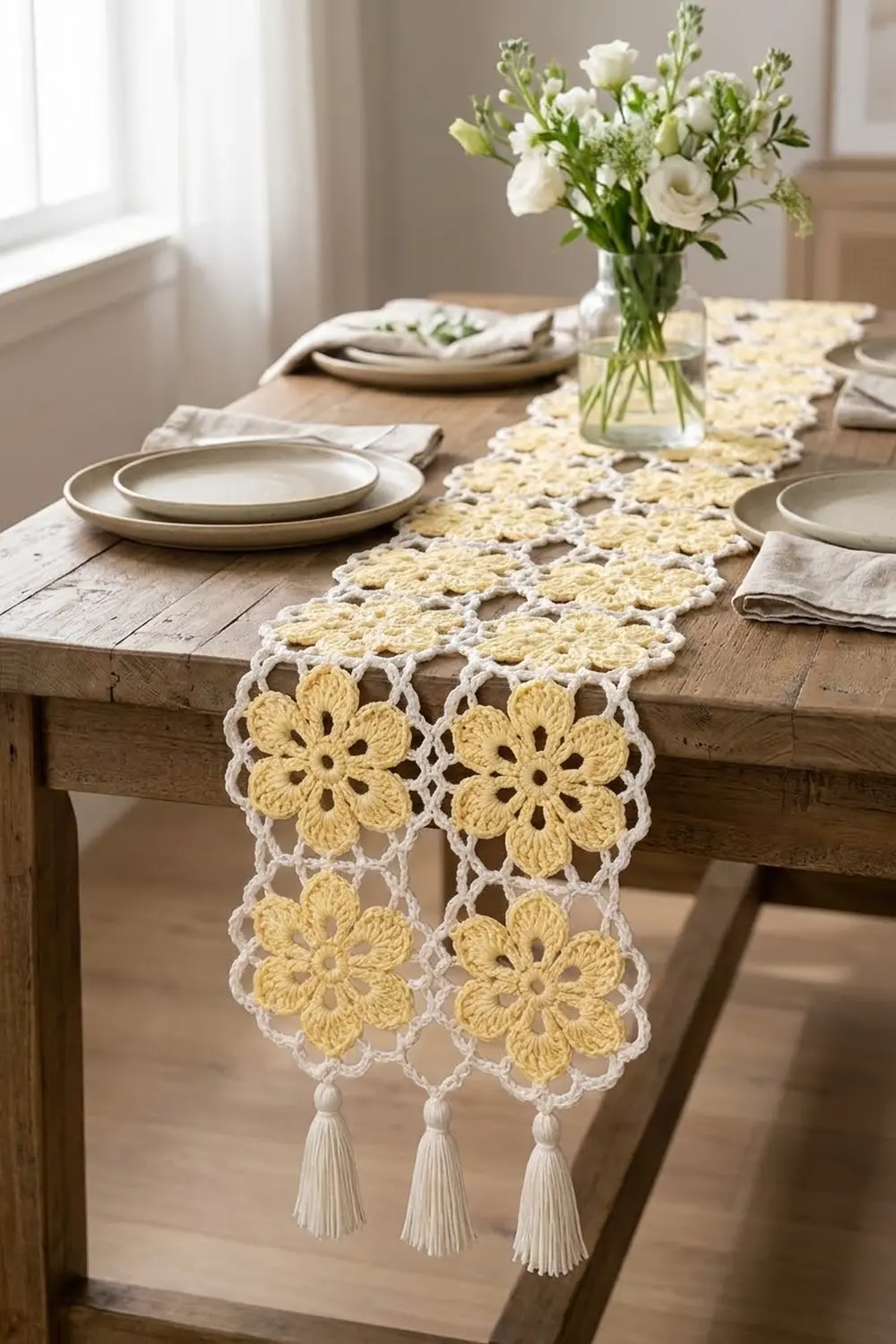
The Butter Blossom Table Runner is a delicate strip of six-petal flowers in pale butter yellow, each framed in crisp white chain lace. White chain diamonds sit between the flowers, and three soft white tassels hang from the bottom edge. It looks festive on a holiday console table and works year-round.
The palette is two colors only: pale yellow (butter cream) for the flower centers and petals, and white for every frame, spacer, border, and tassel. The style is light, open, and vintage-inspired, with each petal outlined like a doily.
This pattern uses US crochet terms throughout. The finished runner measures 6.5 x 24.5 in (16.5 x 62.2 cm) after blocking, not including the tassels, which hang about 3.5 in (8.9 cm) below the edge.
Construction is simple. You make 16 circular flower motifs and join them join-as-you-go into 2 columns of 8 on the last round. Then you fill each 4-motif intersection with a white chain diamond, add one picot border round, and finish with three tassels.
Finished Size and Construction
- Finished size: 6.5 x 24.5 in (16.5 x 62.2 cm), plus tassels
- Skill level: Intermediate (join-as-you-go, working into chain spaces)
- Terminology: US crochet terms
- Yarn weight: Sport weight (2) mercerized cotton
- Hook: 3.25 mm (US D/3)
- Number of pieces: 16 flower motifs, 7 chain diamond spacers, 3 tassels
- Layout: 2 motifs wide x 8 motifs long
- Piece size: 3 in (7.6 cm) diameter per motif, loop tip to loop tip
- Size before border: 6 x 24 in (15.2 x 61.0 cm)
- Border depth: about 0.25 in (0.6 cm) on each edge
Materials
Choose a smooth mercerized cotton in sport weight. Cotton gives clear stitch definition, crisp petals, and blocks flat. Avoid fuzzy or very stretchy yarns. They blur the lace and let the motifs drift out of shape.
Yarn (approx. 3.1 m per gram):
- Pale yellow (butter cream): 40 g / 124 m, for Rounds 1-3 of all motifs
- White: 60 g / 186 m, for Rounds 4-5, spacers, border, and tassels
These quantities include a margin of about 25% over the estimated use.
Tools:
- 3.25 mm (US D/3) crochet hook
- Tapestry needle
- Scissors
- Stiff card, 3.5 in (8.9 cm) tall, for tassels
- Rustproof pins and a blocking board or foam mats
- Spray bottle or steamer
- Ruler or tape measure
Abbreviations (US Terms)
- ch – chain
- sl st – slip stitch
- sc – single crochet
- hdc – half double crochet
- dc – double crochet
- tr – treble crochet (yo twice, insert, pull up a loop, [yo, pull through 2] three times)
- sp(s) – space(s)
- st(s) – stitch(es)
- rnd(s) – round(s)
- JAYG – join-as-you-go
Special stitches:
- Tip picot: (sc, ch 3, sc) worked into the same stitch.
- Joining loop: Instead of ch 6, work ch 3, sl st around the matching ch-6 loop of the neighboring motif, ch 3. The loop still contains 6 chains.
Gauge and Checkpoints
Make one complete motif before you start the runner. Measure it unblocked, lying flat:
- After Rnd 1: 1 in (2.5 cm) across
- After Rnd 2: 1.5 in (3.8 cm) across
- After Rnd 3 (yellow flower): 2.25 in (5.7 cm) petal tip to petal tip
- After Rnd 4: 2.75 in (7.0 cm) across
- After Rnd 5: 3 in (7.6 cm) across, loop tip to loop tip
If your motif is too big, go down 0.25 mm in hook size. If it is too small, go up 0.25 mm. Every runner measurement depends on this 3 in (7.6 cm) motif, so match it before making the other 15.
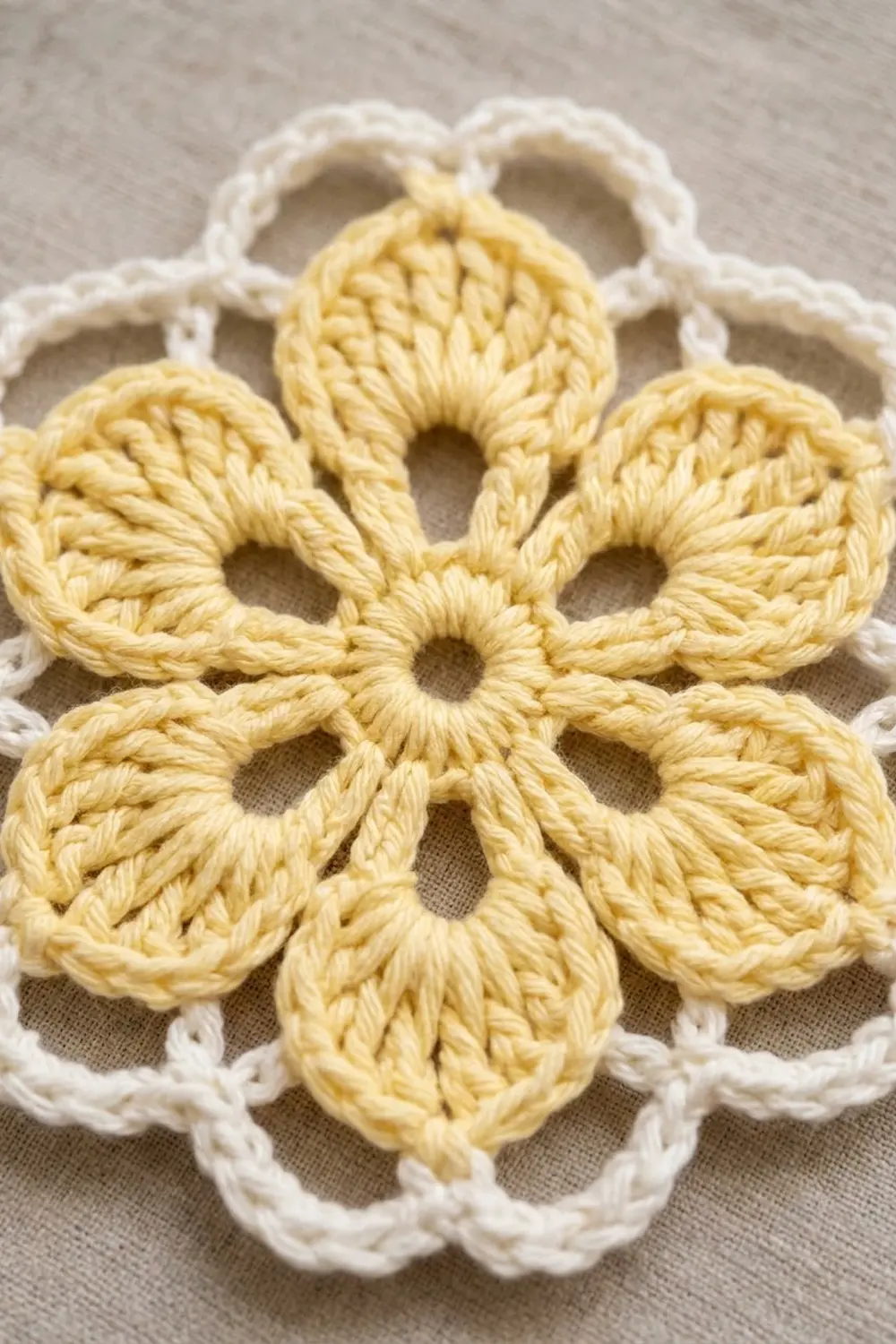
Flower Motif
Yellow Flower
With pale yellow, ch 6 and sl st to the first ch to form a ring. This ring becomes the open center.
Rnd 1: Ch 3 (counts as dc), 17 dc in ring, sl st to top of ch-3. (18 dc)
Rnd 2: Ch 1, sc in same st as join, ch 5, skip 2 dc, sc in next dc, ch 5, skip 2 dc; repeat from * 4 more times, sl st to first sc. (6 sc, 6 ch-5 sps)
The six ch-5 spaces hold the petals. They leave open eyelets between the center ring and each petal base, which creates the lacework.
Rnd 3 (petals): Sl st into first ch-5 sp. In each ch-5 sp work (sc, hdc, 2 dc, 3 tr, 2 dc, hdc, sc). Sl st to first sc. Fasten off. (6 petals of 11 sts each = 66 sts)
The rising and falling stitch heights shape each rounded, scalloped petal. The 2nd of the 3 tr is the petal tip.
White Frame
Rnd 4: Join white with sc in the center tr of any petal. Ch 3, sc in same tr (first tip picot made). Ch 5, sc in the space between this petal and the next, ch 5, tip picot in center tr of next petal. Repeat from * 4 more times. Ch 5, sc in space between petals, ch 5, sl st to first sc. (18 sc, 6 ch-3 picots, 12 ch-5 sps)
This round outlines every petal with white chain and puts a small picot at each tip.
Rnd 5: Sl st in next 3 ch to reach the center of the first ch-5 sp, sc in same sp. Ch 6, sc in next ch-5 sp. Repeat from * 10 more times. Ch 6, sl st to first sc. Fasten off. (12 sc, 12 ch-6 loops)
This is a conversion round. It places 1 sc in each of the 12 existing ch-5 spaces and adds no new spaces.
Loop Positions
Lay the motif flat and rotate it so two loops sit level at the top. The 12 loops then fall into these positions:
- Top pair: 2 loops
- Right pair: 2 loops
- Bottom pair: 2 loops
- Left pair: 2 loops
- Diagonals: 1 loop each at upper right, lower right, lower left, and upper left
That totals 2 + 2 + 2 + 2 + 4 = 12 loops. Pairs join to side and vertical neighbors. Diagonals stay free for spacers or the border.
Make All Pieces
- Motifs: 16, each with Rnds 1-3 in pale yellow and Rnds 4-5 in white
- Motif 1: worked complete, as above
- Motifs 2-16: Rnd 5 worked with JAYG joining loops
- Chain diamond spacers: 7, in white
- Tassels: 3, in white
Layout grid (F = flower motif):
ROW 1: F F
ROW 2: F F
ROW 3: F F
ROW 4: F F
ROW 5: F F
ROW 6: F F
ROW 7: F F
ROW 8: F F
Motif numbering runs left to right, top to bottom. Row 1 holds Motifs 1-2, Row 2 holds Motifs 3-4, and so on to Motifs 15-16.
Joining
Join-As-You-Go Order
- Motif 2: Work Rnd 5. When you reach the left pair, work both as joining loops into Motif 1’s right pair.
- Motif 3: Join its top pair to Motif 1’s bottom pair.
- Motif 4: Join its top pair to Motif 2’s bottom pair, and its left pair to Motif 3’s right pair.
- Continue row by row. Each left motif joins upward only. Each right motif joins upward and to the left.
Stitch-to-Stitch Logic
Joined loops mirror each other. An upper-left loop joins the neighbor’s upper-right loop, and a lower-left loop joins the neighbor’s lower-right loop. Top and bottom pairs pair the same way.
Each joined loop keeps exactly 6 chains (3 + 3). This means motif centers sit exactly 3 in (7.6 cm) apart.
Never join a diagonal loop. At every point where four motifs meet, four diagonal loops face an open diamond-shaped gap.
Chain Diamond Spacers
You need one spacer at each interior intersection. That is 1 column gap x 7 row gaps = 7 spacers.
Join white with a sl st in the center of one inward-facing diagonal loop. Ch 4, sl st in the center of the next inward diagonal loop. Repeat from * twice more, ch 4, sl st in first sl st. Fasten off. (4 ch-4 segments)
The result is a small white chain diamond linking all four flowers.
Tension and Size Checkpoint
Keep your joining sl sts snug but not tight. Tight joins pucker the motifs, and loose joins let them sag apart.
Before the border, lay the runner flat. It should measure 6 x 24 in (15.2 x 61.0 cm).
Border
Border Gauge
Each ch-6 loop takes 6 sc, which is 1 sc per chain. This lets the edge lie flat without ruffling or cupping.
Free Loop Count
Each long side: Every motif in the column has 4 free loops on that edge (outer pair, upper diagonal, lower diagonal). That gives 8 motifs x 4 loops = 32 loops. The corner diagonal loops are counted here.
Each short side: Each end motif has 3 free loops on that edge (top or bottom pair, plus the inner diagonal). That gives 2 motifs x 3 loops = 6 loops.
Total: 32 + 32 + 6 + 6 = 76 free loops.
As a check, each of the 4 corner motifs has 7 free loops (28 total), and each of the 12 middle motifs has 4 free loops (48 total). 28 + 48 = 76.
Valleys: A valley is the point where two motifs meet at the edge. Each long side has 7 valleys and each short side has 1.
Border Round
Rnd 1: Join white with a sl st in any free loop. In each free loop work (3 sc, ch 3, 3 sc). At each valley, work 1 sc around both joined loops at their join point. Sl st to first sc. Fasten off.
This is a conversion round, not a growth round. It works into existing loops only, and no extra corner stitches are needed. Each corner diagonal loop already wraps the curve.
Counts per side:
- Long side: (32 loops x 6 sc = 192 sc) + 7 valley sc = 199 sc, plus 32 picots
- Short side: (6 loops x 6 sc = 36 sc) + 1 valley sc = 37 sc, plus 6 picots
- Total: (2 x 199) + (2 x 37) = 472 sc, plus 76 picots
Why the Math Works
The scallops add about 0.25 in (0.6 cm) on every edge. That brings 6 x 24 in (15.2 x 61.0 cm) up to 6.5 x 24.5 in (16.5 x 62.2 cm).
Tassels
- Wrap white 30 times around the 3.5 in (8.9 cm) card.
- Slide an 8 in (20.3 cm) strand under the wraps at the top and tie tightly.
- Cut the wraps at the bottom.
- Wrap a second strand around the bundle 0.5 in (1.3 cm) below the top, tie, and bury the ends inside.
- Trim the tassel to 3 in (7.6 cm).
Attach tassels along the bottom short edge:
- One at the picot of the bottom-left corner loop
- One at the center valley sc
- One at the picot of the bottom-right corner loop
At each point, join white, ch 6 (about 0.5 in / 1.3 cm), and tie the tassel’s top strand to the end of the chain. The tassels hang about 2.5 in (6.4 cm) apart and are evenly spaced across the width.
Final Blocking
- Weave in all ends, working along chain loops so they stay hidden.
- Soak the runner in cool water for 10 minutes. Press out the water in a towel, without wringing.
- Pin the outline to 6.5 x 24.5 in (16.5 x 62.2 cm).
- Pin the center of every border picot so the scallops open evenly.
- Pin each petal tip picot so the petals sit round and flat.
- Check that the chain diamonds are square and centered.
- Let the runner dry completely before unpinning.
- Comb the tassels straight and re-trim them to 3 in (7.6 cm) if needed.
Final Quality-Control Checklist
- Every motif measures 3 in (7.6 cm) across.
- Each motif has 66 petal sts, 12 ch-5 sps on Rnd 4, and 12 ch-6 loops on Rnd 5.
- All joins use mirrored loop pairs, and all diagonal loops at intersections are free of joins.
- 7 chain diamonds are in place.
- Each long side has 199 sc and 32 picots. Each short side has 37 sc and 6 picots.
- The runner measures 6.5 x 24.5 in (16.5 x 62.2 cm).
- Three tassels hang evenly at the bottom edge.
- All ends are woven in securely.
Troubleshooting
- Petals curl or cup: Rnd 3 is too tight. Go up 0.25 mm in hook size, or block more firmly.
- Rnd 4 ruffles: Your chains are loose. Keep the ch-5 count, but tighten your chain tension.
- Motifs pull apart at joins: Keep the joining sl sts snug and check that each loop has exactly 3 + 3 chains.
- Joined motifs twist: A loop was joined to the wrong position. Undo it and match the mirrored pairs.
- Border wavy: Check for 6 sc per loop. Extra sc causes ruffling.
- Border pulls in: Make sure each valley sc is worked loosely.
- Tassels uneven: Re-trim them while they hang, after blocking.
Care
Hand wash in cool water with mild soap and lay flat to dry, re-pinning the shape if needed. Do not tumble dry.
Final Notes
The measurement chain is straightforward. Each motif reaches 3 in (7.6 cm) after Rnd 5, and 2 x 8 motifs joined give 6 x 24 in (15.2 x 61.0 cm). The picot border adds 0.25 in (0.6 cm) per edge, for a finished size of 6.5 x 24.5 in (16.5 x 62.2 cm).
Optional: For a longer runner, add rows of 2 motifs. Each extra row adds 3 in (7.6 cm) of length, 1 spacer, and 4 loops plus 1 valley sc to each long border side.
Happy crocheting!