

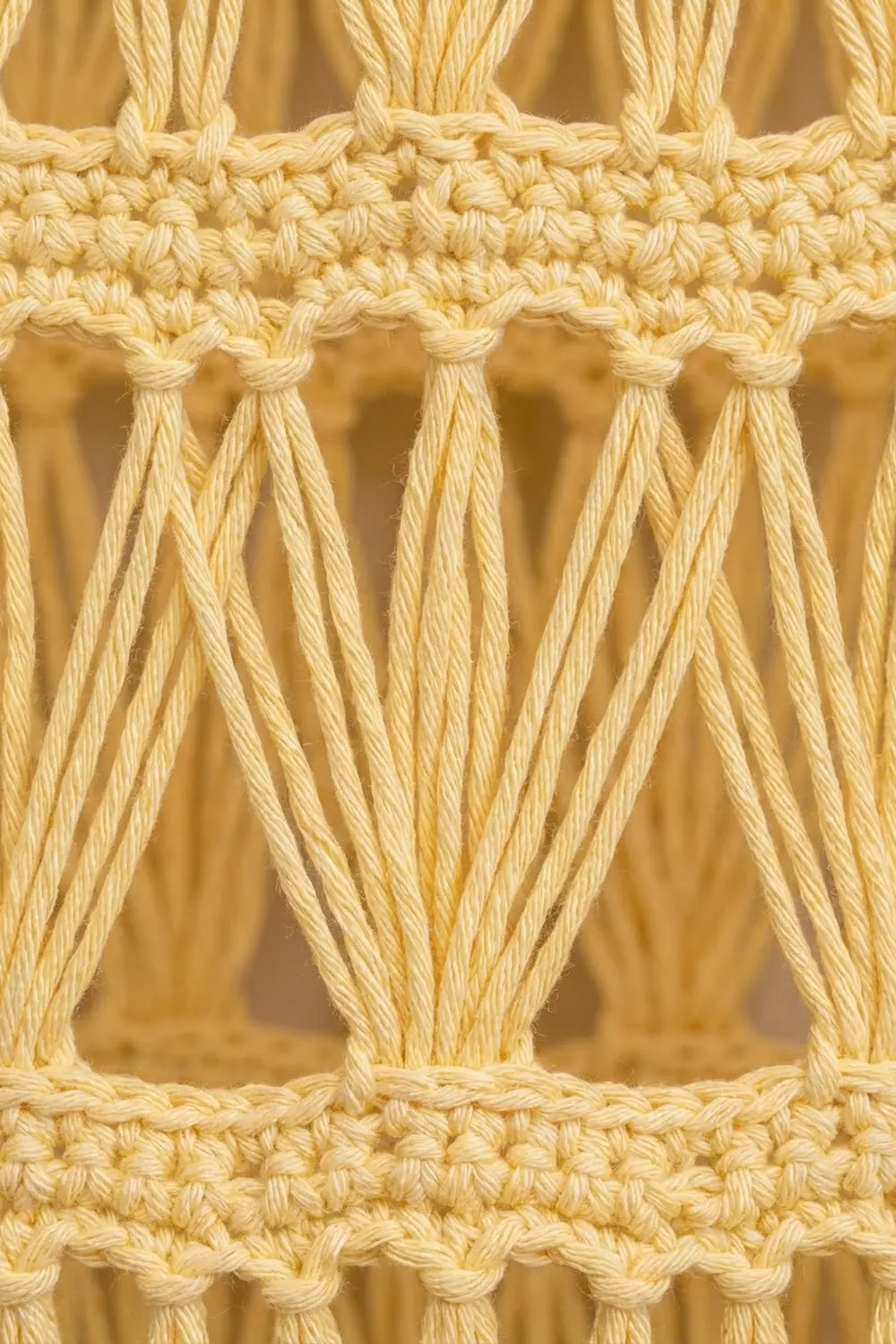
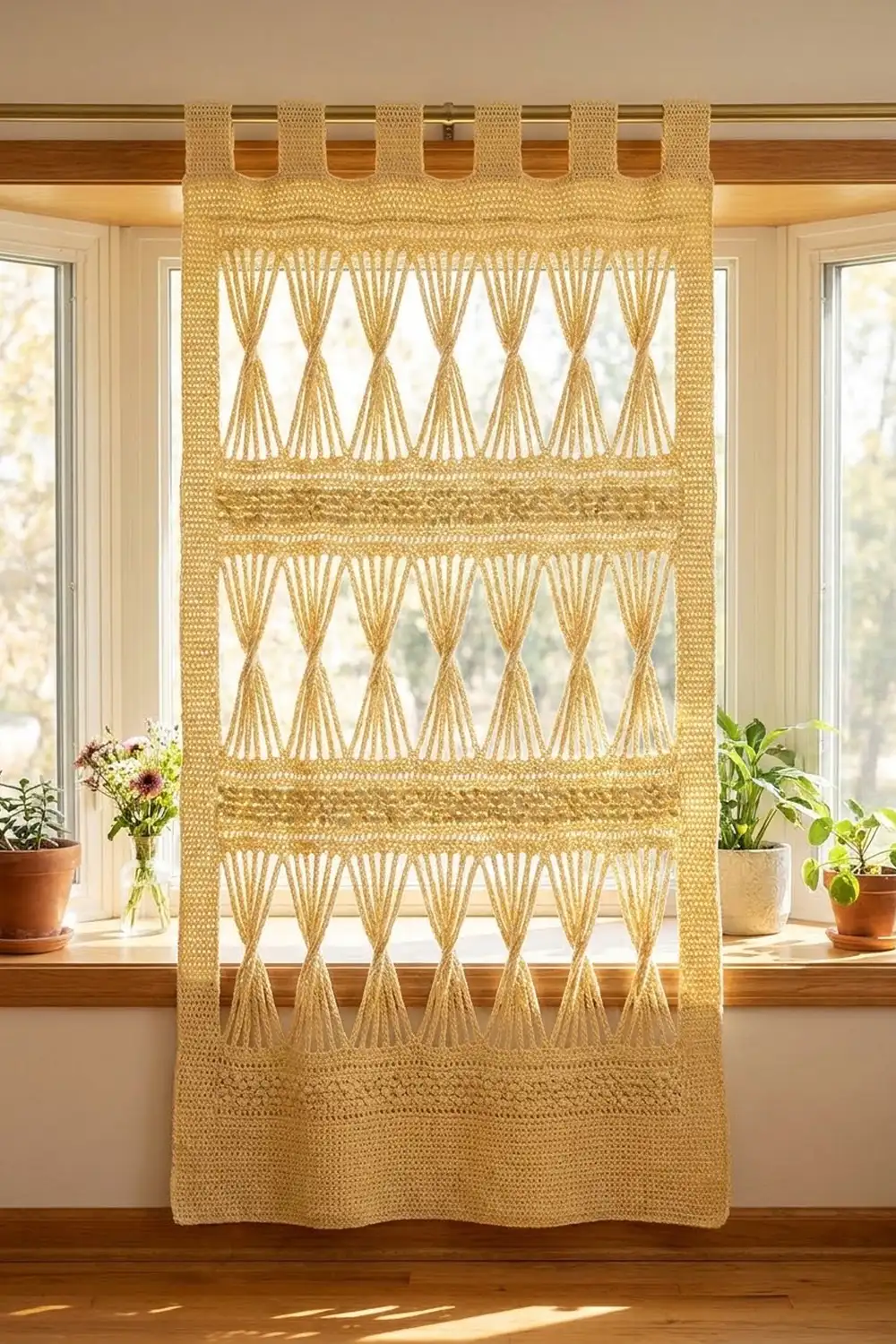
This curtain panel lets soft, filtered light into a kitchen nook or bay window. Tall rows of broomstick lace “fans” alternate with narrow, nubby bands of single crochet and moss stitch. The fabric reads as a ladder of open lace stripes across one long, airy rectangle.
The sample uses a single pale butter-yellow cotton. The color is warm without being loud, so the twisted loops and textured bands carry the design. The style is relaxed and cottage-like, and it suits painted or natural wood window frames.
This pattern uses US crochet terms. The finished panel measures 31 in (78.7 cm) wide by 57 in (144.8 cm) long after the border, plus 7 tab tops for hanging it from a rod. For a pair, as in a bay window, work the pattern twice.
Construction is simple. You chain the full width and work a dense bottom band. Then you repeat a 6-row unit (one broomstick loop row, one work-off row, and 4 band rows) until the panel is long enough. A 2-round single crochet border tidies all four edges. The tabs are worked straight up from the top edge, folded to the back, and sewn down.
Finished Size and Construction
- Finished size: 31 in (78.7 cm) wide x 57 in (144.8 cm) long, excluding tabs
- Skill level: Intermediate (broomstick lace)
- Terminology: US crochet terms
- Yarn weight: Worsted (#4) cotton or cotton blend
- Hook: 5.0 mm (US H-8)
- Broomstick tool: 1 in (2.5 cm) diameter dowel or a US 50 (25 mm) knitting needle
- Number of pieces: 1 (a single panel with the tabs worked on)
- Layout: one vertical rectangle, worked in rows from the bottom up
- Panel size before border: 30 in (76.2 cm) x 56 in (142.2 cm)
- Border depth: 0.5 in (1.3 cm) on every side
- Tabs: 7 tabs, each 2 in (5.1 cm) wide
Materials
Choose a smooth mercerized or combed cotton. Cotton holds the broomstick loops crisply, washes well, and stretches little when hanging. Avoid fuzzy yarns, because they blur the fan shapes.
- Pale butter yellow (main and only color): about 700 g / 1,400 m (1,531 yd) of worsted cotton, for example 7 balls of 100 g / 200 m each
The panel itself uses about 630 g. The quantity above includes a margin of roughly 10 percent for the gauge swatch, tension differences, and weaving in ends.
Tools:
- 5.0 mm (US H-8) crochet hook
- 1 in (2.5 cm) dowel or US 50 (25 mm) knitting needle, at least 24 in (61.0 cm) long
- 4 locking stitch markers
- Tapestry needle
- Scissors and a flexible tape measure
- Rustproof pins and a large blocking surface
- Curtain rod up to 1.25 in (3.2 cm) in diameter
Abbreviations (US Terms)
- ch – chain
- sc – single crochet
- sk – skip
- sl st – slip stitch
- sp – space
- st(s) – stitch(es)
- RS / WS – right side / wrong side
- rep – repeat
- yo – yarn over
Special stitch – Broomstick Lace (BL):
Loop row: With RS facing and the working loop at the left edge, do not turn. Enlarge the loop on your hook and slip it onto the dowel. Working from left to right, insert the hook in the next st, yo, pull up a loop, and slip it onto the dowel. Repeat across. Each st makes one loop.
Work-off row: Working from right to left, slide the first 5 loops off the dowel together. Insert the hook through the center of the group, yo, pull through, and ch 1 (this ch doesn’t count). Work 5 sc into the center of the group. For each following group of 5 loops, insert the hook through all 5, yo, pull through, and work 5 sc into the center. The loops twist slightly into the fan shape shown in the photo.
Moss stitch row: Ch 1, sc in first st, ch 1, sk next st, sc in next st; repeat to the last st, then sc in last st. On the next moss row, work each sc into a ch-1 sp and ch 1 over each sc. Every sc and every ch-1 sp counts as one st.
Gauge and Checkpoints
Gauge: 16 sts and 16 rows of sc = 4 in (10.2 cm). One broomstick unit (loop row plus work-off row) = 1.5 in (3.8 cm) tall.
Test swatch: Ch 21. Work Rows 1–8 of the Bottom Band over 20 sts. Then work one broomstick unit (4 groups of 5) and 4 band rows. The swatch should measure 5 in (12.7 cm) wide x 4.5 in (11.4 cm) tall. Measure after a light steam, because cotton relaxes.
If your swatch is too big, go down to a 4.5 mm hook. If it is too small, go up to a 5.5 mm hook. If only the broomstick unit is off, keep your hook and change the dowel: a thinner dowel makes shorter fans and a thicker one makes longer fans.
Checkpoints while working:
- After the Bottom Band: 30 in (76.2 cm) wide x 2 in (5.1 cm) tall
- After 4 repeats: 12 in (30.5 cm) tall
- After 10 repeats: 27 in (68.6 cm) tall
- After 21 repeats: 54.5 in (138.4 cm) tall
- After the Top Band: 56 in (142.2 cm) tall
Measure flat on a table without stretching. The width should stay at 30 in (76.2 cm) at every checkpoint.
Panel Pattern
The panel is 120 sts wide, which makes 24 broomstick groups of 5. Every row except the loop row ends with 120 sts.
Foundation and Bottom Band
Foundation: Ch 121.
Row 1 (WS): Sc in 2nd ch from hook and in each ch across, turn. (120 sc)
Row 2 (RS): Ch 1, sc in each st across, turn. (120 sc)
Rows 3–6: Work 4 moss stitch rows, turning at the end of each. (120 sts each; Row 3 has 61 sc + 59 ch-1 sps)
Row 7 (WS): Ch 1, sc in each sc and each ch-1 sp across, turn. (120 sc)
Row 8 (RS): Ch 1, sc in each st across. Do not turn. (120 sc)
The Bottom Band is 8 rows and 2 in (5.1 cm) tall. You finish at the left edge with RS facing, ready for the loop row.
Main Repeat (6 rows)
Row A – Loop row (RS): Do not turn. Work a BL loop row across. (120 loops on the dowel)
Row B – Work-off row (RS): Work off the loops in groups of 5. (24 groups x 5 sc = 120 sc) Turn.
Row C (WS): Ch 1, sc in each st across, turn. (120 sc)
Row D (RS): Work 1 moss stitch row, turn. (120 sts)
Row E (WS): Work 1 moss stitch row, turn. (120 sts)
Row F (RS): Ch 1, sc in each sc and each ch-1 sp across. Do not turn. (120 sc)
One repeat is 2.5 in (6.4 cm) tall: 1.5 in (3.8 cm) of broomstick plus 1 in (2.5 cm) of band. Row F always ends at the left edge with RS facing, so the next loop row starts in the right place.
Work Rows A–F a total of 21 times. The panel now measures 54.5 in (138.4 cm).
Tip: Keep the loop row loose and even. Pull each loop straight up to the dowel and keep the dowel level. If the dowel feels crowded, slide finished loops toward the far end.
Top Band
Turn so the WS faces you.
Row 1 (WS): Ch 1, sc in each st across, turn. (120 sc)
Rows 2–3: Work 2 moss stitch rows, turning at the end of each. (120 sts)
Rows 4–5: Ch 1, sc in each sc and ch-1 sp across, turn. (120 sc)
Row 6 (RS): Ch 1, sc in each st across. Do not turn. (120 sc)
The Top Band adds 6 rows, or 1.5 in (3.8 cm). The panel now measures 30 in (76.2 cm) x 56 in (142.2 cm). Total rows: 8 + (21 x 6) + 6 = 140. Do not fasten off.
Border and Tab Tops
Border gauge: The border uses the same 16 sc = 4 in (10.2 cm). Along the side edges, work 1 sc into the end of each sc or moss row. Work 6 sc along each broomstick unit, because one unit is 1.5 in (3.8 cm) and 1.5 x 4 = 6.
Side stitch count: 8 (Bottom Band) + 21 x (6 + 4) + 6 (Top Band) = 224 sc. That equals 56 in x 4 sts per inch, so the sides will lie flat.
Round 1 (RS): Ch 2 for the first corner, do not turn. Rotate the work and, with RS facing, work 224 sc evenly down the side as described above. Ch 2. Work 120 sc across the bottom, one into the base of each foundation st. Ch 2. Work 224 sc up the second side. Ch 2. Work 120 sc across the top, one in each st of Row 6. Sl st to the first sc. (688 sc + 4 corner ch-2 sps)
Place a marker in each corner space.
Round 2: Ch 1, sc in each sc around, working (sc, ch 2, sc) in each corner ch-2 sp. Join with a sl st to the first sc. (Top and bottom: 122 sc each. Sides: 226 sc each. Total: 696 sc + 4 corner ch-2 sps)
Why the math works: In Round 2, each side gains exactly 1 sc at each end from the corner spaces, so each per-side count rises by 2. Those extra sc and the 2 rounds of depth add 0.5 in (1.3 cm) on every edge. That brings the panel to 31 in (78.7 cm) x 57 in (144.8 cm). No extra stitches are added along the edges, so the border neither ruffles nor pulls in.
Tab Tops
The top edge of Round 2 has 122 sc between the two corner spaces. Seven tabs of 8 sts each use 56 sts. The other 66 sts split into 3 sts at each outer edge and 10 sts between tabs: 3 + 8 + (10 + 8) x 6 + 3 = 122.
With RS facing, skip the first 3 sc of the top edge and join the yarn in the next sc.
Tab Row 1: Ch 1, sc in the same st and in the next 7 sts, turn. (8 sc)
Tab Rows 2–24: Ch 1, sc in each st across, turn. (8 sc)
Each tab is 6 in (15.2 cm) long. Fasten off, leaving a 12 in (30.5 cm) tail.
Skip the next 10 sc on the top edge and join the yarn for the next tab. Repeat until you have 7 tabs, with 3 sc left over at the far edge.
Fold each tab to the WS and sew its last row to Row 6 of the Top Band. This makes a loop about 2.75 in (7.0 cm) deep, which fits a rod up to 1.25 in (3.2 cm) across.
Final Blocking
- Weave in all ends along the solid bands, never through the broomstick loops.
- Soak the panel in cool water with a little gentle wash for 15 minutes.
- Press out the water in a towel. Do not wring.
- Lay the panel flat on blocking mats or a clean sheet, RS up.
- Pin the corners first to 31 in (78.7 cm) x 57 in (144.8 cm).
- Pin along each band every 4 in (10.2 cm), keeping the bands straight and parallel.
- Open each broomstick fan with your fingers so the loops twist evenly.
- Pin the tabs flat, and let everything dry completely before unpinning.
Final Quality-Control Checklist
- Every work-off row has 24 groups of 5 sc (120 sc).
- Every band row has 120 sts.
- There are 21 broomstick rows between the top and bottom bands.
- Border Round 2 has 122 sc on the top and bottom and 226 sc on each side.
- The 7 tabs are evenly spaced, 10 sts apart, with 3 sts at each outer edge.
- The blocked size is 31 in (78.7 cm) x 57 in (144.8 cm).
- All ends are hidden in the solid bands.
Troubleshooting
The fans lean to one side. You may be inserting the hook through the loops unevenly. Always go through the exact center of all 5 loops at once.
The broomstick rows are shorter at one edge. The dowel tilted or some loops slipped. Hold the dowel firmly and parallel to the work.
The panel narrows toward the top. Count each work-off row, because a group with 4 sc instead of 5 loses a stitch. Also make sure you sc into the ch-1 sps when leaving the moss rows.
The side edges wave. Recount the border sts on the sides. You need exactly 6 sc per broomstick unit and 1 sc per band row.
The tabs twist. Sew each tab down straight, centered over the stitches it was worked from.
The panel stretches when hung. Cotton grows a little over time. Work the bands at a firmer tension, or stop at 20 repeats and check the length.
Care
Hand wash, or machine wash on a gentle cool cycle inside a laundry bag. Dry flat and reshape to the blocked measurements.
Final Notes
Every part of this panel follows one measurement chain. A gauge of 16 sc = 4 in (10.2 cm) gives 120 sts for a 30 in (76.2 cm) width, which divides evenly into 24 broomstick groups of 5. The Bottom Band adds 2 in (5.1 cm), each of the 21 repeats adds 2.5 in (6.4 cm), and the Top Band adds 1.5 in (3.8 cm), for a total of 56 in (142.2 cm). The 2-round border brings the panel to 31 in (78.7 cm) x 57 in (144.8 cm), and the 7 tabs fit evenly across the 122-st top edge.
Check your swatch, count every work-off row, and the rest will fall into place. Happy crocheting!