

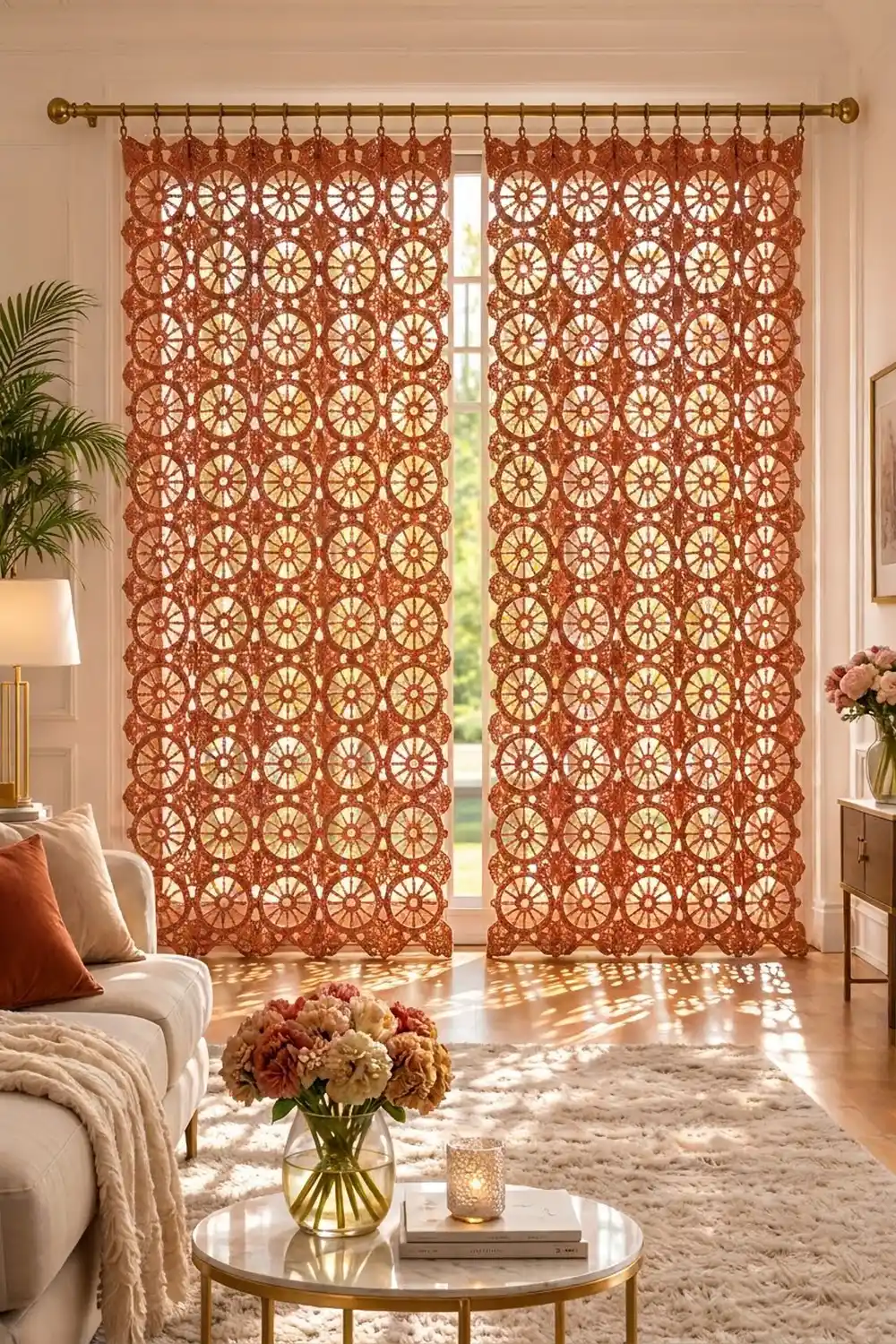
The Terracotta Wheel Lace Curtain is made from small 12-spoke wheel motifs joined into an open, airy grid. Light passes through the spokes and the diamond-shaped gaps, so the panel throws soft wheel-shaped shadows on the floor while still giving a room some warmth and privacy.
The design uses one color: a warm terracotta cotton with a slight sheen. It has a boho, mid-century feel and works especially well with light walls, wood, and brass hardware.
This pattern is written in US crochet terms. One finished panel measures about 35.8 in (90.9 cm) wide by 85.8 in (217.9 cm) tall, including the border. Make two panels for a standard window pair.
You work each motif in five rounds, from the center ring out to the rim. From the second motif on, you join motifs as you go at their four chain loops, building a grid 7 motifs wide and 17 motifs tall. Finally, a two-round scalloped sc border tidies the outer edge.
Finished Size and Construction
- Finished panel size: 35.8 in x 85.8 in (90.9 cm x 217.9 cm)
- Skill level: Intermediate
- Terminology: US crochet terms
- Yarn weight: DK / light worsted (#3) cotton or cotton blend
- Hook: 3.5 mm (E-4)
- Number of pieces: 119 motifs per panel (238 for a pair)
- Layout: 7 motifs wide x 17 motifs tall per panel
- Motif size: 4 in (10.2 cm) across the solid body; 5 in (12.7 cm) from loop tip to loop tip
- Size before border: 35 in x 85 in (88.9 cm x 215.9 cm)
- Border depth: 0.4 in (1.0 cm) on each edge
Materials
Yarn: Use a smooth, mercerized or combed cotton in DK weight, at about 115 m per 50 g. Cotton keeps the spokes crisp and hangs straight without stretching. Avoid fuzzy or very stretchy yarns, because the lace will lose definition and the curtain can grow in length over time.
- Terracotta: 800 g / 1,840 m per panel (1,600 g / 3,680 m for a pair)
Tools:
– 3.5 mm (E-4) crochet hook
– Tapestry needle
– Stitch markers (at least 4)
– Scissors
– Measuring tape
– Blocking mats and rustproof pins (or a large clean floor area with towels)
– Spray bottle
– Curtain rod with clip rings (about 7–9 rings per panel)
Yarn quantities include a margin of about 10% for gauge differences and the gauge-test motif.
Abbreviations (US Terms)
- ch – chain
- sl st – slip stitch
- sc – single crochet
- hdc – half double crochet
- dtr – double treble crochet (yarn over 3 times, insert hook, pull up a loop, [yarn over, pull through 2 loops] 4 times)
- st(s) – stitch(es)
- sp – space
- rep – repeat
Special stitch – Joining Loop (JL): Work this in place of a ch-5 loop. Sc in the stitch, ch 2, drop the loop from your hook. Insert the hook from front to back through the matching ch-5 loop of the finished motif, pick up the dropped loop and pull it through. Ch 2, then sc in the same stitch. The joined loop counts as that motif’s ch-5 loop.
Gauge and Checkpoints
Base gauge: 20 sc = 4 in (10.2 cm), so 5 sc = 1 in (2.5 cm).
Always make one complete test motif first and block it lightly before you start the curtain. Check these sizes, measured flat across the diameter:
- After Round 1: 1.25 in (3.2 cm)
- After Round 2: 3 in (7.6 cm)
- After Round 3: 3.4 in (8.6 cm)
- After Round 4: 3.75 in (9.5 cm)
- After Round 5: 4 in (10.2 cm) across the body; 5 in (12.7 cm) loop tip to loop tip
If your motif is bigger than 4.25 in (10.8 cm) across the body, go down to a 3.25 mm hook. If it is smaller than 3.75 in (9.5 cm), go up to a 3.75 mm hook. A difference of 0.25 in (0.6 cm) per motif adds up to 1.75 in (4.4 cm) across the width and 4.25 in (10.8 cm) down the length of a panel, so match gauge before you continue.
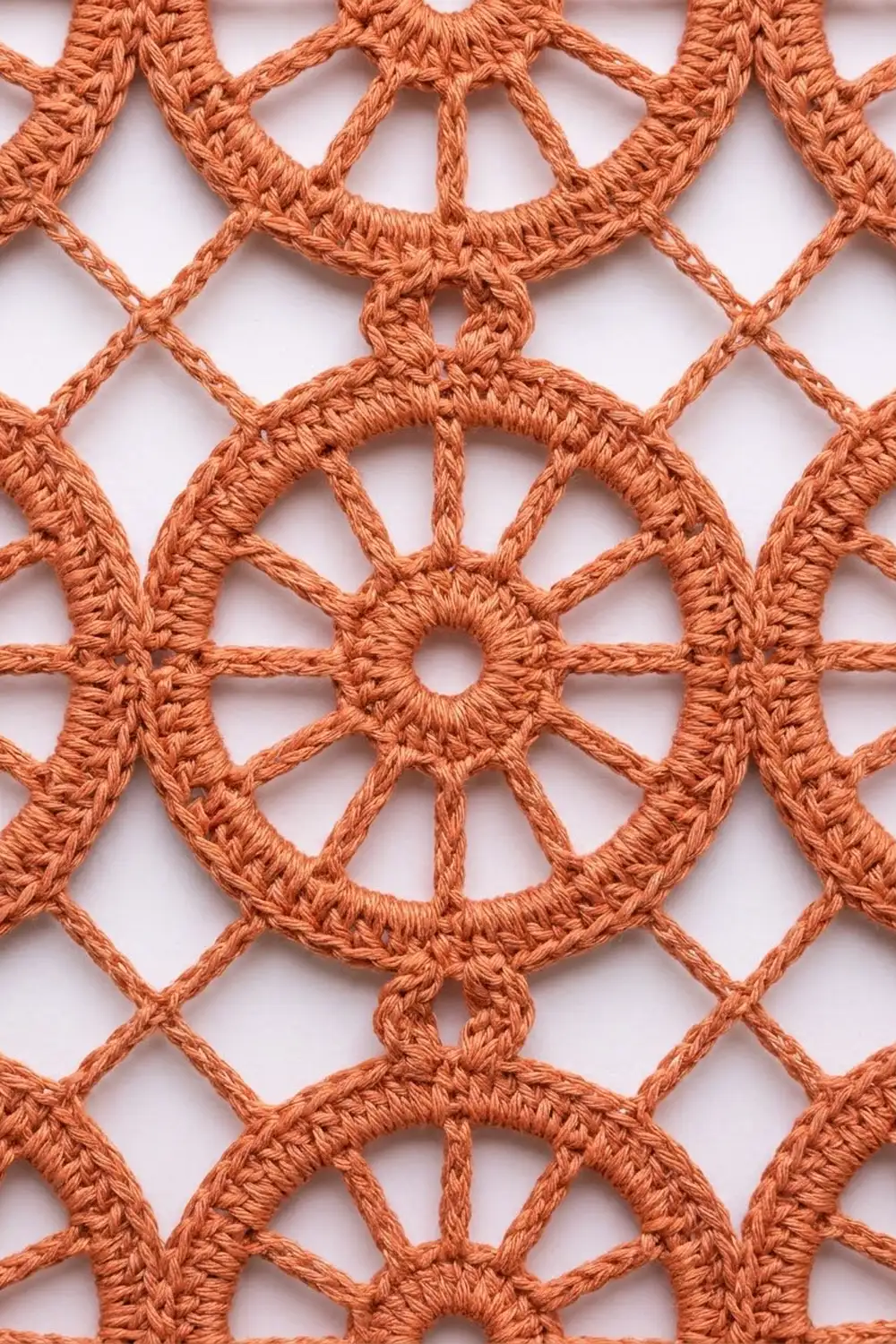
Wheel Motif
Center ring
Ch 8, sl st in the first ch to form a ring.
Round 1: Ch 1, work 24 sc into the ring, sl st in the first sc to join. (24 sc)
The center hole should be about 0.5 in (1.3 cm) wide, with a firm, rounded ring of sc around it.
Round 2 (spokes): Ch 5 (counts as the first dtr), ch 3. Skip the next st, dtr in the next st, ch 3. Rep from * 10 more times. Sl st in the top of the beginning ch-5 to join. (12 dtr, 12 ch-3 sps)
These 12 tall dtr are the wheel’s spokes. Keep each dtr fully extended and straight; don’t pull the final yarn-overs tight against the post.
Round 3 (inner rim): Ch 1, sc in the same st as the join, 4 sc in the next ch-3 sp. Sc in the next dtr, 4 sc in the next ch-3 sp. Rep from * 10 more times. Sl st in the first sc to join. (60 sc: 12 sc on the spokes + 48 sc in the spaces)
Each spoke now has 5 sts: 1 sc on top of the spoke and 4 sc in the space after it.
Round 4 (rim body): Ch 2 (does not count as a stitch), hdc in each st around. Sl st in the first hdc to join. (60 hdc)
Round 5 (rim edge and loops):
- First motif only: Ch 1. Sc in the next 14 sts, then (sc, ch 5, sc) in the next st. Rep from * 3 more times. Sl st in the first sc to join. Fasten off and weave in the ends.
- Count: 60 sts worked 1 per stitch + 4 extra sc = 64 sc, plus 4 ch-5 loops.
The 4 loops sit 15 sts apart, so each one lines up with every third spoke. Mark the loops as T (top), R (right), B (bottom) and L (left). On every motif, there are exactly 14 plain sc between one loop group and the next.
Joined motifs: Work Rounds 1–4 as written. In Round 5, replace each loop that has a neighbor with a Joining Loop (JL) attached to that neighbor’s matching loop. Work all other loops as normal ch-5 loops.
Make All Pieces
For each panel, make 119 motifs in Terracotta (238 for a pair). Joining as you go means each motif is finished and attached in the same step.
Text layout grid for one panel (7 wide x 17 tall). Each O is one motif, and – and | are joined loops:
Row 1:   O–O–O–O–O–O–O
         | | | | | | |
Row 2:   O–O–O–O–O–O–O
         | | | | | | |
 ...     (rows 3–16 the same)
         | | | | | | |
Row 17:  O–O–O–O–O–O–O
Joining
Method: Join as you go, loop to loop, during Round 5.
- Row 1: Make motif 1 in full. For motifs 2–7, join each motif’s L loop to the R loop of the motif to its left. Work the T, R and B loops as normal ch-5 loops.
- Rows 2–17, first motif: Join its T loop to the B loop of the motif above.
- Rows 2–17, remaining motifs: Join the L loop first (to the left neighbor’s R loop), then continue around and join the T loop (to the above motif’s B loop).
Stitch logic: The JL replaces the 5 chains with ch 2 + join + ch 2. The sc on either side of the loop stays the same, so every joined motif still has 64 sc. No stitches are added at the seams.
Join count per panel: 6 horizontal joins x 17 rows = 102, and 7 vertical joins x 16 gaps = 112, for 214 joins in total.
Tension: Keep the ch-2 sections relaxed so the joined loops sit flat, about 0.5 in (1.3 cm) long, just like the free loops. Joins that are too tight pull the wheels into ovals.
Size checkpoint: After Row 1, the strip should measure 35 in (88.9 cm) wide from tip to tip. After Row 4, the panel should measure 20 in (50.8 cm) tall. If either is off by more than 1 in (2.5 cm), check your hook and gauge before you continue.
Border
Border gauge: 5 sc = 1 in (2.5 cm). Each border round adds about 0.2 in (0.5 cm), so the 2 rounds add 0.4 in (1.0 cm) on each edge.
The border follows the scalloped outline of the outer motifs. Work only into Round 5 sts of the edge motifs.
How to pass a seam: Where two edge motifs meet, finish the last plain sc of the first motif’s arc. Then skip that motif’s loop-group sc, the joined loops, and the next motif’s loop-group sc. Work your next sc directly into the first plain sc of the next motif. No extra stitches are worked at seams, and this creates a neat V at each valley.
Section definitions:
- Top and bottom sides: For each of the 7 motifs, work the half-circle from the L seam to the R seam: 14 sc, then sc in the loop-group sc, 3 sc in the free ch-5 loop, sc in the next loop-group sc, then 14 sc. That makes 33 sts per motif.
- Left and right sides: For each of the 15 motifs between the corners, work the outer half from the T seam to the B seam in the same way: 33 sts per motif.
- Corner sections: On each corner motif, after its 33-st top or bottom half, work the free side loop group (sc, 3 sc in the loop, sc) plus the remaining 14-sc outer quarter. That makes 19 sts per corner.
Round 1: Join the yarn at the top-left corner motif and work around the whole panel as defined above. Sl st in the first sc to join.
- Top side: 7 x 33 = 231 sts
- Bottom side: 7 x 33 = 231 sts
- Left side: 15 x 33 = 495 sts
- Right side: 15 x 33 = 495 sts
- Corners: 4 x 19 = 76 sts
- Total: 1,528 sc
Round 2: Ch 1, sc in each st around, working 3 sc in the center sc of each 3-sc group over a free loop. Sl st in the first sc to join. Fasten off.
There are 48 free loops on the perimeter: 7 top, 7 bottom, 17 left and 17 right. Each one adds 2 sts, for 96 extra sts in total.
- Top side: 7 x 35 = 245 sts
- Bottom side: 7 x 35 = 245 sts
- Left side: 15 x 35 = 525 sts
- Right side: 15 x 35 = 525 sts
- Corners: 4 x 21 = 84 sts
- Total: 1,528 + 96 = 1,624 sc
Why the math works: Round 1 places exactly 1 sc in each existing Round 5 sc, so the border has the motif’s own stitch count and cannot ruffle or pull in. The half-circumference of a 4 in (10.2 cm) circle is about 6.3 in (16.0 cm). At 5 sc per inch, that is about 31 sts, and the 33-st arc includes 2 extra sts to round the loop tip. Increasing only at the loop tips in Round 2 keeps the points sharp and the valleys flat.
Final Blocking
- Weave in all remaining ends along the rims, never through the spokes.
- Lay the panel flat on mats or towels, right side up.
- Pin each top-row T loop along a straight line 35.8 in (90.9 cm) long.
- Pin the bottom row the same way, 85.8 in (217.9 cm) below the top.
- Pin the side loops into straight lines, checking that each column of joins runs straight.
- Spray until damp, not soaked. Gently pat each wheel round and straighten any bent spokes with your fingers.
- Let it dry completely (12–24 hours) before unpinning.
Final Quality-Control Checklist
- Every motif has 12 straight spokes and 64 sc in Round 5.
- All 214 joins are secure, with no twisted loops.
- Each panel measures 35.8 in x 85.8 in (90.9 cm x 217.9 cm).
- The border has 1,624 sts, and the valleys sit flat.
- No loose ends are visible in the open spaces.
- Both panels match in length within 0.5 in (1.3 cm).
Troubleshooting
- Motif cups: Your dtr spokes are too short. Loosen the yarn-overs or go up one hook size for Round 2 only.
- Motif ruffles: Your Round 3 is too loose. Work it with a firmer tension.
- Spokes lean sideways: Make sure you skip exactly 1 st between dtr in Round 2.
- Grid skews diagonally: You joined a wrong loop. Count 15 sts between loops and check the T/L positions.
- Border waves: You worked extra sc at the seams. Pass each seam with no added stitches.
- Curtain lengthens after hanging: Rewet, block to size again, and dry it flat.
Care
Hand wash in cool water with mild detergent, press out the water in a towel, and dry flat to the blocked measurements. Don’t tumble dry or hang the panel while it is wet.
Final Notes
Everything in this curtain depends on one measurement chain. Five sc per inch gives a 4 in (10.2 cm) motif body and 5 in (12.7 cm) from loop tip to tip. Seven motifs across make 35 in (88.9 cm), and 17 motifs down make 85 in (215.9 cm). A 0.4 in (1.0 cm) border on each edge brings the finished panel to 35.8 in x 85.8 in (90.9 cm x 217.9 cm). Check your gauge on the first motif, check your size after the first rows, and the rest will fall into place.
Happy crocheting!