

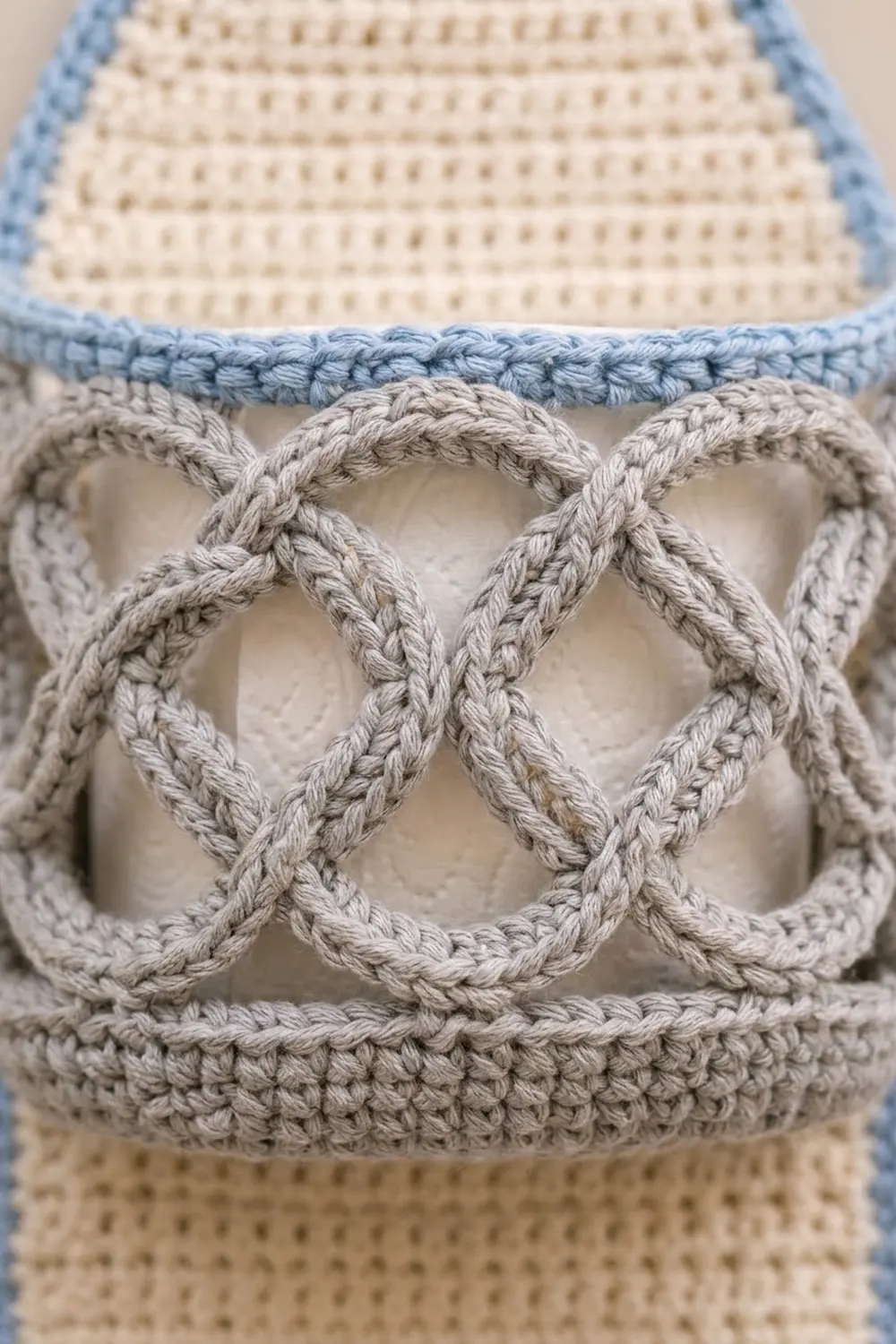
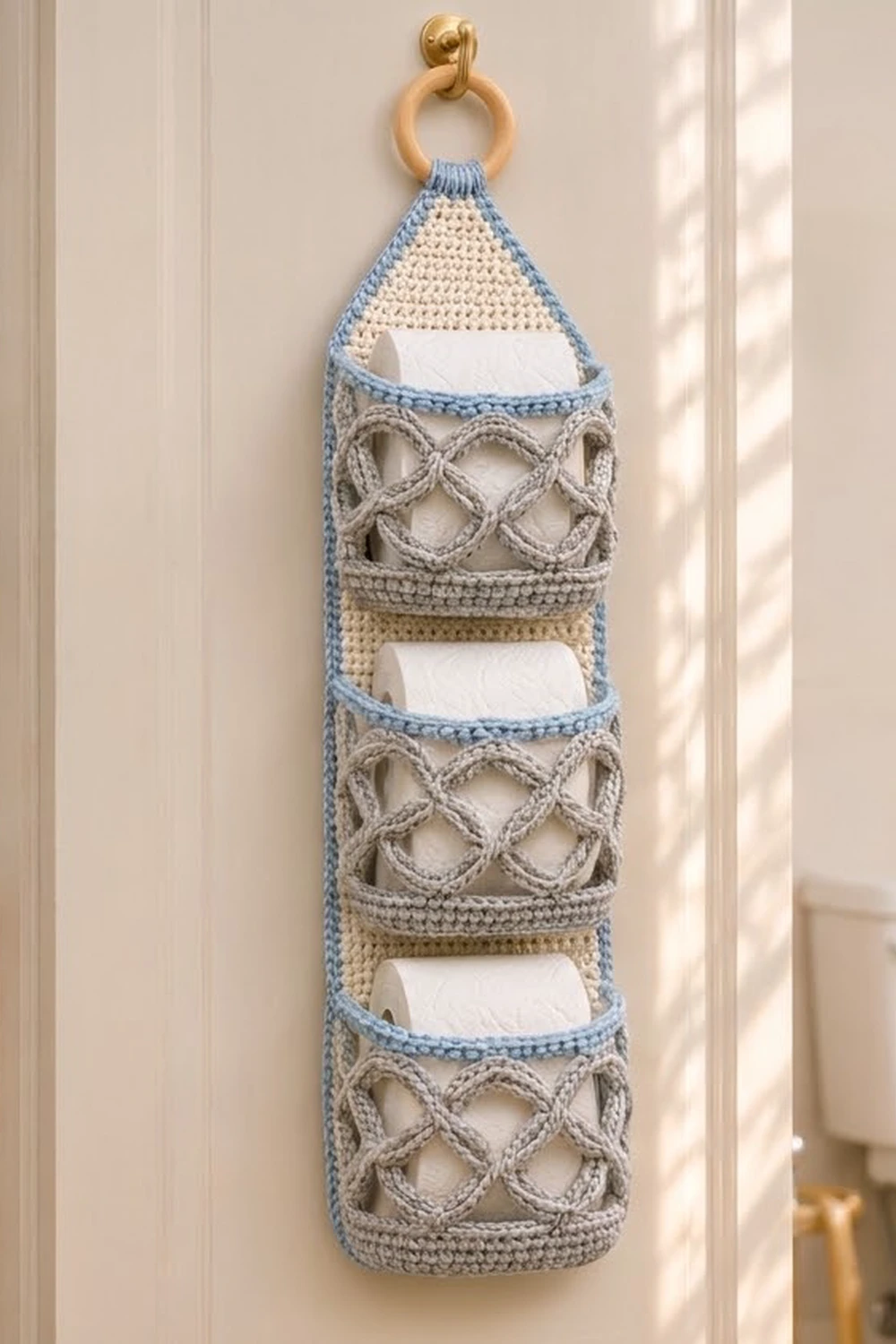
This hanging holder keeps three rolls of toilet paper tidy on a door or wall hook. It has a long cream backing panel with three stacked gray pockets. Each pocket front is a band of padded rings linked like chain mail, which gives an open, Celtic-style lattice.
Pale blue edging frames the panel and tops each pocket. A narrow tab at the top wraps around a natural wooden ring. The cream, heather gray and pale blue palette looks calm and slightly vintage, and it suits light wood, brass or white bathroom fittings.
The pattern uses US crochet terms. Laid flat, the holder measures 6.75 in (17.1 cm) wide and 28.75 in (73.0 cm) long. With the tab folded over the ring, it hangs about 26.75 in (67.9 cm). Each pocket measures 8.5 in (21.6 cm) wide and about 5.25 in (13.3 cm) tall.
Here is the order of work. First you crochet the panel in single crochet rows and taper it into a tab. For each pocket, you link nine padded rings into a band, then work a solid base down from the band and a rim up from it. Next you sew the pockets to the panel and add a two-round blue border. Finally you fold the tab over the wooden ring and sew it down.
Finished Size and Construction
- Finished size: 6.75 in × 28.75 in (17.1 cm × 73.0 cm) flat. It hangs about 26.75 in (67.9 cm).
- Skill level: Intermediate
- Terminology: US crochet terms
- Yarn weight: Worsted (#4)
- Hook: 5.0 mm (H-8)
- Number of pieces: 4 (1 panel and 3 pockets). The pockets contain 27 padded rings in total.
- Layout: 3 pockets stacked in 1 column on the panel
- Pocket size: 8.5 in × 5.25 in (21.6 cm × 13.3 cm)
- Panel size before border: 6 in × 28 in (15.2 cm × 71.1 cm)
- Border depth: about 3/8 in (1.0 cm) per edge
Materials
Use a smooth worsted-weight cotton or cotton blend. Cotton keeps the rings firm and the panel flat. Acrylic works too, but the pockets will stretch more under the weight of the rolls.
- Color A, Cream (panel): 80 g / 150 m
- Color B, Heather Gray (rings, pocket bases and rims): 70 g / 130 m
- Color C, Pale Blue (border and rim edges): 40 g / 75 m
Tools:
- 5.0 mm (H-8) crochet hook
- Tapestry needle
- 1 wooden ring, 2.75 in (7.0 cm) across
- Locking stitch markers
- Measuring tape, rust-proof pins and a blocking mat
The yarn quantities include a margin of about 15 percent.
Abbreviations (US Terms)
- ch: chain
- sl st: slip stitch
- sc: single crochet
- sc2tog: single crochet 2 together (decreases by 1 stitch)
- rev sc: reverse single crochet (crab stitch)
- st(s): stitch(es)
- RS / WS: right side / wrong side
- rep: repeat
Padded ring: Chain a ring and close it with a sl st. Then cover it completely with sc worked into the center of the ring, over the chain. The result is a thick, rope-like ring.
Reverse sc: Work sc from left to right (if you crochet right-handed), into the next stitch to the right.
Gauge and Checkpoints
Gauge: 16 sc × 18 rows = 4 in (10.2 cm). That works out to 4 sts and 4.5 rows per inch. Every measurement in this pattern comes from these two numbers.
Make one complete pocket before you start the panel. It tests your tension on both the rings and the solid rows.
Checkpoints:
- Padded ring: about 2 in (5.1 cm) across the outside, with a center opening of about 1.25 in (3.2 cm)
- Ring band of 9 rings: about 3 in (7.6 cm) tall
- Finished pocket: 8.5 in (21.6 cm) across the rim and about 5.25 in (13.3 cm) tall
- Panel after Row 20: 6 in (15.2 cm) wide and about 4.4 in (11.2 cm) tall
- Panel after Row 90: 20 in (50.8 cm) long
If your pieces come out too big, go down half a hook size. If they come out too small, go up half a hook size. If only the rings are off, change the ring chain to ch 18 or ch 22. Always keep 32 sc around each ring so the base and rim stitch counts stay correct.
Backing Panel
Use Color A. The ch 1 at the start of each row does not count as a stitch.
Row 1 (RS): Ch 25. Sc in the 2nd ch from the hook and in each ch across. Turn. (24 sc)
Rows 2–90: Ch 1, sc in each st across. Turn. (24 sc)
The panel now measures 6 in × 20 in (15.2 cm × 50.8 cm).
Taper:
Row 91: Ch 1, sc2tog, sc in each st to the last 2 sts, sc2tog. Turn. (22 sc)
Row 92: Ch 1, sc in each st across. Turn. (22 sc)
Rows 93–108: Rep Rows 91–92 eight more times. After each decrease row the count is 20, 18, 16, 14, 12, 10, 8 and then 6. (6 sc at the end of Row 108)
The panel now measures 24 in (61.0 cm) long.
Tab:
Rows 109–126: Ch 1, sc in each st across. Turn. (6 sc)
Fasten off. The panel measures 6 in × 28 in (15.2 cm × 71.1 cm) over 126 rows.
Each pocket has three parts: a band of 9 linked rings, a base worked down from the band, and a rim worked up from it.
Ring Band
Use Color B.
Lower rings (make 5 and label them L1–L5): Ch 20 and sl st in the first ch to form a ring. Ch 1, then work 32 sc into the ring over the chain. Sl st in the first sc. Fasten off. (32 sc)
Lay L1–L5 in a row from left to right, with their edges touching.
Upper rings (make 4 and label them U1–U4): Ch 20 but do not join. Pass the free end of the chain down through L1 from front to back, then up through L2 from back to front. Sl st in the first ch to close the ring. Ch 1 and work 32 sc into the ring, sliding L1 and L2 along as you go. Sl st in the first sc. Fasten off. (32 sc)
Link the other upper rings the same way: U2 through L2 and L3, U3 through L3 and L4, and U4 through L4 and L5.
Each upper ring now sits over the gap between two lower rings and overlaps the top half of both. Because each upper ring goes under one ring and over the next, the band looks woven and interlocked. It measures about 3 in (7.6 cm) tall.
Base
Use Color B. Turn the band so the bottoms of the lower rings face up.
Row 1 (RS): Join yarn in L1 and ch 1. Sc in each of the 6 bottom sts of L1, ch 1. *Sc in each of the 6 bottom sts of the next lower ring, ch 1. Rep from * twice more. Sc in each of the 6 bottom sts of L5. Turn. (30 sc + 4 ch = 34 sts)
Rows 2–3: Ch 1, sc in each sc and each ch across. Turn. (34 sc)
Row 4: Ch 1, sc2tog, sc in each st to the last 2 sts, sc2tog. Turn. (32 sc)
Row 5: Rep Row 4. (30 sc)
Row 6: Rep Row 4. (28 sc)
Fasten off. The base is about 1.3 in (3.3 cm) deep. The decreases round off the lower corners, and the bottom edge measures 7 in (17.8 cm).
Rim
Turn the pocket so the upper rings face up, with the RS facing you.
Row 1 (RS): Join Color B with a sc in the st at about the 10 o’clock position on L1, then sc in the next st. Ch 2, then sc in each of the 5 top sts of U1. *Ch 2, sc in each of the 5 top sts of the next upper ring. Rep from * twice more. Ch 2, then sc in each of the 2 sts at about the 2 o’clock position on L5. Turn. (2 + 2 + 5 + 2 + 5 + 2 + 5 + 2 + 5 + 2 + 2 = 34 sts)
Row 2: Ch 1, sc in each sc and each ch across. Fasten off. (34 sc)
Row 3: With the RS facing, join Color C in the first st. Ch 1, sc in each st across. Do not turn. (34 sc)
Row 4: Ch 1, rev sc in each st across. (34 rev sc)
Fasten off. The rim is about 0.9 in (2.3 cm) deep, and the pocket measures 8.5 in (21.6 cm) across the top.
Make All Pieces
- Color A: 1 backing panel
- Colors B and C: 3 pockets, using 27 rings in total (15 lower and 12 upper)
Layout, front view:
        [ wooden ring ]
            [ tab ]
          /  taper  \
         |   cream   |
         | Pocket 3  |  Rows 57–80
         |   gap     |
         | Pocket 2  |  Rows 30–53
         |   gap     |
         | Pocket 1  |  Rows 3–26
         |___________|
Joining
Use stitch markers to mark where each pocket goes: Rows 3–26, Rows 30–53 and Rows 57–80. The pocket bottoms are 27 rows, or 6 in (15.2 cm), apart. That leaves a 3-row cream gap of about 0.7 in (1.8 cm) between pockets.
Bottom seam: Use Color B. Sew the 28 sts of Base Row 6 across the 24 sts of the marked panel row, working through the front loops. Sew 1 pocket st to 1 panel st. At pocket sts 4, 10, 16 and 22, sew that st and the next pocket st together into a single panel st. This uses up the extra stitches exactly: 28 − 4 = 24.
Side seams: Whipstitch each side of the pocket to the outer cream stitch column of the panel, one stitch per panel row, for 24 rows. Catch the base row-ends, 3–4 sts on the outer edge of L1 or L5, and the rim row-ends.
The pocket is 8.5 in (21.6 cm) wide but sits on a 6 in (15.2 cm) panel, so the extra width bows outward. This makes the pocket about 2.25 in (5.7 cm) deep, and the rings stretch around a 4.5 in (11.4 cm) roll.
Sew with even tension. If you can see gaps in the seam, it is too loose. If the panel ripples, it is too tight.
Checkpoint: Measured flat, the panel is still 6 in (15.2 cm) wide at each pocket.
Border
The border keeps to the main gauge of 4 sc per inch. The long edges have 4.5 rows per inch, so skip 1 row-end in every 9 to keep them flat.
Rnd 1: With the RS facing, join Color C in the first foundation loop at the bottom right corner.
- Bottom edge: 3 sc in the first loop, sc in each of the next 22 loops, 3 sc in the last loop. (28 sc, including both corners)
- First long edge: *Sc in each of the next 8 row-ends, skip 1. Rep from * 8 more times. Then sc in each of the last 8 row-ends of Rows 2–90. (80 sc) Sc in each row-end of Rows 91–108. (18 sc) On Rows 109–125, sc in 8 row-ends, skip 1, then sc in 8 row-ends. (16 sc) This edge has 114 sc.
- Top of tab: 3 sc in the first st of Row 126, sc in each of the next 4 sts, 3 sc in the last st. (10 sc, including both corners)
- Second long edge: Work in mirror order: 16 sc on the tab, 18 sc on the taper and 80 sc on the rectangle. (114 sc)
Sl st in the first sc. (28 + 114 + 10 + 114 = 266 sc)
Rnd 2: Ch 1, rev sc in each st around. Sl st in the first st and fasten off. (266 rev sc)
Why the math works: On the rectangle, 9 rows measure 2 in (5.1 cm), which matches 8 sc at gauge. That is why 80 sc fit along 89 row-ends without ruffling. On the taper, every 2 rows rise 0.44 in (1.1 cm) and step in 0.25 in (0.6 cm). That gives a slanted edge of about 0.5 in (1.3 cm) per 2 rows, which matches 2 sc exactly. The 3-sc corners let the border turn without cupping. With the border, the panel measures 6.75 in × 28.75 in (17.1 cm × 73.0 cm).
Hanging ring: Pass the tab through the wooden ring from front to back. Fold the top 2 in (5.1 cm) of the tab to the back. Sew it down with Color A along both sides and straight across.
Final Blocking
- Take the holder off the hook and remove the rolls.
- Mist the panel and pockets until they are damp.
- Pin the panel face up to 6.75 in × 28.75 in (17.1 cm × 73.0 cm).
- Fill each pocket with a towel rolled to about 4.5 in (11.4 cm) across so the pocket keeps its curve as it dries.
- Shape each ring into an even circle with your fingers and straighten the overlaps.
- Let it dry completely, then unpin it.
Final Quality-Control Checklist
- The panel is 6.75 in (17.1 cm) wide and its edges lie flat.
- The border has 266 sts in each round, and the corners are crisp.
- Each pocket has 5 lower rings and 4 upper rings, and each upper ring is linked through two lower rings.
- Each rim has 34 sts with a neat blue edge.
- The pockets sit level on Rows 3–26, 30–53 and 57–80.
- The tab is folded 2 in (5.1 cm) over the ring and sewn securely.
- All yarn ends are woven in on the WS.
Troubleshooting
- The rings look lumpy: Push the sc close together so they fully cover the chain, and keep all 32 sc.
- The pocket rim flares: Make sure each gap in Rim Row 1 is exactly ch 2.
- The panel edges ripple: You missed some skipped row-ends. Rework the border to 114 sc per long edge.
- The panel edges pull in: Work Rnd 1 with a hook half a size larger.
- The pockets sag: Tighten the side seams, or switch to cotton yarn.
Care
Hand wash in cool water and roll the holder in a towel to remove excess water. Dry it flat with the pockets filled, and do not tumble dry.
Final Notes
The pattern is built on one gauge: 16 sc × 18 rows = 4 in (10.2 cm). At that gauge, 24 sts make a 6 in (15.2 cm) panel and 126 rows make it 28 in (71.1 cm) long. Each ring has 32 sc and measures about 2 in (5.1 cm). Nine linked rings make a 3 in (7.6 cm) band, and the 34-st rim makes each pocket 8.5 in (21.6 cm) wide. The 266-st border brings the panel to 6.75 in × 28.75 in (17.1 cm × 73.0 cm). If you check each measurement as you go, the holder will hang straight and hold three rolls neatly.
Happy crocheting!