

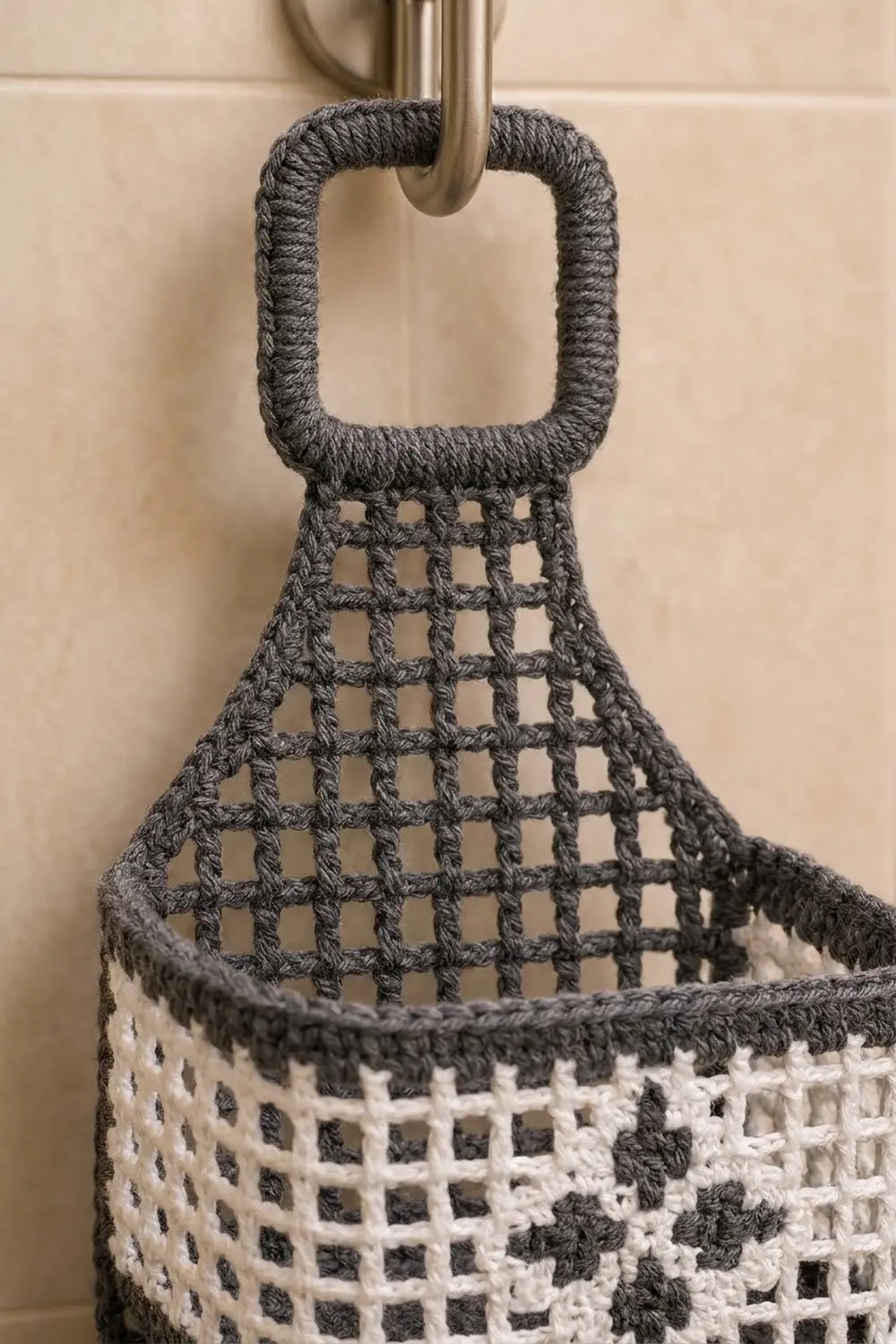
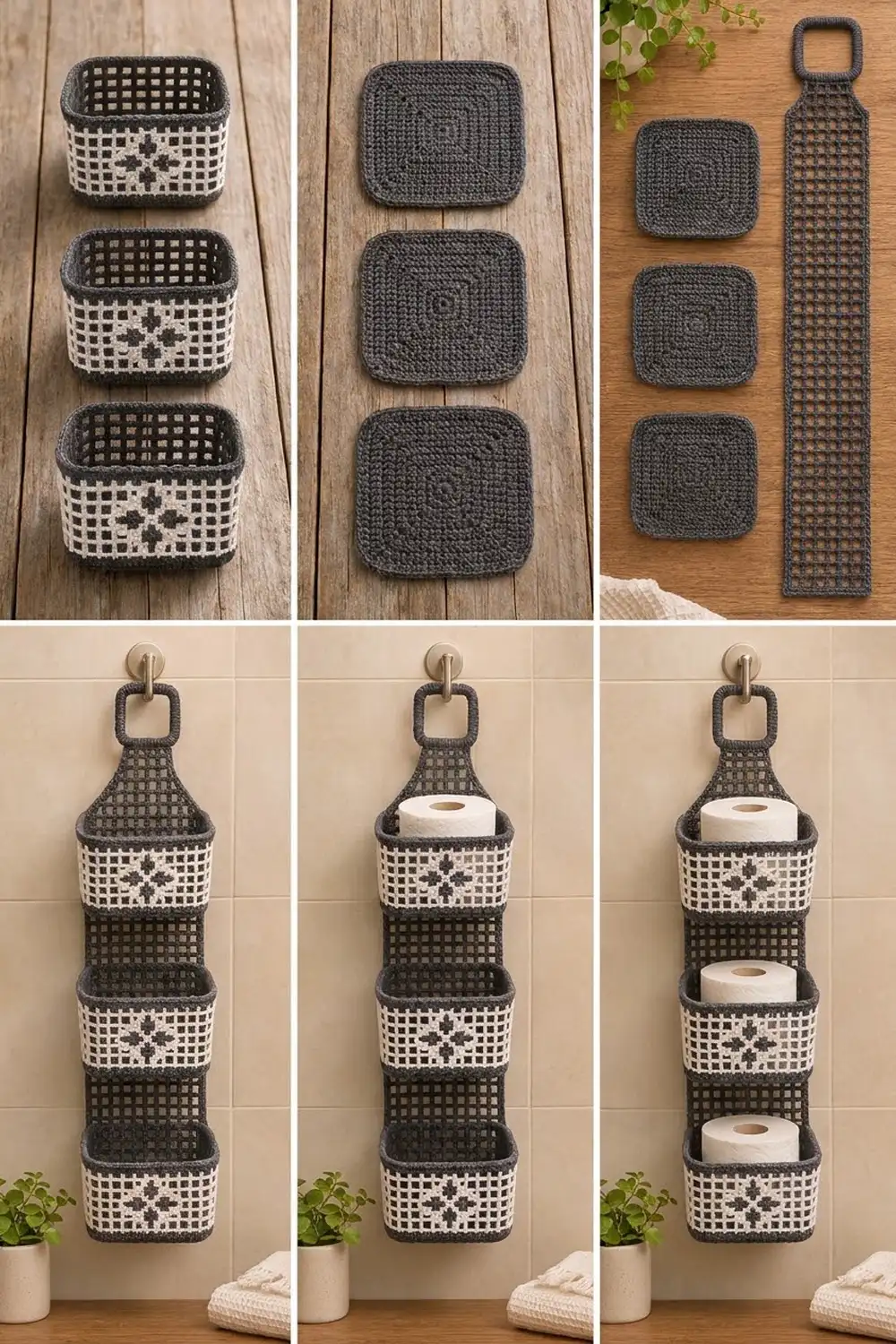
This hanging organizer has three square baskets sewn to one long mesh back panel. A padded square loop at the top lets it hang from a towel hook, and each basket holds one standard toilet roll.
It uses two colors, charcoal gray and white, for a crisp graphic look. Each basket has a solid charcoal base and white filet-mesh walls. A charcoal four-petal flower is worked in filled blocks on the front, with a solid charcoal band at the bottom and a corded charcoal rim at the top. The back panel is open charcoal mesh.
The pattern uses US crochet terms. The finished hanger is about 5.5 in (14.0 cm) wide and 22 in (55.9 cm) long, including the loop. Each basket is 5.5 in (14.0 cm) square and 4.5 in (11.4 cm) tall.
Construction overview:
- Each basket starts with a square base worked in rounds.
- The walls rise straight up from the base. The mesh section is worked in joined, turned rounds.
- The back panel is worked flat in mesh rows, tapered at the top and finished with a loop worked in one piece with it.
- One border round neatens the panel edges.
- The baskets are whipstitched to the panel at set rows.
Finished Size and Construction
- Finished size: about 5.5 in (14.0 cm) x 22 in (55.9 cm)
- Skill level: Intermediate
- Terminology: US
- Yarn weight: Worsted (#4) cotton
- Hook: 5.0 mm (H-8)
- Number of pieces: 4 (3 baskets, 1 back panel with loop)
- Layout: baskets stacked vertically, with 1.5 in (3.8 cm) gaps between them
- Basket size: 5.5 in (14.0 cm) square x 4.5 in (11.4 cm) tall
- Panel before border: 4.75 in (12.1 cm) wide, with a 17 in (43.2 cm) straight section
- Border depth: 0.25 in (0.6 cm)
Materials
Use a firm, smooth 100% cotton worsted yarn. Cotton holds the basket shape and keeps the mesh squares crisp, while acrylic makes softer walls. The amounts below assume about 1.6 m per gram, which is typical for worsted cotton.
- Charcoal gray: 180 g, about 288 m (315 yd)
- White: 75 g, about 120 m (131 yd)
Both quantities include a margin of about 20% for swatching and differences in tension.
Tools:
- 5.0 mm (H-8) hook
- Tapestry needle
- 4 stitch markers
- Scissors
- Measuring tape
- Rust-proof pins and a blocking mat
- Optional: spray starch
Abbreviations (US Terms)
- ch – chain
- sl st – slip stitch
- sc – single crochet
- dc – double crochet
- sk – skip
- sp – space
- BLO – back loop only
- rev sc – reverse single crochet (crab stitch)
- st(s) – stitch(es)
Special stitches:
- Mesh: dc in next dc, ch 1, sk next st or ch-1 sp. One mesh = 2 sts, open.
- Block: dc in next dc, dc in next ch-1 sp or st. One block = 2 sts, filled.
- Color change: work the last yarn-over of the previous stitch with the new color.
Gauge and Checkpoints
- Solid sc: 16 sts and 18 rounds = 4 in (10.2 cm)
- Filet mesh: 8 meshes and 8 rows = 4 in (10.2 cm), so each mesh is 0.5 in (1.3 cm) square
Make one complete basket first. That basket is your gauge test.
Checkpoints:
- After base Rnd 10, each side measures 5.5 in (14.0 cm).
- After Rnd 19, the mesh section measures 3.5 in (8.9 cm) tall.
- The finished basket is 4.5 in (11.4 cm) tall.
- After Row 34, the panel measures 17 in (43.2 cm) x 4.75 in (12.1 cm).
If your pieces measure too large, go down to a 4.5 mm hook. If they measure too small, go up to 5.5 mm. Don’t change the number of rounds, because the wall counts depend on the 80 base stitches. If the mesh squares come out taller than they are wide, keep your yarn-overs snug.
Baskets (Make 3)
Base
In this section, “per side” means the sc between two corner ch-2 spaces.
With charcoal, make a magic ring.
Rnd 1: Ch 1, (2 sc, ch 2) 4 times in ring, sl st to first sc. (8 sc, 2 per side; 4 corner sps)
Rnd 2: Ch 1. Sc in each sc, and work (sc, ch 2, sc) in each ch-2 sp. Sl st to first sc. (16 sc, 4 per side)
Rnds 3–10: Repeat Rnd 2. Each round has 2 more sc per side than the round before:
- Rnd 3: 24 sc (6 per side)
- Rnd 4: 32 sc (8 per side)
- Rnd 5: 40 sc (10 per side)
- Rnd 6: 48 sc (12 per side)
- Rnd 7: 56 sc (14 per side)
- Rnd 8: 64 sc (16 per side)
- Rnd 9: 72 sc (18 per side)
- Rnd 10: 80 sc (20 per side)
Checkpoint: each side measures 5.5 in (14.0 cm).
Walls
Rnd 11 (base fold): Ch 1. Working in BLO, sc in each of the 80 sc and work 2 sc in each corner sp. Sl st to join. (80 + 8 = 88 sc; 22 sts per side) The unworked front loops create the sharp fold between base and walls.
Rnd 12: Ch 1, sc in each st around, sl st to join. (88 sc)
Place markers on sts 1, 23, 45 and 67. These mark the start of Sides 1–4, and Side 3 is the front.
Fasten off the charcoal. Wind a 3 m (3.3 yd) charcoal bobbin for the flower.
Rnd 13 (conversion to mesh): Join white. Ch 4 (counts as dc + ch 1), sk 1. Work [dc in next st, ch 1, sk 1] around. Sl st to 3rd ch of beginning ch. (44 meshes = 88 sts; 11 meshes per side)
Rnds 14–19: Turn and ch 4. Work [dc in next dc, ch 1] around and sl st to join. Each round has 44 meshes. Work the flower chart on the front as you go.
Finding the front:
- On right-side rounds (13, 15, 17, 19), the front is meshes 23–33.
- On wrong-side rounds (14, 16, 18), the front is meshes 12–22.
The flower uses the center 7 meshes of the front, which leaves 2 open meshes on each side.
Working the colors:
- Work the blocks in charcoal and carry the white inside them.
- Carry the charcoal only inside the motif. Float it loosely on the inside of the wall behind open meshes.
- No float is ever longer than 2 meshes, or 1 in (2.5 cm).
- Because the rounds are turned, the charcoal strand is always waiting near the motif edge where the next round starts.
Flower chart (X = charcoal block, o = white mesh; read from the bottom up):
Rnd 19:  o o o X o o o
Rnd 18:  o o X X X o o
Rnd 17:  X X o X o X X
Rnd 16:  X X X o X X X
Rnd 15:  X X o X o X X
Rnd 14:  o o X X X o o
Rnd 13:  o o o X o o o
Every row is symmetrical, so you can read it in either direction. The open center on Rnd 16 forms the flower’s eye. Cut the charcoal bobbin after Rnd 19.
Checkpoint: the mesh section measures 3.5 in (8.9 cm) tall.
Rnd 20 (conversion to solid): Join charcoal and don’t turn. Ch 1, then sc in each dc and each ch-1 sp. Sl st to join. (44 posts + 44 sps = 88 sc)
Rnd 21: Ch 1, sc around, sl st to join. (88 sc)
Rnd 22: Ch 1, rev sc around, sl st to join. (88 rev sc) Fasten off and leave a 30 in (76.2 cm) tail.
Checkpoint: the basket is 4.5 in (11.4 cm) tall and 5.5 in (14.0 cm) per side.
Back Panel
With charcoal, ch 22.
Row 1: Dc in 6th ch from hook. The skipped chs count as dc, ch 1 and one skipped ch. Work [ch 1, sk 1, dc in next ch] 8 times. (10 posts, 9 meshes = 19 sts)
Rows 2–34: Ch 4 (counts as dc + ch 1), turn. Work [dc in next dc, ch 1] across, ending with dc in 3rd ch of turning ch. (9 meshes)
Checkpoint: the panel measures 17 in (43.2 cm) x 4.75 in (12.1 cm).
Row 35: Turn. Sl st in first ch-1 sp and in next dc, then ch 4. Work meshes across, ending with dc in the second-to-last dc. Leave the last mesh unworked. (7 meshes)
Rows 36–37: Repeat Row 35. (5 meshes, then 3 meshes)
Row 38: Ch 4, turn, work meshes across. (3 meshes = 7 sts; 1.75 in / 4.4 cm wide)
Row 39 (conversion to solid): Ch 1, turn. Sc in each dc and each ch-1 sp. (4 posts + 3 sps = 7 sc)
Rows 40–41: Ch 1, turn, sc across. (7 sc)
Loop:
- Ch 28, then sl st in the first sc of Row 41 to make an arch.
- Loop Rnd 1: Ch 1, turn. Working around the arch: sc 8, 3 sc in next ch, sc 10, 3 sc in next ch, sc 8. Sl st to neck. (32 sc)
- Loop Rnd 2: Ch 1, turn. Sc in each sc, working 3 sc in the center st of each of the 2 corners. Sl st to neck. (32 + 4 = 36 sc)
The loop is about 2.5 in (6.4 cm) square. Don’t fasten off.
Make All Pieces
- Each basket: about 42 g charcoal and 20 g white
- Back panel: about 25 g charcoal
These per-piece amounts total 151 g charcoal and 60 g white. The difference from the Materials list is the margin.
Placement on the panel (Row 1 is at the bottom):
[ Loop + neck   Rows 39–41 ]
[ Taper         Rows 35–38 ]
[ Open mesh     Row 34     ]
[ Basket 3      Rows 25–33 ]
[ Gap           Rows 22–24 ]
[ Basket 2      Rows 13–21 ]
[ Gap           Rows 10–12 ]
[ Basket 1      Rows 1–9   ]
A basket is 4.5 in (11.4 cm) tall. Nine panel rows at 0.5 in (1.3 cm) each also measure 4.5 in, so each basket covers exactly 9 rows.
Border
Work the border on the panel before joining.
Border gauge: 4 sc per inch (2.5 cm) along every edge.
Border Rnd: Use the attached charcoal. Sl st to the edge of Row 41, then work down the first long side:
- Neck: 1 sc in each row end of Rows 41–39 = 3 sc
- Taper row ends: 2 sc around each row-end post of Rows 38–35 = 8 sc
- Taper ledges: 2 sc along each of the 3 exposed ledge meshes = 6 sc
- Straight edge: 2 sc around each row-end post of Rows 34–1 = 68 sc
- Side total: 3 + 8 + 6 + 68 = 85 sc
Bottom edge: Work 3 sc in each of the 2 end foundation chs (the corners) and 1 sc in each of the 17 chs between them. That gives 6 + 17 = 23 sc.
Work the second long side to match (85 sc). Sl st at the far edge of Row 41 and fasten off.
Total: 85 + 23 + 85 = 193 sc.
Why the math works:
- Each dc row is 0.5 in (1.3 cm) tall, so 2 sc at 4 per inch fill it exactly. That gives 34 x 2 = 68 sc for 17 in (43.2 cm).
- Each ledge mesh is also 0.5 in wide and takes 2 sc.
- The corner 3-sc groups let the bottom edge turn without cupping.
- The border adds 0.25 in (0.6 cm) on each side. The panel becomes 5.25 in (13.3 cm) wide, slightly narrower than the 5.5 in (14.0 cm) baskets, so it stays hidden behind them.
Joining
Use the 30 in (76.2 cm) charcoal tail and whipstitch each basket’s back wall (Side 1) to the panel.
Stitch matching:
- One panel row is 19 sts plus 2 border sc, for 21 sts.
- The back wall of a basket has 22 sts.
- Start at the center of the basket’s back wall and match 1 basket st to 1 panel st, working outward. Let the final corner st ease in.
Seams for each basket:
- Bottom seam: sew Rnd 12 of the basket to the lowest panel row of its range (for example, Row 1 for Basket 1).
- Top seam: sew Rnd 21 of the basket to the highest panel row of its range (for example, Row 9 for Basket 1).
- Corners: tack both back corners to the panel edge every 1 in (2.5 cm).
Pull each stitch snug but not tight. The panel should lie flat behind the basket without puckering.
Checkpoint: the assembled hanger measures about 22 in (55.9 cm), and both gaps between baskets measure 1.5 in (3.8 cm).
Final Blocking
- Spritz the whole piece with water until it is damp.
- Lay the panel flat and pin it to 5.25 in (13.3 cm) wide, keeping the mesh squares square.
- Stuff each basket with a toilet roll or a folded towel so it holds a 5.5 in (14.0 cm) square shape.
- Pin the loop into a square.
- Optional: mist with spray starch for firmer walls.
- Let it dry completely, at least 24 hours, before you hang it.
Final Quality-Control Checklist
- Each basket measures 5.5 in (14.0 cm) per side and 4.5 in (11.4 cm) tall.
- Every basket round has 88 sts.
- The flower is centered with 2 open meshes on each side.
- No charcoal floats show from the outside.
- The panel has 9 meshes per row and a 193-sc border.
- The baskets sit at Rows 1–9, 13–21 and 25–33.
- All seams are flat and every tail is woven in.
Troubleshooting
- The walls flare outward: your mesh tension is loose. Go down a hook size for Rnds 13–19.
- The base cups: check that you worked (sc, ch 2, sc) in every corner.
- The flower sits off-center: recount from the markers on every round.
- Floats show through the mesh: keep them on the inside of the wall and loose.
- The panel is narrower than 4.75 in (12.1 cm): your foundation chain is tight. Chain with a hook one size larger.
- The baskets sag: add a seam stitch through every panel st and tack the corners more often.
Care
Hand wash in cool water, press out the excess and dry flat, reshaping the baskets while damp. Re-starch if the walls soften.
Final Notes
The measurements chain together like this:
- 80 base sc make a 5.5 in (14.0 cm) square.
- The walls have 88 sts, or 44 meshes, with 11 per side.
- 9 mesh rows at 0.5 in (1.3 cm) each match each 4.5 in (11.4 cm) basket.
- The 34-row panel is 17 in (43.2 cm) long and has a 193-sc border.
- Everything finishes at about 22 in (55.9 cm).
If your measurements hit these checkpoints, the pieces will fit together. Happy crocheting!