
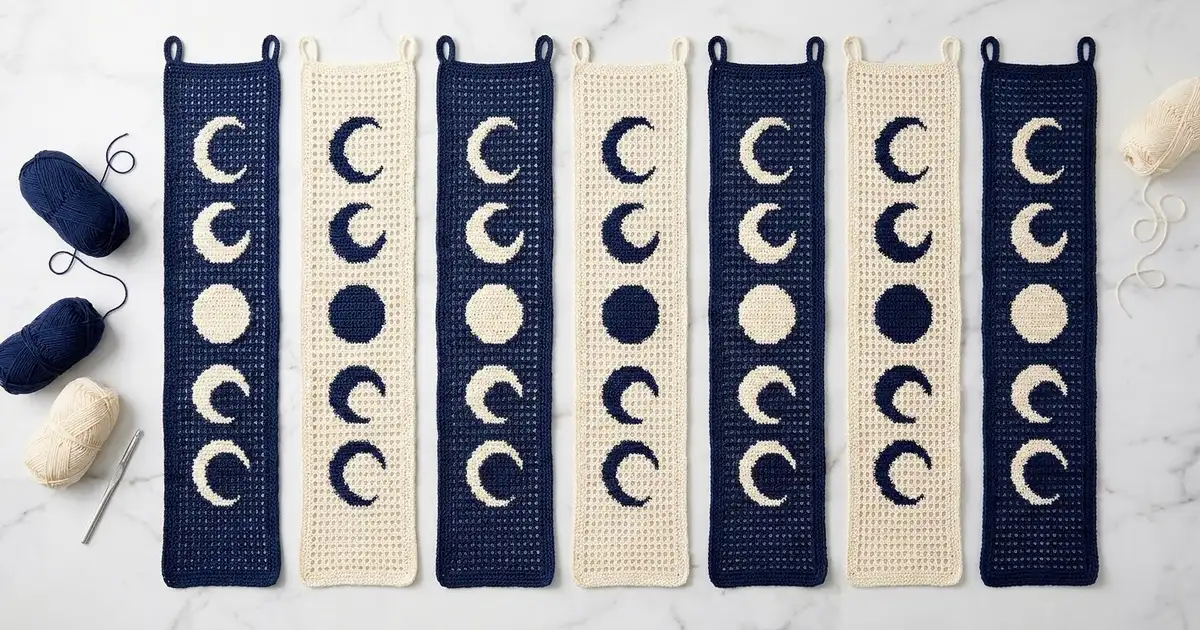
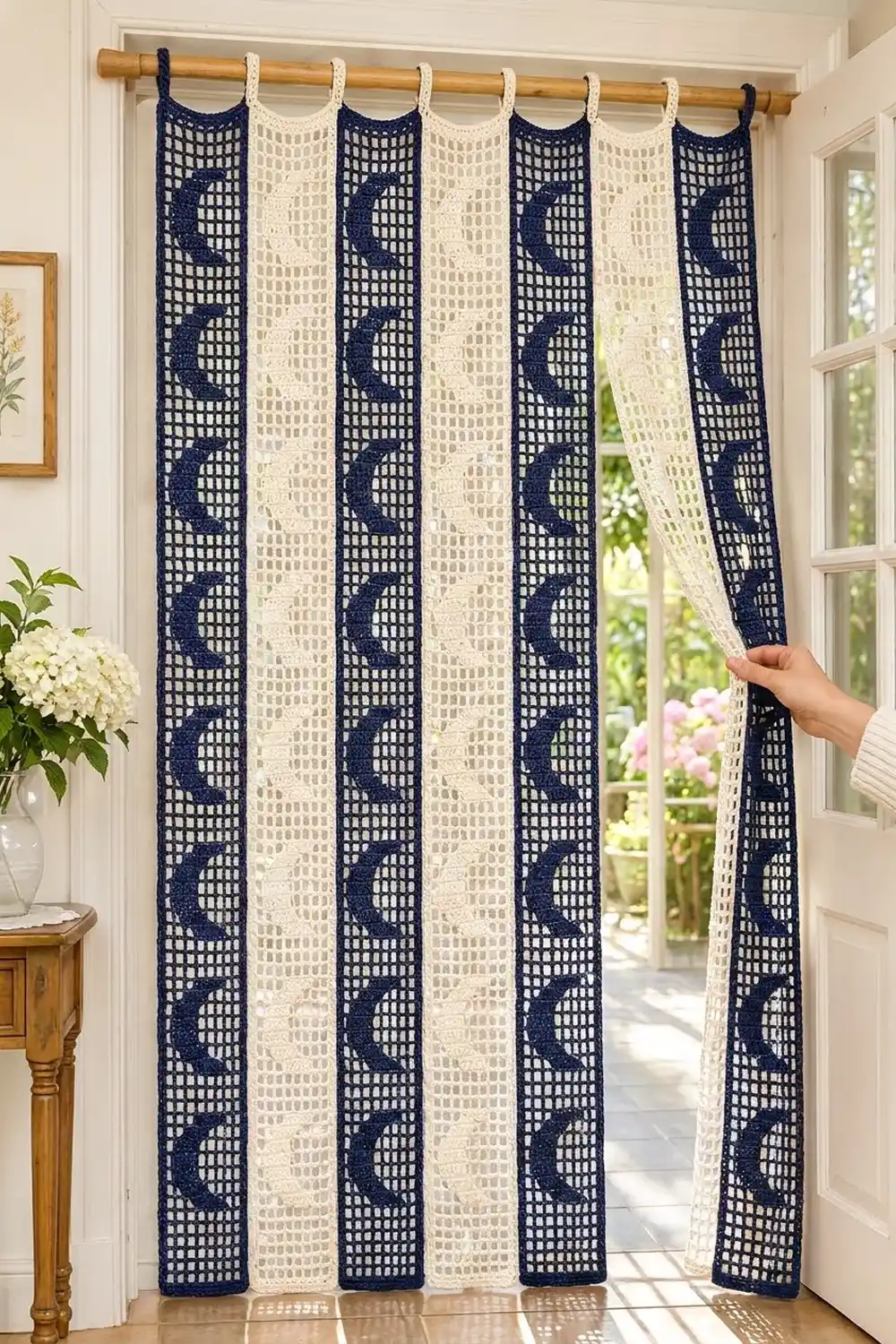
This doorway curtain is made of seven independent filet crochet strips in alternating navy and cream. Each strip is an open grid of square meshes with a column of solid crescent moons running down its length. Light passes through the mesh, while the moons stay crisp and graphic.
The color plan is simple: four navy strips and three cream strips, hung navy–cream–navy–cream–navy–cream–navy. Each moon is worked in the same yarn as its strip, so the motif reads through texture and shadow rather than color changes.
This pattern uses US crochet terms. Each finished strip measures 5.25 in (13.3 cm) wide and 74.75 in (189.9 cm) long, plus 1.5 in (3.8 cm) hanging loops. The seven strips together span about 39.75 in (101.0 cm) on the rod when spaced 0.5 in (1.3 cm) apart.
Construction is straightforward. You work each strip flat in rows of filet mesh from the bottom up, adding solid blocks to form nine crescents. A two-round single crochet border finishes all four edges, and two covered loops are added at the top. The strips are never sewn together; they hang side by side on the rod.
Finished Size and Construction
- Finished strip size: 5.25 in × 74.75 in (13.3 cm × 189.9 cm), plus 1.5 in (3.8 cm) loops
- Skill level: Intermediate (basic filet reading)
- Terminology: US
- Yarn weight: DK (weight 3) cotton
- Hook: 4.0 mm (US G-6)
- Number of pieces: 7 strips (4 navy, 3 cream)
- Layout: 7 strips side by side on a rod, not joined
- Strip size before border: 9 meshes × 148 rows = 4.5 in × 74 in (11.4 cm × 188.0 cm)
- Border depth: 0.375 in (1.0 cm) per side, 2 rounds of sc
- Moon size: 4 meshes × 8 rows = 2 in × 4 in (5.1 cm × 10.2 cm)
Materials
Choose a smooth DK cotton or mercerized cotton. Cotton holds the square mesh shape, blocks cleanly, and hangs straight without stretching the way acrylic can. Avoid fuzzy or textured yarns; they blur the mesh.
- Navy: 250 g / 575 m (5 balls of 50 g / 115 m) for 4 strips
- Cream: 200 g / 460 m (4 balls of 50 g / 115 m) for 3 strips
One strip uses approximately 105–115 m (about 50 g). The quantities above include a margin for the test swatch, gauge differences, and weaving in.
Tools:
– 4.0 mm (US G-6) crochet hook
– Tapestry needle
– Scissors
– Stitch markers
– Tape measure
– Blocking mats and rust-proof pins (or a long table and towels)
– Spray bottle
– Curtain rod or tension rod, up to 0.75 in (1.9 cm) in diameter and at least 42 in (106.7 cm) long
Abbreviations (US Terms)
- ch: chain
- sl st: slip stitch
- sc: single crochet
- dc: double crochet
- sk: skip
- sp: space
- st(s): stitch(es)
- RS / WS: right side / wrong side
Special stitches (filet units):
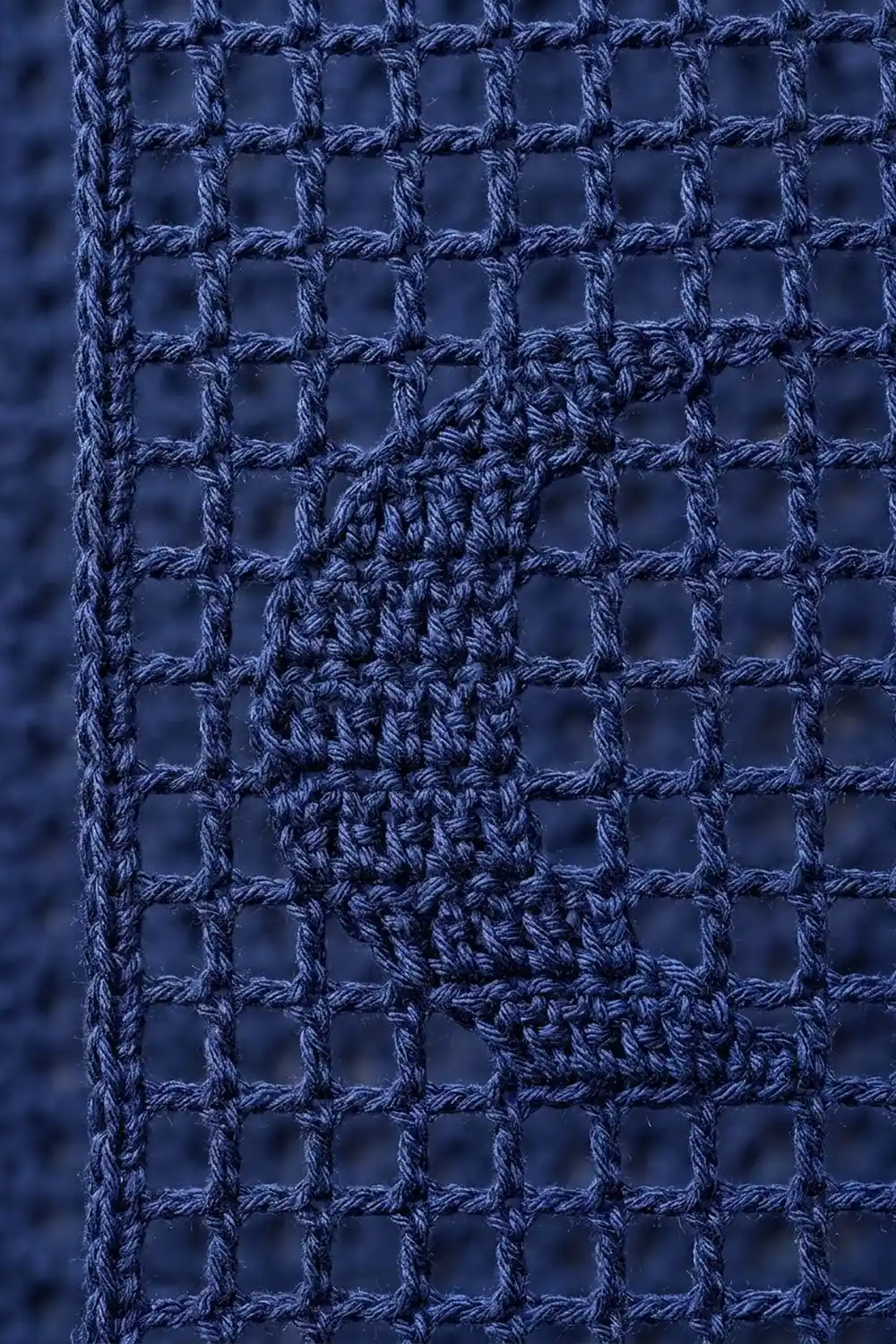
- Mesh (open square): ch 2, sk next 2 sts (or ch-2 sp), dc in next dc.
- Block (solid square) over a mesh: 2 dc in next ch-2 sp, dc in next dc.
- Mesh over a block: ch 2, sk next 2 dc, dc in next dc.
- Beginning mesh: ch 5, turn (counts as first dc + ch 2), sk first ch-2 sp, dc in next dc.
Every row contains 10 dc “posts” and 9 squares, for 28 sts total (10 dc + 18 ch or dc). The count never changes; only the fill of each square does.
Gauge and Checkpoints
Gauge: 8 meshes and 8 rows = 4 in (10.2 cm) in filet mesh, after light blocking. Each square is 0.5 in × 0.5 in (1.3 cm × 1.3 cm).
Test one piece first. Make a single-moon swatch before starting a full strip:
- Ch 32 and work Row 1 of the pattern (9 meshes).
- Work 1 more plain mesh row.
- Work Moon Rows 1–8 (below).
- Work 2 plain mesh rows.
You now have 12 rows. Steam lightly and measure. The swatch should be 4.5 in × 6 in (11.4 cm × 15.2 cm), and the moon should be 2 in × 4 in (5.1 cm × 10.2 cm).
Checkpoints on the full strip:
– After Row 6: 4.5 in wide × 3 in tall (11.4 cm × 7.6 cm)
– After Row 22 (first moon plus spacing): 11 in (27.9 cm) tall
– After Row 70: 35 in (88.9 cm) tall
– After Row 148: 74 in (188.0 cm) tall
Measure flat and unstretched. A width tolerance of ±0.25 in (0.6 cm) is fine.
If your swatch is too big: go down to a 3.75 mm hook. If it’s too small: go up to a 4.5 mm hook. If the width matches but the height is off, change how far you pull up each dc loop instead of changing hooks. Tall, loose dc make the squares rectangular.
Strip Pattern
Make 7 strips (4 navy, 3 cream). All strips are identical except for color.
Reading the rows: Odd rows are RS and are worked right to left; even rows are WS. Columns are numbered 1–9 from the right edge as seen on the RS. Each moon row below is written in working order, so simply follow it from the start of the row.
Row 1 (RS): Ch 32, dc in 8th ch from hook, [ch 2, sk 2 ch, dc in next ch] 8 times. Turn. (9 meshes; 10 dc posts, 28 sts)
The 7 skipped chains form the first mesh. Its corner is the 3rd of those 7 chains, counting from the hook end.
Row 2 (WS): Beginning mesh, [ch 2, sk ch-2 sp, dc in next dc] 7 times, ch 2, sk 2 ch, dc in the corner chain (3rd skipped chain from the hook end). Turn. (9 meshes, 28 sts)
Rows 3–6: Beginning mesh, [ch 2, sk ch-2 sp, dc in next dc] 7 times, ch 2, dc in 3rd ch of turning ch-5. Turn. (9 meshes, 28 sts per row)
Rows 1–6 are the bottom plain band. Check: 3 in (7.6 cm) tall.
Moon Repeat (16 rows)
Each repeat is 8 moon rows followed by 8 plain rows. In the counts below, “M” means mesh and “B” means block.
Moon Row 1 (RS): 3 M, 2 B, 4 M. Blocks fill columns 4–5. (28 sts)
Moon Row 2 (WS): 3 M, 2 B, 4 M. Blocks fill columns 6–5. (28 sts)
Moon Row 3 (RS): 5 M, 2 B, 2 M. Blocks fill columns 6–7. (28 sts)
Moon Row 4 (WS): 2 M, 2 B, 5 M. Blocks fill columns 7–6. (28 sts)
Moon Row 5 (RS): 5 M, 2 B, 2 M. Columns 6–7. (28 sts)
Moon Row 6 (WS): 2 M, 2 B, 5 M. Columns 7–6. (28 sts)
Moon Row 7 (RS): 4 M, 2 B, 3 M. Columns 5–6. (28 sts)
Moon Row 8 (WS): 4 M, 2 B, 3 M. Columns 5–4. (28 sts)
Each moon row has 2 blocks and 7 meshes. That gives 10 posts + 4 block dc = 14 dc, plus 7 × ch 2 = 14 ch, for 28 sts.
From bottom to top, the block columns step 4–5, 5–6, 6–7, 6–7, 6–7, 6–7, 5–6, 4–5. Seen on the RS, column 9 is on the left. The crescent therefore bulges to the left with its tips pointing right, forming a “C” two squares thick. Each moon uses 16 blocks.
Plain Rows 9–16 of the repeat: Work as Rows 3–6 (9 meshes, 28 sts per row). Remember that a mesh worked over a block skips 2 dc instead of a ch-2 sp.
Full Strip Sequence
- Rows 1–6: plain mesh (bottom band)
- Rows 7–134: work the 16-row Moon Repeat 8 times (8 moons)
- Rows 135–142: Moon Rows 1–8 (9th moon)
- Rows 143–148: 6 plain mesh rows (top band)
Total: 148 rows, 9 moons. Each repeat is 16 rows = 8 in (20.3 cm). Because 16 is even, every moon starts on an RS row. Both end bands are 6 rows deep, and every gap between moons is 8 rows.
Do not fasten off after Row 148; continue directly into the border.
Make All Pieces
- Navy: 4 strips
- Cream: 3 strips
Layout on the rod, left to right, as you face the curtain from the room:
| N | C | N | C | N | C | N |
N = navy, C = cream. Hang every strip with its RS facing the room so every crescent opens the same way.
Hanging the Strips (No Seaming)
The strips are not stitched to each other. Each one hangs freely from its own two loops, so the curtain parts easily when someone walks through it.
Spacing: Thread the strips onto the rod in layout order and space them about 0.5 in (1.3 cm) apart. Seven strips at 5.25 in (13.3 cm) total 36.75 in (93.3 cm). The six gaps add 3 in (7.6 cm), for a total of 39.75 in (101.0 cm).
Tension advice: Nothing ties the strips together, so matching their lengths matters more than usual. Hang all seven strips before trimming the ends, and check that the bottom edges line up within 0.5 in (1.3 cm). Re-block any that are short.
Size checkpoint: Each hanging strip should measure 76.25 in (193.7 cm) from the top of its loops to its bottom edge.
Border
Border gauge: 4 sc = 1 in (2.5 cm) along all edges.
The math works because the rate is the same in both directions. Each mesh is 0.5 in wide and gets 2 sc (one in the dc, one in the ch-2 sp). Each row is 0.5 in tall and gets 2 sc along its end. Both come to 4 sc per inch, so the edge lies flat without ruffling or cupping.
Round 1 (RS): Ch 1, turn so the RS faces you. Work across the top edge (Row 148):
– 3 sc in first dc (corner).
– [1 sc in ch-2 sp, sc in next dc] 8 times, 1 sc in last ch-2 sp.
– 3 sc in last dc (corner).
– Down the long side: 2 sc around the post of each row-end, 148 rows.
– 3 sc in the corner at the base of the last dc of Row 1.
– Across the bottom: [1 sc in ch-2 sp, sc in base of next dc] 8 times, 1 sc in last sp.
– 3 sc in the final corner.
– Up the second long side: 2 sc in each row-end, 148 rows.
– Sl st to first sc.
Counts: the middle sc of each 3-sc group is the corner st. Between corners, the top and bottom have 19 sc each (1 + 17 + 1), and each long side has 298 sc (1 + 296 + 1). Total: 19 + 19 + 298 + 298 + 4 corners = 638 sc.
Round 2: Ch 1, sc in each sc around, working 3 sc in each corner sc. Sl st to first sc. Fasten off.
Counts: the top and bottom have 21 sc each between corners, and the long sides have 300 sc each. Adding the 4 corners: 21 + 21 + 300 + 300 + 4 = 646 sc.
The border adds 0.375 in (1.0 cm) per side, bringing the strip to 5.25 in × 74.75 in (13.3 cm × 189.9 cm).
Hanging Loops
With the RS facing, number the 21 sc between the top corners 1 to 21, from right to left.
Right loop: Join yarn with sl st in sc 3. Ch 12, sk sc 4–6, sl st in sc 7. Turn, work 18 sc into the ch-12 loop, sl st in sc 3. Fasten off.
Left loop: Join with sl st in sc 15. Ch 12, sk sc 16–18, sl st in sc 19. Turn, work 18 sc into the loop, sl st in sc 15. Fasten off.
The loops mirror each other, each starting 3 sts in from its corner, with 8 sts (2 in, 5.1 cm) between them. Each loop stands 1.5 in (3.8 cm) tall and fits a rod up to 0.75 in (1.9 cm) in diameter.
Weave all ends into the border. Tails woven across open meshes would show.
Final Blocking
- Soak the strip in cool water for 15 minutes, then roll it in a towel and press out the water. Do not wring.
- Lay it flat on mats, or on a long table covered with towels, RS up.
- Pin the long sides straight at 5.25 in (13.3 cm) wide, and pin the length to 74.75 in (189.9 cm).
- Square the meshes with your fingers so each opening is 0.5 in (1.3 cm), keeping the columns of posts vertical.
- Shape each crescent so the curve is smooth and both tips sit level.
- Pin the loops upright and open.
- Let the strip dry completely, then unpin.
Final Quality-Control Checklist
- Each strip has 9 meshes across and 148 rows.
- Every row has 28 sts and 10 posts.
- Each strip has 9 crescents, all opening right on the RS.
- The bands at top and bottom are 6 rows each.
- Border Round 2 has 646 sc with 3-sc corners.
- Two loops sit 3 sts in from each top corner.
- Each strip measures 5.25 in × 74.75 in (13.3 cm × 189.9 cm).
- All 7 strips match in length within 0.5 in (1.3 cm).
- All ends are woven into the border.
Troubleshooting
Squares look like tall rectangles. Your dc are too loose. Pull the first loop up only to the height of the ch-2, or try a smaller hook.
Strip slants or narrows. You probably missed the last dc in the turning chain. Count 10 posts in every row.
Crescent looks jagged or reversed. Check RS/WS. The moon rows are written in working order, so if you start a moon on a WS row, the shape flips.
Long edges ripple. You worked too many sc in Round 1. Use exactly 2 sc per row-end.
Edges pull in. You worked too few sc, or your tension is too tight. Go up one hook size for the border only.
Strips hang at different lengths. Re-wet and re-block the short strip, pinning it to 74.75 in (189.9 cm).
Care
Hand wash in cool water with mild detergent and lay flat to dry, re-pinning to size if needed. Don’t hang strips while they’re wet, because the weight of the water will stretch them.
Final Notes
Every measurement in this curtain builds from the one before. Gauge sets each square at 0.5 in (1.3 cm). Nine squares make 4.5 in (11.4 cm), and 148 rows make 74 in (188.0 cm). At 4 sc per inch, the border adds 0.375 in (1.0 cm) per side, for a 5.25 in × 74.75 in (13.3 cm × 189.9 cm) strip. The 1.5 in (3.8 cm) loops bring each strip to 76.25 in (193.7 cm). Seven strips spaced 0.5 in (1.3 cm) apart fill 39.75 in (101.0 cm) of rod.
Happy crocheting!