

This beaded curtain is made of hanging strands of lacy peacock feathers. Each feather has an open gold-ringed eye inside a deep emerald band, surrounded by cream lace that ends in picot scallops. Between the feathers, cream and emerald crocheted balls sit on a firm cream cord, so the strands sway and catch the light like a beaded door curtain, but softer.
The palette is cream, emerald green and metallic gold. The look is elegant and a little vintage. It suits a bedroom window, a doorway or a reading nook. The pattern uses US crochet terms throughout.
The finished curtain is about 60.5 in (153.7 cm) wide. Strand A hangs 77 in (195.6 cm) long and Strand B hangs 83.5 in (212.1 cm) long. Each feather measures 5.5 in x 7.5 in (14.0 cm x 19.1 cm).
To make it, you crochet each feather in the round, starting from the gold eye and working outward. Then you make the cream and emerald balls, crochet one cord per strand, close the balls around the cord, and sew the feathers on behind.
Finished Size and Construction
- Finished curtain: 60.5 in (153.7 cm) wide; Strand A 77 in (195.6 cm), Strand B 83.5 in (212.1 cm)
- Skill level: Intermediate
- Terminology: US
- Yarn weight: Sport (2) mercerized cotton, plus sport-weight metallic gold
- Hook: 3.0 mm (C/D)
- Number of pieces: 72 feathers, 120 cream balls, 72 emerald balls, 12 cords
- Layout: 12 strands, 6 feathers each, with Strands A and B alternating
- Piece size: 5.5 in x 7.5 in (14.0 cm x 19.1 cm) per feather
- Size before border: 4.75 in x 6.75 in (12.1 cm x 17.1 cm) after Round 7
- Border depth: 0.375 in (1.0 cm)
Materials
Choose a smooth mercerized cotton. It gives crisp picots, holds its shape when it hangs, and resists sun fading better than acrylic. The amounts below assume about 155 m per 50 g.
- Cream: 600 g (1,860 m)
- Emerald green: 200 g (620 m)
- Metallic gold, sport weight: 50 g (200 m at about 4 m per g)
These quantities include a margin of about 10%.
Tools:
– 3.0 mm hook
– Large-eye blunt tapestry needle
– Polyester fiberfill (a small handful per 10 balls)
– Locking stitch markers
– Rust-proof pins and a blocking board
– Spray bottle
– Measuring tape
– 12 curtain clip rings
Abbreviations (US Terms)
- ch: chain
- sl st: slip stitch
- sc: single crochet
- hdc: half double crochet
- dc: double crochet
- tr: treble crochet
- sk: skip
- sp: space
- st(s): stitch(es)
- MR: magic ring
- inc: 2 sc in the same st
- dec: sc2tog
- [ ]×n: repeat the bracketed part n times
Special stitch – Picot: ch 3, sl st in the 3rd ch from the hook. A picot is not counted as a stitch.
Gauge and Checkpoints
Swatch gauge: 22 sc and 24 rows = 4 in (10.2 cm). Even so, a full test feather is the most reliable check, so make one complete feather before starting the batch.
Checkpoints (measured flat, width x length):
– After Round 1: 1.25 in x 1.75 in (3.2 cm x 4.4 cm)
– After Round 4: 3.5 in x 4.75 in (8.9 cm x 12.1 cm)
– After Round 6: 4.25 in x 6 in (10.8 cm x 15.2 cm)
– After Round 7: 4.75 in x 6.75 in (12.1 cm x 17.1 cm)
– After Round 8, blocked: 5.5 in x 7.5 in (14.0 cm x 19.1 cm)
If your feather is too big, go down to a 2.75 mm hook. If it is too small, go up to a 3.25 mm hook. If the green band cups, your tension is tight in the treble section, so relax your yo pulls there. If it ruffles, check your increase counts against the totals below.
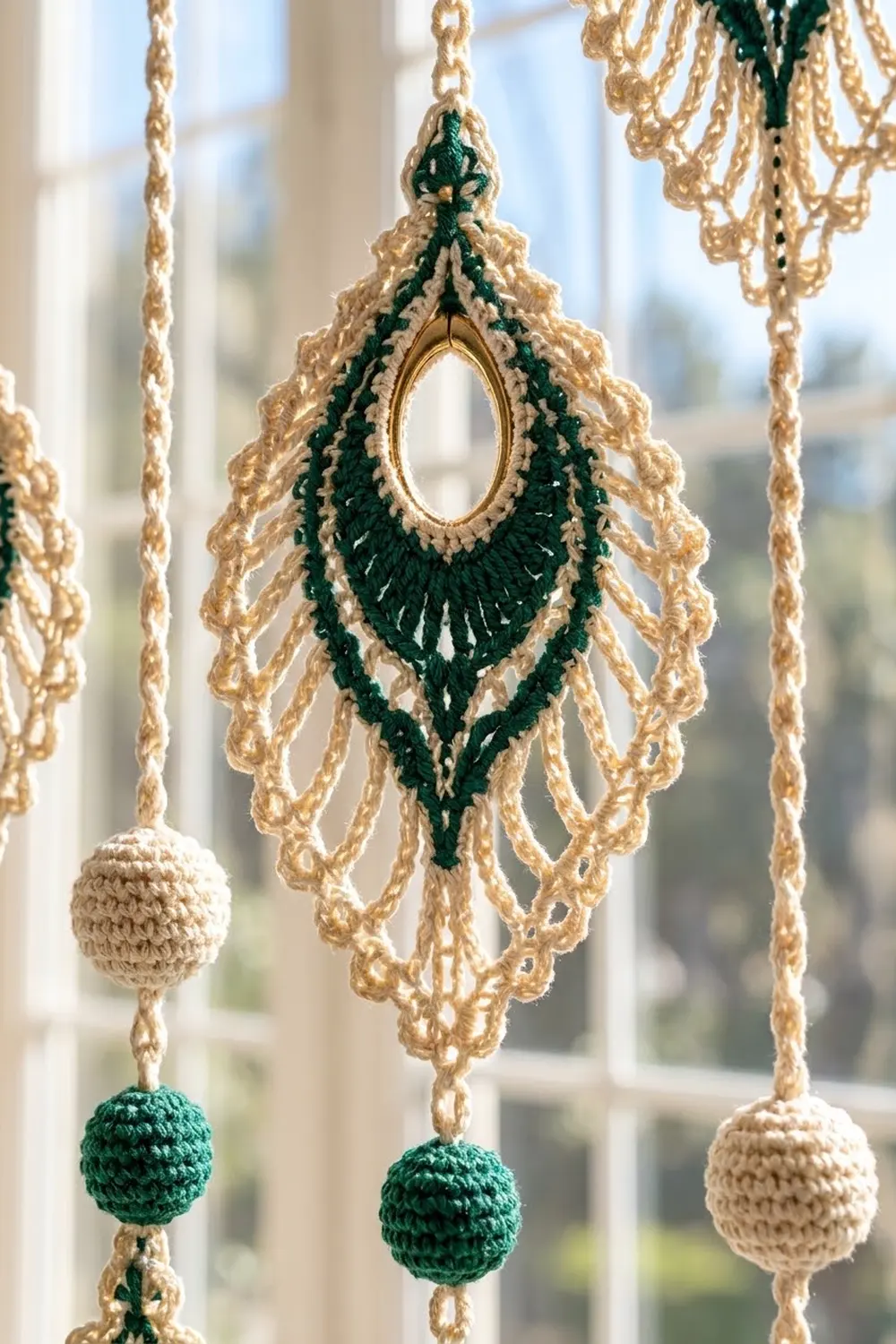
Feather Motif (make 72)
The Gold Eye
Round 1 (gold): Ch 24 and sl st in the first ch to form a ring, taking care not to twist it. Ch 1, then work 36 sc into the ring, working over the chain rather than into the ch sts. Sl st in the first sc. (36 sc)
Pinch the ring into a vertical oval. Fasten off.
The Emerald Band
Place a marker in any sc of Round 1 and call that st 1. It sits at the top of the eye. Stitches are counted clockwise from st 1 (right-handed).
Round 2 (green, growth round): Join green in st 1 and ch 1. Work in this order:
– sc in sts 1–3
– hdc in the next 3
– [dc in next, 2 dc in next]×3 (9 dc)
– [tr in next, 2 tr in next]×6 (18 tr)
– [2 dc in next, dc in next]×3 (9 dc)
– hdc in the next 3
– sc in the last 3
Sl st in the first sc. (48 sts)
Round 3 (growth round): Ch 1. Work:
– sc in the first 3
– hdc in the next 3
– [dc in next 2, 2 dc in next]×3 (12 dc)
– [tr in next 2, 2 tr in next]×3 (12 tr)
– ch 2 for the bottom point
– [2 tr in next, tr in next 2]×3 (12 tr)
– [2 dc in next, dc in next 2]×3 (12 dc)
– hdc in the next 3
– sc in the last 3
Sl st to join. (60 sts plus 1 ch-2 point sp)
Round 4 (growth round): Ch 1. Work:
– sc in the first 3
– hdc in the next 3
– [dc in next 3, 2 dc in next]×3 (15 dc)
– [tr in next 3, 2 tr in next]×3 (15 tr)
– (2 tr, ch 2, 2 tr) in the point sp
– [2 tr in next, tr in next 3]×3 (15 tr)
– [2 dc in next, dc in next 3]×3 (15 dc)
– hdc in the next 3
– sc in the last 3
Sl st to join. (76 sts plus 1 ch-2 point sp; 38 sts on each half) Fasten off.
The trebles sit only below the eye, so the band grows deeper at the bottom and forms the green V.
The Cream Lace
Round 5 (cream, outline): Join cream in the first sc of Round 4 and ch 1. Work sc in each of the next 38 sts, then (sc, ch 3, sc) in the point sp, then sc in each of the last 38 sts. Sl st to join.
Count: 76 sc worked 1 per existing st + 2 sc added at the point = 78 sc plus 1 ch-3 point sp (39 sc per half).
Round 6 (spokes): Work the left half, the point, then the right half.
– Left half: Ch 3 (counts as dc). [Ch 2, sk 1, dc in next]×10. [Ch 2, sk 1, tr in next]×9.
– Point: Ch 3, (tr, ch 3, tr) in the point sp, ch 3.
– Right half: Tr in the next sc. [Ch 2, sk 1, tr in next]×8. [Ch 2, sk 1, dc in next]×11.
– Close: Ch 1, sl st in the 3rd ch of the beginning ch-3.
Count: 42 spokes (22 dc, 20 tr); 38 ch-2 sps, 3 ch-3 sps and 1 ch-1 top sp, for 42 sps in total. The spokes get longer toward the bottom, the same way the green band does.
Round 7 (loops): Sl st into the ch-1 top sp, ch 1, and sc in the same sp. Work:
– [ch 4, sc in next ch-2 sp]×10
– [ch 6, sc in next ch-2 sp]×9
– ch 6, sc in the next ch-3 sp
– ch 6, sc in the point ch-3 sp
– ch 6, sc in the next ch-3 sp
– [ch 6, sc in next ch-2 sp]×10
– [ch 4, sc in next ch-2 sp]×9
– ch 4, sl st in the first sc
Count: 42 loops (20 ch-4 loops, 22 ch-6 loops) and 42 sc. Each half has 10 ch-4 loops and 10 ch-6 loops, and there are 2 ch-6 loops at the point.
Check that the feather measures 4.75 in x 6.75 in (12.1 cm x 17.1 cm). Do not fasten off; go straight into the Border (Round 8).
Cream Ball (make 120)
Diameter: 1 in (2.5 cm).
Round 1: 6 sc in MR. Leave the ring slightly open, about the width of the cord. (6)
Round 2: Inc in each st. (12)
Round 3: [Sc, inc]×6. (18)
Rounds 4–5: Sc in each st. (18)
Round 6: [Sc, dec]×6. (12)
Stuff the ball lightly and leave the yarn on a locking marker. You will finish it on the cord.
Emerald Ball (make 72)
Diameter: 0.75 in (1.9 cm).
Round 1: 6 sc in MR, leaving the ring slightly open. (6)
Round 2: Inc in each st. (12)
Rounds 3–5: Sc in each st. (12)
Stuff the ball lightly and leave it on a marker. It closes with Round 6 on the cord.
Cord (make 12)
Use cream throughout. The cord gauge is 6 ch = 1 in (2.5 cm).
- Strand A (make 6): Ch 463. Sl st in the back bump of the 2nd ch from the hook and in each ch across. (462 sl st, 77 in / 195.6 cm)
- Strand B (make 6): Ch 502. Work as for Strand A. (501 sl st, 83.5 in / 212.1 cm)
Leave a 12 in (30.5 cm) tail at the bottom end.
Make All Pieces
| Color | Piece | Quantity |
|---|---|---|
| Gold | Eye ring (Round 1) | 72 |
| Green | Emerald band (Rounds 2–4) | 72 |
| Green | Emerald balls | 72 (6 per strand) |
| Cream | Lace and border (Rounds 5–8) | 72 |
| Cream | Cream balls | 120 (10 per strand) |
| Cream | Cords | 6 A + 6 B |
Layout, looking at the curtain from the room. F = feather, the rod is at the top:
A  B  A  B  A  B  A  B  A  B  A  B
F     F     F     F     F     F
   F     F     F     F     F     F
F     F     F     F     F     F
   F     F     F     F     F     F
   ... 6 feathers on every strand ...
The strands are spaced 5 in (12.7 cm) apart. Feathers on B strands sit 6.5 in (16.5 cm) lower than those on A strands, so they nest without colliding.
Joining (Strand Assembly)
Method: Lay the cord out flat. Thread each ball onto the cord through its open magic ring, then work the final round of the ball snugly around the cord:
– Cream balls: [dec]×6 (6 sts)
– Emerald balls: [dec]×6 (6 sts)
Then sew the last 6 sts closed through the cord so the ball cannot slide.
Strand A positions, measured from the top:
– 4.25 in (10.8 cm) of bare cord at the top for the clip ring
– Feather 1: from 4.25 in to 11.75 in (10.8 cm to 29.8 cm)
– Connector, 5.25 in (13.3 cm) long, in this order:
– 0.75 in (1.9 cm) of cord
– a cream ball
– 0.5 in (1.3 cm) of cord
– an emerald ball
– 0.5 in (1.3 cm) of cord
– a cream ball
– 0.75 in (1.9 cm) of cord
– Repeat the feather and connector until all 6 feathers are on. The repeat is 12.75 in (32.4 cm), so each feather starts 12.75 in below the one above it.
– Tail: 0.75 in (1.9 cm) of cord, then an emerald ball at the very end
Check the total: 4.25 + (6 × 7.5) + (5 × 5.25) + 1.5 = 77 in (195.6 cm).
Strand B is the same, but the top lead is 10.75 in (27.3 cm), which gives 83.5 in (212.1 cm).
Stitch-to-stitch logic: The cord runs behind each feather. Tack it on in four places:
1. The Round 8 sc at top center
2. The top center sc of Round 5
3. The two Round 5 sc at the point
4. The Round 8 sc in the point sp
Pull each tack just snug. If you pull too tight, the feather puckers. If it is too loose, the feather tips forward when hung.
Size check: Hang each strand from a clip and measure it. Strand A should be within 0.5 in (1.3 cm) of 77 in (195.6 cm).
Border (Feather Edging, Round 8)
Work the border on every feather before assembly, continuing straight from Round 7.
Border gauge: 2 scallops = 1 in (2.5 cm) along the edge, measured after blocking.
Round 8:
– In each ch-4 loop: (sc, hdc, dc, picot, dc, hdc, sc) – 6 sts
– In each ch-6 loop: (sc, hdc, 2 dc, picot, 2 dc, hdc, sc) – 8 sts
Sl st in the first sc and fasten off.
Counts per side:
– Left side: 10 ch-4 scallops (60 sts) + 10 ch-6 scallops (80 sts) = 140 sts
– Point: 2 ch-6 scallops = 16 sts
– Right side: 140 sts, mirroring the left side
– Total: 140 + 16 + 140 = 296 sts and 42 picots
Why the math works: A ch-4 loop holds 6 sts (1.5 per ch) and a ch-6 loop holds 8 sts (1.33 per ch). That keeps the scallops full but flat. Each finished scallop is about 0.5 in (1.3 cm) wide, so the 42 scallops make an edge of about 21 in (53.3 cm). That matches the outline of a 5.5 in x 7.5 in teardrop, so blocking opens the scallops instead of fighting a ruffle.
Final Blocking
- Mist each feather until it is damp but not soaked.
- Pin the eye into an oval 1.25 in x 1.75 in (3.2 cm x 4.4 cm).
- Pin the top center and the bottom point 7.5 in (19.1 cm) apart.
- Pin the widest point to 5.5 in (14.0 cm).
- Pin every picot outward, keeping the spokes straight and radiating.
- Let it dry completely, then unpin.
- Block all feathers before assembly. Steam-press the cords lightly to straighten them.
Final Quality-Control Checklist
- Every feather is 5.5 in x 7.5 in (14.0 cm x 19.1 cm), give or take 0.25 in (0.6 cm)
- The gold eye is open, oval and centered above the green V
- Each feather has 42 scallops and 42 picots
- All balls are firm and do not slide on the cord
- Connectors are 5.25 in (13.3 cm) long
- Strand A is 77 in (195.6 cm) and Strand B is 83.5 in (212.1 cm)
- All tails are woven in and trimmed
Troubleshooting
- The eye closes up: You worked into the ch sts in Round 1. Redo it, working over the chain.
- The green band is round, not a V: Check that the trebles sit only in the bottom section.
- The lace ruffles: Recount your Round 7 loops. There should be 20 ch-4 loops and 22 ch-6 loops.
- A ball slides: Sew its closing round through the cord twice.
- Feathers twist when hung: Add a fifth tack at the gold ring.
- Strands differ in length: Recount the cord chains, or adjust the top lead.
Care
Hand wash in cool water with mild soap, roll the curtain in a towel, and dry it flat. Re-pin the feathers if needed. Keep it out of harsh direct sun for long periods to protect the green.

Final Notes
Here is the measurement chain:
– Eye: 1.25 in x 1.75 in (3.2 cm x 4.4 cm)
– Emerald band: 3.5 in x 4.75 in (8.9 cm x 12.1 cm)
– Before border: 4.75 in x 6.75 in (12.1 cm x 17.1 cm)
– Finished feather: 5.5 in x 7.5 in (14.0 cm x 19.1 cm)
– Strand repeat: 12.75 in (32.4 cm)
– Strands: 77 in (195.6 cm) and 83.5 in (212.1 cm)
– Curtain width: 60.5 in (153.7 cm)
Check each link before moving on and the curtain will hang evenly.
Happy crocheting!